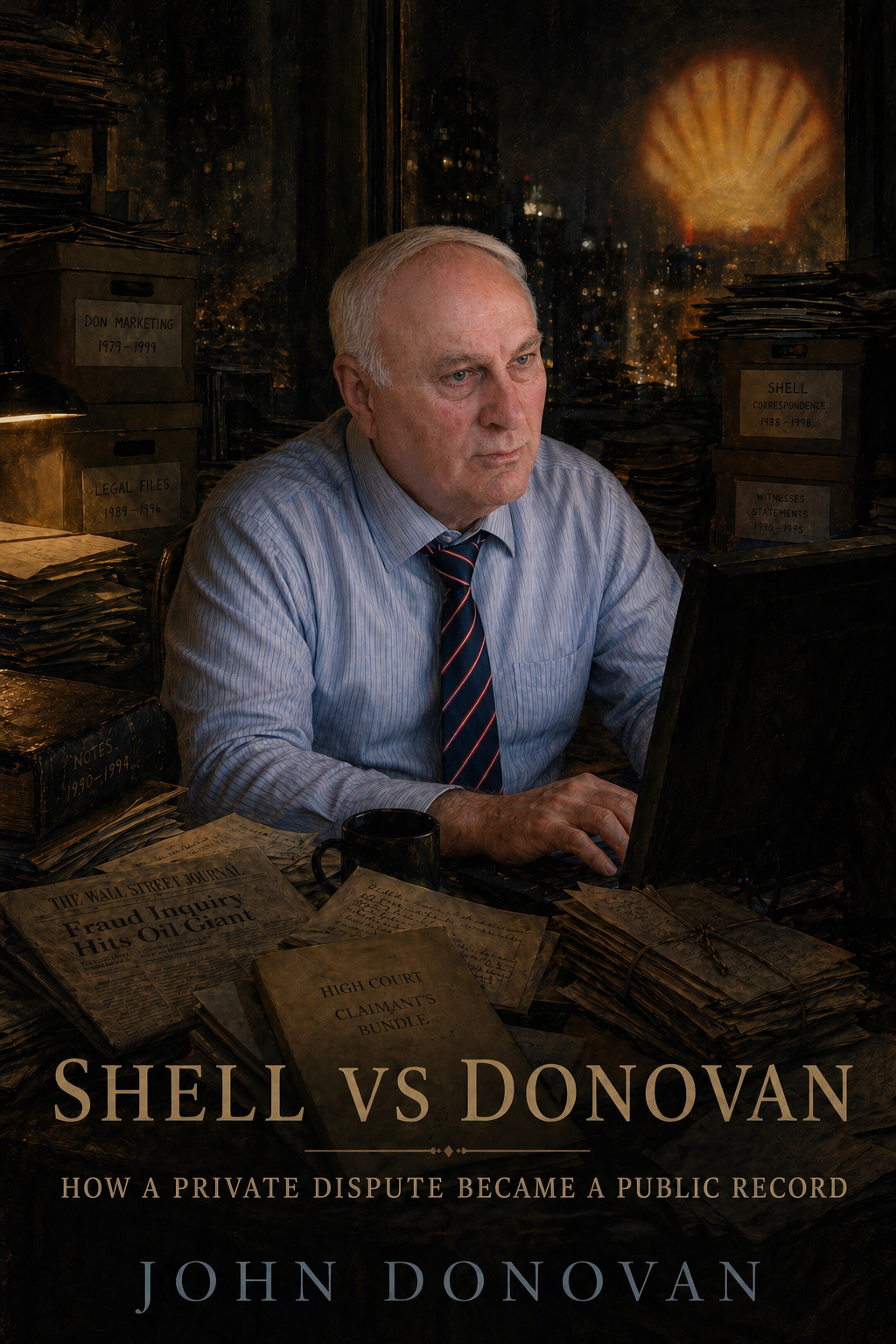
Shell had the project, the lawyers and the official channels. The Donovan archive had the one thing corporate crisis managers fear most: insiders willing to put the story where the public could read it.
A newly reviewed SAR bundle shows how John and Alfred Donovan corresponded with Shell’s top lawyers, supplied Sakhalin II material to Russian environmental officials, offered Shell an unedited right of reply — and helped preserve one of the most revealing paper trails in Shell’s modern history.
Introduction: The SAR That Came Back Like a Boomerang With Frostbite
There are corporate files. There are embarrassing corporate files. And then there are Shell Sakhalin II files: the sort of paperwork that appears to have crawled out of a frozen Russian gas field wearing a hard hat, carrying a legal threat, and asking why the budget has mysteriously doubled.
The uploaded PDF — Sakhalin31to70.pdf, described by John Donovan as material supplied by Shell in response to a Subject Access Request — is not a polished report. It is a scanned, repetitive, sometimes badly reproduced bundle of emails, copied articles, internal forwarding chains, correspondence with Shell lawyers, and published Donovan material concerning the Sakhalin II crisis. It is messy. It repeats itself. Some pages appear in near-duplicate. But underneath the administrative rubble is a remarkable archive trail.
The document shows the Donovan side repeatedly corresponding with senior Shell figures and legal officers about Sakhalin II; sending material to Russian and international bodies; highlighting insider warnings about environmental, technical, cost-control and governance risks; offering Shell advance sight of a major article; and then publishing Shell’s response unedited. The correspondence involved, among others, Jeroen van der Veer, Malcolm Brinded, Richard Wiseman, and Keith Ruddock, with other Sakhalin-linked names appearing in the article material itself.
This is not a dry historic footnote. It is a snapshot of a moment when Shell’s gigantic Sakhalin II project — once marketed as an “elephant project” — became a white elephant with frostbite. And it is also highly relevant to the Kindle book now being prepared by John Donovan: book number six about Shell, this time focused on the Sakhalin II debacle, a catastrophe that, by Shell’s own later internal DPA-era acknowledgement referenced by Donovan, cost Shell billions.
Part One: The Email to Russia — Donovan Points Mitvol Toward Shell’s Own Insiders
The opening strand of the PDF begins with an email from John Donovan to the Russian Ministry of Natural Resources, addressed for the personal attention of Oleg Mitvol, Deputy Head of the Ministry’s ecological department. The email is copied to Shell senior executives including Jeroen van der Veer and Malcolm Brinded. Its subject: “Sakhalin-2 Project.”
The message says Donovan had read reports that Mitvol was considering legal action in respect of the Shell-led Sakhalin II project. Donovan then directs him to royaldutchshellplc.com, specifically the site’s “Live Chat” feature, describing it as a source of “important Shell insider information regarding environmental issues.”
That is the first crucial strand: the Donovan website was not merely publishing anti-Shell opinion. According to the bundle, it was being actively presented as a conduit for insider material about Shell projects, including environmental and safety concerns.
The email also states that Shell had shut down its own “Tell Shell Forum”, while Donovan’s site had created an alternative “Live Chat” facility enabling anonymous postings. The message claims that the facility was receiving more daily postings than Shell’s own forum and that many postings appeared to come from informed Shell insiders.
This is important because it frames the whole Sakhalin affair as an information-control contest. Shell had the project. Shell had the lawyers. Shell had the official channels. But the Donovan site had something deeply irritating to any corporate machine: anonymous insiders willing to talk.
Part Two: The Cost-Overrun Confusion — $20bn, $22bn, $25bn or $26bn?
A central strand of the PDF concerns the spiralling cost of Sakhalin II. In September 2006, John Donovan emailed Jeroen van der Veer, copied to Malcolm Brinded, Richard Wiseman, and Alfred Donovan, under the subject line:
“Sakhalin II Cost Overrun: $20 billion, £22 billion, $25 billion or $26 billion?”
The email points to conflicting media figures: the Wall Street Journal reportedly still using $20 billion, Bloomberg using $22 billion, The Observer having mentioned $25 billion, while Donovan says that, until Shell clarified matters, the site would stick with $26 billion, based on “usually reliable Shell insider sources.”
The sharpest line in that exchange is the question Donovan put directly to Shell’s top leadership:
“What is the current highest projected Sakhalin II project cost stated in Shell internal documents?”
That question still has bite. It is not just “what number is Shell using in public?” but “what number is sitting inside the company’s own files?”
The PDF makes clear that Donovan was challenging Shell not merely about overruns, but about whether the market, partners, shareholders, employees and the Russian government had been given the full picture. The email says: “The stability and reputation of Royal Dutch Shell is at stake if the truth is being deliberately withheld at this crucial time.”
That is the second major strand: the Sakhalin dispute was not just environmental. It was also about disclosure, governance, and whether Shell’s public cost narrative matched its internal knowledge.
Part Three: The Environmental Catastrophe Warning
Another strand concerns the technical and environmental risks allegedly raised by Shell-linked insiders.
In November 2006, John Donovan wrote to Richard Wiseman, copied to Jeroen van der Veer and Malcolm Brinded, saying he was to be interviewed by a Russian newspaper about Sakhalin II. The email stated that there were “some things in life which supersede national considerations,” including a potential environmental catastrophe.
The language is dramatic, but the underlying material is not merely rhetorical. The PDF reproduces correspondence and article material concerning leaked emails between Shell/Sakhalin figures Hans Bouman and Engel van Spronsen. These emails are presented as central to the Russian environmental pressure on Sakhalin Energy.
The Bouman email, dated 29 May 2002, is one of the most important pieces in the bundle. Bouman says that after hearing about well completions and problems including an earthquake area, young faults with gas plumes, limited access to the platform, and other issues, he “started to worry.” He adds: “I would NEVER EVER want to be schedule driven pre FID on a 9 billion $ project. That is asking for problems.”
This is the kind of line that makes corporate legal departments reach for aspirin.
Bouman also warns that NAM had not signed off Sakhalin’s well design, saying: “I also hope nobody will state somewhere that NAM has reviewed their design and it is now OK. We never did anything like this.”
The later exchange lists specific concerns, including limited platform access, gas plumes over faults, the possibility of reactivating faults, reliability of supply, cuttings injection, and why everything was being done from one platform rather than templates. The quoted explanation for some decisions was effectively: yes, we think so too, but we are already on a schedule-driven programme.
That phrase — schedule-driven — is the corporate equivalent of a red warning light flashing in an Arctic storm.
Part Four: Live Chat, Whistleblowers and the Blowout Nightmare
The PDF also includes Live Chat postings and insider emails discussing the risks of extended-reach drilling through young faults, limited winter access, unmanned offshore facilities, and the possibility of blowouts in frozen seas.
One Live Chat posting warns that if an extended-reach well were drilled through an active geological fault, geological activity could rupture the well casing and production tubing, causing a blowout. It states that the environmental consequences in winter could be catastrophic because blowout control measures might be impossible until the following summer.
An insider email dated October 2006, reproduced in the bundle, makes a similar point: if Sakhalin II wells penetrated active, non-sealing faults, fault movement could shear the wells, with an offshore release potentially involving oil, frozen seas, and months of prevented remedial action.
These are allegations and technical concerns, not judicial findings within this PDF. But the significance lies in the fact that they were being circulated, published, sent to authorities, and placed before Shell. The document shows a pattern: concerns were not merely whispered after the event. They were being raised in real time.
And that is precisely why the SAR material matters for the forthcoming Kindle book. It gives chronology. It gives names. It gives correspondence. It gives the paper trail.
Part Five: The EBRD Letter — Donovan Takes the Matter Beyond Shell and Russia
The PDF includes a substantial email from John Donovan to Mr Enery Quinones, Chief Compliance Officer of the European Bank for Reconstruction and Development, concerning a pending loan decision in relation to Sakhalin Energy. The email is copied to Richard Wiseman, Jeroen van der Veer, and Malcolm Brinded.
In that letter, Donovan says he wishes to draw attention to Shell internal correspondence from 2002 between senior Shell managers, including the technical director of Sakhalin Energy, which he says placed a question mark over important safety and environmental issues and the possibility of a cover-up.
He also says the documents were the basis of a pending legal claim against Shell by Oleg Mitvol, and that Mitvol had confirmed to the media that Donovan supplied the evidence.
The strategic importance of this is obvious. Donovan was not just publishing. He was sending the material to decision-makers and funders. If EBRD money was in play, then environmental, governance and reputational concerns became lender-risk issues.
For Shell, this must have been deeply unwelcome: a critic using Shell’s own internal material to raise questions not only with Russian regulators but also with an international financial institution.
Part Six: The Mitvol Strand — “I Received These Letters From John Donovan”
One of the most striking sections of the PDF reproduces article material quoting Oleg Mitvol in an interview. Asked where the documents came from, Mitvol is quoted as saying:
“I have email correspondence between executives in Sakhalin Energy management from 2002. I received these letters from John Donovan, owner of the anti-Shell website www.royaldutchshellplc.com.”
He is also quoted as saying that he had forwarded the letters to Sakhalin Energy and had not received a reply, adding: “I presume that they are in shock.”
The PDF then reproduces a further confirmation attributed to an Interfax report, stating that Mitvol had sent a letter to Sakhalin Energy CEO Ian Craig, asking him either to confirm or deny the information in confidential emails from Hans Bouman to Engel van Spronsen, and that copies had been forwarded to Rosprirodnadzor from John Donovan, described as a Shell shareholder and website owner.
This is one of the archive’s most valuable strands: it documents that the Donovan website was not merely commenting on Sakhalin II from the sidelines. The material it published and supplied was cited by a senior Russian environmental official as part of the regulatory pressure on Shell’s project.
That does not make Russian motives pure. The PDF itself acknowledges the wider geopolitical poker game. But it does show that the Donovan archive intersected with a major international pressure campaign against Shell.
Part Seven: Shell’s Lawyers Enter the Scene — Wiseman, Ruddock and the Offer to Publish Unedited
The strongest legal correspondence strand concerns Alfred Donovan’s December 2006 and January 2007 exchanges with Shell lawyers.
On 30 December 2006, Alfred Donovan emailed Richard Wiseman, Shell International Petroleum Company’s General Counsel, drawing attention to a teaser article titled “Coming soon … the inside story on the Sakhalin II debacle.”
Wiseman replied on 31 December 2006:
“Contrary to your assertion, you have not sent me a copy of your proposed article.”
Alfred clarified that the link was to the teaser article and made a formal offer:
“The offer is to let Shell have advance sight of the comprehensive article currently being drafted with the active involvement of senior Shell/Sakhalin insiders. We would carefully consider any comments made by Shell and, as always, would happily publish with the article, on an unedited basis, any comments/rebuttal made by Shell in response to the revelations and allegations contained in the article.”
That point deserves emphasis. The PDF confirms that Shell was offered advance sight and an opportunity to comment; the Donovans offered to publish Shell’s comments or rebuttal unedited.
On 1 January 2007, Wiseman accepted the offer:
“We would like to take you up on your offer to let us see a draft of your article. I should be grateful if you would email it to my colleague, Keith Ruddock, who is more au fait with the Sakhalin situation than I am.”
Keith Ruddock then replied:
“Thank you Mr Donovan and I look forward to hearing from you. You are indeed correct that we have come across each other previously as you describe.”
This is a vital documentary point. It shows Shell did not ignore the article in ignorance. Shell’s lawyers engaged. Shell accepted the offer to review a draft. Shell routed the matter from Wiseman to Ruddock because Ruddock was considered more familiar with Sakhalin.
For any future book chapter, this is a crucial passage: Shell had notice, access, and an opportunity to respond.
Part Eight: Shell’s Response — Short, Legal, and Carefully Non-Specific
The published article reproduced in the PDF states that Shell accepted the offer on 1 January 2007 and supplied a response on 5 January, which was published unedited. The Shell response, attributed to Keith Ruddock, General Counsel Exploration and Production, Shell International B.V., reads:
“We disagree fundamentally with the factual basis and interpretation of much of the material you have produced but believe that no useful purpose would be achieved by engaging in a detailed rebuttal.”
That is Shell legal minimalism at its finest.
Not: “This is false.”
Not: “We demand correction.”
Not: “We will seek an injunction.”
Not even: “Here is a detailed rebuttal.”
Instead, Shell disagreed “fundamentally” with much of the material but declined to engage in detailed rebuttal.
The Donovan article then made the point that Shell had the opportunity to seek an injunction if it believed the allegations were unfounded, but chose not to do so.
That does not prove the allegations true. But it does strengthen the archive’s journalistic significance: Shell had advance notice, senior legal involvement, and a published right of reply.
Part Nine: The “Inside Story” Article — From Cost Control to Corporate Omertà
The reproduced Donovan article itself is incendiary. It alleges deception, double-dealing, corruption, pollution, intrigue, blackmail, murder and spies as part of the broader Sakhalin II backdrop. Those are grave words, and any modern republication should frame them carefully as the language of the 2007 article, not as fresh proven findings.
But within the rhetorical firestorm are several specific strands worth extracting.
First, the article states that Shell had surrendered its majority position and become a minority shareholder alongside Mitsui and Mitsubishi, with each founding partner selling 50% of its holding to Gazprom at less than market value.
Second, it says the project budget had dramatically increased, and frames the matter as a humiliation for Shell after Russian government pressure.
Third, it claims that senior managers were aware of cost overruns earlier than admitted and that the true costs were suppressed inside the project.
Fourth, it alleges that an insider with access to monthly cost reports saw a mid-2003 figure of nearly $13 billion while the reported cost was still $9.6 billion, and that later estimates climbed to around $14.5 billion.
Fifth, it states that contingency was allegedly only 5%, whereas industry norms for such a project might be around 12–15%, sometimes as high as 20%.
Sixth, it alleges deficiencies in cost control, contract oversight, audit follow-up, currency hedging, infrastructure control, project scope, and contractor arrangements.
Seventh, it names senior people said to have been in relevant chains or roles, including David Greer, Steve McVeigh, Mike Taylor, David Meehan, Campbell Wyper, and others.
Again, these are article allegations reproduced in the SAR bundle, not judicial findings. But the importance is that Shell’s own legal department saw the draft, responded, and had its response published unedited.
Part Ten: Senior Shell Figures — Who Appears in the Paper Trail?
The PDF confirms the involvement or awareness of several senior Shell-linked figures, at least in the sense that they appear as email recipients, copied parties, legal correspondents, or named subjects in the article material.
The main names include:
Jeroen van der Veer — then Shell CEO, copied on Donovan correspondence about Sakhalin II cost overruns and wider crisis issues.
Malcolm Brinded — Shell Exploration & Production executive, copied on correspondence and discussed repeatedly in the article material concerning cost knowledge and Sakhalin governance.
Richard Wiseman — Shell lawyer/General Counsel, directly corresponding with Alfred Donovan and accepting the offer for Shell to see the draft article.
Keith Ruddock — Shell General Counsel Exploration and Production, described by Wiseman as more au fait with the Sakhalin situation, and author of Shell’s published response.
Engel van Spronsen and Hans Bouman — central figures in the reproduced 2002 technical email exchange concerning Sakhalin risks.
Ian Craig — referenced as Sakhalin Energy CEO in the Interfax/Mitvol strand.
David Greer, Mike Taylor, Steve McVeigh, David Meehan, Campbell Wyper, Togrul Tosun — named in the reproduced article as individuals associated with the project or related cost/control allegations.
For book purposes, the distinction matters. Some names are proven by direct correspondence. Some are named in the article. Some are mentioned in allegations attributed to insiders. The article should not flatten those categories.
Part Eleven: Spies, Special Services and the Corporate Hunt for Leakers
The PDF contains another familiar Shell-Donovan theme: surveillance and leak-hunting.
The article material says Oleg Mitvol had called in Russian “special services” to verify the authenticity of the leaked Spronsen/Bouman emails.
It also says Shell insiders reported that Shell “spooks” were involved in attempts to track down the sources of leaked documents and information. One section says there were reports that spyware had been installed on Shell PCs and laptops in the hunt for Shell insiders leaking information to the Donovans.
These claims should be handled carefully. The PDF records that they were alleged and circulated; it does not itself adjudicate them. But they fit into a broader Donovan-Shell feud narrative involving claims of undercover activity, corporate surveillance, whistleblower pursuit, and Shell’s admitted use of undercover agents in other contexts.
In the Sakhalin archive, the spy strand is not decorative. It sits at the centre of the story: Shell wanted to identify leakers; Russian officials wanted to authenticate leaks; the Donovan website sat between insiders, regulators, lawyers and media.
A normal company has a communications problem. Shell, in this telling, had a leak-hunting ecosystem.
Part Twelve: The Book Angle — Kindle Book No. 6 and the Billion-Dollar Question
This PDF is tailor-made for the forthcoming Kindle book: John Donovan’s sixth book about Shell, focused on Sakhalin II.
Why? Because it contains three ingredients every strong documentary chapter needs:
First, primary correspondence: emails to Shell executives, Shell lawyers, regulators and funding bodies.
Second, contemporaneous warnings: cost confusion, technical risk warnings, insider concerns, and environmental disaster scenarios.
Third, corporate response: Shell’s lawyers accepted advance sight of the article and issued a short response, which was then published unedited.
The Sakhalin II debacle cost Shell billions, as Donovan says was later acknowledged in a Shell DPA email. This PDF helps explain the mechanism by which that reputational and financial disaster unfolded: insiders warning, critics publishing, regulators circling, lawyers responding, and the company losing control of the narrative as surely as it lost control of the project.
The phrase “cost Shell billions” should not be treated as hyperbole in the book. It should be presented as a central theme: Sakhalin II was not merely an awkward Russian adventure. It was one of the great humiliations of modern Shell history — a project where technical ambition, political risk, governance failure, cost escalation, environmental pressure and reputational blowback collided on ice.
Part Thirteen: The Cleaned-Up Timeline
2002 — Internal Shell/Sakhalin-linked emails between Hans Bouman and Engel van Spronsen raise concerns about well design, schedule pressure, seismic/fault risks, completions, contingency, and whether NAM had reviewed the design.
2003 — According to the later Donovan article, an insider allegedly saw cost figures significantly above the public/project baseline, including nearly $13 billion while the reported cost was still $9.6 billion.
2005 — The cost-overrun and Gazprom/Russian pressure issue intensifies publicly; Donovan later frames Shell’s timing and disclosure as central to the crisis.
August 2006 — John Donovan emails Oleg Mitvol at the Russian Ministry of Natural Resources, copied to Shell senior executives, pointing him to the Live Chat and Shell insider material.
September 2006 — Donovan writes to Van der Veer, Brinded and Wiseman asking what the highest projected Sakhalin II project cost is in Shell internal documents.
October–November 2006 — The Mitvol strand develops, with Russian environmental authorities reportedly relying on the leaked emails and Mitvol publicly acknowledging receiving letters from John Donovan.
November 2006 — Donovan writes to the EBRD compliance officer, copied to Shell, warning about safety, environmental and cover-up concerns relating to Sakhalin II.
December 2006 — Alfred Donovan publishes a teaser article and offers Shell advance sight of the full article, with an offer to publish Shell comments unedited.
1 January 2007 — Richard Wiseman accepts the offer and asks that the draft be sent to Keith Ruddock, described as more familiar with Sakhalin.
5 January 2007 — Shell supplies a short response from Keith Ruddock, disagreeing fundamentally with much of the material but declining detailed rebuttal. The Donovan article publishes the response unedited.
Part Fourteen: What This PDF Really Shows
Strip away the repetition and poor scan quality, and the PDF shows five big things.
First, the Donovans were actively communicating with senior Shell executives and lawyers during the Sakhalin II crisis.
Second, the Donovan website was being used as a platform for insider warnings about technical, environmental, cost and governance concerns.
Third, material supplied by John Donovan was publicly acknowledged by Oleg Mitvol as relevant to Russian environmental action against Sakhalin Energy.
Fourth, Shell’s lawyers were offered advance sight of the Donovan article and the chance to publish a response unedited. Shell accepted that process.
Fifth, Shell’s eventual response was notably brief: it disagreed with much of the material but did not provide a detailed rebuttal.
That is not just archive clutter. That is a documentary record of a critic, a website, insiders, lawyers, regulators and one of Shell’s most costly geopolitical misadventures colliding in real time.
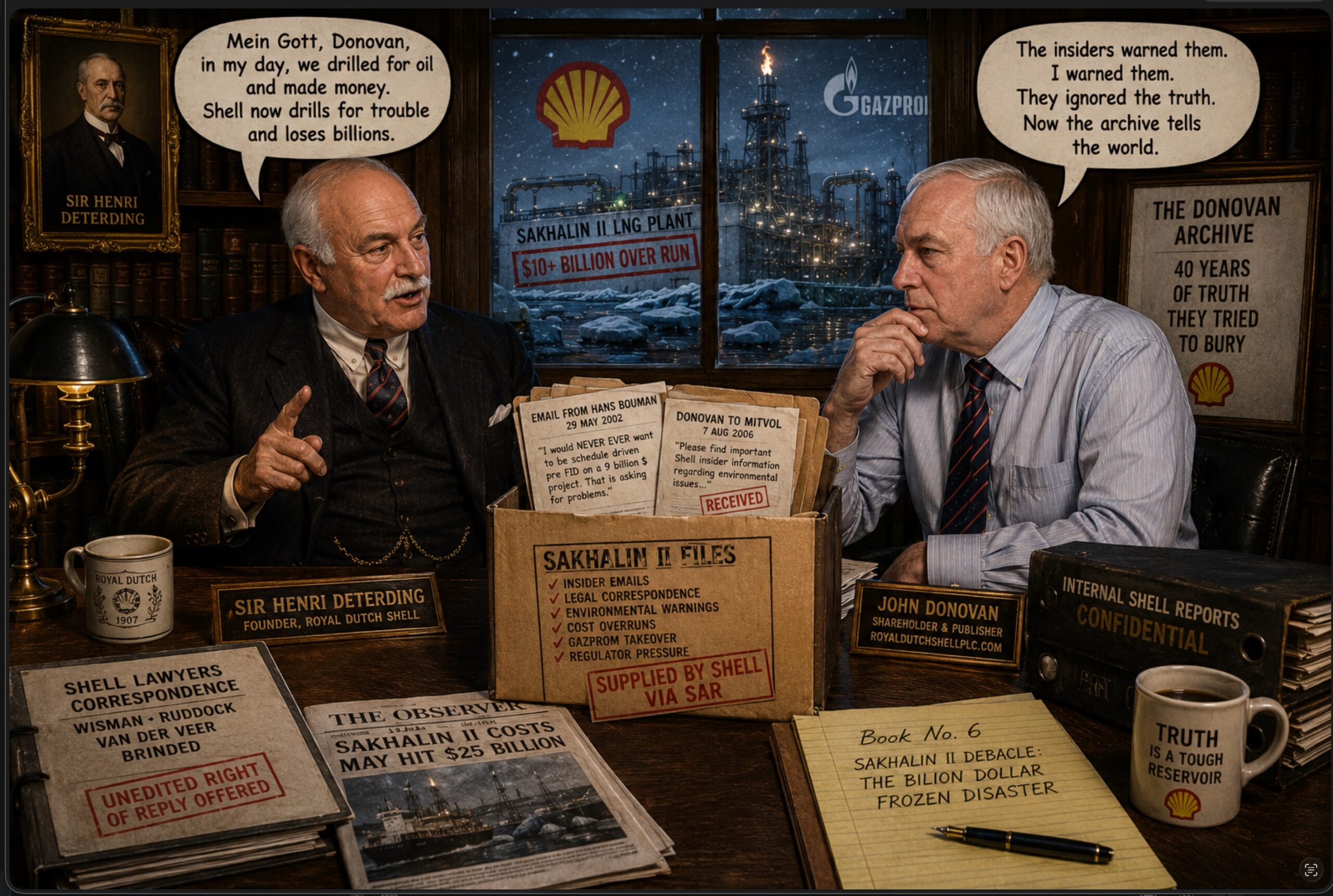
Deterding & Donovan Mini-Skit
Deterding: Ach, Mr Donovan, in my day an oil empire lost money with dignity. Here Shell appears to have misplaced billions in the snow.
Donovan: Sakhalin II was supposed to be an elephant project.
Deterding: Ja. Then it became a white elephant, frozen solid and sold to the bear.
Donovan: The SAR papers show correspondence with Shell lawyers, senior executives, regulators and insiders.
Deterding: Lawyers, regulators, insiders — Mein Gott, it is not a project, it is a courtroom with pipelines.
Donovan: Shell was offered the chance to comment unedited.
Deterding: And what did they say?
Donovan: They disagreed fundamentally but did not engage in detailed rebuttal.
Deterding: Ah. The old corporate waltz: deny the music, refuse to name the tune, then blame the orchestra.
Donovan: The archive may now form part of Kindle book number six.
Deterding: Six books? Mr Donovan, Shell should have settled with you when books were still printed by monks.
DISCLAIMER
This article is opinion and commentary based on the uploaded PDF bundle described as material supplied by Shell in response to a Subject Access Request, together with contextual information provided by John Donovan. It is not legal advice, financial advice or investment advice. Allegations contained in historic correspondence and reproduced articles are presented as allegations, claims, warnings or contemporaneous statements unless independently established by the cited material. No fresh allegation of unlawful conduct is made. Readers should consult the underlying source material and form their own judgement. Site wide disclaimer also applies.
RELATED
WWF Evidence submitted in 2008 to House of Commons Select Committee quoting from a John Donovan Sakhalin II article published on royaldutchshellplc.com
(1): The UNITED KINGDOM PARLIAMENT Hansard Archives Research Uncorrected Evidence: 20 June 2008
(2): Memorandum submitted by WWF to inquiry by House of Commons Select Committee: Quotes Sakhalin II corruption allegations from royaldutchshellplc.com article: 20 June 2008
(3): House of Commons Environmental Audit – Minutes of Evidence ordered by the House of Commons to be printed 14 October 2008 (RELATED LINK IS IMMEDIATELY BELOW)
(4) www.parliament.uk: Evidence submitted by WWF to Select Committee on Environmental Audit: Evidence submitted 20 June 2008: (SAKHALIN II BACKGROUND INFORMATION: — Allegations have been made by a whistleblower of inappropriate relationships between SEIC management and its contractors, in particular Starstroi and its subcontractor SU4.[22])
|
Sakhalin Evidence Boston Globe: The Russian power play on oil, natural gas reserves: 23 August 2008 (In one of the most blatant instances, Shell Oil was forced to yield control of its operations off Sakhalin Island in exchange for a payment of $7.4 billion from state-dominated Gazprom. Most outside analysts estimate that Shell’s share was worth $15 billion to $17 billion.) The Observer: Shell comes under fire for role in Sakhalin audit: 31 August 2008 BusinessGreen.com: Shell accused of manipulating environmental report: 1 September 2008 Environmental Leader: Shell Criticized for Manipulating Environmental Audit Report: 2 September 2008 Ethical Corporation: Shell’s Sakhalin influence: October 2008 DAVID GREER AFFAIR ft.com: ‘Pipeliners All!’ Shell’s memo to Sakhalin: Published: June 5 2007 22:29 | Last updated: June 6 2007 13:07 As if laying pipelines across Sakhalin Island, described by Chekhov as “hell”, were not enough, the engineers battling the elements there have to put up with their boss’s motivational memos. In a leaked email from David Greer, the deputy chief executive of Sakhalin Energy Investment Company, the consortium running the Sakhalin 2 project, he reveals that he despises cowards and urges his staff to “Lead me, follow me, or get out of my way”. Much of the memo appears to have been drawn from a speech by General George S. Patton to US troops ahead of the D-Day invasion, when he said: “When you were kids, you all admired the champion marble player; the fastest runner; the big league ball players; the toughest boxers. Americans love a winner and will not tolerate a loser. Americans despise cowards. Americans play to win – all the time.” The Patton link was noted in a posting to an FT.com forum by Mark Bisset. Sakhalin 2 has had a troubled history, hit by rising costs and concerns about its environmental impact. In a deal completed in April, Royal Dutch Shell and its Japanese partners were forced to allow Gazprom, Russia’s state-controlled gas company, to buy a majority stake. Mr Greer’s e-mail reveals the pressure the company is under to hit its schedule of delivering its first shipments of liquefied natural gas by the second half of next year and the unusual management techniques he is using. “Pipeliners All! Many thanks to all of you for your contributions to this week’s Bi-Annual Challenge … and what a Challenge it is going to be for all of us!” the e-mail begins, cheerily enough. “From the outset, I want to assure you that, despite the mutterings on the day and the challenges ahead, I have total faith in you and our collective ability to complete the task ahead of us.” After the good news, though, the mood darkens. “However, some of the comments and body language witnessed at the Bi-annual Challenge meeting do suggest that PDP is running the risk of becoming a team that doesn’t want to fight and lacks confidence in its own ability. Surely, this is not the case? Pipeliners and Engineers love to fight and win, traditionally. All real engineers love the sting and clash of challenge.” After more appeals to the pride of “real frontier professionals” comes the inspirational bit. “When everyone of you were kids, I am sure that you all admired the champion marble player, the fastest runner, the toughest boxer, the big league football players. Personally, I, like most others, love winning. I despise cowards and play to win all of the time. This is what I expect of each and everyone of you…” “Strive to be proud and confident in yourselves, be proud of your tremendous pipeline achievements to date and lift up your level of personal and team energy to show everyone that you are a winning team capable to achieving this year’s goals. If you can crack this angle, I am very confident you can crack the job, with ease. “So Lead me, Follow me or Get out of my way; Success is how we bounce when we are on the bottom.” The memo was leaked to the website www.royaldutchshellplc.com, which has long been a thorn in Shell’s side. Shell confirmed the e-mail was genuine but was reluctant to discuss it further. Copyright The Financial Times Limited 2010. Shell shakedown: Fortune’s Abrahm Lustgarten reports how the world’s second-largest oil company lost control of its $22 billion project on Russia’s Sakhalin Island. February 1 2007: 12:10 PM ESTExtracts The news was stunning, even if rumors had been flying: Shell (Charts) was halving its ownership in the $22 billion project, cutting its stake from 55% to 27.5%, and Gazprom, the Russian gas giant, was stepping in, buying Shell’s share plus half the stakes owned by Japanese partners Mitsui and Mitsubishi, for just $7.5 billion – the equivalent, says a Shell spokesman, of “paying to enter on the ground floor, as if they were a shareholder at the beginning.” The foreign companies also agreed to absorb $3.6 billion of the project’s mounting cost overruns. That Shell and its partners were victims of an unscrupulous campaign by the Russians to win leverage at the negotiating table is certainly true. The company’s loss of its controlling interest in what chief executive Jeroen van der Veer called a “key part of Shell’s upstream strategy,” amounting to an estimated 5 percent of its global reserves, is largely a story about the high risks of frontier international energy projects. But it is also a tale of how Shell misplayed a strong hand and, after 12 years of work, lost untold billions of dollars in future earnings. |