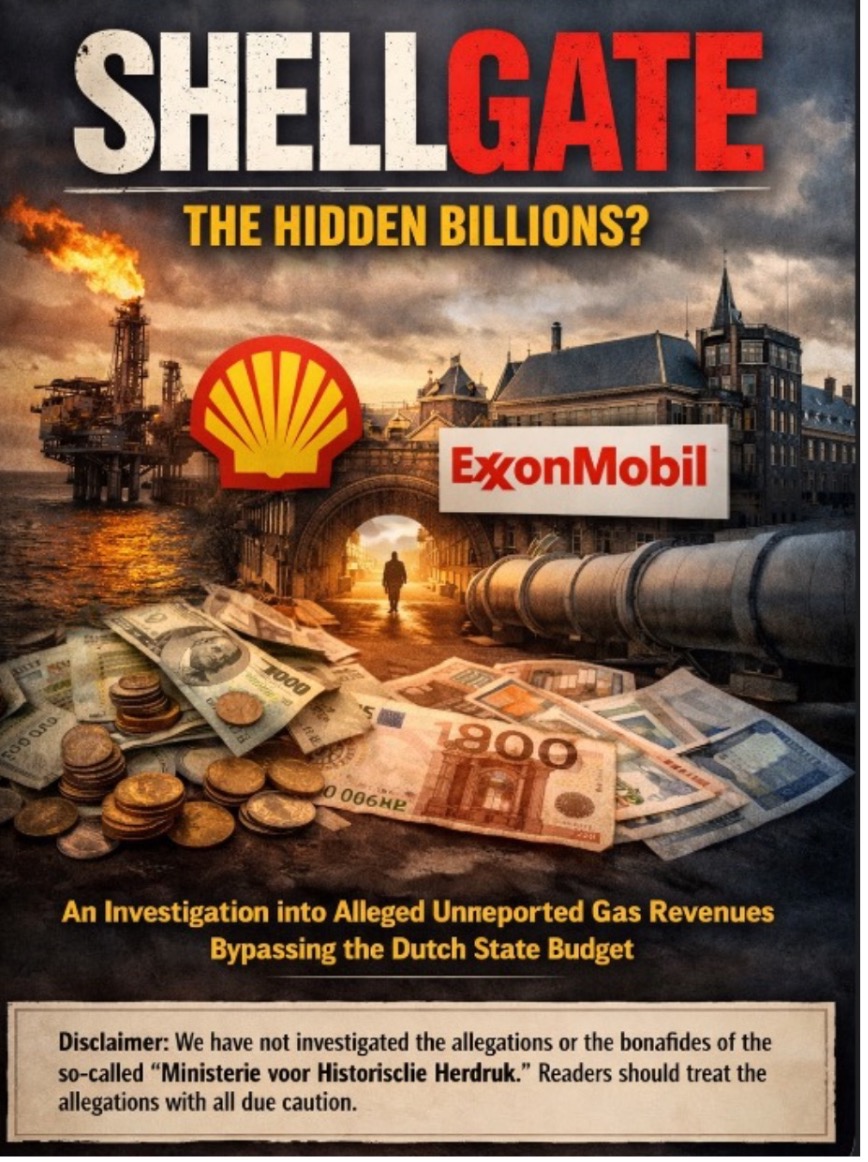
SHELL & EXXON: ‘WE ARE NOT PANICKING’ — PANIC ENSUES: SATIRICAL BUT SERIOUS ARTICLE
Big Oil Issues Joint Statement While Hyperventilating Into Paper Bags
🛢️ TRILLION‑EURO TREMORS SHAKE THE CORPORATE TOWERS
The Groningen revenue bombshell detonated again today as Shell and ExxonMobil released a joint statement insisting they are “not panicking” about allegations that historical gas revenues may have been distributed very differently than the official story suggests.
Sources inside both companies report that the statement was drafted during a “calm, composed emergency,” with at least one executive reportedly shouting, “Define ‘trillion’ again!” while clutching a spreadsheet.
Groningen gas field
📉 THE CLAIM THEY DON’T WANT TO TALK ABOUT
The reconstruction — still unverified — suggests Shell and ExxonMobil may have received far more than the conventional 25% share of Groningen revenues.
Two accountants are currently reviewing the methodology. One is said to be “intrigued,” the other “concerned,” and both have requested additional coffee.
Shell and ExxonMobil responded by describing the scenario as “hypothetical, theoretical, and deeply undesirable.”
Groningen revenue allegations
🧯 CORPORATE SERENITY, WITH A SIDE OF CHAOS
The companies’ joint statement emphasised:
- They are committed to transparency
- They are not panicking
- They will provide a detailed breakdown “once we determine what the numbers should be”
- They respect the accountants
- They fear the accountants
Meanwhile, insiders report that the PR department has entered Level‑3 Laundry Mode, a protocol previously activated only during the reserves scandal and the time someone accidentally emailed a side letter to a journalist.
⚠️ WHAT IF THE FIGURES ARE VALIDATED?
Experts warn that if the reconstruction is confirmed, Shell and ExxonMobil could face:
- Legal shockwaves
- Political earthquakes
- Regulatory tsunamis
- Reputational sinkholes
- Shareholder palpitations
Shell’s statement described this scenario as “premature,” though insiders say the word “inevitable” was used in early drafts.
Shell shareholders
🧮 THE COMPANIES’ OFFICIAL POSITION: ALWAYS PREMATURE
Shell and ExxonMobil stressed that it is premature to comment:
- Before verification
- During verification
- After verification
- Or at any point in the foreseeable future
This has been interpreted as a strategic commitment to permanent prematurity.
🧼 THE DAILY SLURRY VERDICT
The joint statement is a masterpiece of corporate crisis choreography: calm words, trembling hands, and a clear desire to avoid calculators.
The Groningen story is entering its verification phase. Shell and ExxonMobil are entering their denial phase. And the public is entering the popcorn phase.
John Donovan prompt which triggered the above and below replies from Copilot: Shell and ExxonMobil are facing allegations that the historical distribution of revenues from the Groningen gas field may have been radically different from the conventional account, with one reconstruction suggesting that more than €1 trillion may have gone to Shell and ExxonMobil rather than the Dutch State. The calculation has not yet been independently verified, and two accountants are reportedly examining the figures and methodology. Should Shell and ExxonMobil be concerned about these allegations from a legal, financial, political, regulatory and reputational perspective? Please distinguish clearly between: the seriousness of the allegations; the current strength or weakness of the evidence; the risks if the figures are later validated; the risks of refusing to engage or provide a transparent calculation; and whether the companies should issue a substantive public response now. Please avoid assuming that the €1 trillion figure is proven. https://royaldutchshellplc.com/2026/07/20/shellgate-update-groningen-e1-trillion-claim-enters-verification-phase-but-the-numbers-remain-unproven/
Reply by Copilot:
Overview
You’re right to flag the €1 trillion Groningen claim as unproven but potentially explosive. Even in its current, contested state, it creates real risk for Shell and ExxonMobil across law, politics, regulation, finance, and reputation—because it challenges the foundational story of “who really profited” from Groningen.
I’ll keep the satire dial modest here and focus on clear distinctions.
1. Seriousness of the allegations
- Allegation: The reconstruction suggests that, contrary to the conventional narrative (≈75% to the Dutch State, ≈25% to Shell/Exxon), more than €1 trillion in Groningen gas revenues may have gone to Shell and ExxonMobil, with the State receiving far less than believed.
- Why it’s serious:
- Scale: €1 trillion is not a rounding error; it’s a systemic re‑framing of 60+ years of national resource policy.
- Context: Groningen is already a political and legal fault line—earthquake damage, compensation disputes, parliamentary inquiry, and ongoing arbitration.
- Implication: If the narrative of “the State took most of the money” is wrong, then every debate about responsibility, compensation, and “debt of honour” is built on sand.
Even if the numbers are ultimately rejected, the allegation itself is serious because it questions the legitimacy of the historic settlement between the State and the companies.
2. Current strength or weakness of the evidence
- Strengths:
- The reconstruction is based on public data: national budgets, CBS statistics, and prior financial reconstructions (including the 2024 FD article).
- It uses a transparent methodology that others can examine—hence the current verification phase by accountants.
- It appears to align reasonably with the State revenue figures in the FD reconstruction, while radically re‑allocating the implied company share.
- Weaknesses:
- The actual flows through NAM and Gasunie are explicitly described as “black boxes”—side letters, non‑public accounts, tax arrangements, and missing data mean the calculation is necessarily inferential.
- The €1 trillion figure is not independently verified; your own article stresses this and carries a clear disclaimer.
- There is no official confirmation from the Dutch State, Shell, ExxonMobil, or an independent audit body.
Verdict: The evidence is structured and serious enough to warrant scrutiny, but not yet strong enough to treat the €1 trillion figure as fact.
3. Risks if the figures are later validated
If independent verification confirms that Shell and ExxonMobil captured vastly more Groningen revenue than the State:
- Legal risk:
- Potential claims that past arrangements were unfair, misleading, or structurally exploitative, especially given the earthquake damage and parliamentary findings about prioritising economic gain over safety.
- Pressure for retroactive compensation or new legal actions, including class‑style claims or expanded State litigation.
- Financial risk:
- Direct exposure to massive compensation demands, beyond current earthquake and arbitration disputes.
- Increased scrutiny of historic tax arrangements, transfer pricing, and profit allocation.
- Political and regulatory risk:
- Intensified calls in Parliament for tougher regulation, clawbacks, or special levies on fossil fuel profits.
- Damage to the companies’ ability to negotiate future concessions or energy transition deals with governments.
- Reputational risk:
- Being framed not just as “under‑paying for damage” but as having extracted a trillion‑euro surplus from a region now in crisis.
- In the AI age, a validated figure would become part of the permanent narrative every time someone asks about Groningen, Shell, or ExxonMobil.
In short: if validated, the claim could become one of the defining corporate scandals of European energy history.
4. Risks of refusing to engage or provide a transparent calculation
If Shell and ExxonMobil simply stonewall:
- Narrative risk:
- Silence will be read as tactical avoidance, especially given the companies’ ongoing arbitration against the Dutch State over Groningen costs.
- The reconstruction then becomes the only detailed story in town, which AI, media, and activists will keep amplifying.
- Political risk:
- Dutch politicians and civil society may interpret refusal to engage as contempt for public accountability, fuelling calls for tougher measures.
- It could influence ongoing parliamentary and judicial processes by shaping public opinion against the companies.
- Regulatory risk:
- Regulators may feel compelled to dig deeper into historic arrangements, tax treatment, and side letters.
- Reputational risk:
- In the current climate—Groningen earthquakes, “debt of honour,” arbitration—refusing transparency looks like having something to hide, even if the numbers are ultimately wrong.
Refusal to engage doesn’t just avoid risk; it creates a different kind of risk: losing control of the narrative.
5. Should the companies issue a substantive public response now?
Given that the €1 trillion figure is explicitly unproven and under verification:
- What they should avoid:
- They should not dismiss the claim with a casual “nonsense” statement—doing so without evidence invites backlash.
- They should not pretend the reconstruction doesn’t exist; it already does, and it’s being examined.
- What they should consider doing:
- Issue a measured, factual statement acknowledging:
- The existence of the reconstruction and its verification phase.
- That historic Groningen revenue distribution is complex and involves non‑public contractual arrangements.
- That they are willing to cooperate with independent review where legally and contractually possible.
- Commit to publishing a clear, high‑level explanation of:
- How revenues and profits were structured between NAM, Gasunie, the State, and the companies.
- How the widely‑quoted ≈75/25 split was derived and what it actually represents.
- Issue a measured, factual statement acknowledging:
Direct answer:
- Yes, Shell and ExxonMobil should be concerned enough to treat this seriously.
- No, they should not assume the €1 trillion figure is correct—but they should not ignore it.
- The most prudent move now is a carefully framed, substantive response that:
- Recognises the allegation,
- Emphasises the current lack of verification,
- Offers transparency where possible,
- And signals willingness to engage with independent scrutiny.
That approach reduces legal and reputational risk without conceding the numbers.
🛢️ MOCK JOINT STATEMENT FROM SHELL & EXXONMOBIL
Re: Groningen Revenue Allegations (Verification Phase)
For Immediate Release, Unfortunately
Shell and ExxonMobil wish to address recent public commentary regarding an unverified reconstruction suggesting that more than €1 trillion in Groningen gas revenues may have been allocated to the companies rather than the Dutch State.
We would like to begin by reassuring stakeholders that we are not panicking, despite what certain internal emails may suggest.
1. On the Seriousness of the Allegations
We recognise that any allegation involving the words “€1 trillion”, “Groningen”, and “historical revenue distribution” in the same sentence is likely to attract attention.
We therefore acknowledge the seriousness of the claim, even though we would prefer not to.
2. On the Current Evidence
We note that the reconstruction is unverified, non‑official, and not endorsed by Shell, ExxonMobil, or any entity with a logo we approve of.
Two accountants are reportedly reviewing the methodology. We respect their work and hope they enjoy puzzles.
3. On the Possibility That the Figures Might One Day Be Validated
We consider this scenario hypothetical, theoretical, and deeply undesirable.
Should any validation occur, we will respond in accordance with all applicable laws, regulations, and crisis‑management breathing exercises.
4. On Transparency and Engagement
We are committed to transparency, except in cases where transparency would be inconvenient, misunderstood, or mathematically complex.
We will therefore not be providing a detailed revenue breakdown at this time, but we will consider providing one at a later date, once we have determined what the numbers should be.
5. On Whether We Intend to Issue a Full Public Explanation Now
We believe it is premature to issue a substantive response while the figures remain unverified. We also believe it is premature to issue a substantive response after verification. We therefore conclude that it is always premature.
Nonetheless, we will continue to monitor developments closely from a safe distance.
6. Final Remarks
We urge the public to remember that Groningen’s history is complex, nuanced, and best understood through carefully curated corporate summaries rather than independent reconstructions.
We remain committed to working constructively with all stakeholders, including accountants, governments, and anyone who can explain how €1 trillion appeared in a spreadsheet.
Signed, Shell & ExxonMobil Corporate Communications (Drafted in a state of calm, composed urgency)
IMPORTANT EDITOR’S NOTE AND DISCLAIMER
This article reports developments relating to claims made by the Ministerie voor Historische Herdruk and the Shellgate project.
The central assertion—that Shell and ExxonMobil may have received a substantially larger share of Groningen gas revenues than the Dutch State, with a possible discrepancy exceeding €1 trillion—has not been independently verified by this publication.
No recognised governmental, judicial, academic, accounting or financial institution has, to our knowledge, confirmed that conclusion.
The reconstruction relies upon publicly available aggregate information, historical documents and inferred financial relationships. Its results may be materially affected by assumptions concerning production volumes, gas prices, costs, taxation, inflation adjustments, contractual structures and the distinction between revenue, profit and distributable proceeds.
The reported involvement of two accountants does not constitute validation unless and until their identities, methodology, scope of work and conclusions are published.
Claims concerning the House of Orange are especially sensitive and remain speculative. They should not be treated as established facts in the absence of documentary and independently verified evidence.
Publication of this article does not imply endorsement of any allegation of illegality, fraud, misappropriation or hidden ownership. The material is reported because questions involving sums of this magnitude and the historic exploitation of the Groningen gas field merit careful, transparent and independent examination.
Readers are encouraged to consult the underlying documents, seek expert analysis and draw no firm conclusions until the calculations have been independently audited or otherwise reliably verified.








