 The latest announcement from Shell is exactly the sort of news its exploration geologists dream about.
According to Egypt’s Ministry of Petroleum and Upstream, Shell has made what is being described as a breakthrough frontier discovery with the ultra-deepwater Velox-1X exploration well in the Herodotus Basin offshore Egypt. Egyptian officials described the result as being of “great importance” for understanding one of the Mediterranean’s least explored hydrocarbon provinces.
The announcement is significant for several reasons.
First, the Herodotus Basin has long been viewed as one of the Mediterranean’s last major unexplored frontiers. Unlike Egypt’s established Nile Delta gas fields or giant discoveries such as Zohr, much of this deepwater basin remains largely unknown.
Secondly, it demonstrates that Shell remains committed to high-risk frontier exploration despite years of public messaging emphasising capital discipline, shareholder returns and the energy transition.
Another chapter in Shell’s Mediterranean expansion
The Velox discovery did not emerge in isolation.
During 2026 Shell has been conducting one of its largest Egyptian drilling programmes in years using the sixth-generation Stena IceMAX drillship. The campaign includes development drilling at Mina West together with exploration wells including Sirius and Velox.
Earlier this year:
- Shell announced encouraging results from the Sirius-1X exploration well.
- Production testing at Mina West-1 showed promising gas and condensate flow rates.
- Egypt has been actively encouraging new offshore exploration to reduce expensive LNG imports and restore domestic gas production.
Rather than winding down exploration, Shell appears to be expanding it.
Why Egypt matters
For Egypt, the discovery comes at a strategically important moment.
Domestic gas production has fallen from previous highs, forcing Egypt back into importing LNG during periods of high demand.
Every successful offshore discovery potentially reduces import dependence, improves energy security and attracts badly needed foreign investment.
From Cairo’s perspective, new discoveries are an economic necessity.
From Shell’s perspective, they are another opportunity to replace reserves and generate long-term production.
The awkward climate question
This is where the story becomes more complicated.
Shell frequently highlights its investments in low-carbon businesses, EV charging, hydrogen and biofuels.
Yet its capital allocation continues to include billions of dollars directed towards finding entirely new oil and gas resources around the world.
Egypt joins a growing list.
In recent months and years Shell has pursued or expanded major upstream projects including:
- Nigeria
- Brazil
- Namibia
- Venezuela
- the Gulf of Mexico
- offshore Egypt
Each discovery strengthens Shell’s future production portfolio.
Each also reinforces criticism from environmental organisations that the company remains fundamentally committed to expanding fossil-fuel production despite international climate objectives.
Shell argues that the world will continue to require oil and gas for decades and that new production is necessary to meet demand while older fields naturally decline.
Its critics counter that every new frontier project risks locking in additional emissions for many years.
Investors are likely to approve
The market reaction is likely to be more enthusiastic than many climate campaigners.
Major institutional investors—including BlackRock, Vanguard and State Street, all among Shell’s largest shareholders—generally reward successful exploration when it improves reserve replacement and future cash-flow prospects.
For investors, discoveries can translate into future production, dividends and buybacks.
For campaigners, they represent another reminder that “transition” often arrives with a drillship attached.
Exploration remains part of Shell’s DNA
Shell has spent more than a century discovering hydrocarbons across every continent.
Despite changing logos, sustainability reports and climate commitments, the underlying business model still depends upon replacing reserves.
The Velox result demonstrates that exploration remains central to Shell’s long-term strategy.
Whether one views that as prudent energy planning or evidence that the energy transition is progressing more slowly than advertised depends largely on where one sits.
One thing, however, is difficult to dispute.
When Shell says it is focusing on shareholder value, it increasingly means exactly what it says.
And sometimes that value is still found several kilometres beneath the Mediterranean seabed.
Image
Title: “Shell’s Egyptian Jackpot”
A dramatic ultra-deepwater drilling vessel bearing Shell branding towers above the Mediterranean. Beneath the sea floor, a glowing reservoir of oil illuminates the darkness. In the distance, the Pyramids of Giza appear beneath a blazing sunset while executives cheer from a glass boardroom suspended above the drillship. A faded green “Energy Transition” banner flutters behind them, partially submerged beneath the waves.
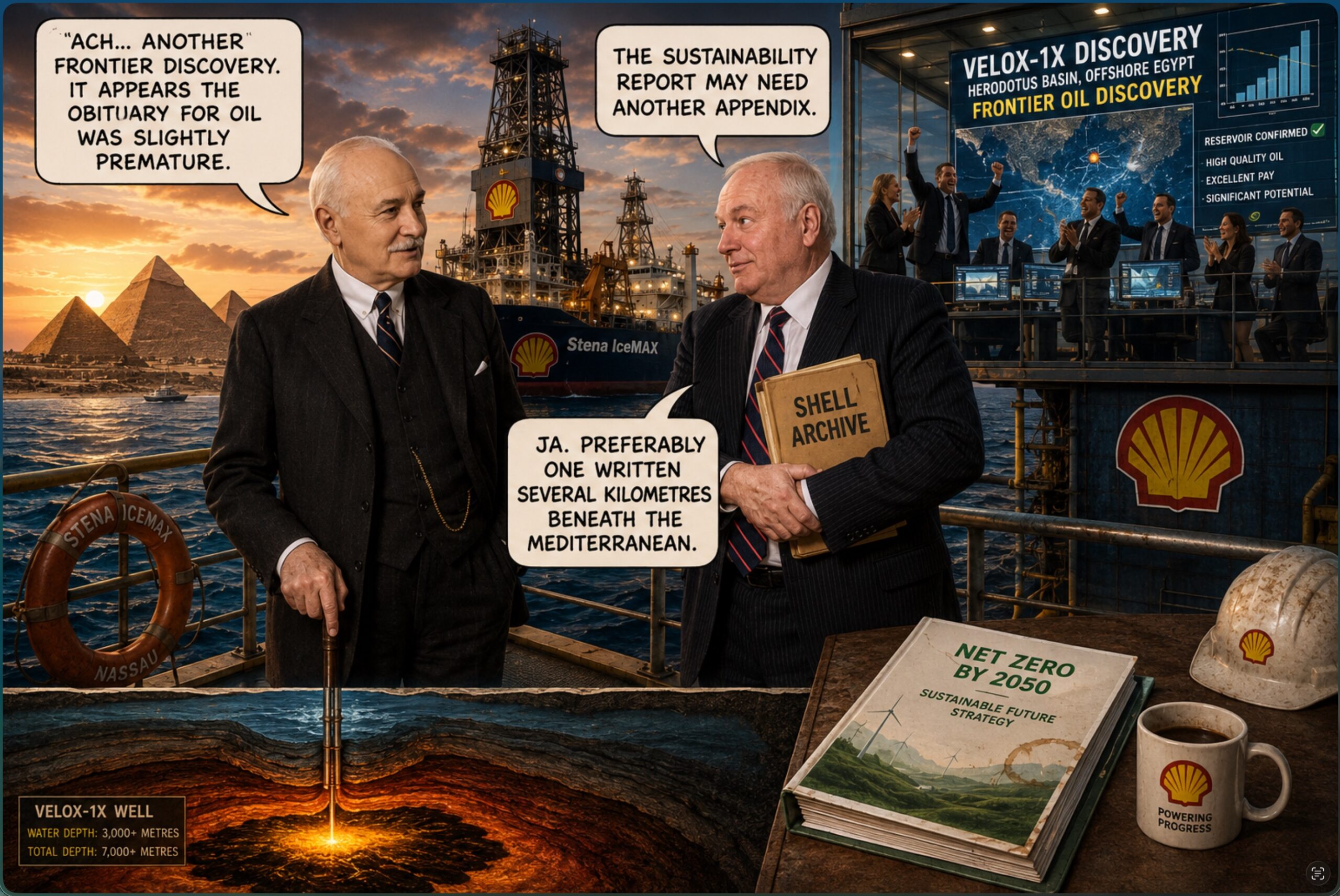 Deterding & Donovan Skit
Deterding: “Ach… frontier exploration. Now this is something I understand. One does not become an oil major by apologising for finding oil.”
Donovan: “Shell might prefer the headlines focused on EV chargers and hydrogen.”
Deterding: “Ja… but the shareholders become much happier when the drill bit finds hydrocarbons instead of PowerPoint presentations.”
Donovan: “Environmental campaigners won’t be celebrating.”
Deterding: “Mein Gott… neither did they celebrate when I was alive. Yet here we are, still discussing another Shell discovery over a century later.”
Donovan: “History has a habit of repeating itself.”
Deterding: “Especially when there is oil beneath the seabed.”
DISCLAIMER: This article is an opinion and commentary piece based on publicly reported information and official statements. It is intended for discussion and educational purposes only. It does not constitute financial, investment or legal advice.
*This website and sisters royaldutchshellgroup.com, shellnazihistory.com, royaldutchshell.website, johndonovan.website, shellnews.net, and shellwikipedia.com, are owned by John Donovan - more information here. There is also a Wikipedia segment, the Shell DPA Files, "Shell and the Spies", the Shell Leaks files, as well as books written and published by John Donovan - Kindle eBooks. Timeline of the Donovan Shell Feud. Toxic History of Royal Dutch Shell Group. Shell and the Donovans: The Full Media Record — 550+ Articles, 110 Books, 40 Years. *All created and supported by internet wizz, Nick Gill.







