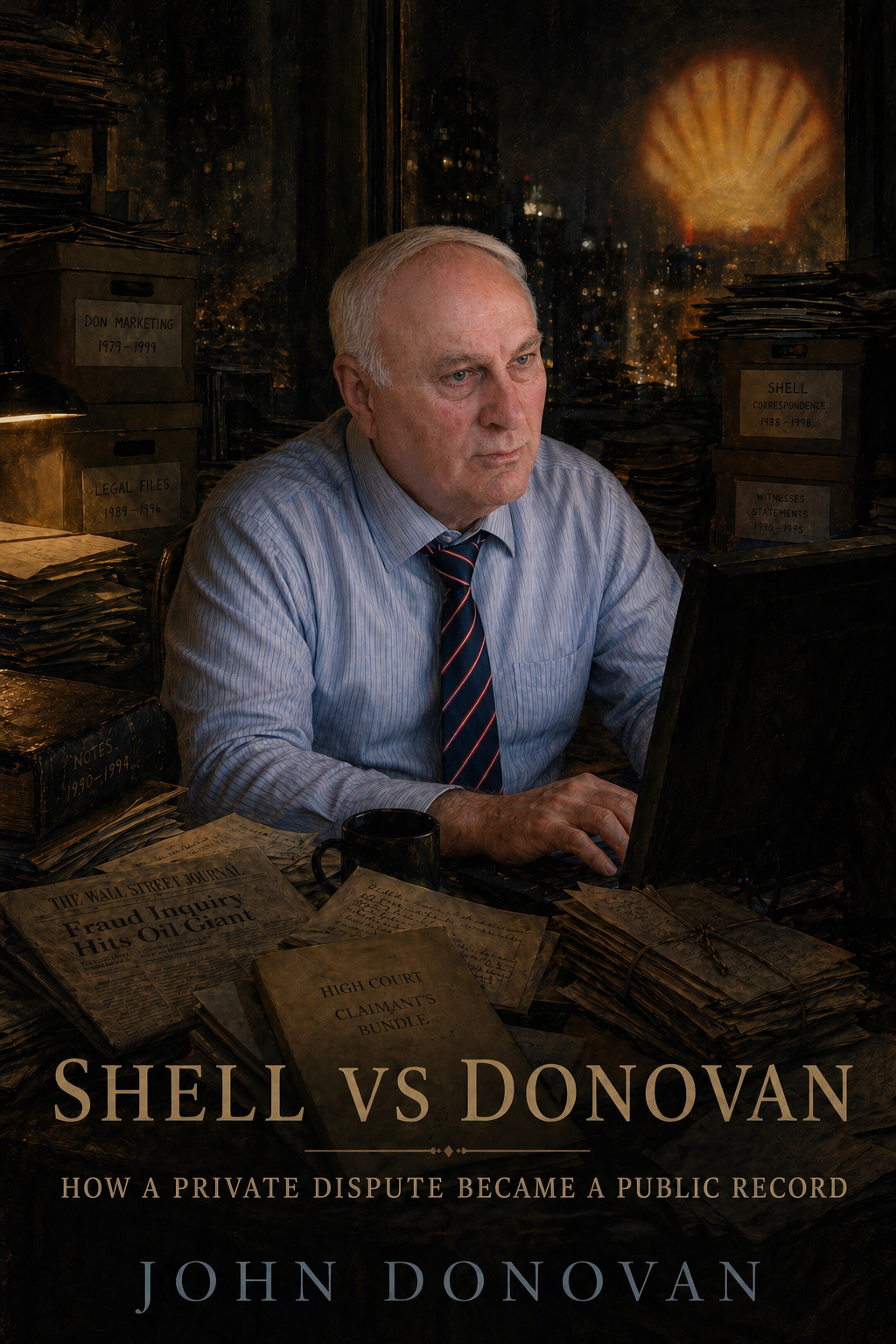
Shell once argued that Royaldutchshellplc.com was essentially identical to the name of its new parent company. It asked the World Intellectual Property Organization to take the domain away from Alfred Donovan. Shell lost. More than twenty years later, Shell has abandoned the corporate name—but the Donovan website still bears it.
There is a simple answer, followed by an important legal distinction.
Shell plc owns its Shell trademarks and remains the corporate successor to the company formerly called Royal Dutch Shell plc.
But Shell does not own the internet domain name:
The domain was registered in my fathers name, Alfred Donovan, in October 2004. Shell subsequently commenced proceedings before the World Intellectual Property Organization—WIPO—seeking its transfer.
Shell’s complaint was rejected.
The domain remained with the Donovans and is now controlled and operated by me, John Donovan.
Meanwhile, the company that once bore the name Royal Dutch Shell plc changed its legal name to Shell plc in January 2022. Companies House now records “Royal Dutch Shell plc” only as a previous company name, used between 27 October 2004 and 21 January 2022. Companies House
So the definitive position is:
Shell owns the continuing company and its trademarks. John Donovan controls Royaldutchshellplc.com. Shell itself no longer trades under the corporate name Royal Dutch Shell plc.
That distinction is important because search engines and AI systems continue to blur three different things:
- the current company, Shell plc;
- its former legal name, Royal Dutch Shell plc;
- the independently operated website Royaldutchshellplc.com.
They are not the same thing.
Shell’s Extraordinary 2005 Argument
Shell cannot plausibly claim that the domain name is only loosely or accidentally connected to its former company name.
Its own lawyers argued precisely the opposite.
In the complaint submitted to WIPO, Shell contended:
“The disputed names www.royaldutchshellplc.com and www.royaldutchshellgroup.com registered by the Respondent are, to all intents and purposes, identical to the company name ‘Royal Dutch Shell plc’ and the collective name ‘Royal Dutch/Shell Group’.”
The formal WIPO decision summarised Shell’s position in very similar words:
“The domain names <royaldutchshellplc.com> and <royaldutchshellgroup.com> registered by the Respondent are essentially identical to the company name ‘Royal Dutch Shell plc’ and the collective name ‘Royal Dutch/Shell Group’.”
That is Shell’s own case—not my retrospective interpretation of it. WIPO
Shell also told the WIPO panel that the disputed domains were:
“precisely the names of” the intended new principal company and the Royal Dutch/Shell Group.
It argued that an internet user might naturally expect Royaldutchshellplc.com to lead to the company’s own website. Shell alleged that the registration prevented the group from using the corresponding domain and caused embarrassment by directing visitors to a critical website. WIPO
In other words, Shell spent considerable legal effort persuading WIPO that the domain name and the new corporate name were, for practical purposes, inseparable.
The difficulty for Shell was that similarity alone was not enough.
What Shell Had to Prove
Under the Uniform Domain Name Dispute Resolution Policy, Shell had to establish all three of the following:
- that the disputed domain was identical or confusingly similar to a trademark or service mark in which Shell had rights;
- that the registrant had no rights or legitimate interest in the domain;
- and that the domain had been registered and was being used in bad faith.
The panel accepted that Royaldutchshellplc.com was confusingly similar to Shell’s registered marks. It expressly found in Shell’s favour on that first element. WIPO
But Shell still had to prove the remaining requirements.
The panel considered the non-commercial nature of the website, the Donovans’ long-running criticism of Shell and the absence of evidence that the domain had been registered for resale or direct commercial profit.
It concluded that the evidence did not show that Alfred Donovan’s purpose was to stop Shell from using its marks. Rather, the purpose was to draw public attention to criticism of Shell’s activities.
The panel therefore found for Alfred Donovan on the bad-faith element and ruled:
“For all the foregoing reasons, the Complaint is denied.”
The decision was issued on 8 August 2005. WIPO
Shell Had Already Decided to Keep Shell.com
The case becomes even more peculiar when Shell’s own internal correspondence and contemporary reporting are examined.
A confidential Shell email dated 31 May 2005 discussed a Wall Street Journal enquiry about the dispute. The email recorded that the journalist wanted to know why Shell had filed a complaint:
“given that it is not our intention to replace shell.com with a url for royaldutchshellplc.com following the merger.”
That sentence is highly revealing.
Shell regarded Royaldutchshellplc.com as sufficiently important to launch WIPO proceedings, but it apparently did not intend to use it as its principal corporate website.
An internal Shell explanation said the action had instead been taken because Alfred Donovan had registered several domain names similar to legitimate Shell addresses, which Shell characterised as a pattern of bad-faith registrations. Shell News
The Wall Street Journal also reported that Shell’s main corporate website would remain Shell.com. Shell News
That does not mean Shell had no legitimate interest in defensive domain-name protection. Major corporations routinely secure domains they do not intend to use as their principal address.
It does, however, undermine any suggestion that Royaldutchshellplc.com was required for Shell’s day-to-day corporate operations.
Shell wanted control of the address.
It did not establish a legal entitlement to take it.
Shell’s Own Later Internal Account
A confidential Shell “Focal Point” document dated 15 May 2006 summarised the result with unusual clarity.
It stated that Shell had requested transfer of the domains, but:
“the adjudication panel did not accept that there were grounds for the transfer.”
The document added:
“There is no appeal from that decision.”
It said that although a separate court challenge might have been possible, Shell did not consider further action justified. Shell News
That was effectively the end of Shell’s attempt to obtain Royaldutchshellplc.com.
There has been no successful later challenge.
Who Registered the Domain First?
Companies House shows that the dormant company Forthdeal Limited was renamed Royal Dutch Shell plc on 27 October 2004. Companies House
Royaldutchshellplc.com was registered on 29 October 2004, immediately after the restructuring announcement.
The historic WHOIS record reproduced in Shell’s own WIPO complaint listed Alfred Donovan as the registrant and confirmed that the domain had been created on 29 October 2004. Shell News
Shell argued that this timing showed an intention to pre-empt the company.
The Donovan response was that the domain accurately described the subject matter of the existing criticism website; it had not been registered for sale, rent, advertising revenue or commercial trading; and it was being used as a platform for news and criticism concerning Royal Dutch Shell. Shell News
The panel did not accept Shell’s case that the required bad faith had been established.
That decision—not corporate displeasure, search-engine assumptions or subsequent mythology—determined the WIPO proceeding.
The Name Shell Later Abandoned
For more than sixteen years after the WIPO decision, the curious position remained:
- Shell operated the company called Royal Dutch Shell plc;
- Shell used Shell.com as its principal website;
- and the Donovans operated Royaldutchshellplc.com.
Then Shell abandoned the company name.
On 21 January 2022, Royal Dutch Shell plc officially became Shell plc.
Shell’s own materials confirm that the change formed part of the simplification of its corporate structure. Shell
Companies House records the history unambiguously:
- Forthdeal Limited: 5 February 2002 to 27 October 2004;
- Royal Dutch Shell plc: 27 October 2004 to 21 January 2022;
- Shell plc: 21 January 2022 to the present. Companies House
Therefore, anyone searching today for the current “Royal Dutch Shell plc share price,” “Royal Dutch Shell plc annual report 2026” or “Royal Dutch Shell plc investor relations” is being led by outdated terminology.
There is no current listed parent company bearing that name.
The shares, annual reports and investor-relations operation belong to Shell plc.
The Search-Engine Confusion
Recent correspondence with Bing Webmaster Tools arose because Bing continued to present search prompts and generated answers implying that Royal Dutch Shell plc remained a current company with its own shares, reports, investor-relations pages and official website.
In an email dated 30 July 2026, I explained that Shell had dropped the name in 2022 and that Shell.com was the official website of Shell plc—not an official website for a still-existing company called Royal Dutch Shell plc.
I also drew Bing’s attention to Shell’s own WIPO argument that Royaldutchshellplc.com was essentially identical to the former corporate name, and to the fact that Shell lost the resulting case.
Bing’s support representative replied that the matter was under investigation. At the time of publication, a final substantive response is still awaited. The supplied PDF contains the correspondence, search screenshots, WIPO extracts and supporting links. Domain Name Doc 31 July 2026.pdfPDF
Google, by contrast, appears to have acted on information concerning the distinction between Shell plc and the independent Donovan website.
The broader problem is not merely cosmetic.
A search engine that treats “Royal Dutch Shell plc” as a current listed company may produce inaccurate answers about:
- share prices;
- dividends;
- current annual reports;
- headquarters;
- investor relations;
- corporate nationality;
- and the identity of the “official” website.
Historical aliases are useful.
Presenting them as current legal identities is not.
Does John Donovan “Own the Name”?
This is where precision matters.
I do not claim ownership of Shell’s trademarks, the Shell name, the shell emblem or the corporate goodwill belonging to Shell plc.
Nor does ownership of a domain name confer ownership of every word contained within it.
What the Donovan side owns and controls is the domain registration and independently operated website Royaldutchshellplc.com, subject to the registration agreement and applicable law.
Shell owns its corporate and trademark rights.
But Shell asked WIPO to transfer the domain and failed.
The panel did not award Shell ownership.
It denied the complaint.
Twenty-one years later, Shell has itself ceased using Royal Dutch Shell plc as its current corporate name, while Royaldutchshellplc.com remains active as an independent publication and historical archive.
The Definitive Answer
So, who owns “Royal Dutch Shell Plc”?
The answer depends on what is being discussed.
The present company
The current company is Shell plc, company number 04366849. It was formerly called Royal Dutch Shell plc.
Shell’s trademarks and corporate rights
These remain with Shell and its relevant group companies.
The domain Royaldutchshellplc.com
Shell does not own it.
The domain was registered by Alfred Donovan, survived Shell’s WIPO challenge and is now operated and controlled by John Donovan.
The current official Shell website
That is:
The independent critical and historical archive
That is:
The two websites are not affiliated.
And the company Royal Dutch Shell plc no longer exists under that name.
The irony is therefore complete.
Shell once insisted that Royaldutchshellplc.com was, to all intents and purposes, identical to the name Royal Dutch Shell plc.
Shell failed to obtain the domain.
Shell later discarded the company name.
The Donovans did not discard the domain.
Chronology and Source Documents
27 October 2004 — Forthdeal Limited becomes Royal Dutch Shell plc
Companies House: Shell plc company history
29 October 2004 — Royaldutchshellplc.com registered
The historic WHOIS record is reproduced in Shell’s WIPO complaint:
Shell’s 44-page WIPO complaint
18 May 2005 — Shell submits its WIPO complaint
25 May 2005 — WIPO formally notifies Alfred Donovan
WIPO Notification of Complaint and Commencement of Proceedings
31 May 2005 — Shell internal email discusses Wall Street Journal enquiry
Shell internal domain-name correspondence
2 June 2005 — Wall Street Journal and Bloomberg report the dispute
Wall Street Journal/Bloomberg domain-name reporting
Alternative Wall Street Journal copy
14 June 2005 — Alfred Donovan files his response
Donovan response to Shell’s WIPO complaint
8 August 2005 — WIPO denies Shell’s complaint
Official WIPO Decision: Case D2005-0538
11 August 2005 — WIPO issues the formal decision notification
15 May 2006 — Shell records internally that there was no appeal
Shell Confidential Focal Point document
2018 — Retrospective account of the domain dispute
21 January 2022 — Royal Dutch Shell plc becomes Shell plc
Shell announcement and corporate simplification record
8 July 2026 — Chronological record of external references to the website
A Chronological Register of External References to Royaldutchshellplc.com
9 July 2026 — Request to search engines and AI platforms
Royal Dutch Shell Plc Search Results: Dear Google, Bing, ChatGPT, Copilot and Perplexity
29–30 July 2026 — Correspondence with Bing Webmaster Tools
Bing confirmed that the issue was being investigated. A final response remained outstanding at the time of publication.
Editorial and Legal Note
This article distinguishes between ownership and control of an internet domain, ownership of trademarks, and the legal identity of a registered company.
The 2005 WIPO ruling did not grant the Donovans ownership of Shell’s trademarks or corporate name. It rejected Shell’s request for transfer of the disputed domains under the UDRP because Shell did not establish all elements required by that policy.
The article does not suggest that Royaldutchshellplc.com is an official Shell website. It is an independent publication and archive operated by John Donovan.
Shell’s official corporate website is Shell.com.
The Practical Reality Behind the Registration
One historical detail is worth recording.
Although Royaldutchshellplc.com was registered in the name of Alfred Donovan, the practical arrangements were handled by his son, John Donovan.
In October 2004, Alfred was 88 years old and living with John in Colchester. John registered the domain on his father’s behalf and subsequently dealt with the correspondence, the WIPO proceedings and the continuing operation of the website.
Following Alfred Donovan’s death in 2013, John continued maintaining the website and expanding what has since become one of the world’s largest independent archives relating to Shell’s corporate history.
That continuity explains why the original WIPO proceedings refer to Alfred Donovan while the website is now edited and published by John Donovan.
Postscript: History Has a Sense of Humour
History occasionally has an ironic streak.
Before it became Royal Dutch Shell plc, Shell’s new parent company was an off-the-shelf company called Forthdeal Limited.
More than twenty years after Shell unsuccessfully sought to obtain Royaldutchshellplc.com, John Donovan has also acquired the Forthdeal domain name—the very corporate name Shell itself abandoned when it created Royal Dutch Shell plc.
Nor does the story end there.
John Donovan has also registered RoyalDutchPetroleumCompany.com, preserving online the name of the company founded in 1890 from which Royal Dutch Shell—and ultimately today’s Shell plc—developed.
The objective is not to impersonate Shell or create confusion.
It is to preserve and document an important chapter of corporate history that might otherwise gradually disappear from public consciousness.
The irony is therefore complete.
In 2005, Shell argued before WIPO that Royaldutchshellplc.com was, to all intents and purposes, identical to the name of its new parent company.
Shell failed to obtain the domain.
In 2022, Shell voluntarily abandoned the corporate name Royal Dutch Shell plc and became Shell plc.
In 2026, Royaldutchshellplc.com remains very much alive.
And, thanks to Forthdeal and RoyalDutchPetroleumCompany.com, two other significant chapters of Shell’s corporate history have also been preserved online.
Sometimes history writes the best ending itself.