THE SHELL LEAKS FILES: 1 SEPTEMBER 2026
SLF-2007-044
The Sakhalin Papers XXXIV: The Second Japanese Lifeline — NEXI and the Extra $1.4 Billion That Took Project Finance to $6.7 Billion
In February 2008 Sakhalin Energy abandoned its proposed British export-credit backing. By June, Japan’s JBIC and commercial banks had supplied a $5.3 billion replacement financing package. Then, in October 2009, another $1.4 billion arrived — this time from commercial banks protected by Japanese government export-credit insurance. Shell no longer controlled Sakhalin Energy, but the documentary record shows that it remained a shareholder, technical participant and one of the sponsors standing behind the financing until project completion.
Archive reference: SLF-2007-044
Collection: The Sakhalin Papers
Principal financing record: Mitsubishi Corporation/Sakhalin Energy announcement, 7 October 2009
Authenticated Shell record: Royal Dutch Shell plc Annual Report and Form 20-F 2009; Shell corporate reporting archive
Contemporaneous reporting: Reuters, 1 October 2009; Offshore, 7 October 2009; LNG Journal, October 2009
Public-finance record: Nippon Export and Investment Insurance — NEXI — resource and untied-loan insurance framework
Environmental record: International Union for Conservation of Nature and Western Gray Whale Advisory Panel material from 2009
Court record: Export Credits Guarantee Department v Friends of the Earth [2008] EWHC 638 (Admin), used here to establish the termination of the earlier British financing route
Evidence standard: Financing agreements, shareholdings and company statements are distinguished from lender or corporate assessments of the project’s creditworthiness. Environmental-group allegations are identified as such. No inference is made that NEXI financing constituted a judicial or regulatory determination that every environmental controversy surrounding Sakhalin II had been resolved.
Introduction
The previous Shell Leaks File followed Sakhalin II’s financing east.
Britain’s Export Credits Guarantee Department had spent years considering approximately $650 million of support.
Environmental organisations had challenged the process.
Government documents had gone through information litigation.
A separate judicial review was approaching hearing.
Then Sakhalin Energy withdrew its British application on 29 February 2008.
The High Court subsequently recorded the decisive fact: no final ECGD decision had been made, and after the withdrawal none ever would be. (vLex)
Japan then supplied the alternative.
In June 2008, the Japan Bank for International Cooperation and commercial banks signed a $5.3 billion project-finance package.
That might reasonably have looked like the end of the financing story.
It was not.
On 1 October 2009, Reuters reported that Sakhalin Energy had secured another $1.4 billion.
Six days later, a shareholder announcement set out the formal structure.
The commercial banks would lend the money.
Japan’s government export-credit insurer would protect the lending.
And the shareholders — including Royal Dutch Shell — would provide a sponsor guarantee until completion.
Total Phase 2 project debt:
$6.7 billion. (Royal Dutch Shell Plc .com)
That second Japanese-backed tranche deserves examination in its own right.


1. Reuters Reported the Money Before the Formal Announcement
The first contemporaneous signal appears on 1 October 2009.
Reuters reported from Moscow that Sakhalin Energy had secured $1.4 billion of new funding for Sakhalin II.
The report cited Interfax quoting Sakhalin Energy chief executive Ian Craig.
Reuters placed the new money directly on top of the earlier $5.3 billion package provided by JBIC and international commercial banks.
Craig said the new funds would be paid in shortly. (Royal Dutch Shell Plc .com)
The Reuters report is preserved in the contemporary RoyalDutchShellPlc.com archive, complete with its original date, Moscow dateline, reporter Vladimir Soldatkin and Reuters attribution. (Royal Dutch Shell Plc .com)
Six days later, the transaction received a more detailed documentary description.
2. 7 October 2009: The Structure Becomes Clear
A Mitsubishi Corporation announcement dated 7 October 2009 stated that Sakhalin Energy had concluded an additional financing agreement of $1.4 billion with a consortium of international commercial banks.
The Japanese government export-credit agency Nippon Export and Investment Insurance — NEXI — would insure the loan.
The document described the cover as Overseas Untied Loan Insurance for natural-resources and energy financing. (FinanzNachrichten.de)
The arithmetic was explicit:
Existing financing: $5.3 billion
Additional financing: $1.4 billion
Total project debt: $6.7 billion
The additional funds were intended to finance completion of the full Phase 2 scope, including the continuing drilling programme needed to achieve full oil and gas production capacity. (FinanzNachrichten.de)
3. NEXI Did Not Lend the $1.4 Billion
This distinction matters.
The $3.7 billion JBIC component of the 2008 package involved a Japanese public-sector lender actually advancing money.
The 2009 structure was different.
Commercial banks supplied the $1.4 billion.
NEXI insured their exposure. (FinanzNachrichten.de)
That distinction is central to understanding export-credit finance.
Loan insurance can make commercial-bank participation possible — or substantially more attractive — because an export-credit agency absorbs specified risks that the lender would otherwise bear.
NEXI’s own description of its resource-finance insurance explains the general mechanism: the cover protects qualifying lenders against losses arising from long-term overseas resource-development lending, including defined political and commercial risks such as restrictions on transfers, force majeure and borrower default. (Nexi)
The exact contractual terms of the 2009 Sakhalin policy are not reproduced in the public material examined for this file.
The safe conclusion is therefore narrower:
private banks supplied the money; Japanese public credit insurance stood behind the lending.
4. Japan Had Now Backed Both Layers of the Financing
By October 2009, Japanese public finance occupied two distinct positions in Sakhalin II.
JBIC had provided direct project lending as part of the first $5.3 billion package.
NEXI now insured the additional $1.4 billion commercial-bank tranche.
In each case the ultimate policy logic was closely connected with natural resources and Japanese energy security.
NEXI continues to describe its natural-resource loan insurance as a mechanism intended to support overseas resource projects from the perspective of securing stable resource supplies for Japan. (Nexi)
The Sakhalin financing fitted that strategic pattern almost perfectly.
Japan had Japanese shareholders in the project.
Japanese utilities had long-term LNG purchase contracts.
Japanese financial institutions were involved in the debt.
And Japan was about to receive a large proportion of Sakhalin II’s output.
5. The LNG Plant Was No Longer a Construction Promise
There was another major difference between 2009 and the years when ECGD, EBRD and other prospective lenders had been examining the project.
Sakhalin II was now operating.
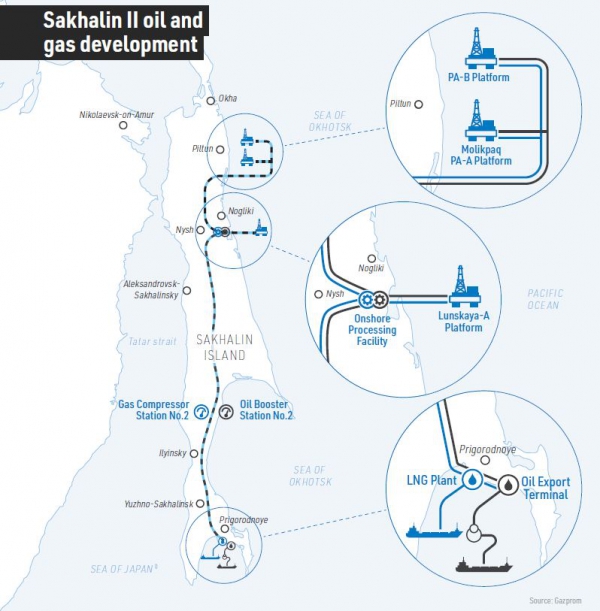
Gazprom formally inaugurated Russia’s first LNG plant at Prigorodnoye on 18 February 2009.
Its two trains were designed for combined annual output of 9.6 million tonnes.
Gazprom said approximately 65 per cent of Sakhalin LNG was contracted to nine Japanese purchasers. (Gazprom)
The first LNG cargo left for Japan in March.
By May, the second train had started operation.
Contemporaneous industry reporting said the plant was being ramped toward full design capacity. (Offshore Magazine)
The financial proposition had therefore changed profoundly.
Lenders were no longer being asked principally to finance an uncertain future LNG business.
The LNG business had begun.
6. Shell’s Own Annual Report Records the Transition
Royal Dutch Shell’s 2009 Annual Report and Form 20-F described Sakhalin II as one of the major projects completed during the year.
Shell stated that, together with its partners, it had completed Russia’s first LNG plant, describing Sakhalin II as one of the world’s largest integrated energy projects. (KU Leuven Bibliotheken)
The report is part of Shell’s official historical annual-report archive, which continues to make the 2009 corporate reporting available. (Shell)
This is useful authenticated corporate evidence because it fixes Shell’s own presentation of Sakhalin II at the moment the additional finance arrived.
The project had crossed the boundary from construction megaproject to producing asset.
7. Shell Was Still There — But No Longer in Control
By October 2009 the ownership structure was:
Gazprom — 50 per cent plus one share
Royal Dutch Shell — 27.5 per cent minus one share
Mitsui — 12.5 per cent
Mitsubishi — 10 per cent (FinanzNachrichten.de)
This distinction has been maintained throughout the Sakhalin Papers because it matters historically.
Shell controlled Sakhalin Energy when many of the controversial Phase 2 decisions were taken.
After the 2007 restructuring, Gazprom controlled it.
But Shell did not disappear.
A 27.5 per cent interest in a project of Sakhalin II’s scale remained economically substantial.
And the 2009 financing documents reveal something more specific about Shell’s continuing role.
8. The Shareholders Signed a Sponsor Guarantee
The Mitsubishi announcement states that Mitsubishi, together with Sakhalin Energy’s other shareholders, signed a sponsor guarantee agreement connected with the additional financing.
That guarantee would remain effective until completion of the project. (FinanzNachrichten.de)
The identified shareholders included Royal Dutch Shell.
Accordingly, the documentary record establishes that Shell was one of the sponsors standing behind this additional financing structure.
What the public announcement does not disclose is equally important.
It does not specify the financial allocation of the guarantee among the four shareholders.
It does not establish that Shell guaranteed 27.5 per cent of the $1.4 billion.
It does not provide the detailed trigger provisions, caps or completion tests.
Those figures should therefore not be invented.
The established fact is:
Shell remained contractually involved as a project sponsor while the additional financing moved toward completion.
9. This Was Project Finance — But With Completion Support
The Mitsubishi statement described the financing as project finance secured principally by the cash flow generated by Sakhalin II.
That is the conventional attraction of large infrastructure project financing: lenders look primarily toward future project revenues rather than simply relying upon the general balance sheets of the shareholders. (FinanzNachrichten.de)
But the simultaneous sponsor guarantee is an important qualification.
Before agreed completion conditions were achieved, the lenders were not relying solely upon future LNG and oil cash flow.
The sponsors were also providing completion-period support.
That is a finance interpretation derived from the structure disclosed in the shareholder announcement — not a quotation from a court or lender.
It reinforces an important point about Shell’s status after losing control.
Shell was no longer the operator-controlling shareholder of the earlier years.
But it remained financially intertwined with the project.
10. Why Was Another $1.4 Billion Needed After Production Had Started?
The answer is in the financing announcement itself.
Starting production did not mean every part of Phase 2 was complete.
The proceeds were intended to complete the full project scope and support the continuing drilling programme necessary for full production capacity. (FinanzNachrichten.de)
This is common in very large energy projects.
First production can occur while:
additional wells are being drilled;
production is ramping up;
commissioning continues;
facilities are being optimised;
and expenditure remains before the asset reaches contractual or technical completion.
Sakhalin II was producing LNG in 2009.
It was not yet at full design capacity.
11. The Two LNG Trains Were Still Ramping Up
LNG Journal reported that the first and second LNG trains each had a design capacity of approximately 4.8 million tonnes per year.
The second train came online on 31 May 2009.
Both were still being ramped toward the combined nameplate capacity of 9.6 million tonnes annually when the additional financing was arranged. (OilCor)
The same report described the infrastructure supporting those exports:
three offshore platforms;
approximately 300 kilometres of offshore pipelines;
about 1,600 kilometres of onshore pipelines;
an onshore processing facility;
the oil export installation;
and the LNG plant. (OilCor)
The $1.4 billion was therefore not financing a marginal addition.
It was helping bring an enormous integrated production system fully to maturity.
12. Most of the LNG Had Already Been Sold
Another factor mattered enormously to lenders.
The product had buyers.
Contemporaneous reporting said virtually all of the plant’s planned annual LNG output had already been committed under long-term sales contracts. (OilCor)
Japanese purchasers included some of the country’s largest power and gas utilities.
The contracts created predictable future revenue streams of precisely the type project-finance lenders value.
Japan’s participation was therefore circular in an economically powerful sense:
Japanese companies owned equity.
Japanese consumers bought the LNG.
Japanese banks helped finance the infrastructure.
Japanese public institutions either lent or insured the financing.
The project’s debt and sales architecture reinforced one another.
13. Shell Was Also Buying Sakhalin LNG
Shell’s commercial relationship with Sakhalin II went beyond its equity interest.
On 8 April 2009, Gazprom and Royal Dutch Shell announced agreements under which Shell Eastern Trading and Gazprom Global LNG would each purchase LNG from Sakhalin Energy.
Deliveries were to begin in 2009 and continue until 2028, reaching approximately one million tonnes per year for each buyer at plateau.
A linked arrangement provided equivalent gas volumes to Shell’s European portfolio. (Gazprom)
This is another reason the proposition that Shell had simply “left” Sakhalin after Gazprom took control is historically wrong.
Shell remained:
a shareholder;
a technical participant;
a project sponsor;
and an LNG buyer.
Its role had changed.
It had not evaporated.
14. The Financing Closed in the Shadow of the Financial Crisis
The timing also deserves attention.
The global banking system had suffered its most severe upheaval in generations during 2008 and 2009.
Credit availability had been severely disrupted.
Ian Craig highlighted the significance of securing the additional debt under the prevailing financial-market conditions.
Sakhalin Energy characterised the combined Phase 2 financing as a record for Russia and evidence of the project’s strategic and commercial importance. (OilCor)
Those are corporate assessments, not independent credit ratings.
They nevertheless document how Sakhalin Energy itself viewed the financing achievement.
Obtaining another $1.4 billion in international bank debt during that period was commercially significant.
15. The $6.7 Billion Figure Had an Earlier History
There is a curious circularity to the total.
Before the ownership restructuring and before the earlier international financing structure disintegrated, Sakhalin II had contemplated project finance of roughly $6.7 billion.
After years of institutional change, lender departures, environmental controversy, the Gazprom takeover and reconstruction of the financing, the ultimate total returned to:
$6.7 billion.
The route was entirely different.
The number was remarkably familiar.
The final structure comprised the 2008 JBIC/commercial package and the 2009 NEXI-insured additional tranche. (Project Finance)
16. Britain Had Disappeared From the Financing — Not From the Documentary History
The contrast with the earlier UK process is stark.
Mr Justice Mitting’s 17 March 2008 High Court judgment records that approximately $650 million of ECGD project-finance support had been sought.
It also records that Sakhalin Energy withdrew that application on 29 February 2008 before a final decision was made. (vLex)
That judgment concerned environmental-information disclosure.
It did not rule upon the legality of the separate 2004 conditional commitment challenged by WWF and The Corner House.
It did not reject Sakhalin Energy’s financing application.
And it said nothing about the later Japanese loans.
Its relevance here is narrower but important:
it provides an independent judicial record confirming when the British financing route ended.
The Japanese-financed route succeeded afterwards.
17. Did Japan Simply Apply Weaker Environmental Standards?
The documentary record does not support such a categorical conclusion.
JBIC had imposed environmental monitoring requirements when it joined the 2008 financing.
NEXI operated its own system for examining environmental and social considerations in insured overseas projects.
Its framework requires categorisation and environmental review for projects carrying significant potential impacts and allows insurance support to be refused where environmental and social consideration is insufficient. (Nexi)
But the existence of formal standards does not establish that critics regarded those standards as adequate.
They plainly did not.
Environmental disputes around Sakhalin II remained active throughout 2009.
18. February 2009: IUCN Criticised Sakhalin Energy’s Cooperation
Before the NEXI-insured tranche was concluded, the independent Western Gray Whale Advisory Panel had raised a serious concern.
On 12 February 2009, IUCN reported that the Panel was dissatisfied with delays in Sakhalin Energy supplying relevant documents and scientific information.
IUCN warned that inadequate collaboration could impair the Panel’s ability to provide conservation advice for the Western Gray Whale population. (IUCN)
This was not an NGO campaigning allegation from outside the scientific process.
It was a statement from the institution convening the independent panel with which Sakhalin Energy itself had agreed to work.
But events shortly afterwards also provide evidence of the system functioning.
19. April 2009: The Scientific Panel Called for a Moratorium
On 24 April 2009, IUCN reported that the Western Gray Whale Advisory Panel had recommended postponement of industrial activities capable of adversely affecting the whales.
Its recommendation included Sakhalin Energy’s planned 2009 seismic survey.
The Panel was particularly concerned about observations during 2008 suggesting changes in whale distribution and behaviour. (IUCN)
The recommendation was precautionary.
It did not declare that Sakhalin Energy had killed whales.
It did not establish environmental liability.
It called for activities to be postponed until further monitoring reduced the scientific uncertainty.
What happened next is important.
20. Sakhalin Energy Accepted the Recommendation
Four days later, on 28 April 2009, IUCN announced that Sakhalin Energy had accepted the Panel’s advice and postponed the seismic survey.
IUCN publicly welcomed the decision. (IUCN)
The detailed Panel record confirms the nuance.
Sakhalin Energy maintained that it believed the survey could have proceeded safely with the agreed mitigation and monitoring programme.
Nevertheless, in light of the Panel’s recommendation, it agreed to postpone the work until 2010. (IUCN Cetacean Specialist Group)
That is an instructive piece of the financing story.
By 2009 the project was financed and producing.
Yet independent scientific scrutiny still had enough institutional weight to cause a planned industrial activity to be deferred.
21. Financial Close Had Not Ended Environmental Dispute
This distinction is worth making explicit.
The successful financing did not mean:
all environmental questions answered.
The February and April IUCN records prove otherwise.
Nor did continuing environmental controversy mean:
the project could no longer obtain finance.
The October $1.4 billion agreement proves otherwise.
Those facts are not contradictory.
They describe the model that had emerged by 2009:
finance the project;
attach monitoring and environmental processes;
continue operation;
and address individual scientific or environmental issues while the business proceeds.
Environmental organisations often regarded that model as fundamentally inadequate.
The lenders and sponsors evidently regarded it as workable.
22. Environmental Campaigners Continued to Raise Pipeline Concerns
The controversy also extended far beyond whales.
On 20 October 2009, less than two weeks after the formal additional-financing announcement, Sakhalin Environment Watch publicly alleged continuing problems along the trans-Sakhalin pipeline route.
Its statement described erosion, landslides and river-crossing problems and said Russian environmental authorities had previously identified violations requiring corrective work. (FOE Japan)
These statements must be handled carefully.
They document what the environmental organisation alleged and what it said Russian inspections had found.
They are not substituted here for the underlying Russian regulatory orders or a court judgment.
The important documentary point is simply this:
serious environmental criticism continued after the financing had closed.
23. Sakhalin Energy Presented a Very Different Environmental Record
The company’s own environmental material presented another side.
Sakhalin Energy described extensive impact assessment, biodiversity programmes, river restoration, monitoring of protected species and measures developed with specialists to mitigate impacts on Western Gray Whales.
It pointed particularly to rerouting offshore pipelines away from whale feeding areas and cooperation with the IUCN-convened advisory process. (Gazprom)
These company statements are relevant evidence.
They should not automatically be accepted as independent findings any more than activist claims should.
The documentary method requires both to be labelled by source.
The proper historical record contains the disagreement.
24. What Exactly Did the Additional Finance Prove?
Very little about environmental legality.
Quite a lot about commercial viability.
The banks and NEXI were prepared to support another $1.4 billion of project debt.
Long-term LNG sales were in place.
Production had begun.
The plant was ramping up.
The shareholders provided completion support.
And Japan had a powerful strategic interest in ensuring the project reached full production.
Those facts demonstrate confidence sufficient for a financing transaction.
They do not amount to a finding that every environmental issue had been resolved.
Project finance is not a court judgment.
Credit insurance is not environmental absolution.
25. What Did It Mean for Shell?
For Shell, the October 2009 financing crystallised its transformed position.
It had once held 55 per cent and controlled Sakhalin Energy.
It now held 27.5 per cent under Gazprom control.
But Shell’s continuing commercial exposure can be traced through several authenticated records.
Shell remained an equity investor. (FinanzNachrichten.de)
Its Annual Report celebrated completion of Russia’s first LNG plant with its partners. (KU Leuven Bibliotheken)
It entered long-term arrangements to buy Sakhalin LNG. (Gazprom)
And the financing announcement records that Sakhalin Energy’s shareholders collectively entered the sponsor guarantee associated with the extra $1.4 billion. (FinanzNachrichten.de)
Shell had surrendered control.
It had not surrendered its economic interest in success.
26. The Financing Architecture Was Now Complete
By the end of 2009, Sakhalin II had achieved something that had seemed far less certain only a few years earlier.
It possessed a $6.7 billion external project-finance structure.
It had Japan’s principal public international lender involved.
It had Japanese government credit insurance protecting additional commercial debt.
It had international banks.
It had shareholder completion support.
It had long-term buyers.
And it had begun generating LNG revenues.
The financing problem that had occupied British officials, campaigners, lawyers and prospective lenders for years had not disappeared.
It had been solved somewhere else.
Documentary Findings
Established
Sakhalin Energy withdrew its application for British ECGD support on 29 February 2008, before ECGD made a final financing decision. This is recorded in the High Court judgment in Export Credits Guarantee Department v Friends of the Earth. (vLex)
Sakhalin Energy subsequently concluded a $5.3 billion project-finance package involving JBIC and commercial banks in June 2008.
On 1 October 2009, Reuters reported that Sakhalin Energy had secured an additional $1.4 billion. (Royal Dutch Shell Plc .com)
On 7 October 2009, Mitsubishi Corporation announced the formal additional-financing agreement.
The $1.4 billion was to be advanced by international commercial banks and insured by NEXI.
The additional tranche took total Phase 2 project debt to $6.7 billion. (FinanzNachrichten.de)
The funds were intended for completion of the Phase 2 scope, including continuing oil and gas drilling required to achieve full production capacity. (FinanzNachrichten.de)
The shareholders at that point were Gazprom, Royal Dutch Shell, Mitsui and Mitsubishi.
Shell held approximately 27.5 per cent. (FinanzNachrichten.de)
Mitsubishi’s announcement records that the shareholders entered into a sponsor guarantee effective until project completion. (FinanzNachrichten.de)
Shell’s 2009 Annual Report records completion of Russia’s first LNG plant at Sakhalin II with its partners. (KU Leuven Bibliotheken)
Sakhalin II was already exporting LNG while the additional financing was being completed.
The LNG plant consisted of two trains designed for combined annual capacity of approximately 9.6 million tonnes. (Gazprom)
Established Environmental Context
In February 2009, the IUCN-convened Western Gray Whale Advisory Panel expressed concern about Sakhalin Energy’s provision of information necessary to its conservation work. (IUCN)
In April 2009 the Panel recommended postponement of activities that might adversely affect Western Gray Whales, including Sakhalin Energy’s proposed seismic survey. (IUCN)
Sakhalin Energy accepted that recommendation and postponed the survey, while maintaining that it believed the survey could have been undertaken safely with appropriate mitigation. (IUCN)
These facts demonstrate that environmental scrutiny continued after project finance had become available.
They do not establish environmental liability.
Alleged or Contested
Sakhalin Environment Watch continued in October 2009 to allege pipeline, erosion, regulatory and river-crossing deficiencies.
Those allegations are part of the contemporaneous record but are not presented here as judicial findings. (FOE Japan)
Sakhalin Energy’s own environmental materials described extensive mitigation, monitoring and biodiversity measures and presented the company’s record substantially more favourably. (Gazprom)
The conflict between these accounts is preserved rather than artificially resolved.
Not Established
It is not established that NEXI itself lent the additional $1.4 billion. The commercial banks supplied the loan; NEXI insured it.
It is not established from the public announcement how the sponsor-guarantee obligation was divided among Shell, Gazprom, Mitsui and Mitsubishi.
It is not established that Shell guaranteed precisely 27.5 per cent of the additional debt.
It is not established that NEXI’s participation represented a determination that every environmental issue associated with Sakhalin II had been resolved.
It is not established that the British, US or EBRD financing routes failed solely because of environmental concerns.
It is not established that Japanese public finance was arranged merely because British financing disappeared.
And no court decision identified in the records examined for this file held that the NEXI-insured financing was unlawful.
Commentary
The extra $1.4 billion makes the evolution of the Sakhalin financing story unusually clear.
At the beginning, public finance looked like a gate.
Could EBRD approve the project?
Would ECGD provide cover?
Would American export-credit support follow?
Would environmental standards prevent financial close?
By late 2009, the gate had become something else.
Sakhalin II was already through it.
Billions had been invested.
Oil was flowing.
LNG cargoes were sailing.
Long-term customers had signed contracts.
Gazprom controlled the venture.
Shell, Mitsui and Mitsubishi remained deeply invested.
Japan wanted the energy.
The financing question was no longer whether Sakhalin II would exist.
It was how its remaining costs would be funded and how lenders would manage the risks of an operating megaproject.
Japan provided the answer.
First JBIC lent.
Then NEXI insured.
Private banks supplied capital behind the Japanese public guarantee structure.
The shareholders supplied completion support.
And the total debt reached $6.7 billion.
Yet the environmental record did not become irrelevant.
The same year that the extra financing was arranged, an independent scientific panel criticised Sakhalin Energy’s information-sharing, recommended postponement of a seismic survey, and saw Sakhalin Energy accept that recommendation.
That combination is revealing.
Finance and environmental constraint were no longer mutually exclusive outcomes.
The project could obtain billions of dollars and still be required — through lender-linked and independent scientific mechanisms — to alter individual activities.
Whether those constraints were sufficient remains legitimately debatable.
What the documentary record establishes is the structure that emerged:
Sakhalin II would proceed. Environmental scrutiny would proceed with it.
And Shell, despite no longer controlling the project, remained financially and commercially attached to both.
Source Record
The principal financing source is the 7 October 2009 announcement concerning the additional Sakhalin II project-finance contract, issued in connection with Mitsubishi Corporation’s 10 per cent shareholding. It records the $1.4 billion commercial-bank financing, NEXI insurance, sponsor guarantee, intended use of the proceeds and resulting $6.7 billion total Phase 2 debt. (FinanzNachrichten.de)
Contemporaneous Reuters reporting dated 1 October 2009, preserved in the RoyalDutchShellPlc.com archive, records Ian Craig’s announcement that Sakhalin Energy had obtained the additional $1.4 billion and places it alongside the earlier $5.3 billion financing. (Royal Dutch Shell Plc .com)
Contemporaneous industry confirmation is supplied by Offshore, 7 October 2009, which reported the NEXI-insured $1.4 billion financing and stated that the funds would support completion and the drilling programme required for full production capacity. (Offshore Magazine)
LNG Journal subsequently reported the $6.7 billion financing total, the status of the two LNG trains, the long-term customer base and Sakhalin Energy’s assessment of the transaction’s significance under difficult financial-market conditions. (OilCor)
The authenticated Shell corporate record is the Royal Dutch Shell plc Annual Report and Form 20-F 2009, which records Sakhalin II among the major projects completed that year and identifies the LNG plant as Russia’s first. Shell’s official website maintains its historical annual reports archive including 2009. (KU Leuven Bibliotheken)
The contemporaneous Gazprom record includes its 18 February 2009 announcement inaugurating the LNG plant, documenting its 9.6 million-tonne design capacity and the large proportion of LNG contracted to Japanese customers. (Gazprom)
Gazprom’s 8 April 2009 announcement with Royal Dutch Shell records long-term LNG purchase arrangements involving Shell Eastern Trading and confirms Shell’s continuing commercial relationship with Sakhalin output. (Gazprom)
The relevant judicial record remains Export Credits Guarantee Department v Friends of the Earth [2008] EWHC 638 (Admin), which establishes that Sakhalin Energy withdrew its UK export-credit application on 29 February 2008 before a substantive ECGD financing decision was made. (vLex)
The independent scientific record is supplied by IUCN and the Western Gray Whale Advisory Panel, including the February 2009 criticism concerning information provision, the April recommendation to postpone potentially harmful activity and IUCN’s subsequent confirmation that Sakhalin Energy postponed its planned seismic survey. (IUCN)
Environmental-group material concerning alleged pipeline deficiencies is included only as evidence of contemporaneous criticism and is expressly distinguished from judicial or regulatory findings. (FOE Japan)
Archive disclaimer: Project financing, insurance support and financial close do not themselves determine environmental compliance. Environmental allegations are attributed to their sources. NEXI’s insurance participation is not characterised as a judicial approval of Sakhalin II’s environmental record. Shell’s inclusion among the project shareholders and sponsors is established, but no unsupported allocation of the sponsor-guarantee liability is made.
Site wide disclaimer also applies.
Next Archive File
SLF-2007-045 — The Sakhalin Papers XXXV: Stop the Survey — When the Western Gray Whale Panel Told Sakhalin Energy to Stand Down
In February 2009, the independent scientists advising Sakhalin Energy were publicly unhappy.
They said the company had not supplied important information early enough for proper assessment.
Two months later, their concern became more serious.
After troubling observations concerning Western Gray Whale distribution and behaviour during the previous summer, the IUCN-convened panel recommended a moratorium on activities capable of disturbing the animals.
That recommendation included Sakhalin Energy’s planned 2009 seismic survey. (IUCN)
Sakhalin Energy disagreed with the scientists on one important point.
The company believed the survey could be carried out safely under the elaborate mitigation programme already devised.
But it did something significant nonetheless.
It cancelled the 2009 survey. (IUCN)
The episode raises a question central to the entire Sakhalin financing controversy.
Years earlier, environmental campaigners had argued that once the project was built and financed, meaningful lender leverage would disappear.
Yet here was an operating, financed LNG megaproject changing its plans in response to an independent scientific panel.
How independent was the Panel?
What information had Sakhalin Energy failed to provide?
What had happened to the whales in 2008?
What exactly did the scientists recommend?
And did the company’s decision demonstrate that the environmental safeguards demanded during the financing battles still had real force after financial close?
SLF-2007-045 will return from the money to the whales — and examine the moment Sakhalin Energy was told not to proceed.
*This website and sisters royaldutchshellgroup.com, shellnazihistory.com, royaldutchshell.website, johndonovan.website, shellnews.net, and shellwikipedia.com, are owned by John Donovan - more information here. There is also a Wikipedia segment, the Shell DPA Files, "Shell and the Spies", the Shell Leaks files, as well as books written and published by John Donovan - Kindle eBooks. Timeline of the Donovan Shell Feud. Toxic History of Royal Dutch Shell Group. Shell and the Donovans: The Full Media Record — 550+ Articles, 110 Books, 40 Years. *All created and supported by internet wizz, Nick Gill.