THE SHELL LEAKS FILES: 2 SEPTEMBER 2026
SLF-2007-045
The Sakhalin Papers XXXV: Stop the Survey — When the Western Gray Whale Panel Told Sakhalin Energy to Stand Down
Sakhalin Energy had spent two years developing an elaborate monitoring and mitigation programme for a 2009 seismic survey beside the feeding grounds of one of the world’s most endangered whale populations. The independent scientists advising the company said the plan itself was approaching exemplary standard. Then new evidence from the 2008 feeding season changed the calculation. The Panel recommended postponement. Sakhalin Energy maintained that it could operate safely — but stood down anyway.
Archive reference: SLF-2007-045
Collection: The Sakhalin Papers
Principal scientific record: Western Gray Whale Advisory Panel, Report of the Sixth Meeting, Geneva, 21–24 April 2009
Authenticated Shell records: Shell Sustainability Report 2005; Shell Sustainability Report 2009
Contemporaneous reporting: Offshore, 24 April 2009; Sakhalin Energy press-centre material reported 30 April 2009; contemporary conservation reporting
Court record: Export Credits Guarantee Department v Friends of the Earth [2008] EWHC 638 (Admin), used solely for the earlier financing and environmental context
Evidence standard: Scientific observations and WGWAP recommendations are distinguished from conclusions about causation. Sakhalin Energy’s statements are identified as the company’s position. NGO commentary is attributed. The WGWAP was an advisory scientific body, not a court or Russian regulator; its April 2009 recommendation was not a legal prohibition.
Introduction
The headline requires an immediate qualification.
No judge issued an injunction.
No Russian regulator identified in the material examined for this instalment ordered Sakhalin Energy to stop.
The Western Gray Whale Advisory Panel — WGWAP — recommended that Sakhalin Energy postpone its proposed 2009 seismic survey.
Sakhalin Energy then chose to comply.
That distinction makes the episode more interesting, not less.
By April 2009 Sakhalin II was no longer a project waiting to see whether it could be built. LNG production had started. Billions of dollars of project finance had been secured. Gazprom controlled Sakhalin Energy and Shell retained a 27.5 per cent interest. Shell’s own Sustainability Report recorded the continuing role of the independent Western Gray Whale Advisory Panel in advising the venture on potential effects from its offshore operations. (Shell)
Yet an independent scientific recommendation was still capable of changing an operational plan.
The planned seismic vessel did not begin acquiring data on 20 June 2009.
The survey moved to 2010.
Why it moved is the subject of this file.

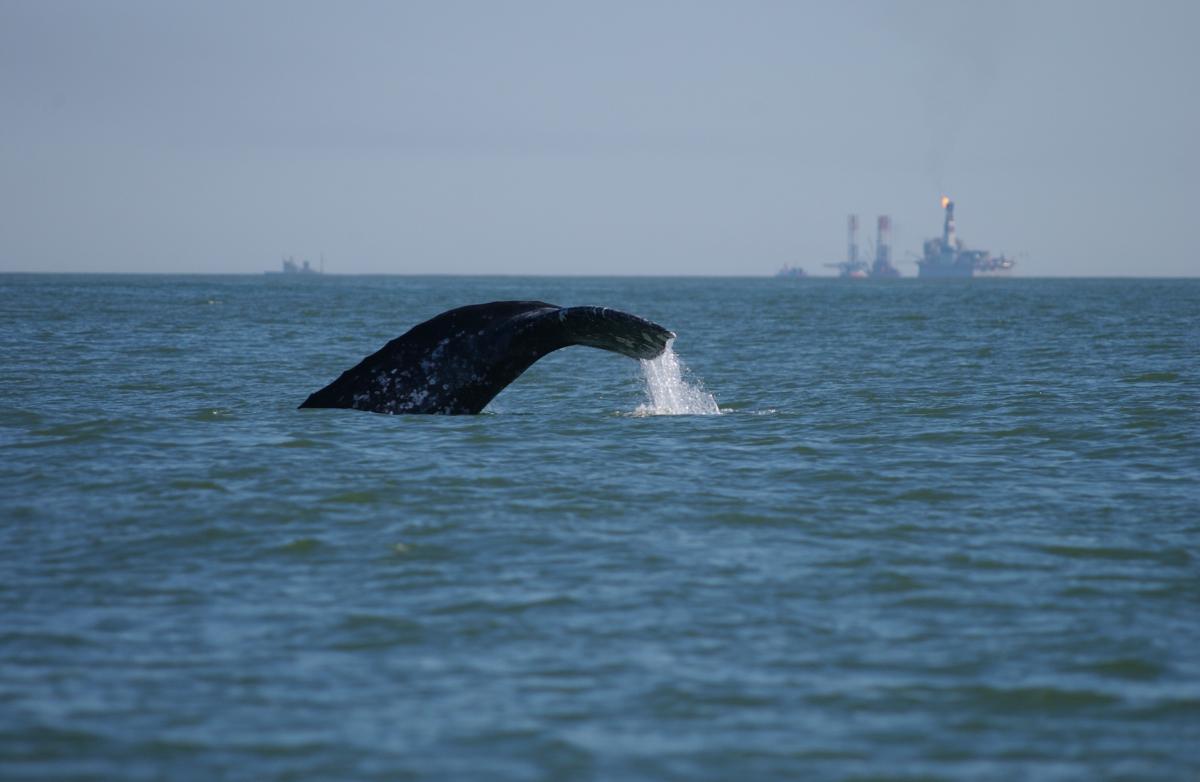
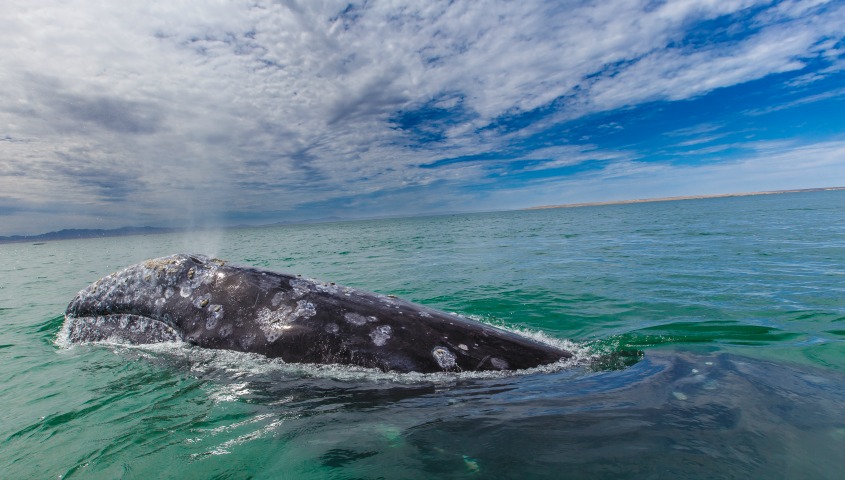
1. The Panel Existed Because of an Earlier Sakhalin Crisis
The story did not begin in 2009.
In 2004, at Sakhalin Energy’s request, IUCN convened an independent scientific review of the possible effects of Sakhalin II Phase 2 on the western North Pacific gray whale population.
The resulting 2005 report examined threats, mitigation options and monitoring requirements for a population then estimated at only about 100 animals. (IUCN Portals)
Shell’s own Sustainability Report 2005 recorded the company’s response. It said Sakhalin Energy had initiated the independent review and had accepted important advice arising from it, including moving offshore pipelines approximately 20 kilometres farther from the principal whale feeding ground. Shell also said Sakhalin Energy was working with IUCN to establish a permanent advisory panel. (Shell)
That permanent body became WGWAP.
IUCN formally announced it in October 2006 as an independent panel of international scientists intended to provide continuing scientific advice on oil and gas operations around the whales’ feeding habitat. (IUCN)
So by 2009, the scientists were not outsiders suddenly attempting to halt a Shell-related operation.
They were part of an advisory mechanism that Sakhalin Energy itself had helped create.
2. Independence Did Not Mean Agreement
The arrangement was collaborative.
It was not compliant.
An earlier example came in 2007, when WGWAP publicly criticised Sakhalin Energy over proposed noise-management criteria.
IUCN reported that the Panel considered the company’s apparent rejection of recommended noise criteria potentially unsafe for the whale population, while Sakhalin Energy said aspects of the recommendation were not technically feasible. (IUCN)
That disagreement is useful background.
The Panel was not functioning as a corporate public-relations committee.
Nor did Sakhalin Energy automatically accept every recommendation.
Its purpose was to create a formal arena in which scientific advice and industrial requirements could collide in public.
In April 2009, they did.
3. The Planned Survey Was Real and Imminent
Sakhalin Energy intended to conduct a 4-D seismic survey over the Astokh area.
The technique involves repeating seismic measurements over an existing field so engineers can compare the subsurface response over time and monitor changes as hydrocarbons are produced.
This was not a vague future proposal.
A contractor had been selected.
The programme was being prepared around a planned 20 June 2009 start.
The survey itself was expected to require roughly a week under favourable conditions, although weather, ice, repeated survey lines and whale-protection shutdown rules could lengthen the operation. (IUCN Cetacean Specialist Group)
Sakhalin Energy had spent considerable time designing environmental safeguards around it.
4. Two Years of Work Had Gone Into Protecting the Whales
The most striking feature of the April decision is that WGWAP did not reject the proposed mitigation scheme as inadequate.
Quite the reverse.
Panel scientists and Sakhalin Energy specialists had worked through a dedicated Seismic Survey Task Force for approximately two years.
The proposed programme incorporated acoustic monitoring, whale observation, survey timing and operational restrictions intended to minimise disturbance.
Contemporaneous Offshore reporting confirmed that the company had incorporated monitoring and mitigation arrangements agreed with WGWAP over the preceding two years. (Offshore Magazine)
Later IUCN assessment of the programme described the resulting approach as exceptionally comprehensive and influential in developing standards for seismic work around marine mammals. (IUCN)
This was therefore not a battle between scientists demanding safeguards and a company refusing to devise any.
A sophisticated safeguard system already existed.
Something else caused the postponement.
5. In December 2008, the Picture Had Begun to Change
The problem was what scientists had seen during the 2008 feeding season.
Western gray whales spend the ice-free months feeding in waters off northeastern Sakhalin. At that time the population was regarded as Critically Endangered, with only a very small number of reproductive females.
WGWAP had become concerned that the whales’ distribution in 2008 looked anomalous.
The nearshore Piltun feeding area — particularly important to mothers and calves — appeared to contain substantially fewer whales than in earlier seasons.
The Panel did not know why.
That uncertainty is one of the most important facts in this archive file.
6. The 2008 Monitoring Showed a Major Shift
By the April 2009 meeting, WGWAP had considerably more information than it possessed in December.
Material supplied through Sakhalin Energy’s monitoring programmes showed a pronounced change: whale use of the nearshore area had fallen sharply compared with 2007, while use of the offshore feeding area had increased.
The Panel also had photo-identification, behaviour, acoustic and prey-monitoring information, plus research from other scientific teams. (IUCN Cetacean Specialist Group)
Contemporary IUCN material summarised the concern more broadly: the distribution and behaviour observed in 2008 were sufficiently unusual for the scientists to question whether industrial disturbance might have contributed. (IUCN Portals)
But “might” matters.
The scientific record did not establish that Sakhalin Energy’s operations had caused the change.
7. The Scientists Could Not Determine the Cause
Several explanations had to be considered.
Food distribution was one possibility.
Industrial noise was another.
Other environmental variables could also have influenced where whales chose to feed.
And critically, Sakhalin Energy was not the only industrial operator in the region.
The Panel said the available information was insufficient to distinguish confidently among competing explanations. Some potentially relevant industrial activity had been undertaken by companies other than Sakhalin Energy. (IUCN Cetacean Specialist Group)
This is precisely where a documentary account must resist retrospective certainty.
The Panel observed an anomaly.
It considered anthropogenic disturbance plausible.
It did not establish a causal finding that Shell, Sakhalin Energy or any other named operator had displaced the whales.
8. Other Companies Complicated the Science
The northeastern Sakhalin shelf contained several oil and gas developments.
Exxon Neftegas was operating Sakhalin I.
Other exploration programmes were also occurring or being planned.
In May 2008, WGWAP had separately expressed concern about Exxon Neftegas proposals involving Piltun Lagoon, illustrating that the Panel’s attention was not confined to Sakhalin Energy. (IUCN)
By 2009 this created a fundamental scientific difficulty.
A whale does not distinguish between underwater sound generated by Company A and Company B.
A scientist attempting to determine why an animal has changed feeding location must nevertheless know which industrial activities occurred, where, when and at what acoustic intensity.
WGWAP repeatedly complained that information concerning other operators was incomplete.
The problem was therefore cumulative impact.
That would become one of the defining themes of the Western Gray Whale story.
9. The Original Moratorium Had Not Automatically Included Sakhalin Energy’s Survey
There is an important subtlety in the Panel record.
At its previous meeting, WGWAP had called for a moratorium on potentially disturbing industrial activities in and around the feeding grounds unless independently verified mitigation measures were available.
But the Panel initially contemplated that Sakhalin Energy’s 2009 seismic survey could still proceed if the carefully developed monitoring and mitigation programme was satisfactory. (IUCN Cetacean Specialist Group)
That distinction demolishes an overly simple interpretation of the episode.
The scientists had not entered 2009 determined to stop Sakhalin Energy irrespective of safeguards.
They continued working on the survey plan.
The change came because the additional 2008 whale data increased rather than reduced their uncertainty.
10. The Company Wanted an Answer Quickly
Commercial timing now met scientific deliberation.
Sakhalin Energy asked WGWAP to reach its conclusion during the April meeting rather than several weeks afterwards.
Contractual arrangements needed to be finalised.
The company was working toward the 20 June survey start.
The Panel agreed to accelerate its advice. (IUCN Cetacean Specialist Group)
This detail provides an unusually clear view of how the process functioned.
The scientists were not discussing an academic proposition.
A vessel schedule, contractors, field personnel and a live operating project were waiting for their answer.
11. The Lenders Were Still Watching
Another revealing detail appears in the meeting record.
Representatives from Credit Suisse and Mizuho Corporate Bank attended WGWAP-6 alongside Sakhalin Energy, Shell International, IUCN, Russian government representatives, WWF and Pacific Environment. (IUCN Cetacean Specialist Group)
The lenders’ position recorded in the meeting material was that, if the seismic survey proceeded, they expected the opportunity to review Sakhalin Energy’s environmental impact assessment in accordance with applicable World Bank/IFC-style requirements, irrespective of the separate dispute over whether Russian law required that particular review. (IUCN Cetacean Specialist Group)
This directly connects the whale process to the financing story examined in previous Shell Leaks Files.
Financial close had occurred.
Environmental oversight had not ended.
12. Then Came the Unusual Scientific Conclusion
WGWAP reached an almost paradoxical position.
The work undertaken with Sakhalin Energy on seismic mitigation was strong.
Under ordinary circumstances, the Panel indicated that it would have been prepared to advise that the survey could proceed once remaining recommendations were incorporated.
But these were no longer ordinary circumstances.
The unexplained 2008 whale distribution raised too much uncertainty.
The scientists therefore applied the precautionary principle and recommended that Sakhalin Energy’s survey be postponed until another season of monitoring could clarify what was happening. If the 2009 data reduced that uncertainty, the Panel said it might reconsider a survey in 2010. (IUCN Cetacean Specialist Group)
This point should not be lost:
the postponement was not a finding that the mitigation plan had failed.
It was a finding that the biological uncertainty had become too great to justify proceeding.
13. Sakhalin Energy Disagreed — and Complied
Sakhalin Energy did not concede that the proposed survey was unsafe.
Its representative told the Panel that the company believed the survey could safely proceed in 2009 if the previously agreed monitoring and mitigation programme were implemented.
But the company accepted the recommendation.
The survey would be postponed until 2010. (IUCN Cetacean Specialist Group)
Sakhalin Energy’s press-centre account, reported contemporaneously on 30 April, presented essentially the same position: the company believed the planned safeguards made the work safe, but it would nevertheless follow the Panel’s recommendation and defer the survey. (Oreanda News)
That difference between agreement and compliance is significant.
The company did not adopt the Panel’s risk assessment.
It adopted the Panel’s recommended course of action.
14. Contemporary Industry Reporting Confirmed the Decision Immediately
This was not a later reconstruction.
On 24 April 2009, Offshore reported that Sakhalin Energy had postponed the planned 4-D seismic work until 2010 following the WGWAP meeting.
The industry publication also noted that the company had incorporated the monitoring and mitigation measures worked out with the Panel over the previous two years. (Offshore Magazine)
The chronology is therefore unusually well documented:
the Panel met;
the scientific recommendation was made;
Sakhalin Energy accepted it;
and contemporary industry reporting recorded the postponement the same day.
15. Environmental Campaigners Called It a Victory
WWF, Pacific Environment and other campaign organisations welcomed the decision.
A contemporaneous statement described the outcome as evidence that collaborative science could influence even highly complex oil-and-gas developments and praised Sakhalin Energy for following the scientific advice. (Banktrack)
Those assessments should be recognised for what they are:
campaigners’ interpretations of the decision.
They are relevant to the historical record because they show how the episode was understood publicly.
They are not independent scientific findings.
The underlying scientific case remains the WGWAP record itself.
16. Something Rare Had Happened
The commercial facts make the decision striking.
Sakhalin II was already producing LNG.
The initial $5.3 billion Japanese-led financing package had been signed.
Long-term customers were waiting for cargoes.
Billions had already been invested.
And Shell’s economic interest remained substantial.
Yet the seismic programme moved by a year because an advisory scientific panel considered that the available biological evidence was too uncertain.
That does not prove environmental governance around Sakhalin II was universally effective.
It proves something narrower and documentable:
on this occasion, an independent scientific recommendation materially changed an operating decision.
17. Shell’s Own Reports Confirm the Institutional Structure
Shell’s authenticated sustainability reporting provides useful corporate bookends.
Its 2005 Sustainability Report described the independent scientific review, the pipeline-rerouting response and plans for a permanent whale advisory body. (Shell)
Its 2009 Sustainability Report, published after the events examined here, recorded that the independent Western Gray Whale Advisory Panel continued advising Sakhalin Energy on the potential effects of offshore activities. It also identified Shell’s interest in Sakhalin II as 27.5 per cent. (Shell)
Shell therefore documented the existence and continuing role of the very mechanism that had just contributed to postponement of the survey.
The reports do not transform every WGWAP recommendation into a Shell admission.
They establish that Shell publicly recognised the advisory structure as part of the project’s environmental-management framework.
18. An Important Historical Irony
The Panel itself acknowledged a problem.
Sakhalin Energy was participating.
It was providing information.
It had spent years developing mitigation with the scientists.
It had agreed to postpone the survey.
Other operators in the same marine environment were not necessarily subject to — or participating in — the same advisory process.
The scientists therefore faced an uncomfortable possibility:
the company cooperating with the Panel might alter its programme while industrial activity by others continued.
That problem eventually became central to WGWAP’s emphasis on regional and cumulative effects. The modern WGWAP archive records that over the life of the process the panels directed hundreds of formal recommendations not only toward Sakhalin Energy but also toward other operators and government authorities. (IUCN Cetacean Specialist Group)
The environmental problem did not respect corporate boundaries.
Neither could the science.
19. This Was Not a Finding Against Shell
That clarification is particularly important in a series centred upon Shell documents.
By April 2009 Shell held 27.5 per cent of Sakhalin Energy.
Gazprom controlled the company.
The unusual 2008 whale observations could not be attributed definitively to a particular industrial activity from the information available to WGWAP.
Some of the activities of concern involved companies outside Sakhalin II.
And WGWAP explicitly said its recommendation to postpone was not a criticism of Sakhalin Energy’s cooperation or the work undertaken on the seismic mitigation programme. (IUCN Cetacean Specialist Group)
The factual proposition is therefore not:
Shell was found to have driven the whales away.
No such finding is established.
The factual proposition is:
uncertainty about the causes of an unusual whale-distribution pattern was serious enough for independent scientists to recommend precautionary postponement of a Sakhalin Energy operation.
20. The Earlier High Court Record Supplies Context — Not a Verdict on This Survey
The whale issue had already appeared in an English courtroom.
In Export Credits Guarantee Department v Friends of the Earth [2008] EWHC 638 (Admin), Mr Justice Mitting described the Sakhalin II development in the context of the proposed approximately $650 million British export-credit support.
The judgment recorded Shell’s earlier majority position, Gazprom’s subsequent entry and the potentially serious environmental implications of the project for the Western Grey Whale feeding habitat. It also recorded that Sakhalin Energy withdrew the ECGD financing application on 29 February 2008. (vLex)
But the limits of that authority must be preserved.
The High Court case concerned access to government environmental information.
It did not determine whether the 2009 seismic survey was lawful.
It did not decide what caused the 2008 changes in whale distribution.
It did not find Shell environmentally liable.
And it did not order Sakhalin Energy to postpone anything.
The April 2009 decision came through a scientific advisory process, not litigation.
21. So Did Post-Financing Environmental Safeguards Still Have Teeth?
This is the larger question raised by the episode.
Campaigners had long feared that environmental leverage would diminish once Sakhalin II had secured finance and entered production.
The 2009 survey postponement demonstrates that the answer was not absolute.
By then lenders were already committed.
The LNG plant was operating.
Yet environmental mechanisms associated with the project still influenced an operational decision.
The evidence supports describing that as meaningful influence.
It does not support the stronger claim that WGWAP possessed coercive legal power.
It did not.
Its influence depended upon scientific credibility, transparency, stakeholder and lender attention, and Sakhalin Energy’s willingness to accept advice even when management believed it could safely proceed.
That is a very different form of power.
22. The Precautionary Principle Is the Key to Understanding the Decision
There was no proven injury from the proposed 2009 survey because the survey never took place.
There was no established causal chain from a previous Sakhalin Energy operation to the 2008 distribution anomaly.
There was uncertainty.
The Panel treated that uncertainty itself as material because the population was so small and potentially vulnerable.
That is the essence of precautionary environmental decision-making.
Waiting for incontrovertible proof of harm may be incompatible with protecting a population for which the consequence of getting the decision wrong could be severe.
The scientists therefore recommended waiting for another year’s observations.
And that is what happened.
23. The Postponement Was Not Permanent
The story did not end with a cancelled survey.
The 2009 season produced another set of whale observations.
WGWAP met again in December.
Planning for the seismic programme resumed.
The scientific and engineering work continued.
And in June 2010, the Astokh 4-D seismic survey finally went ahead under an unusually elaborate monitoring and mitigation regime.
IUCN later described the resulting methodology as one of the most comprehensive whale-protection programmes developed for a seismic survey. (IUCN)
That later outcome is essential when assessing what happened in 2009.
The Panel had not prohibited seismic surveying as inherently unacceptable.
It had said:
not now, with this degree of uncertainty.
Documentary Findings
Established
The Western Gray Whale Advisory Panel was an independent scientific advisory body convened by IUCN following an earlier independent review of Sakhalin II’s possible impacts on the whale population. Sakhalin Energy participated in and supported the process. (IUCN)
Shell’s 2005 Sustainability Report records Sakhalin Energy’s engagement with the independent scientific process and the development of a continuing advisory-panel mechanism. (Shell)
Sakhalin Energy planned an Astokh 4-D seismic survey for 2009 and worked extensively with WGWAP specialists on monitoring and mitigation.
On 24 April 2009, WGWAP recommended postponement of the survey because of uncertainty arising from unusual whale distribution and behaviour observed during 2008.
The recommendation was precautionary rather than a finding that the proposed survey would necessarily injure whales.
Sakhalin Energy said it believed the survey could be undertaken safely with the agreed safeguards, but nevertheless accepted the Panel’s recommendation and postponed the operation until 2010. Contemporary industry reporting independently recorded the decision. (Oreanda News)
Shell’s 2009 Sustainability Report records the continuing advisory role of WGWAP and Shell’s 27.5 per cent interest in Sakhalin II. (Shell)
Scientifically Observed — Causation Unresolved
The 2008 monitoring data showed an unusual change in whale distribution, including markedly reduced use of portions of the nearshore feeding area.
WGWAP considered the pattern serious enough to require further investigation.
Industrial disturbance was among the hypotheses considered.
Other possible explanations existed.
Industrial activities by companies other than Sakhalin Energy complicated interpretation.
The Panel did not establish a definitive causal explanation for the 2008 anomaly. (IUCN Cetacean Specialist Group)
Sakhalin Energy’s Position
Sakhalin Energy maintained that the 2009 seismic survey could have been carried out safely if the monitoring and mitigation programme developed with WGWAP were fully implemented.
The company nevertheless chose to comply with the Panel recommendation and defer the survey. (Oreanda News)
Its decision therefore should not be described as an admission that the proposed operation was unsafe.
Campaigners’ Position
Environmental organisations welcomed the postponement as evidence that independent science and public scrutiny could influence major oil-and-gas operations.
Some campaigners pressed other Sakhalin operators to follow the same precautionary approach. (Banktrack)
Those statements document the campaign response.
They are not judicial findings and do not establish causation for the 2008 whale observations.
Not Established
It is not established that Shell or Sakhalin Energy caused the unusual 2008 distribution of Western Gray Whales.
It is not established that Sakhalin Energy’s proposed 2009 seismic survey would necessarily have harmed the whale population.
It is not established that WGWAP possessed statutory power to prohibit the survey.
It is not established that a Russian court or regulator ordered the 2009 postponement.
It is not established that Sakhalin Energy’s acceptance of the recommendation amounted to an admission of environmental wrongdoing.
It is not established that all other industrial operators around northeastern Sakhalin suspended their activities in response to WGWAP.
And the English High Court judgment concerning ECGD did not adjudicate the scientific or legal merits of the 2009 seismic proposal.
Commentary
This may be one of the most revealing episodes in the entire Western Gray Whale file precisely because nobody gets a simple villain-or-hero role.
The scientists did not say Sakhalin Energy’s mitigation work was worthless.
They thought it was unusually good.
Sakhalin Energy did not concede that its proposed survey was unsafe.
It believed the work could proceed safely.
The scientists could not prove that industrial noise had caused the strange 2008 whale distribution.
They admitted the causal uncertainty.
Other companies were operating in the same environment, making attribution even harder.
And yet the survey stopped.
That sequence illustrates what a genuine precautionary mechanism looks like when it actually affects a commercial decision.
The standard was not:
prove damage beyond doubt and then act.
It was:
the biological uncertainty is serious enough, the population vulnerable enough and the potential consequence large enough that another year of evidence is preferable to proceeding now.
For all the criticism surrounding Sakhalin II — much of it documented elsewhere in this series — that outcome deserves to be recorded accurately.
It also reveals the value of institutional independence.
An advisory panel that simply endorsed whatever the project operator proposed would have had little historical significance.
WGWAP did something harder.
It spent two years helping to design a survey it believed might be conducted responsibly.
Then, when the biological evidence changed, it recommended that the survey it had helped design should not take place that year.
Sakhalin Energy accepted the recommendation.
There is a broader lesson in that.
Environmental safeguards should not be judged only by the documents companies publish describing them.
The meaningful test is whether the mechanism can alter what the company actually does.
In April 2009, this one did.
Source Record
The central primary scientific source is the Western Gray Whale Advisory Panel Report of its Sixth Meeting, Geneva, 21–24 April 2009. The recovered WGWAP archive maintained by the IUCN Species Survival Commission Cetacean Specialist Group contains the meeting reports and associated task-force records. (IUCN Cetacean Specialist Group)
The authenticated corporate record includes The Shell Sustainability Report 2005, which records Sakhalin Energy’s engagement with the independent whale-science review and the development of the permanent advisory arrangement. (Shell)
The authenticated Shell Sustainability Report 2009 records Sakhalin II production, Shell’s 27.5 per cent interest and the continuing role of the independent WGWAP in advising Sakhalin Energy on potential offshore impacts. (Shell)
Contemporaneous industry reporting is supplied by Offshore, 24 April 2009, which recorded the immediate postponement of Sakhalin Energy’s planned 2009 4-D seismic survey to 2010 and the previous two years of work on monitoring and mitigation. (Offshore Magazine)
Sakhalin Energy’s contemporary position is independently preserved in its press-centre material reported on 30 April 2009: the company maintained that the survey could safely proceed under the agreed mitigation arrangements but said it would follow WGWAP’s recommendation and postpone it. (Oreanda News)
IUCN’s earlier primary records establish the formation and purpose of the independent Panel and the pre-existing history of scientific disagreement over industrial noise around the whale habitat. (IUCN)
The relevant judicial background is Export Credits Guarantee Department v Friends of the Earth [2008] EWHC 638 (Admin), judgment of Mr Justice Mitting dated 17 March 2008. It confirms the earlier UK export-credit process and the environmental importance attached to the Western Grey Whale issue, but it is not treated as authority on the later seismic-survey decision. (vLex)
Archive disclaimer: The April 2009 WGWAP recommendation was scientific advice, not a court injunction or regulatory prohibition. The abnormal whale distribution recorded during 2008 did not establish a definitive causal link to Sakhalin Energy, Shell or any particular industrial operator. Sakhalin Energy’s decision to postpone the survey is not presented as an admission of wrongdoing. Statements by Shell, Sakhalin Energy, NGOs, lenders and scientific bodies are attributed according to source.
Site wide disclaimer also applies.
Next Archive File
SLF-2007-046 — The Sakhalin Papers XXXVI: The Survey Returns — How Sakhalin Energy Went Back to Sea Under Independent Whale Surveillance
The postponement lasted one year.
By the end of 2009, another season of whale data was available.
Scientists reconvened.
The seismic task force returned to work.
And in June 2010, Sakhalin Energy finally conducted the Astokh 4-D survey that had been stopped the previous year.
But it was no ordinary offshore seismic operation.
The monitoring system incorporated real-time acoustic measurements, shore and vessel-based whale observers, defined sound thresholds, exclusion and protection zones, operational shutdown provisions and extensive pre- and post-survey monitoring. The methodology developed jointly by Sakhalin Energy and WGWAP was later described by IUCN as one of the most comprehensive programmes of its kind. (IUCN)
The 2009 decision had therefore not killed the survey.
It had transformed the conditions under which the survey would eventually take place.
What did the scientists learn from the additional year?
Who had authority to stop the seismic guns once the 2010 operation began?
How independent was the monitoring?
Were the shutdown rules actually triggered?
Did the whales alter their behaviour?
And did the results vindicate Sakhalin Energy’s contention that seismic work and whale protection could coexist?
SLF-2007-046 will follow the survey vessel back into the Piltun-Astokh field — and examine what happened when the precautionary principle was finally put to an operational test.
*This website and sisters royaldutchshellgroup.com, shellnazihistory.com, royaldutchshell.website, johndonovan.website, shellnews.net, and shellwikipedia.com, are owned by John Donovan - more information here. There is also a Wikipedia segment, the Shell DPA Files, "Shell and the Spies", the Shell Leaks files, as well as books written and published by John Donovan - Kindle eBooks. Timeline of the Donovan Shell Feud. Toxic History of Royal Dutch Shell Group. Shell and the Donovans: The Full Media Record — 550+ Articles, 110 Books, 40 Years. *All created and supported by internet wizz, Nick Gill.