 THE SHELL LEAKS FILES: 3 SEPTEMBER 2026
SLF-2007-046
The Sakhalin Papers XXXVI: The Survey Returns — Four Shutdowns as the Whale-Protection Plan Was Put to the Test
Sakhalin Energy abandoned its planned 2009 seismic survey after independent scientists recommended postponement. A year later the survey returned. This time an elaborate system of acoustic buoys, shore observers, vessel observers, exclusion zones and real-time shutdown authority stood between the seismic guns and the Western Gray Whales. Shell’s own 2010 Sustainability Report subsequently acknowledged that operations were stopped several times when whales were nearby.
Archive reference: SLF-2007-046. Collection: The Sakhalin Papers. Principal records: Western Gray Whale Advisory Panel Monitoring and Mitigation Plan for the 2010 Astokh 4-D seismic survey; WGWAP Reports of the Eighth and Ninth Meetings; Shell Sustainability Report 2010; contemporaneous Sakhalin Energy statements; Export Credits Guarantee Department v Friends of the Earth [2008] EWHC 638 (Admin), used only for the earlier legal and environmental context. Later peer-reviewed studies are used to assess what the monitoring data eventually showed.
Introduction
The previous Shell Leaks File ended with Sakhalin Energy doing something commercially unusual.
It had prepared a seismic survey.
It had contractors.
It had spent years designing mitigation measures.
Management believed the operation could be carried out safely.
Then the independent Western Gray Whale Advisory Panel recommended that it should not proceed in 2009 because unexplained changes in whale distribution created too much scientific uncertainty.
Sakhalin Energy postponed the survey for a year.
In June 2010, it came back.
But it did not simply send a seismic vessel into the Astokh field and resume where it had left off.
The operation was surrounded by what the WGWAP record describes as one of the most complete whale-focused monitoring and mitigation programmes then developed for a seismic survey anywhere in the world. Five specialist task-force meetings and five WGWAP reviews had contributed to its design.
And this time the safeguards were not merely words in an environmental-management document.
They stopped the seismic operation.
Four times.
Shell later said so itself. (Shell)
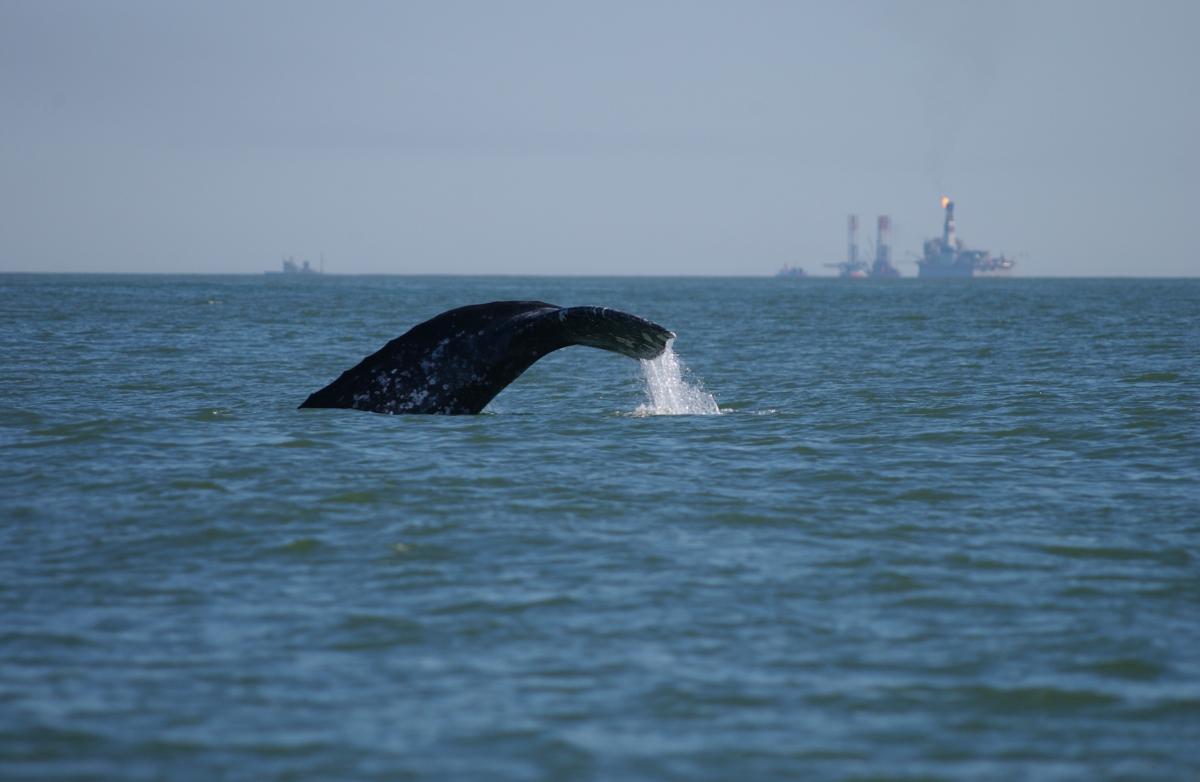
IUCN archive imagery from later Sakhalin whale-monitoring work is shown below for visual context; these photographs should not be taken as photographs of the June 2010 survey itself.

Why the survey was allowed to return
The postponement in 2009 had never been intended as a permanent ban.
The Panel’s concern was uncertainty.
By its April 2010 meeting, another season of monitoring data was available. The 2009 results suggested that overall whale abundance off Sakhalin was broadly similar to years before the unusually low observations of 2008, although significant questions remained about distribution in particular areas. WGWAP specifically noted low numbers in northern parts of the study area and an unexplained absence of sightings at two stations during September 2009. (IUCN Cetacean Specialist Group)
In other words, the scientists did not declare the biological questions solved.
They proceeded with a risk-management approach.
Sakhalin Energy would carry out the survey early in the season, before the main influx of whales, while operating under a monitoring system designed to identify animals and sound exposure in near-real time and interrupt the survey when necessary. (IUCN Cetacean Specialist Group)
That distinction is important.
The 2010 decision was not a scientific declaration that seismic noise presented no risk.
It was a decision that the survey could proceed subject to unusually stringent precautions.
The first defence was the calendar
One of the most important mitigation measures involved no sophisticated technology at all.
Start early.
Western Gray Whales migrate into their northeastern Sakhalin feeding grounds as the ice retreats. Whale numbers generally increase as the feeding season progresses.
The WGWAP strategy was therefore to complete the loudest industrial work while comparatively few whales were present.
At the April 2010 meeting, Sakhalin Energy said its contractors were working toward a nominal 10 June start, with the company then estimating that ice conditions would probably allow seismic acquisition between about 11 and 15 June. The contract reportedly included a significant incentive for the acquisition contractor to begin as early as possible. (IUCN Cetacean Specialist Group)
The ice was declared clear on 9 June.
But the seismic survey did not begin immediately.
The December WGWAP review records that operational problems delayed the start until 18 June. One problem was particularly awkward given the whole early-start strategy: streamers initially deployed for the operation were unsuitable for the cold conditions encountered.
The Panel considered at least some of those delays avoidable. (IUCN Cetacean Specialist Group)
That is a useful example of the difference between designing an environmental safeguard and implementing it.
The plan said start early.
The logistics lost valuable days.
A small discrepancy in the surviving record
There is a minor chronological discrepancy worth recording rather than concealing.
The contemporaneous WGWAP December 2010 report and the independent-observer record describe the operational survey as running from 18 June to 2 July 2010. (IUCN Cetacean Specialist Group)
Several later peer-reviewed papers describe the seismic period as beginning on 17 June and ending on 2 July. (ResearchGate)
The difference may reflect different definitions of the beginning of seismic activity or field operations.
No significance should be attached to the one-day discrepancy without further primary documentation.
For this archive file, the contemporaneous WGWAP operational chronology — 18 June to 2 July — is used when describing the formal survey period.
This was not simply a man with binoculars on the bridge
The Monitoring and Mitigation Plan was considerably more elaborate than conventional marine-mammal observation around a seismic vessel.
At least nine seabed acoustic receivers were to be positioned along the perimeter of the principal feeding area, spaced roughly 2.5 kilometres apart. They transmitted information used to assess sound levels while the seismic source was operating.
Additional acoustic receivers were to operate inside the feeding area.
Shore teams monitored whale distribution from established observation stations.
Separate behavioural teams observed movements and respiration.
A vessel-based team covered areas difficult to observe from shore.
Experienced Marine Mammal Observers were assigned to the seismic, scout and support vessels.
And radio communications linked the observers, acousticians and operational decision-makers.
The system was intended to combine several forms of information at once:
where the seismic vessel was;
where the whales were;
how much sound was reaching the feeding habitat;
how whales appeared to be behaving;
and whether an operational threshold had been reached.
WGWAP’s April report described the need to integrate acoustic measurements, visual sightings and behavioural observations in real time. (IUCN Cetacean Specialist Group)
One person had authority to stop the guns
The most important sentence in the entire Monitoring and Mitigation Plan may be the one concerning authority.
The plan assigned single-point operational shutdown authority to the on-shift Senior Marine Mammal Observer aboard the seismic vessel.
All vessels and the real-time acousticians were to have direct radio access to that observer.
That arrangement matters because environmental procedures can become meaningless if the observer who sees the problem must obtain multiple layers of management approval before industrial equipment is stopped.
Here, the documented structure was different.
The designated Senior MMO could initiate the shutdown.
The MMP required shutdown if a gray whale entered the defined exclusion radius and precautionary shutdown if an animal appeared to be heading into the shutdown zone.
The later operational review states that source-verification work confirmed a 1.5-kilometre exclusion radius to be conservative. (IUCN Cetacean Specialist Group)
There was also a behavioural-protection system
The plan went beyond protecting whales from close exposure capable of posing an auditory-injury risk.
It also attempted to limit disturbance to feeding animals farther away.
Different acoustic measures appear in the technical record and should not be casually conflated.
The plan classified especially sensitive survey lines according to predicted acoustic overlap with the feeding area. WGWAP records refer to a 156 dB sound-exposure-level criterion at the perimeter monitoring line for aspects of this classification, while the formal MMP also used a 163 dB RMS contour in defining the more restrictive “A-zone.” These are different acoustic metrics and should not be treated as interchangeable numbers. (IUCN Cetacean Specialist Group)
Later peer-reviewed description of the programme explains the operational concept more clearly: a behavioural protection zone was managed around a 156 dB per-pulse sound-exposure criterion, with real-time acoustic recorders and whale-position information being integrated so that the seismic source could be stopped when necessary. (JASCO Applied Sciences)
That system was unusually ambitious for its time.
It attempted not only to prevent an animal from getting dangerously close to an airgun array, but also to control sound reaching an ecologically important feeding habitat.
Fog and darkness could stop work too
Whales were not the only trigger.
Visibility mattered.
The MMP imposed special restrictions on the most sensitive survey lines.
Certain acquisition could not proceed at night or in poor visibility.
For other operations, a line had to have been checked under adequate visibility within the preceding six hours and no whales observed before seismic work could proceed under reduced visibility.
If whales had been seen during the pre-dusk scan, night operations were to stop.
This created a deliberate commercial cost.
Every hour of fog, darkness or whale standby could extend a survey that the scientists simultaneously wanted completed as early as possible.
The scheme therefore contained an inherent tension:
stop when protection requires it — but finish before more whales arrive.
WGWAP explicitly analysed that trade-off after the operation. (IUCN Cetacean Specialist Group)
Four mitigation shutdowns
The December 2010 WGWAP review provides the clearest contemporary numerical finding.
It says shutdown occurred on four occasions during the survey.
The broader monitoring and mitigation requirements added roughly four days to the survey duration, although most of that additional time was not simply four prolonged whale shutdowns; fog, darkness and other MMP-related standbys also contributed. (IUCN Cetacean Specialist Group)
Later peer-reviewed analysis provides the breakdown.
One shutdown occurred during ramp-up because a common minke whale was inside the exclusion zone.
Three other shutdowns occurred when gray whales were observed within the A-zone during acquisition of sensitive A-lines. (Inter-Research)
That distinction is worth preserving.
Shell’s subsequent public wording was broader.
Its official Sustainability Report 2010 states that, following advice from independent WGWAP scientists, seismic operations were shut down “several times” when whales were nearby. (Shell)
The WGWAP and later scientific record allows that statement to be made more precise:
four mitigation shutdowns are documented.
Shell put the shutdowns in its own sustainability report
This is one of the stronger authenticated Shell records in the whale archive.
Royal Dutch Shell plc’s Sustainability Report 2010 identified Shell’s Sakhalin II interest as 27.5 per cent and explicitly referred to the Western Gray Whale Advisory Panel.
The report said Shell and its partners continued working with experts to protect the endangered whales and acknowledged the shutdowns during the 2010 seismic operation. (Shell)
That corporate statement is important for a reason that goes beyond public relations.
Shell was not merely claiming that a protection plan existed.
It was recording that the plan had interrupted operations.
For documentary purposes, that is a much more meaningful proposition.
The independent observer was genuinely independent — but only saw part of the survey
The WGWAP process had also insisted upon an Independent Observer.
The April 2010 terms of reference explain why.
The observer was intended to evaluate the effectiveness of the monitoring system, identify problems during implementation and provide a degree of transparency and public confidence. (IUCN Cetacean Specialist Group)
Brendan Hurley was appointed.
The arrangement, however, had limitations.
Rather than being stationed aboard the seismic vessel, the observer was based at the shore command centre, where much of the acoustic, visual and operational information was being integrated.
And because of the mobilisation difficulties that delayed the survey, he was present for only five survey days. (IUCN Cetacean Specialist Group)
That limitation should not be buried.
He did not independently observe every day of the operation.
Nevertheless, his report was positive.
WGWAP records that he regarded the programme as exceptionally complex and thorough, judged the people implementing it to have worked seriously and professionally, and considered the approach capable of serving as a benchmark for seismic work near sensitive cetacean habitat.
The Seismic Survey Task Force broadly shared that assessment. (IUCN Cetacean Specialist Group)
The operation was not perfect
WGWAP did not treat successful completion as proof that nothing needed improvement.
Its post-survey review identified practical weaknesses.
Observer staffing had sometimes been inadequate for the long hours required.
Fog badly limited some post-survey monitoring.
Distance estimation remained a significant technical problem.
The Panel wanted better integration of vessel-position and whale-sighting data.
The independent observer’s deployment had been too short.
And the delay caused by equipment unsuitable for cold water was described as something that should not be repeated. (IUCN Cetacean Specialist Group)
This is one reason the WGWAP material is valuable.
It does not read like a corporate success brochure.
The same report that describes the programme as extraordinarily comprehensive also documents what went wrong.
The industrial objective was equally clear
There was no mystery about why Sakhalin Energy wanted the data.
The Astokh field had been producing oil for years.
A repeat 4-D seismic survey allows geoscientists to compare a new subsurface seismic image with earlier data and observe how reservoir conditions have changed as hydrocarbons are produced.
That information can improve placement of future wells and reservoir management.
At the Sakhalin Oil and Gas conference later in 2010, Sakhalin Energy’s chief executive described the Astokh programme as Russia’s first offshore 4-D seismic survey.
He openly recalled that the work had originally been scheduled for 2009, that WGWAP scientists recommended postponement and that Sakhalin Energy had delayed it for a year.
He also said preliminary seismic results were of high quality and were expected to help optimise existing and future wells. (Oreanda News)
The environmental safeguards therefore surrounded a commercially valuable operation.
That is precisely why the shutdown authority mattered.
Did the whales actually change their behaviour?
At the end of the 2010 field season, nobody could responsibly answer that question with finality.
WGWAP said large quantities of acoustic, distribution and behavioural data required detailed analysis.
The Panel specifically warned against drawing conclusions before that work had been completed. (IUCN Cetacean Specialist Group)
Over the following years, those data became the subject of peer-reviewed scientific studies.
One 2015 paper, authored by researchers from Shell Global Solutions and several scientific organisations, reported that no large changes in whale movement, respiration or distribution patterns had been observed during the survey and interpreted that result as consistent with the mitigation programme having reduced exposure and behavioural response. (Groningen Research Portal)
Another peer-reviewed analysis examined whether whales moved farther offshore in response to seismic sound. It found no statistically significant sound effect, but explicitly acknowledged important limitations, including relatively low sighting numbers, lack of prey-biomass data and sources of observational error that could not be fully incorporated into the model. (ResearchGate)
Those caveats matter.
The later scientific literature does not justify saying:
the survey had absolutely no effect on the whales.
It supports the narrower conclusion that the analyses did not identify large or statistically significant distributional and behavioural effects attributable to the survey under the conditions studied.
That is not the same as proving seismic surveys harmless
This distinction is fundamental.
The 2010 operation was deliberately engineered to reduce exposure.
It was conducted early.
The most sensitive lines had extra restrictions.
Whales were watched from land and sea.
Acoustic conditions were measured continuously.
The source was stopped when specified conditions occurred.
The resulting scientific papers then examined the whales under those mitigated conditions.
If major effects were not detected, that is evidence relevant to whether this mitigation programme worked.
It is not proof that an identical seismic survey without those precautions would have produced the same outcome.
Indeed, the whole purpose of the programme was based upon the opposite premise: uncontrolled sound exposure presented a risk worth actively reducing.
The English High Court record supplies context, not permission
The earlier British litigation remains part of the documentary chain.
In Export Credits Guarantee Department v Friends of the Earth [2008] EWHC 638 (Admin), Mr Justice Mitting dealt with the disclosure of UK government environmental information concerning proposed export-credit support for Sakhalin II.
The judgment records the scale of the proposed financing and the environmental significance attached to the Western Grey Whale issue.
The High Court dismissed ECGD’s appeal against disclosure. (vLex)
But that case did not assess the 2010 seismic operation.
It did not approve the MMP.
It did not establish an acoustic threshold.
It did not direct Sakhalin Energy to carry out or abandon any survey.
And it made no finding about the effects of the 2010 operation, which occurred more than two years later.
Its role in this file is historical context only.
The protection regime had a geographical weakness
There was another problem that the successful Sakhalin Energy survey could not solve.
Whales do not respect licence boundaries.
WGWAP’s formal relationship was with Sakhalin Energy.
Other oil and gas companies were operating in the same wider marine environment.
During the summer of 2010, while Sakhalin Energy was completing its carefully timed survey, scientists and governments were becoming increasingly concerned about seismic work planned by other operators later in the feeding season.
That distinction would soon become stark.
In June 2010, international concern focused on a Rosneft-related seismic programme expected to occur when substantially more whales, including mothers and calves, were present. Contemporary reporting described calls by International Whaling Commission scientists and several governments for postponement. (Phys.org)
WGWAP’s December report would later record disturbing acoustic evidence from that separate operation. (IUCN Cetacean Specialist Group)
The contrast exposed the structural limit of a voluntary advisory mechanism attached to one company.
Sakhalin Energy could agree to a shutdown rule.
It could not impose that rule upon its neighbours.
Documentary Findings
Established: Sakhalin Energy carried out the Astokh 4-D seismic survey in June–July 2010 after postponing the operation from 2009 on WGWAP advice. The contemporaneous WGWAP operational record dates the survey from 18 June to 2 July; some later scientific papers use 17 June as the start date. (IUCN Cetacean Specialist Group)
Established: The monitoring and mitigation programme had been developed through five WGWAP Seismic Survey Task Force meetings and five Panel reviews and incorporated acoustic, shore-based and vessel-based monitoring.
Established: Single-point operational shutdown authority was assigned to the on-shift Senior Marine Mammal Observer aboard the seismic vessel.
Established: The post-survey WGWAP review records four mitigation shutdowns. Later peer-reviewed analysis describes one involving a minke whale in the exclusion zone and three involving gray whales during sensitive A-line operations. (IUCN Cetacean Specialist Group)
Established: Shell’s own Sustainability Report 2010 states that seismic operations were shut down several times when whales were nearby and identifies Shell’s Sakhalin II interest as 27.5 per cent. (Shell)
Established with qualification: An independent observer was included to improve transparency and evaluate implementation, but because of survey mobilisation problems he was present for only five survey days. (IUCN Cetacean Specialist Group)
Later scientific finding: Peer-reviewed analyses did not identify large changes in movement, respiration or distribution attributable to the survey and one specific analysis found no statistically significant relationship between seismic sound and distance of whales from shore. The studies also documented methodological limitations. (Groningen Research Portal)
Not established: The absence of a detected large effect does not establish that the seismic survey produced literally no effect on any whale.
Not established: The 2010 findings do not establish that seismic surveys near whale feeding grounds are inherently harmless.
Not established: The English High Court authorised or evaluated the 2010 survey. It did neither.
Not established: The Independent Observer witnessed the entire operation. He did not.
Commentary
This is an unusual Shell Leaks File because the documentary evidence records an environmental-control mechanism doing something tangible.
The seismic operation stopped.
Not because a press officer said the company cared about whales.
Not because a sustainability report promised future mitigation.
Not because a consultant produced another environmental-management plan.
The guns stopped because the operational rules said they should.
That deserves recognition.
So does the history that produced those rules.
Sakhalin Energy did not invent the safeguards in isolation.
Years of environmental controversy, lender scrutiny, NGO pressure, scientific review and WGWAP negotiation had forced the whale question into the project’s engineering and operational systems.
The result was imperfect.
The seismic vessel started later than the scientists wanted.
Some equipment had been inappropriate for the cold conditions.
The independent observer saw only part of the survey.
Fog interfered with monitoring.
Distance estimation remained problematic.
And the later scientific analyses contained real uncertainties.
But the mechanism passed an important test:
it was capable of constraining the operation it existed to supervise.
That is a much stronger test than whether a company possesses an environmental policy.
There is another reason this file matters.
Shell’s own 2010 report confirms the shutdowns.
The company could have confined its discussion to the successful completion of Russia’s first offshore 4-D seismic programme.
Instead, its sustainability reporting acknowledged that whale protection had interrupted operations.
The scientific literature subsequently found no large or statistically significant behavioural or distributional effect attributable to the survey under the monitored conditions.
It would be tempting to turn that into a simple corporate vindication.
The documents do not justify doing so.
The more defensible conclusion is narrower and more interesting:
Sakhalin Energy conducted a potentially disturbing industrial operation under a unusually intensive mitigation regime; that regime altered operations in real time; and later analyses did not detect the large effects it had been designed to prevent.
That is evidence that the safeguards may have worked.
It is not evidence that the safeguards were unnecessary.
And almost as soon as Sakhalin Energy finished its carefully controlled survey, the limits of the entire arrangement became apparent.
Other seismic guns were preparing to fire.
Those companies were not necessarily playing by the same rules.
Source Record
The principal primary operational source is the Monitoring and Mitigation Plan for the 2010 Astokh 4-D Seismic Survey, preserved in the recovered IUCN Cetacean Specialist Group WGWAP archive. It documents the acoustic-monitoring system, shore and vessel observations, real-time communications, exclusion and protection zones and shutdown authority.
The WGWAP Report of the Eighth Meeting, 16–18 April 2010, documents final preparations, anticipated ice-related timing, contractor arrangements and the role and terms of reference of the Independent Observer. (IUCN Cetacean Specialist Group)
The WGWAP Report of the Ninth Meeting, December 2010, provides the principal contemporaneous post-operation review. It records the 18 June–2 July operational period, four shutdown occasions, approximately four days of MMP-related delay, the independent observer’s assessment and operational lessons learned. (IUCN Cetacean Specialist Group)
The authenticated Shell source is the Royal Dutch Shell plc Sustainability Report 2010, hosted in Shell’s official reporting archive. It identifies Shell’s 27.5 per cent project interest and states that seismic survey operations were shut down several times when whales were nearby. (Shell)
Contemporaneous corporate reporting is supplied by Sakhalin Energy’s 2010 conference statement, preserved by industry news services, in which the company described the 4-D survey as the first of its kind offshore Russia, recalled the 2009 WGWAP postponement and explained the reservoir-management purpose of the work. (Oreanda News)
The later peer-reviewed scientific record includes Bröker, Gailey, Muir and Racca, “Monitoring and impact mitigation during a 4D seismic survey near a population of gray whales off Sakhalin Island, Russia,” Endangered Species Research 28 (2015). The paper describes the behavioural-protection system and reports no large observed changes in whale movement, respiration or distribution during the survey. (JASCO Applied Sciences)
A separate 2015 peer-reviewed study of whale distance from shore found no statistically significant sound effect but documented limitations including low sighting numbers and unavailable prey-biomass information. (ResearchGate)
The judicial background remains Export Credits Guarantee Department v Friends of the Earth [2008] EWHC 638 (Admin). It is cited only to establish the earlier legal context surrounding public-finance scrutiny and environmental information. It made no ruling on the 2010 seismic operation. (vLex)
The surviving WGWAP documents are now preserved by the IUCN Species Survival Commission Cetacean Specialist Group after much of the original IUCN online archive was removed following Russia’s 2022 invasion of Ukraine. The recovered archive contains meeting reports, monitoring plans, task-force records and related scientific publications. (IUCN Cetacean Specialist Group)
Archive disclaimer: The successful completion of the 2010 Astokh survey and the absence of detected large behavioural or distributional effects do not establish that seismic noise presents no risk to Western Gray Whales. The findings relate to a particular survey conducted under a specific monitoring and mitigation regime. Company statements, independent scientific findings, later peer-reviewed interpretation and court records are distinguished according to source.
Site wide disclaimer also applies.
Next Archive File
SLF-2007-047 — The Sakhalin Papers XXXVII: The Survey They Could Not Control — Rosneft, Twelve Governments and the Seismic Guns in the Whale Feeding Season
Sakhalin Energy finished its Astokh survey on 2 July 2010.
The next confrontation was already developing.
Another seismic programme — associated with Rosneft’s Lebedenskoye area — was expected to take place later in the summer, when many more Western Gray Whales were present.
This time WGWAP did not have the same working relationship with the operator.
IUCN appealed to the Russian authorities.
International Whaling Commission scientists expressed alarm.
Britain helped coordinate an international approach.
Contemporary reporting said representatives of twelve governments urged Russia to postpone the work. (The Guardian)
The survey nevertheless proceeded.
When WGWAP examined acoustic recordings afterwards, the Panel reported sound levels above those known to disturb feeding gray whales and inferred that some portions of feeding habitat may have experienced substantially higher exposure. NGOs monitoring the activity also alleged that seismic acquisition had occurred at night contrary to the operator’s own mitigation provisions. WGWAP treated those claims as requiring further investigation rather than as proven regulatory offences. (IUCN Cetacean Specialist Group)
The contrast could hardly have been sharper.
One survey had four documented shutdowns under a jointly developed protection plan.
Another was taking place in the same marine ecosystem beyond WGWAP’s direct operational control.
SLF-2007-047 will examine the letters to Moscow, the international diplomatic intervention, the acoustic evidence and the uncomfortable question exposed by the summer of 2010: what use is an exemplary whale-protection regime if the whales swim into the noise of somebody else’s survey?
*This website and sisters royaldutchshellgroup.com, shellnazihistory.com, royaldutchshell.website, johndonovan.website, shellnews.net, and shellwikipedia.com, are owned by John Donovan - more information here. There is also a Wikipedia segment, the Shell DPA Files, "Shell and the Spies", the Shell Leaks files, the Independent Shell Archive, as well as books written and published by John Donovan - Kindle eBooks. Timeline of the Donovan Shell Feud. Toxic History of Royal Dutch Shell Group. Shell and the Donovans: The Full Media Record — 550+ Articles, 110 Books, 40 Years. *All conjured up by internet wizz, Nick Gill.







