THE SHELL LEAKS FILES: 7 SEPTEMBER 2026
SLF-2007-050
The Sakhalin Papers XL: The Blue Location — PA-C Moves Offshore, but a Safer Site Is Not a Green Light
Sakhalin Energy’s 2012 South Piltun survey produced exactly the sort of result that independent environmental engagement was supposed to achieve. The work finished earlier than the whale scientists’ deadline. No Health, Safety and Environment incident was reported. The feared shallow-gas problem beneath an alternative platform site was not confirmed. And the proposed PA-C location moved farther offshore — away from the Western Gray Whale feeding area and closer to existing pipelines. But the Western Gray Whale Advisory Panel did not treat those improvements as approval of the third platform. Before any irreversible decision, it wanted a full assessment of critical habitat and cumulative impacts. The survey had made PA-C easier to locate. It had not answered whether PA-C should be built.
Archive reference: SLF-2007-050
Collection: The Sakhalin Papers
Principal primary record: Western Gray Whale Advisory Panel, Report of the Twelfth Meeting, Geneva, 5–7 November 2012
Supporting scientific record: WGWAP Noise Task Force and Western Gray Whale research programme material
Authenticated Shell records: Royal Dutch Shell plc Annual Report and Form 20-F 2012; Royal Dutch Shell plc Sustainability Report 2012
Contemporaneous reporting: AFP/WWF, February 2012
Court record: Export Credits Guarantee Department v Friends of the Earth [2008] EWHC 638 (Admin), used solely for the earlier Sakhalin II financing and environmental-disclosure context
Evidence standard: Statements made by Sakhalin Energy to WGWAP are reported as company representations. WGWAP conclusions are identified as independent scientific advice. “No HSE incident” is not treated as proof that the survey produced no biological response. The “blue location” remained a proposed platform site; PA-C had not received a final investment decision.
Introduction
By November 2012, the argument over Sakhalin Energy’s proposed third offshore platform had changed.
For almost two years the question had been largely theoretical.
Would another platform be necessary?
Could South Piltun hydrocarbons be recovered from PA-A or PA-B instead?
Could subsea equipment be used?
Could drilling technology reach far enough?
Would another structure impose unacceptable additional pressure on Western Gray Whales?
Then Sakhalin Energy surveyed the seabed.
The result narrowed the uncertainty.
According to the company’s presentation recorded in the Twelfth WGWAP Report, the site survey confirmed that an alternative location — previously identified to the Panel simply as the “blue location” — was technically suitable. It lay farther offshore than the site previously favoured, farther from the Piltun whale feeding area and closer to existing pipelines. Earlier concern about shallow gas beneath it was not substantiated. (IUCN Cetacean Specialist Group)
There was still shallow faulting.
That caused the proposed position to be adjusted by approximately 300 metres to the south-east. (IUCN Cetacean Specialist Group)
This was environmental mitigation with a measurable physical consequence.
The proposed platform had moved.
But the project itself had not yet been approved.
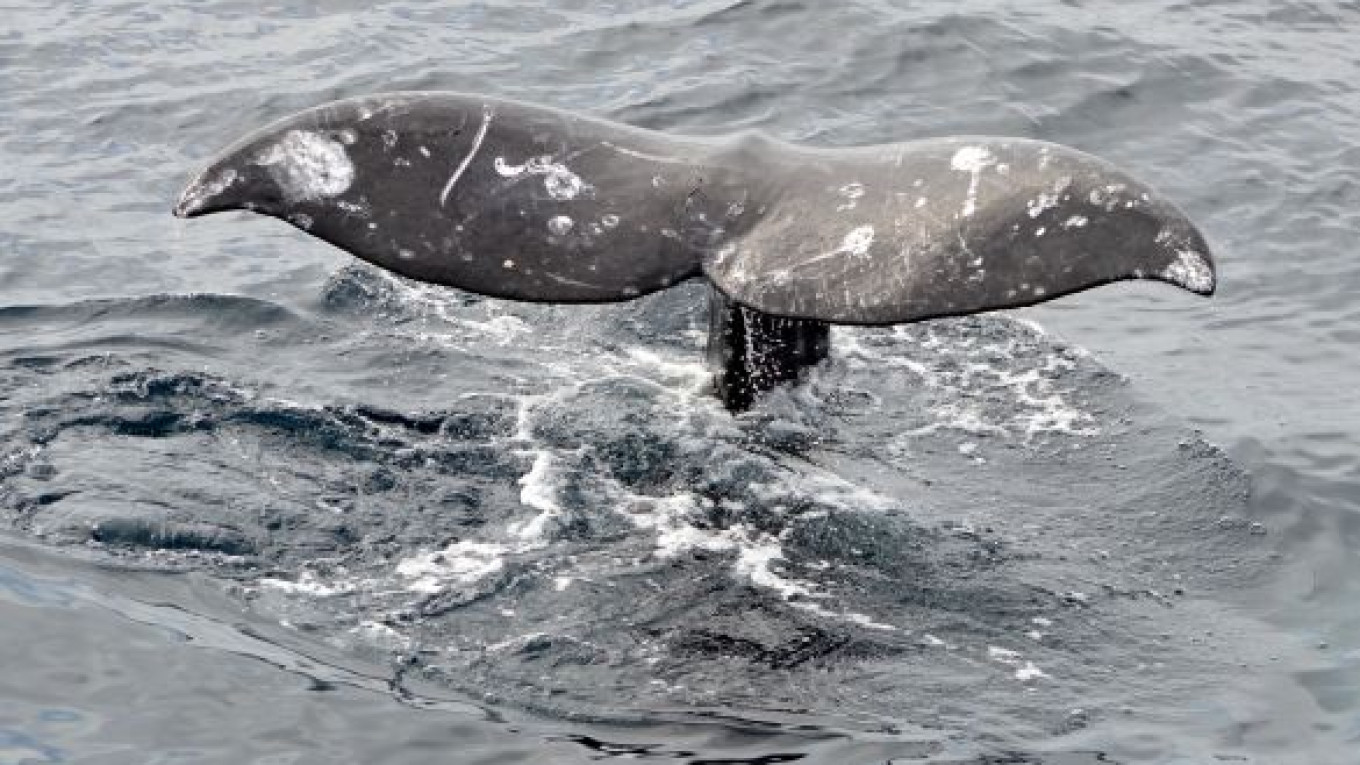
Visual context only: the existing PA-B installation and a Western Gray Whale. PA-C remained a proposal during the period examined here.

1. The scientists got the early finish they had wanted
The most important mitigation measure for the 2012 seismic work had always been timing.
Western Gray Whales arrive progressively at their Sakhalin feeding grounds during the open-water season.
WGWAP therefore wanted the seismic component completed as early as possible and, in any event, before 15 July.
Sakhalin Energy did better than that.
The WGWAP Noise Task Force recorded that the seismic survey was completed by 8 July 2012 and said it was especially pleased with the early finish. (IUCN Cetacean Specialist Group)
That matters.
The Panel had repeatedly argued that seasonal timing was not merely an administrative preference but one of the most effective means of reducing whale exposure.
A survey completed on 8 July occurred before the higher whale numbers expected later in the feeding season.
The subsequent geotechnical work continued for longer, but Sakhalin Energy reported that those operations were completed before the onset of the storm season at the end of September. (IUCN Cetacean Specialist Group)
2. Sakhalin Energy reported no HSE incident
The company told WGWAP that the 2012 programme had been completed without any Health, Safety and Environment incidents.
The work included high-resolution and ultra-high-resolution seismic surveying, analogue seabed surveys and geotechnical operations. (IUCN Cetacean Specialist Group)
That is an established company-reported operational outcome.
But it must not be translated into a scientific claim the documents do not make.
“No HSE incident” does not mean:
no whale heard the survey;
no whale altered its behaviour;
no acoustic exposure occurred;
or no biological effect was possible.
Indeed, WGWAP’s next action demonstrates the opposite caution.
The scientists wanted the monitoring data analysed.
3. Seventy-two scans and thirty-four whale tracks still had to be examined
During the 2-D survey, behavioural observers obtained 72 scans and 34 tracks, together with a number of focal observations collected before, during and after seismic activity.
WGWAP recommended formal analysis of those observations to determine whether they were sufficient to reveal relationships between received sound levels and gray-whale behaviour. (IUCN Cetacean Specialist Group)
The proposed analysis was detailed.
The scientists wanted whale locations plotted geographically.
They wanted pre-, during- and post-seismic distributions compared.
They wanted movement tracks examined against estimated received sound energy.
They wanted whale numbers considered against recent cumulative acoustic exposure.
The reason was stated plainly in the technical discussion: knowledge of gray-whale responses to noise remained limited. (IUCN Cetacean Specialist Group)
So the correct documentary conclusion is not:
the survey caused no effect.
It is:
the survey was completed under the agreed mitigation regime, and WGWAP then sought analysis capable of detecting whether behavioural effects had occurred.
4. The scientists were also worried about noise that was not coming from the airguns
The airgun array was not the only acoustic source under scrutiny.
WGWAP recommended additional analysis of non-airgun low-frequency geoacoustic equipment used during the South Piltun work.
The purpose was to determine whether such sources might possess acoustic characteristics — including sound level and frequency spectrum — sufficiently similar to airguns to produce similar impacts. (IUCN Cetacean Specialist Group)
This is a small but revealing point.
Environmental assessments can become dominated by the most obvious source of disturbance.
For seismic surveys that normally means the airgun array.
WGWAP was asking whether other survey equipment had escaped equivalent attention.
Again, the record shows an advisory process still learning from the operation after it had finished.
5. Then came the result that changed the geography of PA-C
The site-survey data were interpreted in what Sakhalin Energy described as “real time.”
The result was consequential.
The “blue location” was confirmed as suitable.
It was farther offshore than the previously preferred site.
It was therefore farther from the Piltun feeding ground.
It was also nearer existing pipeline infrastructure.
And the suspected shallow-gas problem had not materialised. (IUCN Cetacean Specialist Group)
That is one of the clearest examples in the Sakhalin archive of environmental and engineering interests pointing in the same direction.
Moving offshore potentially reduced proximity to the whales.
Moving closer to existing pipelines potentially reduced some infrastructure requirements.
Resolving the shallow-gas uncertainty removed an engineering concern.
The same location could therefore be preferable for both environmental and commercial reasons.
6. But shallow faulting prevented the survey from producing a perfect answer
The blue location was not accepted completely unchanged.
The survey identified shallow faulting.
Sakhalin Energy therefore moved the proposed position by about 300 metres south-east. (IUCN Cetacean Specialist Group)
That detail is useful because it shows what “site selection” actually meant.
PA-C was not simply being moved farther offshore because someone had drawn a new dot on a presentation slide.
Seismic, seabed and geotechnical information was being used to refine an engineering position measured in hundreds of metres.
The project was becoming more specific.
And specificity matters in major-project development.
Every resolved geological uncertainty makes cost estimates, engineering designs and environmental predictions more concrete.
7. PA-C nevertheless remained in the “select” phase
Sakhalin Energy was careful about the status of the development.
The WGWAP report states that the South Piltun team remained in the “select” phase.
No decision had yet been taken concerning the project’s size, scope or feasibility. (IUCN Cetacean Specialist Group)
But the commercial picture was beginning to sharpen.
The company said its emerging assessment of costs and hydrocarbon volumes supported an integrated oil-and-gas development.
If that reasoning survived further review, a platform with full processing facilities appeared likely.
Timing would depend partly upon available capacity — “ullage” — elsewhere in the production system and upon commercial arrangements with customers. (IUCN Cetacean Specialist Group)
That is a significant progression from the earliest PA-C discussions.
The question was no longer merely whether a third steel structure could physically stand off Piltun Lagoon.
Sakhalin Energy was modelling how another integrated production facility would fit into the economics and infrastructure of Sakhalin II.
8. An appraisal well was still under consideration
One major uncertainty remained underground.
Sakhalin Energy was considering drilling an appraisal well in summer 2014.
The company said this might reduce what it described as large subsurface uncertainties and improve understanding of the field, although significant uncertainty could remain even after appraisal. (IUCN Cetacean Specialist Group)
The decision was not described as purely geological.
The WGWAP record says the company intended to evaluate technical, economic, commercial, organisational and political factors.
A jack-up drilling rig would have to be brought into the area by tugs.
One or two wells might be drilled.
A reservoir core might be taken.
A production test could last several days. (IUCN Cetacean Specialist Group)
That would create another potential period of industrial activity near the feeding grounds.
Sakhalin Energy assured the Panel that IUCN would be notified once a decision was taken and that WGWAP would have an opportunity to comment on monitoring and mitigation. (IUCN Cetacean Specialist Group)
9. The shareholders were about to meet
The November 2012 WGWAP meeting occurred immediately before another important corporate decision point.
Sakhalin Energy said a shareholder engagement meeting would take place later that month.
Three questions were to be addressed:
the preferred development concept;
whether an appraisal well should be drilled;
and the pace and schedule of the project. (IUCN Cetacean Specialist Group)
The company expressly told observers that this would not be the final investment decision on PA-C.
It also clarified an important point concerning the Production Sharing Agreement.
The PSA did not require Sakhalin Energy to construct another platform.
According to the company’s explanation, it required effective recovery of hydrocarbons from the licensed area using available technology. (IUCN Cetacean Specialist Group)
That qualification matters.
Earlier discussion of PA-C sometimes created the impression that another platform followed automatically from contractual obligations to Russia.
The WGWAP record says otherwise.
Hydrocarbon recovery was the obligation.
PA-C was one possible engineering response.
10. WGWAP accepted that no irreversible decision had yet been taken
The Panel recorded Sakhalin Energy’s assurance that no final decision had been made concerning whether, how or whena South Piltun platform would be constructed.
Nor had a precise platform design or construction method been fixed. (IUCN Cetacean Specialist Group)
WGWAP accepted that assurance.
But it attached a condition to its acceptance.
Before any irreversible decisions, the Panel expected an in-depth assessment of potential impacts on gray whales, expressly including critical habitat and cumulative impacts.
The Panel tied that expectation to the 2012 IFC Performance Standards, particularly Performance Standards 1 and 6. (IUCN Cetacean Specialist Group)
This is an important progression in the documentary trail.
Earlier WGWAP recommendations had warned against piecemeal assessment.
Now the company had told the scientists that it had adopted the newer World Bank/International Finance Corporation standards.
The Panel intended to use that framework.
11. Sakhalin Energy said it had voluntarily adopted the new IFC standards
Company representative Ian Evans told WGWAP that Sakhalin Energy had fully adopted the 2012 World Bank/IFC Standards.
A lender representative explained that the newer standards underpinned commercial-bank standards and were aligned with the Equator Principles.
The record states that Sakhalin Energy had voluntarily agreed to implement the newer version of the standards, with Performance Standard 1 and Performance Standard 6 particularly relevant to South Piltun. (IUCN Cetacean Specialist Group)
Performance Standard 1 concerns assessment and management of environmental and social risks.
Performance Standard 6 concerns biodiversity conservation and sustainable management of living natural resources.
For WGWAP, the practical point was straightforward.
The cumulative impact assessment had to happen before, not after, the development decision.
The Panel later emphasised precisely that point: cumulative-impact work for South Piltun needed to feed into the relevant decision-making process rather than become an exercise conducted after the fact. (IUCN Cetacean Specialist Group)
12. The wider Sakhalin shelf made a platform-only assessment increasingly artificial
WGWAP was not looking only at Sakhalin Energy.
Its November report again reviewed industrial activity throughout the northeastern shelf.
Sakhalin I.
Sakhalin II.
Sakhalin III.
Sakhalin V.
Berkut construction.
Existing vessel traffic.
Future seismic programmes.
Operations near the Piltun and offshore feeding areas.
The Panel stated that cumulative assessment had to incorporate activity by other companies, not just Sakhalin Energy. (IUCN Cetacean Specialist Group)
This was a direct continuation of the problem exposed in 2010.
A whale does not distinguish a Sakhalin Energy sound source from a Rosneft or Exxon Neftegas sound source.
The cumulative acoustic environment belongs to the animal.
Corporate ownership boundaries belong to humans.
13. Another substantial seismic programme was already on the horizon
Even while WGWAP was discussing PA-C, Sakhalin Energy was warning it about future 3-D/4-D seismic acquisition.
The company anticipated further seismic surveys over Piltun-Astokh and Lunskoye in approximately 2014–2016, with repeat surveys potentially every three to four years thereafter to monitor hydrocarbon and water movement.
The prospective Piltun-Astokh survey area could reach 750 square kilometres. (IUCN Cetacean Specialist Group)
Sakhalin Energy said future sources were likely to be comparable with those used during the much larger 2010 survey.
The company also recognised a practical problem: with equipment similar to that used in 2010, completing such a survey before mid-July might be difficult.
WGWAP therefore wanted planning to begin early, using experience from both the 2010 and 2012 operations. (IUCN Cetacean Specialist Group)
The industrial footprint was not approaching a fixed end state.
It was becoming cyclical.
Production itself required repeated imaging of the reservoir.
14. Shell’s own filing shows how commercially important Sakhalin II had become
Royal Dutch Shell’s Annual Report and Form 20-F for 2012 provides the authenticated corporate context.
Shell recorded a 27.5% interest in Sakhalin-2.
It described the project as one of the world’s largest integrated oil-and-gas developments.
In 2012, Sakhalin II produced approximately 335,000 barrels of oil equivalent per day, while output from the two LNG trains exceeded 10 million tonnes. (Annual Reports)
This was therefore not a peripheral Shell investment receiving disproportionate environmental attention.
Sakhalin II was already a major producing hydrocarbon system.
PA-C concerned the possibility of extracting still more resource from within that system.
15. Shell’s Sustainability Report stated the corporate principle WGWAP was trying to enforce
Royal Dutch Shell plc’s Sustainability Report 2012 provides another useful corporate benchmark.
Shell said that when planning a major project or an expansion of an existing facility, it conducts an environmental impact assessment and considers effects on local biodiversity.
The report also highlighted Shell’s partnership with IUCN as one means by which the company developed biodiversity-management approaches. (Shell Thailand)
That is broadly consistent with what WGWAP was demanding at South Piltun.
But the Panel’s concern went one step further.
It was not enough merely to perform an EIA.
The information had to arrive while decisions were still reversible.
And cumulative impacts had to include activity beyond the boundaries of the Shell-linked project.
The distinction is subtle but important.
A technically excellent environmental assessment delivered after the preferred project concept is effectively locked in has much less power than one delivered while alternatives remain commercially possible.
16. The campaigners had wanted the banks to stop PA-C before the survey ever reached this point
Only nine months earlier, WWF had publicly asked BNP Paribas, Credit Suisse and Standard Chartered to oppose the proposed third platform.
AFP reported WWF’s claim that PA-C would be dangerously close to the principal feeding area and its warning that the small Western Gray Whale population remained highly vulnerable. (Phys.org)
Those were campaigning positions.
They were not WGWAP findings.
Nor did the evidence establish that the banks possessed a unilateral legal veto over PA-C.
But the campaign is worth remembering when examining the blue location.
By November, Sakhalin Energy had identified a platform site farther away from the feeding ground.
The documentary material establishes the movement of the site.
It does not establish that WWF’s lender campaign caused that change.
Engineering, shallow-gas risk, pipeline proximity and environmental considerations were all part of the site-selection process.
Attribution beyond that would be speculation.
17. The old High Court judgment still supplied an uncomfortable historical backdrop
The British judicial record had already established how long the whale issue had shadowed Sakhalin II.
In Export Credits Guarantee Department v Friends of the Earth [2008] EWHC 638 (Admin), Mr Justice Mitting recorded that approximately $650 million of UK-backed project finance had been sought for the project and described its potential impact on Western Grey Whale habitat and feeding grounds as potentially great.
The financing application was withdrawn on 29 February 2008, before the ECGD made a final decision. (vLex)
The language of that judgment is unusually stark because it records the conservation concerns then before the British authorities.
But its legal relevance to PA-C is limited.
The judgment predated South Piltun.
It did not adjudicate the blue location.
It did not determine whether a third platform could lawfully be constructed.
It did not approve or reject Sakhalin Energy’s 2012 survey.
Its significance here is historical.
Four years after the British courts had recorded the whale issue as part of the project’s international environmental controversy, the same habitat remained central to the next phase of Sakhalin development.
Documentary Findings
Established
Sakhalin Energy successfully completed the South Piltun platform site survey and associated relief-well surveys during 2012. The work involved high-resolution and ultra-high-resolution seismic surveying, seabed survey operations and geotechnical investigation. The company reported no Health, Safety and Environment incident. (IUCN Cetacean Specialist Group)
The seismic component was completed by 8 July 2012, earlier than WGWAP’s outer target of 15 July. WGWAP expressly welcomed the early completion. (IUCN Cetacean Specialist Group)
Behavioural monitoring produced 72 scans and 34 whale tracks plus focal observations. WGWAP recommended further analysis to investigate possible relationships between sound exposure and whale behaviour. (IUCN Cetacean Specialist Group)
The survey confirmed the suitability of the “blue location.” That proposed site was farther offshore, farther from the Piltun feeding area and closer to existing pipelines than the previously preferred location. Earlier shallow-gas concerns were not substantiated. Shallow faulting led to an additional approximately 300-metre south-easterly adjustment. (IUCN Cetacean Specialist Group)
Sakhalin Energy remained in the project “select” phase. No decision had been taken about the project’s final size, scope or feasibility. The company’s emerging commercial assessment favoured an integrated oil-and-gas development. (IUCN Cetacean Specialist Group)
A 2014 appraisal well remained under consideration at the November WGWAP meeting, and shareholders were due to discuss the preferred development concept, appraisal drilling and project pace later that month. That shareholder meeting was explicitly not described as a final investment decision. (IUCN Cetacean Specialist Group)
WGWAP accepted Sakhalin Energy’s assurance that no irreversible PA-C decision had yet been made, but expected an in-depth assessment of effects on gray whales, including critical habitat and cumulative impacts, before such a decision. (IUCN Cetacean Specialist Group)
Sakhalin Energy stated that it had voluntarily adopted the 2012 World Bank/IFC Performance Standards. WGWAP viewed the cumulative-impact requirements of that framework as especially relevant to South Piltun. (IUCN Cetacean Specialist Group)
Royal Dutch Shell’s 2012 Annual Report recorded its 27.5% interest in Sakhalin II, approximately 335,000 boe/d of project production in 2012 and more than 10 million tonnes of LNG output from the two trains. (Annual Reports)
Sakhalin Energy’s Position
Sakhalin Energy’s position was that the survey had successfully reduced uncertainty surrounding the South Piltun development.
The blue location offered advantages over the earlier preferred site.
The company was still determining the optimum development concept and had not taken a final investment decision.
It considered itself obliged under the Production Sharing Agreement to recover commercially viable hydrocarbons effectively, but told WGWAP that the PSA did not specifically require construction of another platform. (IUCN Cetacean Specialist Group)
The emerging engineering and commercial case favoured an integrated oil-and-gas development, subject to further technical work, market conditions and shareholder decisions.
WGWAP’s Position
WGWAP welcomed the successful implementation of the 2012 survey mitigation programme and particularly its early completion.
It did not convert that operational success into endorsement of PA-C.
The Panel wanted behavioural and acoustic data analysed.
It wanted cumulative impacts considered across the activities of multiple Sakhalin operators.
And it expected critical-habitat and cumulative-impact assessment to influence decision-making before irreversible commitments were made. (IUCN Cetacean Specialist Group)
Campaigners’ Position
WWF opposed the proposed third platform more categorically and had called upon European project lenders to intervene before the development advanced further. Contemporary AFP reporting recorded WWF’s warnings about proximity to whale feeding habitat and the vulnerability of the population. (Phys.org)
Those statements were advocacy positions.
They do not establish that PA-C would inevitably cause population-level harm.
Not Established
It is not established that PA-C had received final investment approval by November 2012.
It is not established that construction had commenced.
It is not established that the blue location eliminated all environmental risk.
It is not established that completion of the site survey without a reported HSE incident means no whale experienced an acoustic or behavioural effect.
It is not established that WWF’s campaign caused the platform location to move.
It is not established that WGWAP endorsed PA-C because it assisted with survey mitigation; the Panel had explicitly rejected that interpretation.
It is not established that the Production Sharing Agreement required Sakhalin Energy to construct a third platform.
And the 2008 English High Court judgment did not determine any issue concerning PA-C or the 2012 site-selection process.
Commentary
The blue location is one of the most revealing episodes in the entire Sakhalin documentary record because almost everyone can point to it as evidence supporting a different conclusion.
Sakhalin Energy could say:
the environmental process worked.
The company consulted independent scientists.
It completed its seismic survey early.
It identified a location farther from the feeding ground.
It moved still farther because of geological information.
It adopted new IFC standards.
And it had not yet taken an irreversible investment decision.
Those are legitimate points.
WGWAP could say:
independent engagement produced a better outcome than disengagement.
Its recommendations affected timing.
Its scientists scrutinised the survey design.
The resulting site moved away from critical habitat.
And the Panel retained the freedom to say that none of this constituted approval of the development itself.
That too is supported by the record.
WWF could say:
the problem remained a third platform that had never formed part of the earlier two-platform development assumption.
Moving it farther offshore reduced one risk.
It did not eliminate construction noise, vessel traffic, spill risk, repeated seismic surveys or the cumulative industrialisation of the whale feeding range.
That argument also remained alive.
This is precisely why the documentary approach matters.
There is no need to manufacture villains or heroes.
The evidence is more instructive.
The 2012 survey appears to have been an example of mitigation achieving something tangible.
The proposed platform moved farther from the whales.
That should not be minimised.
But it would be equally wrong to confuse a better location with an environmentally approved project.
The survey solved a site-selection problem.
It did not solve the cumulative-impact problem.
In fact, by removing shallow-gas uncertainty, the survey simultaneously did two things.
It made PA-C potentially less damaging geographically.
And it made PA-C more technically credible.
That dual effect lies at the heart of WGWAP’s uneasy relationship with industrial development.
Successful mitigation can restrain a project.
Successful mitigation can also enable a project.
The difference depends upon what happens at the next decision gate.
And that gate was now approaching.
Later in November 2012, Sakhalin Energy’s shareholders were due to consider the preferred development concept.
They were not being asked for final investment approval.
But they were being asked to decide what kind of PA-C they wanted, how quickly they wanted it and whether another expensive appraisal well was necessary.
The scientists had moved the conversation from:
where could the platform go?
to:
what happens if the shareholders decide to proceed?
The answer, when it came, would introduce another revealing phrase into the Sakhalin record.
“Just in time.”
Source Record
The principal primary record is the Western Gray Whale Advisory Panel Report of the Twelfth Meeting, 5–7 November 2012. The recovered report is preserved by the IUCN SSC Cetacean Specialist Group, whose archive explains that the WGWAP operated as a 17-year independent scientific oversight programme advising on threats and mitigation associated with Sakhalin offshore development. (IUCN Cetacean Specialist Group)
WGWAP Report of the Twelfth Meeting — November 2012
The report documents completion of the survey by 8 July, WGWAP’s request for further behavioural analysis, the “blue location,” the absence of substantiated shallow gas there, the 300-metre site adjustment, the continuing select phase, possible appraisal drilling, the forthcoming shareholder meeting and WGWAP’s expectation that critical-habitat and cumulative-impact assessments precede irreversible decisions. (IUCN Cetacean Specialist Group)
Royal Dutch Shell plc’s authenticated Annual Report and Form 20-F 2012 confirms Shell’s 27.5% Sakhalin II interest and the commercial scale of the project — approximately 335,000 boe/d production in 2012 and more than 10 million tonnes of LNG output. (Annual Reports)
Royal Dutch Shell plc’s authenticated Sustainability Report 2012, retained in Shell’s reporting archive, states Shell’s general approach to environmental impact assessment for major projects and expansions and its policy of considering local biodiversity. The report also records Shell’s environmental partnership with IUCN. (Shell Thailand)
Royal Dutch Shell plc Sustainability Report 2012
Contemporaneous AFP reporting of 9 February 2012 records WWF’s campaign urging BNP Paribas, Credit Suisse and Standard Chartered to oppose the proposed additional platform. Those claims are included as the contemporary campaign record, not as scientific or judicial findings. (Phys.org)
The judicial background remains Export Credits Guarantee Department v Friends of the Earth [2008] EWHC 638 (Admin), judgment of Mr Justice Mitting dated 17 March 2008. The judgment records both the earlier request for approximately $650 million of UK-backed project finance and the environmental concern regarding Western Grey Whale habitat. The financing application had been withdrawn on 29 February 2008. The case did not concern PA-C. (vLex)
Export Credits Guarantee Department v Friends of the Earth — [2008] EWHC 638 (Admin)
Archive disclaimer: “No HSE incident” is reproduced as Sakhalin Energy’s operational report and is not interpreted as proof of zero biological effect. The blue location remained a proposed site. WGWAP’s involvement in mitigation did not constitute approval of PA-C. References to future development, appraisal drilling and commercial schedules reflect the status of planning at the dates documented and should not be read as evidence that those plans were ultimately executed.
Site wide disclaimer also applies.
Next Archive File
SLF-2007-051 — The Sakhalin Papers XLI: “Just in Time” — The Shareholders Back a PA-C Concept, but Still Refuse to Take the Final Investment Decision
The shareholder meeting took place.
And something changed.
By the time WGWAP reconvened in May 2013, Sakhalin Energy reported that its shareholders had endorsed a “just-in-time” platform concept for South Piltun toward the end of 2012.
Construction timing would be linked to the expected decline of production from Lunskoye.
The concept contemplated an integrated oil-and-gas facility tied into existing infrastructure.
A hypothetical 2017 final investment decision could put non-associated gas on stream in 2022, with oil infill drilling later.
There was also an accelerated option.
But the shareholders made another decision.
The proposed 2014 appraisal well would not be drilled.
And despite endorsing a platform concept, they still had not taken the final investment decision to build PA-C. (IUCN Cetacean Specialist Group)
The project had therefore entered a peculiar intermediate state.
The site had been investigated.
The preferred location had been improved.
The development concept had shareholder backing.
The appraisal well had been dropped.
Yet PA-C itself remained unsanctioned.
Meanwhile another issue was emerging.
Sakhalin Energy was already planning a major Piltun-Astokh 3-D/4-D seismic programme for 2015, with repeat surveys potentially every three years.
WGWAP wanted to know why such frequent airgun surveys were necessary — and whether alternatives existed. (IUCN Cetacean Specialist Group)
SLF-2007-051 will examine the shareholders’ “just-in-time” decision, the cancellation of the appraisal well, the increasingly marginal economics of South Piltun and the moment PA-C changed from an immediate expansion threat into a project waiting for the commercial clock to tell it when — or whether — to proceed.
*This website and sisters royaldutchshellgroup.com, shellnazihistory.com, royaldutchshell.website, johndonovan.website, shellnews.net, and shellwikipedia.com, are owned by John Donovan - more information here. There is also a Wikipedia segment, the Shell DPA Files, "Shell and the Spies", the Shell Leaks files, the Independent Shell Archive, as well as books written and published by John Donovan - Kindle eBooks. Timeline of the Donovan Shell Feud. Toxic History of Royal Dutch Shell Group. Shell and the Donovans: The Full Media Record — 550+ Articles, 110 Books, 40 Years. *All conjured up by internet wizz, Nick Gill.