 Shell doubles down on Canada: LNG Canada Phase 2 turns Kitimat into a 28-million-tonne export hub
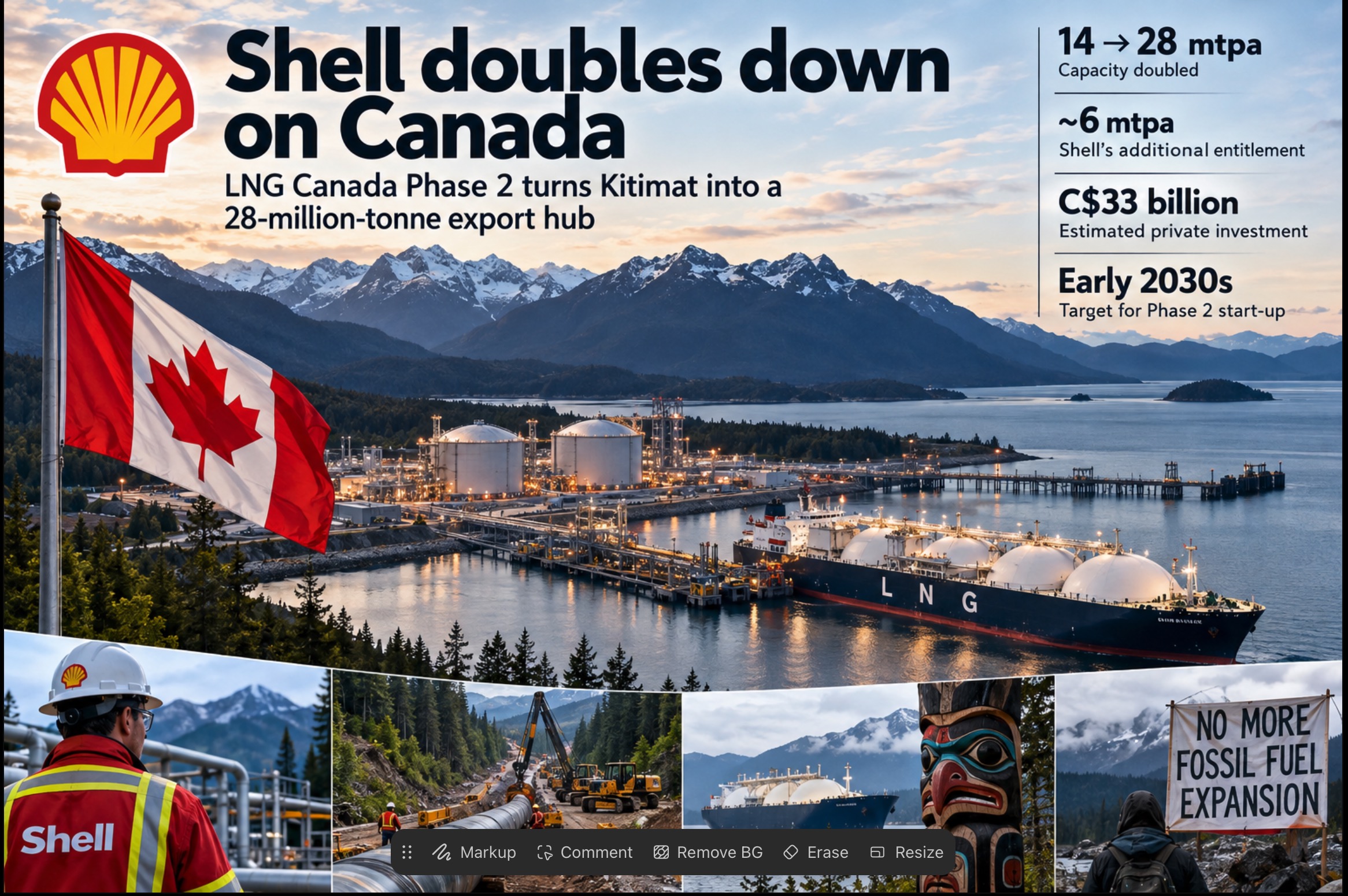
Shell has taken the final investment decision on LNG Canada Phase 2, committing with its partners to double the capacity of the Kitimat, British Columbia, export terminal from 14 million to 28 million tonnes of LNG a year. The decision substantially deepens Shell’s exposure to Canadian natural gas only weeks after it completed its acquisition of ARC Resources, adding roughly 370,000 barrels of oil equivalent a day of Canadian production. Shell Canada
For Shell, this is not a peripheral investment. The company owns 40% of LNG Canada, alongside PETRONAS with 25%, PetroChina 15%, Mitsubishi 15% and KOGAS 5%. Phase 2 will add two further liquefaction trains, an additional LNG storage tank, condensate storage, another loading berth and expanded utilities. The 670-kilometre Coastal GasLink pipeline will also be expanded through five new compressor stations. Commercial operations are expected in the early 2030s. Shell Canada
Shell says its additional entitlement from Phase 2 will be close to 6 million tonnes of LNG annually, and that the investment should produce returns above the hurdle rate for its Integrated Gas business. Its strategic rationale is straightforward: connect abundant western Canadian gas with Shell’s global LNG trading system and growing Asian demand. Shell’s own 2026 LNG outlook forecasts global demand rising from 422 million tonnes in 2025 to nearly 700 million tonnes by 2050. Shell Canada
Canada has made the project a national priority
The decision also reflects a major change in Canadian energy policy.
Prime Minister Mark Carney’s government has identified LNG Canada Phase 2 as a project of national significance and has been working with British Columbia to accelerate major energy and trade infrastructure. Ottawa’s Major Projects Office says the expansion could attract around C$33 billion in private-sector capital, create thousands of jobs and help diversify Canadian energy exports beyond the United States. Canada
In May, the federal government, British Columbia and LNG Canada announced an “enhanced investment co-operation” arrangement intended to clear remaining commercial, regulatory, First Nations and infrastructure issues ahead of a possible final investment decision. The federal statement said Phase 2 could help make Canada a top-five LNG-exporting country. Canada
The Wall Street Journal places Shell’s decision squarely within that broader policy shift, describing the expansion as supportive of Carney’s ambition to make Canada a larger global energy supplier while streamlining project development and encouraging investment. The Wall Street Journal
That is government and press interpretation. It should not be confused with Shell’s own investment rationale, which centres on LNG demand, portfolio integration and returns.
A much larger Canadian gas position
The timing becomes more interesting when LNG Canada is viewed alongside Shell’s recent acquisition of ARC Resources.
Shell completed that transaction on 2 September 2026, acquiring a major producer with operations in British Columbia and Alberta. When announcing the deal, Shell said ARC’s assets complemented its existing Groundbirch gas business and LNG Canada exposure. The acquisition added approximately 370 kboe/d of production and increased Shell’s direct access to low-cost western Canadian gas. Shell
The strategic chain is therefore becoming increasingly clear:
Shell owns substantial upstream Canadian gas production.
It owns 40% of LNG Canada.
It has now approved a doubling of liquefaction capacity.
And it can market its proportionate LNG through one of the world’s largest integrated LNG trading businesses.
That is a much deeper vertical position than simply owning part of an export terminal.
From first cargo to expansion in little more than a year
LNG Canada Phase 1 shipped its first cargo in June 2025. Phase 2 has now received its final investment decision little more than a year later.
The expansion will use infrastructure deliberately designed from the outset to accommodate four trains rather than the original two. LNG Canada describes Phase 2 as building on the existing footprint instead of starting an entirely separate greenfield project. Newswire
That offers obvious advantages in infrastructure, permitting and construction compared with building another LNG terminal from scratch.
It does not, however, eliminate the scale of the investment. The Financial Times reports that the consortium is committing as much as US$23 billion to the expansion. Financial Times
The Asian market is central
Shell’s announcement repeatedly emphasises Asia.
Kitimat’s Pacific location gives LNG Canada direct access to Asian markets without requiring cargoes to transit the Panama Canal. Shell expects the facility to provide competitively priced gas into a region where it forecasts substantial long-term demand growth. Shell Canada
The broader commercial argument has also been strengthened by recent geopolitical disruption.
The Wall Street Journal notes that earlier concerns about an emerging LNG supply glut have been moderated by supply insecurity and geopolitical disruption, while Shell continues to forecast strong long-term growth in global gas demand. The Wall Street Journal
Again, those forecasts remain forecasts.
A final investment decision represents a commercial judgment about future markets, not proof that Shell’s demand assumptions will prove correct.
The environmental argument has not disappeared
The project also carries the familiar tension surrounding large LNG developments.
Shell promotes LNG as a flexible, secure energy source and cites International Energy Agency analysis indicating that electricity generated from LNG can, on average globally, have life-cycle greenhouse-gas emissions around 40% lower than coal-fired generation. Shell Canada
Canadian government material similarly describes Phase 2 as comparatively low-emissions LNG and says projected emissions performance could be substantially below global LNG averages. Canada
Environmental groups dispute the broader climate case for continued expansion of fossil-gas infrastructure. Contemporary reporting on the Phase 2 decision records concerns that a larger LNG industry could increase upstream gas production and make national climate targets harder to meet. Financial Times
Those are competing assessments rather than an issue that can be settled by Shell’s marketing or environmental campaigning alone.
And Phase 1 has already had operational problems
LNG Canada’s commissioning period has not been entirely smooth.
The facility has issued repeated notices concerning both planned and unplanned flaring. An unplanned event at the end of August involved flaring reportedly reaching around 60 metres, with noise, visible emissions and intermittent black smoke. LNG Canada says flaring is a regulated safety measure associated with commissioning and abnormal operating conditions and is not expected to be routine in normal operation. LNG Canada
Further planned flaring was announced during September, with the company warning nearby communities about visible emissions and noise. LNG Canada
That does not establish that LNG Canada is unsafe or environmentally non-compliant.
It does show that the first phase is still experiencing the sort of start-up and commissioning events that accompany large industrial facilities — an important piece of context when the owners are simultaneously announcing a doubling of capacity.
Indigenous participation — and opposition
LNG Canada operates in the traditional territory of the Haisla Nation.
The project company announced in July an equity-option agreement involving economic-development organisations representing five neighbouring First Nations: the Gitga’at, Gitxaała, Haisla, Kitselas and Kitsumkalum. Newswire
That is a significant element of the project’s economic and political support.
It would nevertheless be misleading to imply uniform Indigenous support.
Wet’suwet’en land defenders and other opponents continue to object to infrastructure connected with LNG Canada, particularly expansion of the Coastal GasLink system across traditional territory. Peace Brigades International Canada
The Canadian LNG story therefore contains both Indigenous commercial participation and Indigenous opposition.
Both belong in any balanced account.
Shell’s Canada strategy is becoming unmistakable
Taken separately, the announcements are significant.
Taken together, they show something larger.
Shell has recently bought one of western Canada’s major upstream producers.
It already owns the largest interest in Canada’s flagship LNG export project.
It has now committed to doubling that project.
And it expects to receive nearly six million additional tonnes of LNG every year once Phase 2 begins operating.
Shell’s statement that LNG Canada is a “core part” of its Integrated Gas portfolio therefore deserves to be taken literally. Shell Canada
Canada is becoming one of the clearest examples of Shell’s present corporate strategy: more gas production, more LNG capacity and greater integration between upstream supply, liquefaction, trading and international customers.
That strategy sits somewhat awkwardly beside the public perception, cultivated for years by Shell and other majors, of an energy sector moving steadily away from hydrocarbons.
Shell is certainly still investing in lower-carbon businesses.
But the scale of LNG Canada Phase 2 makes equally clear where the company expects a substantial part of its future cash flow to come from.
Natural gas.
And a great deal of it.
Documentary position
Established: Shell and its LNG Canada partners have taken a final investment decision to double Kitimat capacity from 14 to 28 mtpa. Shell owns 40% and expects close to 6 mtpa of additional LNG from Phase 2. Commercial operations are targeted for the early 2030s. Shell Canada
Established: Phase 2 includes two additional liquefaction trains, new storage and loading infrastructure, and expansion of Coastal GasLink through five additional compressor stations. Shell Canada
Established: Shell completed its acquisition of ARC Resources in September 2026, substantially increasing its Canadian upstream production and complementing its LNG Canada position. Shell
Established as government policy: Canada and British Columbia have designated and promoted LNG Canada Phase 2 as a major economic and energy project and have worked to accelerate its development. Canada
Established as Shell’s forecast: Shell expects global LNG demand to rise materially through 2050 and expects Phase 2 to generate returns above its Integrated Gas investment hurdle. Those are corporate projections, not guaranteed outcomes. Shell Canada
Contested: The environmental and climate implications of expanding LNG exports remain disputed. Government and industry emphasise energy security, lower emissions intensity and economic benefits; environmental opponents emphasise absolute emissions, further gas development and long-term fossil-fuel lock-in. Canada
Sources
Shell’s own announcement provides the core transaction and capacity figures:
Shell Canada — Shell takes final investment decision to double LNG Canada capacity
LNG Canada’s project announcement provides additional detail on infrastructure, First Nations arrangements and project structure:
LNG Canada — Phase 2 Final Investment Decision
The Government of Canada’s Major Projects Office sets out the federal policy and investment context:
Government of Canada — LNG Canada Phase 2
The Canadian and British Columbian governments’ May agreement documents official efforts to advance the project ahead of FID:
Natural Resources Canada — Enhanced investment co-operation for LNG Canada Phase 2
The Wall Street Journal examines the commercial and global LNG-demand rationale:
Wall Street Journal — Shell to Double Production Capacity at LNG Canada
The Financial Times reports an investment commitment of up to US$23 billion and provides wider political, market and environmental context:
Financial Times — Shell-led consortium backs LNG Canada expansion
Shell’s September announcement confirming completion of the ARC Resources acquisition provides important context for the company’s rapidly expanding Canadian upstream position:
Shell — Shell completes acquisition of ARC Resources
Site-wide disclaimer applies.
*This website and sisters royaldutchshellgroup.com, shellnazihistory.com, royaldutchshell.website, johndonovan.website, shellnews.net, and shellwikipedia.com, are owned by John Donovan - more information here. There is also a Wikipedia segment, the Shell DPA Files, "Shell and the Spies", the Shell Leaks files, the Independent Shell Archive, as well as books written and published by John Donovan - Kindle eBooks. Timeline of the Donovan Shell Feud. Toxic History of Royal Dutch Shell Group. Shell and the Donovans: The Full Media Record — 550+ Articles, 110 Books, 40 Years. *All conjured up by internet wizz, Nick Gill.