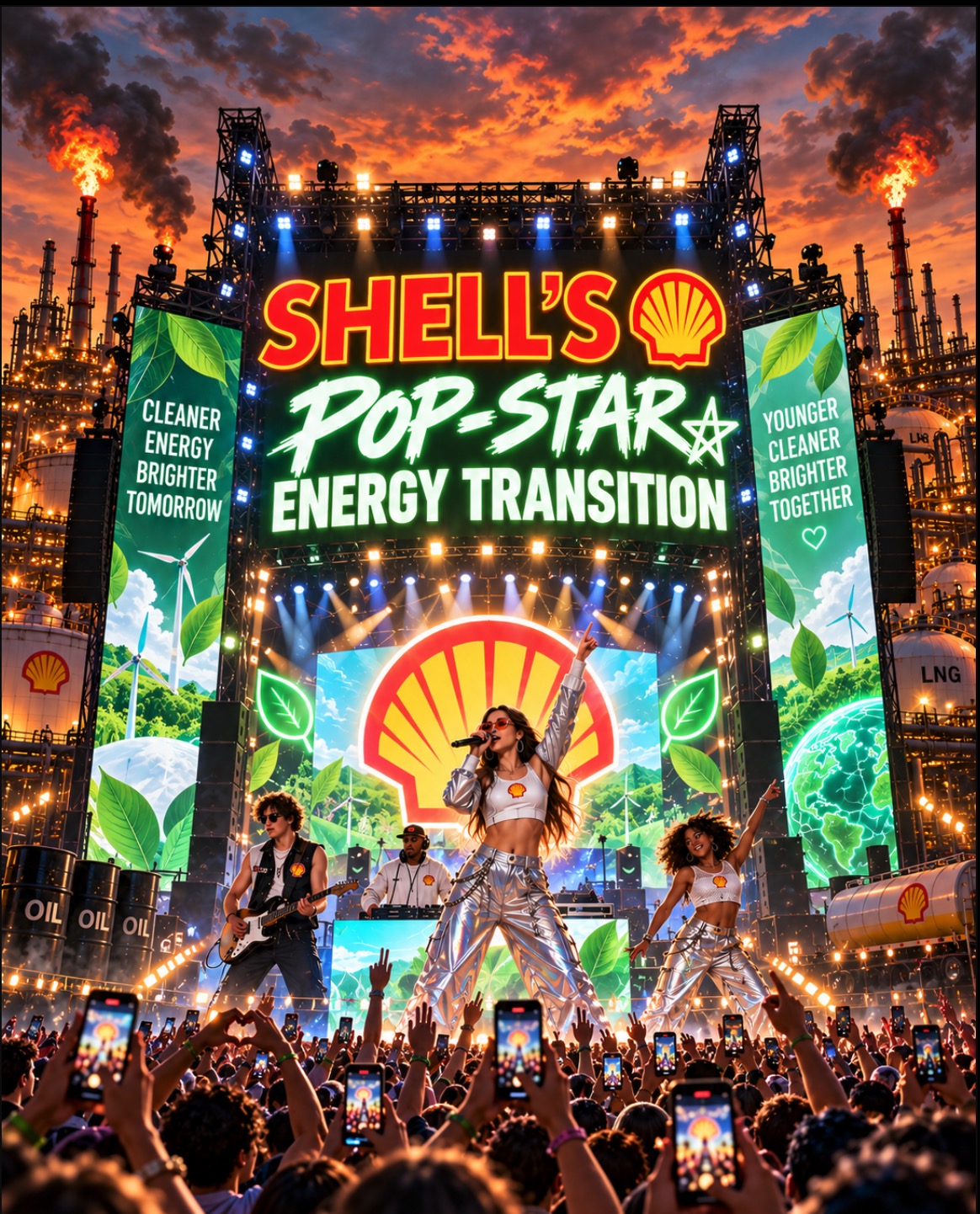
A story highlighted by Campaign is worth revisiting because it captures something larger than a mere advertising stunt. It shows how Shell deliberately used pop music, celebrity culture and youth-oriented digital marketing to present itself as a company associated with the future of clean energy rather than simply as one of the world’s biggest oil and gas businesses. That makes it less a quirky campaign anecdote than a revealing case study in corporate image management.
In late 2017, Shell unveiled a glossy new chapter in its global #makethefuture campaign: a music video for “On Top of the World” featuring an international line-up of artists including Jennifer Hudson, Pixie Lott, Luan Santana, Yemi Alade and Monali Thakur.
Shell said the video was designed to spotlight clean-energy initiatives and projects backed by Shell and its partners, including solar access in Brazil, cleaner lighting in Kenya, cleaner cooking using gas in India, clean cookstoves in China and hydrogen transport initiatives in the US, Germany and the UK.
Shell’s own messaging was dressed in the language of collaboration, innovation and cleaner energy. Malena Cutuli, Shell’s global head of integrated brand communications at the time, said music was being used to “spark a global conversation” about access to cleaner energy.
In other words, Shell was not merely selling fuel. It was trying to sell a feeling: optimism, modernity and cultural relevance, all wrapped up in a catchy song and an attractive visual package.
The campaign becomes even more interesting when one looks at how it was described by the marketing industry itself.
A World Media Group case study on Shell’s earlier “Best Day of My Life” campaign stated the aim in strikingly direct terms: Shell wanted to reach “Energy Engaged Millennials” and transform its reputation from that of a traditional oil company into one seen as actively addressing future energy needs.
The case study said the challenge was to make energy feel exciting and relevant to younger audiences who would otherwise find it distant, technical or dull.
That is a remarkably candid description of reputational engineering.
The same case study boasted extraordinary results.
It said the campaign generated nearly 400 million views, more than 4.1 million shares, and significantly improved how the target audience viewed Shell.
According to the submission, people exposed to the campaign were far more likely to see Shell as a company addressing future energy needs.
A separate campaign success summary also stated that Shell specifically targeted a millennial audience and achieved measurable lifts in ad awareness, message association and the belief that Shell was “setting trends in energy.”
These claims come from campaign materials and case studies, not from independent regulators, but they make clear what Shell believed it was buying with this kind of promotion: not simply attention, but a softer and more progressive public identity.
That is why this is worth an article now.
The important point is not that Shell once sponsored a music video. Big companies sponsor cultural content all the time.
The important point is that Shell used music and celebrity endorsement as part of a broader effort to reposition itself in the minds of younger people as a participant in a cleaner-energy future.
It was, in effect, branding by emotional association: if the audience liked the artists, the visuals and the message, perhaps they would think differently about Shell too.
There is, however, an obvious tension at the heart of this.
While Shell was marketing itself through songs, influencers and “bright energy ideas”, it remained — and remains — a giant fossil-fuel company whose profits and global significance rest overwhelmingly on oil and gas.
That does not mean every clean-energy initiative mentioned in the campaign was fictitious.
It does mean the presentation was selective.
The cleaner, brighter and more youthful image was real as marketing, but it sat alongside a much larger hydrocarbon reality.
Seen in that light, Shell’s musical clean-energy campaign looks less like a harmless piece of brand creativity and more like an early, polished example of the kind of image management that later came under much harsher scrutiny in the greenwashing debate.
The style was upbeat, global and aspirational.
The objective was serious: win over the next generation before that generation decided that oil majors belonged to the past.
That is why the old Campaign story is still worth attention.
It is not really about music.
It is about how a major oil company tried to soundtrack its own reinvention.
Sources
Campaign — Shell turns to music to communicate with younger generations about clean energy
World Media Group — Shell Case Study 2017
Shell #makethefuture campaign success story
Site-wide disclaimer applies.
*This website and sisters royaldutchshellgroup.com, shellnazihistory.com, royaldutchshell.website, johndonovan.website, shellnews.net, and shellwikipedia.com, are owned by John Donovan - more information here. There is also a Wikipedia segment, the Shell DPA Files, "Shell and the Spies", the Shell Leaks files, the Independent Shell Archive, as well as books written and published by John Donovan - Kindle eBooks. Timeline of the Donovan Shell Feud. Toxic History of Royal Dutch Shell Group. Shell and the Donovans: The Full Media Record — 550+ Articles, 110 Books, 40 Years. *All conjured up by internet wizz, Nick Gill.