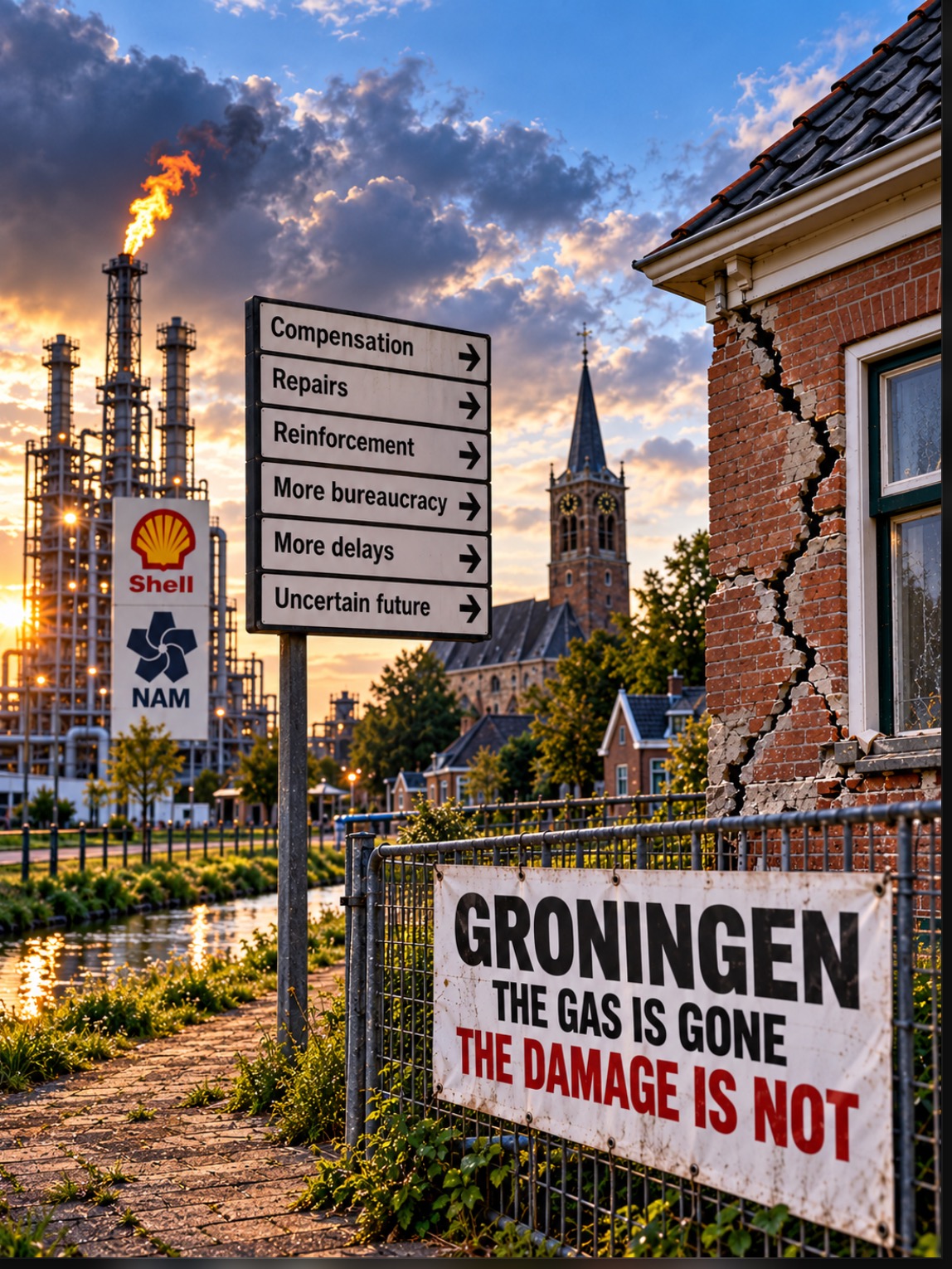
 Years after the Groningen gas crisis became a national scandal, residents are still waiting for repairs, reinforcement and certainty — and regional authorities are warning that another round of bureaucracy could make matters worse.
The Province of Groningen and five earthquake-affected municipalities — Eemsdelta, Groningen, Het Hogeland, Midden-Groningen and Oldambt — have urged the Dutch House of Representatives to prevent fresh delays in the repair and strengthening programme and to protect residents who discover earthquake damage only after their claims have formally been closed. OOG Groningen
Their central complaint is painfully familiar: the system remains too difficult for the people it was created to help.
The regional authorities say thousands of Groningers are still waiting for clarity, damage repair, reinforcement or some prospect of finally moving on. They want the state bodies involved to behave more like one government, rather than forcing residents to work out which organisation is responsible for each part of their case. Provincie Groningen
That is a significant criticism considering how long the Groningen damage crisis has already lasted.
A new problem: “finality”
The immediate dispute concerns a new approach being introduced by the Instituut Mijnbouwschade Groningen (IMG).
Under the new system, once a customised damage claim has been dealt with, the file can be treated as effectively final. The Province and municipalities fear that this could leave residents unable to claim compensation for earthquake damage that was hidden, overlooked or became visible only later. Provincie Groningen
The regional authorities are not opposing simplification in principle.
They support a faster and easier claims process.
What they object to is simplification that comes at the expense of residents’ legal security.
Their request to Parliament is straightforward: ensure that future or previously unidentified earthquake damage can still be reported and compensated. Provincie Groningen
That is hardly an unreasonable demand in a region where building damage can evolve over time and where the history of claims handling has already produced years of mistrust.
The risk of yet more delay
The region is also warning of possible new staffing problems at the Nationaal Coördinator Groningen (NCG), the body responsible for strengthening homes.
One concern involves the Dutch Wet DBA, legislation governing supposedly self-employed contractors who may in practice function as employees. Regional authorities fear that changes affecting freelancers working for the NCG could cause personnel shortages and further slow the strengthening programme. OOG Groningen
For residents who have already waited years, the distinction between one administrative cause of delay and another may be academic.
The practical result is the same:
more waiting.
More inspections.
More procedures.
More uncertainty over whether a home is safe.
“People, not systems”
The Province of Groningen has framed the issue unusually clearly.
Provincial executive Susan Top said too many residents are still waiting for certainty or safety and argued that the recovery programme should be organised around people rather than administrative systems. OOG Groningen
That sentiment goes to the heart of the Groningen affair.
For decades, gas extraction generated enormous revenues.
When the earthquake damage became impossible to ignore, the response produced layer upon layer of compensation mechanisms, safety assessments, reinforcement programmes, appeals procedures and administrative bodies.
The region’s latest intervention suggests that the machinery created to solve the problem is still capable of becoming part of the problem.
The Shell and NAM connection
The present dispute is not about a new decision by Shell.
That distinction needs to be made clearly.
The current arguments concern the way Dutch public bodies — principally the IMG, NCG and central government — are handling damage repair, reinforcement and compensation.
But the reason those institutions exist at all lies in the historic extraction of gas from the Groningen field.
That field was operated by Nederlandse Aardolie Maatschappij (NAM), historically owned equally by Shell and ExxonMobil.
The earthquakes and associated damage were linked to gas extraction from the Groningen reservoir.
So although Shell is not the administrator now deciding whether a late-discovered crack qualifies for compensation, the Shell/NAM history remains the causal backdrop to the entire system.
That distinction matters because accountability should be precise.
The extraction created the problem.
The state is now administering the remedy.
Those are not the same responsibility.
Groningen is officially still unfinished business
The Dutch government itself acknowledges that the recovery process is far from complete.
In July 2026, the national government said that rapid damage settlement and strengthening remained a prerequisite for recovery and recognised that residents had been trapped in lengthy processes they never asked for. Rijksoverheid
That is striking language coming from the state itself.
The gas field may have been shut down, but the social, structural and legal consequences are still being worked through.
And even compensation schemes created specifically because of slow earthquake-damage handling were still operating as recently as 2026. The government’s value-enhancement scheme, for example, was explicitly described as compensation for the slow handling of earthquake damage caused by gas extraction from the Groningen field or the Norg gas storage facility. Rijksoverheid
The legacy is therefore not historical in any meaningful sense.
It is administrative reality.
Residents should not have to guess which door to knock on
One of the strongest elements in the regional authorities’ letter is the demand for greater coordination.
Residents dealing with damage and reinforcement frequently encounter multiple organisations with overlapping or adjacent responsibilities.
The Province and municipalities want those institutions to behave more like a single public authority so that residents do not have to navigate the machinery themselves. OOG Groningen
That sounds almost embarrassingly obvious.
If a person’s house has been damaged by a state-recognised mining disaster, the burden should not fall on that person to become an expert in Dutch administrative architecture.
Yet the fact that local authorities are still asking for this in 2026 says a great deal about how unresolved the system remains.
The deeper problem is trust
The Groningen crisis has never been only about cracked walls.
It became a crisis of trust.
Residents had to establish that damage was real.
Then that it was caused by extraction.
Then that the building needed reinforcement.
Then which organisation was responsible.
Then whether compensation was adequate.
Now some may have to worry that a file considered “finished” today could prevent compensation for damage discovered tomorrow.
That is precisely why the regional authorities are resisting a rigid version of finality.
Administrative closure is useful for institutions.
Physical damage does not necessarily respect administrative deadlines.
Documentary position
Established: The Province of Groningen and five affected municipalities have asked Parliament to reduce the procedural burden on residents and prevent further delays in damage repair and reinforcement. Provincie Groningen
Established: They are particularly concerned that the IMG’s new approach to conditional finality could prevent compensation for hidden or later-discovered earthquake damage. Provincie Groningen
Established: Regional authorities also fear staffing issues at the NCG could lead to additional delays. OOG Groningen
Established: Thousands of residents are still waiting for certainty, repairs, reinforcement or other resolution. Provincie Groningen
Established government position: The Dutch government continues to describe damage settlement and reinforcement as central unresolved priorities for Groningen and northern Drenthe. Rijksoverheid
Historical context: The current compensation bureaucracy concerns damage arising from the Groningen extraction legacy. The present administrative dispute should not be misrepresented as a new act by Shell or NAM.
Commentary
The gas has largely gone.
The invoices have not.
Neither have the cracks.
Nor, apparently, has the bureaucracy.
That is what makes the latest Groningen story worth reporting.
A disaster can continue long after the industrial activity that caused it has stopped.
At that point, the question becomes less about production and more about who carries the burden of repair.
The most troubling aspect of the new “finality” debate is that it risks shifting uncertainty back onto residents.
A government may want to close files.
A house does not know that its file has been closed.
If subsidence-related or earthquake damage emerges later, the resident should not be told that the administrative system has already moved on.
After everything Groningen has endured, compensation policy should be designed around that reality.
Not around the convenience of closing a case.
Sources
The Province of Groningen’s own statement sets out the regional authorities’ position and their request to the Tweede Kamer:
Province of Groningen — Region asks Parliament to focus on reducing procedural burden for residents
OOG Groningen reports the concerns over delays, NCG staffing and later-discovered damage:
OOG Groningen — Region warns of new delays in damage repair
A regional report on the renewed IMG process explains the concern over conditional finality:
GIC — Province and municipalities critical of revised IMG claims process
The Dutch government’s July 2026 statement confirms that damage repair and strengthening remain unresolved national priorities:
Dutch Government — Cabinet sets priorities for Groningen and North Drenthe
Site-wide disclaimer applies.
*This website and sisters royaldutchshellgroup.com, shellnazihistory.com, royaldutchshell.website, johndonovan.website, shellnews.net, and shellwikipedia.com, are owned by John Donovan - more information here. There is also a Wikipedia segment, the Shell DPA Files, "Shell and the Spies", the Shell Leaks files, the Independent Shell Archive, as well as books written and published by John Donovan - Kindle eBooks. Timeline of the Donovan Shell Feud. Toxic History of Royal Dutch Shell Group. Shell and the Donovans: The Full Media Record — 550+ Articles, 110 Books, 40 Years. *All conjured up by internet wizz, Nick Gill.







