8 October 2026
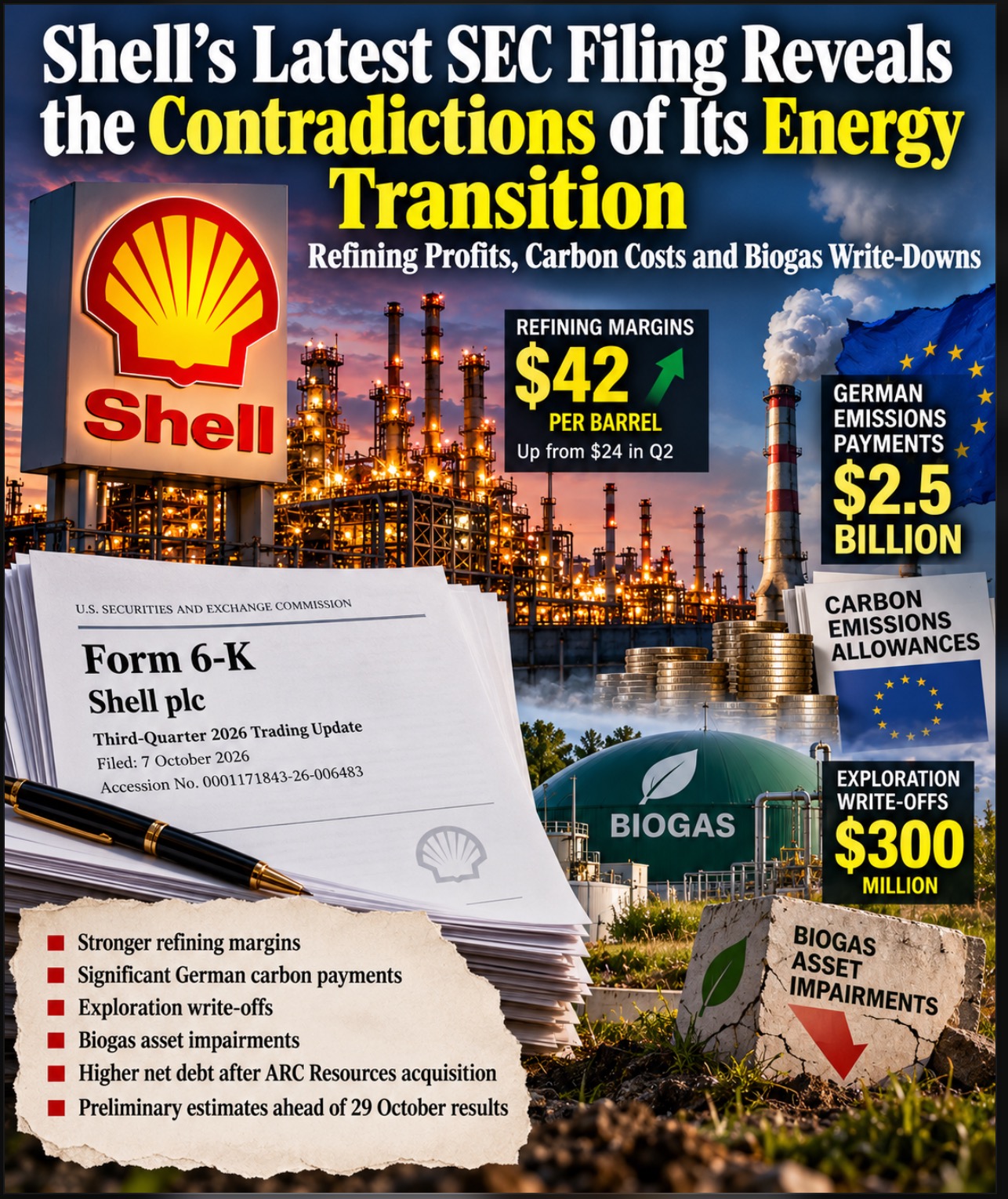
Shell’s latest filing with the US Securities and Exchange Commission reveals a striking financial contrast: record indicative refining margins, approximately $2.5 billion in German carbon-certificate payments, impairments affecting biogas investments, and further exploration write-offs. The disclosures raise important questions about the economics of Shell’s energy transition—and where the company is actually making its money.
Shell plc has submitted its third-quarter 2026 trading update to the US Securities and Exchange Commission, offering investors an unusually revealing snapshot of the competing financial forces shaping one of the world’s largest oil and gas companies.
The document, filed on 7 October as Form 6-K, accession number 0001171843-26-006483, contains several disclosures that deserve attention beyond the routine financial reporting normally associated with quarterly trading updates.
At first glance, the most eye-catching figure is Shell’s indicative refining margin, which has risen from $24 per barrel in the second quarter to an extraordinary $42 per barrel in the third quarter.
But further down the filing are other figures that tell a more complicated story.
Shell expects approximately $2.5 billion in cash outflows associated with the timing of German emissions-certificate payments.
It also anticipates non-cash impairments of biogas assets, although these are expected to be largely offset by an impairment reversal elsewhere in the business.
And its upstream operations are expected to record approximately $300 million in exploration-well write-offs.
Taken together, these disclosures illustrate the complexity—and occasional contradictions—of Shell’s position as a major fossil-fuel producer that simultaneously promotes investment in lower-carbon energy.
Refining margins soar to $42 per barrel
The most immediately positive development for Shell shareholders is the sharp increase in refining margins.
Shell’s SEC filing provides the following comparison:
- Second quarter 2026: $24 per barrel.
- Third quarter 2026 indicative margin: $42 per barrel.
That represents an increase of 75%.
The figure is an indicative refining-margin measure, not Shell’s actual net profit on every barrel processed. Nevertheless, it provides a powerful indication of the unusually favourable market conditions facing refiners.
The surge comes against a background of international fuel-supply disruption and exceptionally strong prices for refined petroleum products.
The Wall Street Journal reported on 7 October that the $42 figure represented a record high for Shell’s refining-margin indicator, surpassing levels recorded following Russia’s invasion of Ukraine in 2022.
The Guardian similarly highlighted the extraordinary contrast between rising refining margins and the fuel-price pressures confronting consumers.
There is an uncomfortable economic reality here.
Conditions that create hardship for motorists, businesses and energy consumers can simultaneously generate exceptional margins for companies positioned to refine and trade petroleum products.
That does not establish improper conduct by Shell. It reflects the economics of disrupted global energy markets.
But it is a legitimate subject for public and shareholder scrutiny.
Strong margins do not mean every refinery is running smoothly
Shell’s filing also reveals that operational conditions have been less favourable than the headline refining-margin figure might suggest.
The company expects refinery utilisation of 93% to 97% in the third quarter, compared with 102% in the preceding quarter.
Shell specifically identifies low water levels on Germany’s River Rhine as affecting utilisation at its Rheinland refinery.
This is a useful reminder that high market margins and strong operational performance are not necessarily the same thing.
A refinery may benefit from exceptional market prices while simultaneously facing logistical difficulties that limit its ability to take full advantage of those prices.
Shell also expects its indicative chemicals margin to decline from $270 to $208 per tonne.
The overall picture is therefore more nuanced than a simple declaration that every part of Shell’s downstream business is booming.
The $2.5 billion German carbon-payment disclosure
One of the most substantial figures in the SEC filing concerns Germany’s carbon-pricing system.
Shell states that cash flow from operations, excluding working-capital movements, is expected to include an approximately $2.5 billion outflow related to the timing of payments for emissions certificates under Germany’s Brennstoffemissionshandelsgesetz, commonly abbreviated BEHG.
This German legislation establishes a national emissions-trading framework covering specified fuels.
Companies subject to the scheme must account for emissions associated with covered fuel supplies and meet the relevant certificate obligations.
The important distinction is that Shell has not disclosed a new $2.5 billion environmental fine.
Nor does the filing suggest that the payment results from a newly discovered environmental offence.
Shell describes it as a cash-flow effect arising from the timing of emissions-certificate payments, which historically occurred in the fourth quarter.
That distinction matters.
Nevertheless, the amount is considerable.
It demonstrates that carbon-pricing mechanisms are not merely abstract environmental-policy instruments. They can produce substantial cash-flow consequences for companies involved in supplying fossil fuels.
For Shell, the financial consequences of carbon regulation are now an important part of the business landscape.
The company benefits from strong hydrocarbon demand and favourable refining margins while simultaneously operating under regulatory systems designed to attach financial costs to fossil-fuel emissions.
Whether those costs materially influence Shell’s long-term investment decisions is a question worth examining.
Biogas impairments: a revealing disclosure
Another significant passage concerns Shell’s biogas investments.
The company expects non-cash, post-tax impairments of biogas assets within its Marketing segment.
An impairment generally occurs when the accounting carrying value of an asset exceeds its recoverable amount under the applicable accounting rules.
In practical terms, it can indicate that an investment is no longer expected to generate the financial value previously anticipated.
However, Shell adds an important qualification.
The biogas impairments are expected to be largely offset by an impairment reversal in its Integrated Gas business.
Both adjustments will be reported as identified items.
The filing does not provide the precise amount of the biogas impairment, identify the affected assets or explain the individual assumptions behind the write-downs.
It would therefore be premature to describe the disclosure as evidence that Shell’s entire biogas strategy has failed.
What it does establish is that some biogas assets are expected to require downward accounting adjustments.
That is particularly relevant because biogas and renewable natural gas have been presented by major energy companies as possible contributors to reducing the carbon intensity of their portfolios.
Investors are entitled to ask whether the economics of these investments are proving as attractive as originally anticipated.
They are also entitled to ask whether Shell’s future capital allocation will continue to favour these businesses or increasingly concentrate on conventional oil and gas and LNG.
The SEC filing does not answer those questions.
But it gives shareholders a reason to ask them.
Another $300 million in exploration write-offs
Shell also expects approximately $300 million in exploration-well write-offs during the third quarter.
Exploration expenditure is inherently risky.
Not every well produces a commercially viable discovery, and companies routinely reassess the carrying value of exploration-related expenditure.
The disclosed write-off is therefore not, by itself, evidence of mismanagement.
Nevertheless, $300 million is a substantial sum.
It represents expenditure associated with exploration activities whose accounting value Shell no longer expects to retain.
For an organisation that regularly emphasises capital discipline and shareholder returns, the figure deserves to be recorded.
It is another reminder that Shell’s traditional upstream business involves substantial uncertainty even before questions of environmental regulation, geopolitical risk or energy-transition policy enter the calculation.
Integrated Gas production increases
The trading update also contains encouraging figures for Shell’s gas business.
Shell now expects third-quarter Integrated Gas production of 740,000 to 780,000 barrels of oil equivalent per day, compared with 631,000 in the second quarter.
The updated outlook incorporates the acquisition of ARC Resources, completed on 2 September 2026.
Shell expects LNG liquefaction volumes of 7.2 million to 7.6 million tonnes, compared with 7.7 million tonnes in the preceding quarter.
These figures underline the continuing importance of natural gas and LNG to Shell’s operating portfolio.
They also provide context for the company’s recent commitment to expand LNG Canada.
Shell is continuing to invest heavily in the long-term production, processing and marketing of natural gas.
Whatever the future contribution of renewable energy, hydrocarbons remain central to the company’s commercial strategy.
Debt, acquisitions and the cost of expansion
The filing identifies additional pressures on Shell’s net debt.
The company expects net debt to be affected by the cash consideration and assumed debt associated with the ARC Resources acquisition.
It also identifies increases in variable components of long-term shipping leases under current market conditions.
These disclosures are important because large acquisitions and long-term commitments can materially alter a company’s financial position even when operating conditions appear favourable.
Strong refining margins may support cash generation, but they do not eliminate the financial consequences of acquisitions, leases and other capital commitments.
The eventual effect on Shell’s balance sheet will become clearer when the company publishes its complete quarterly results.
What does all this say about Shell’s energy transition?
The most revealing aspect of Shell’s SEC filing is not any single number.
It is the juxtaposition of several very different financial developments.
Traditional refining is benefiting from exceptionally favourable margins.
Carbon-pricing obligations are producing substantial cash-flow effects.
Some biogas assets are facing impairment.
Conventional exploration continues to generate write-offs.
And Shell’s Integrated Gas business is expanding through acquisition.
This is not necessarily evidence that Shell’s energy-transition strategy is internally inconsistent in every respect.
A large integrated energy company can reasonably operate conventional and lower-carbon businesses simultaneously.
But the filing highlights the difficult commercial choices involved.
Investments described as supporting the energy transition must ultimately compete for capital against established hydrocarbon operations that can generate very large returns.
The question is whether Shell’s allocation of capital, operating priorities and financial results are consistent with the company’s publicly stated long-term objectives.
That question cannot be answered by corporate sustainability language alone.
It requires examination of actual expenditure, earnings, impairments, asset sales, production forecasts and regulatory disclosures.
That is precisely why Shell’s SEC filings deserve close independent scrutiny.
The historical significance of Shell’s own disclosures
For the independent Shell archive, this latest filing provides another useful primary-source record.
The archive has long documented the importance of distinguishing corporate assurances from the underlying evidence available in financial statements, legal proceedings and regulatory submissions.
The SEC filing is especially valuable because it allows readers to examine Shell’s own figures rather than relying exclusively on public-relations statements or external commentary.
It also reinforces the importance of preserving such disclosures in their original context.
A biogas impairment should not be exaggerated into proof that an entire business has collapsed.
A regulatory carbon-certificate payment should not be misrepresented as an environmental penalty.
An indicative refining margin should not be confused with actual net profit.
And an exploration write-off should not automatically be treated as evidence of wrongdoing.
The strength of independent scrutiny lies in making these distinctions accurately—and then asking the questions the documented facts justify.
The next important date: 29 October 2026
Shell has scheduled publication of its full third-quarter financial results for 29 October 2026.
Those results should provide a clearer picture of the company’s financial performance and the significance of the items highlighted in the latest filing.
Particular attention should be paid to the final refining results, cash-flow movements, the accounting treatment of biogas impairments, the ARC Resources acquisition and changes in net debt.
The preliminary update is informative, but it is not a substitute for the completed financial statements.
Conclusion: the numbers tell their own story
Shell’s latest SEC filing captures the company at an unusual moment.
Its refining operations are positioned to benefit from exceptionally strong market margins.
Its German carbon-certificate obligations are associated with billions of dollars in cash outflows.
Some biogas investments face downward accounting adjustments.
Exploration expenditure continues to produce write-offs.
And the company is expanding its natural-gas business through major acquisitions.
These are not isolated curiosities.
Together, they illustrate the competing financial pressures facing a company whose commercial foundations remain firmly rooted in oil and gas while it continues to present an energy-transition strategy to investors and the public.
The central question is not whether Shell can profit from hydrocarbons while investing in lower-carbon energy. Clearly it can.
The question is whether the financial evidence supports the long-term transformation Shell describes—and how shareholders and the wider public should judge that transformation.
The answer will emerge not from slogans, but from the company’s own regulatory filings.
And the next instalment arrives on 29 October.
Principal sources
- Shell plc — SEC Form 6-K, 7 October 2026 — Primary regulatory filing.
- Shell — Third Quarter 2026 Update Note — Company announcement.
- The Guardian — Shell’s Refining Margins, 7 October 2026 — Independent financial reporting.
- The Wall Street Journal — Shell’s Record Refining Margin, 7 October 2026 — Market context and analysis.
Editorial note: All third-quarter figures are preliminary estimates unless otherwise specified. The approximately $2.5 billion German emissions-certificate outflow is a timing-related regulatory payment, not a newly announced fine. The biogas impairment amount has not been separately quantified by Shell.