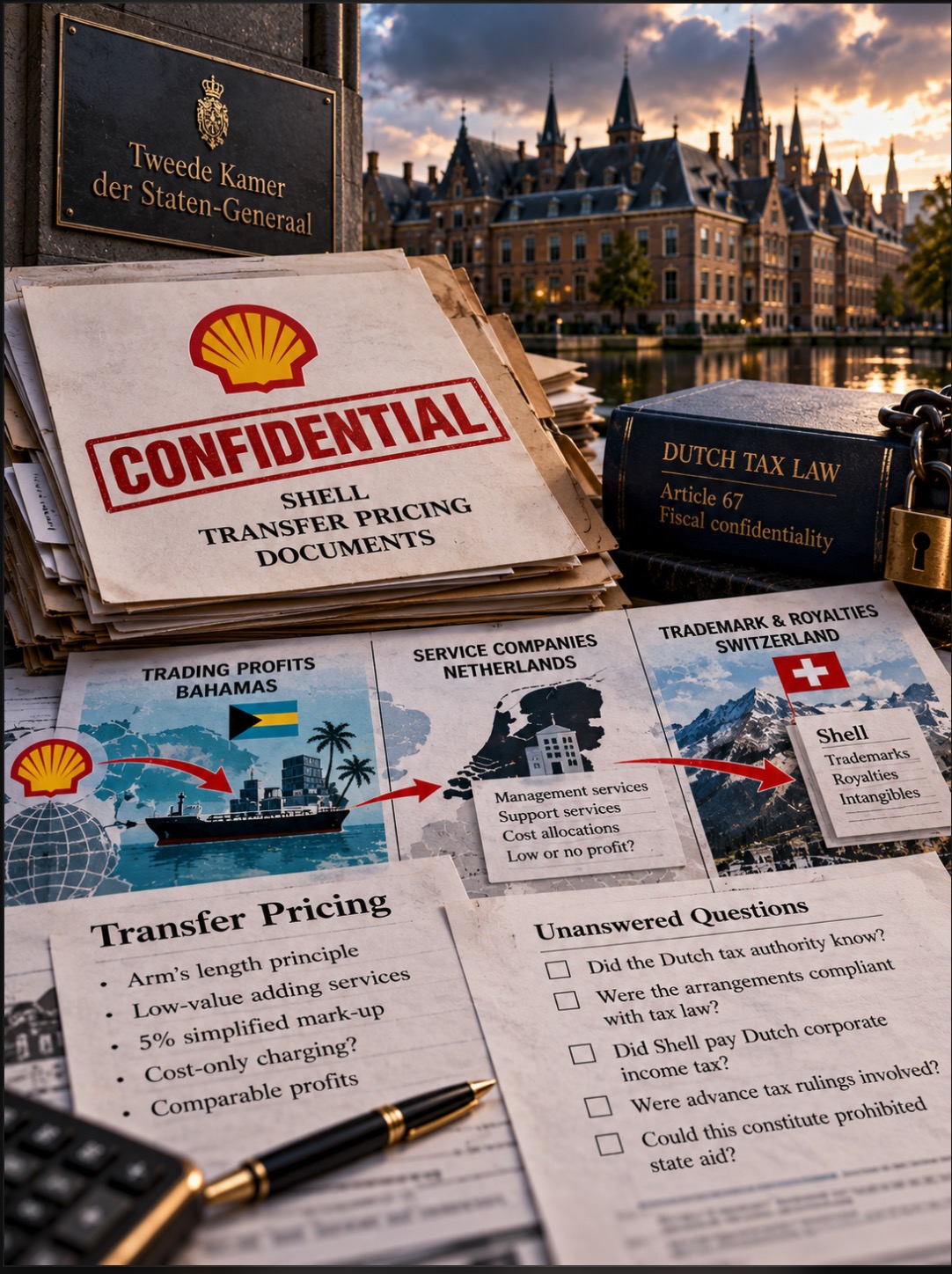
Parliament asked whether Shell’s leaked transfer-pricing arrangements were known to the Dutch tax authority and whether they complied with the law. The government’s answer, in substance: it cannot say.
“Shell rejects allegations of improper tax avoidance or illegality.”
A fresh Dutch parliamentary response has added an important new layer to the controversy surrounding the Shell Files — the cache of leaked Shell transfer-pricing documents published this summer by SOMO and Follow the Money.
On 5 October 2026, Dutch State Secretary for Finance E. Eerenberg answered a detailed series of parliamentary questions about Shell’s transfer pricing.
The questions went directly to the heart of the affair.
Did the Dutch tax authorities know what Shell was doing?
Were the arrangements arm’s length?
Were intra-group services being priced correctly?
Could any preferential treatment amount to prohibited state aid?
And, now that some of Shell’s internal transfer-pricing documents had become public, could Parliament finally be told how the Dutch tax authorities had assessed them?
The government’s answer was striking.
Not where answering would reveal Shell’s individual tax position.
The State Secretary said that Dutch fiscal confidentiality rules continue to apply even when relevant material has already been published by journalists, researchers or other third parties.
That does not clear Shell.
It does not prove wrongdoing either.
What it establishes is an unusual accountability problem: the documents are public, the allegations are public, Shell’s response is public and Parliament’s questions are public — but the Dutch government says it cannot disclose whether the tax authority accepted, rejected, adjusted or otherwise challenged Shell’s particular tax positions.
The Shell Files that triggered the questions
The controversy originated with the 23 July 2026 publication of SOMO’s The Shell Files: Exposing how corporations can use transfer pricing to avoid taxes.
SOMO said the leaked documents offered an unusually detailed look inside Shell’s transfer-pricing system and the way profits were allocated between related companies in different jurisdictions.
The investigation concentrated on three broad areas:
oil trading in the Bahamas;
Shell intellectual property and royalties in Switzerland;
and
intra-group services involving Shell entities in the Netherlands and United Kingdom.
SOMO’s broader argument was not confined to Shell. It contended that the OECD transfer-pricing system gives multinational companies considerable discretion when deciding where functions, risks and profits should be recognised.
SOMO itself described the problem as structural rather than company-specific.
Source:
https://www.somo.nl/the-shell-files/
$6.2 billion profit — 37 employees — Bahamas
The most eye-catching part of the investigation concerns Shell Western Supply and Trading Limited, or SWST, in the Bahamas.
According to SOMO’s analysis, the company employed 37 people yet generated approximately $6.2 billion in profit between 2018 and 2023.
SOMO calculated that profit per employee at the Bahamas entity was 104 times the average across Shell entities.
During much of the period under examination, the Bahamas did not levy ordinary corporate income tax.
The researchers argued that Shell’s transfer-pricing methodology allocated a very substantial share of oil-trading risk and profit to the Bahamian company rather than to Shell companies producing or refining the hydrocarbons elsewhere.
SOMO characterised that as an indication of profit shifting.
That remains SOMO’s analysis.
It is not a finding by a Dutch court, tax tribunal or tax authority.
Shell has defended its transfer-pricing arrangements and says it complies with applicable law and OECD transfer-pricing principles.
The Dutch government will not say what it thinks about Shell’s case
MP Luc Stultiens subsequently put detailed questions to the Dutch government.
The official parliamentary record confirms that the questions were submitted on 8 September 2026 and answered by Eerenberg on 5 October 2026.
Source:
https://www.tweedekamer.nl/kamerstukken/kamervragen/detail?did=2026D48796&id=2026Z18217
The crucial issue was straightforward.
Now that the Shell documents had been reported publicly, could the government tell Parliament whether the Dutch tax authority had seen, approved, challenged or otherwise dealt with the structures concerned?
Eerenberg said no.
He relied on the fiscal secrecy obligation governing individual taxpayers.
According to the government, publication of information by third parties does not extinguish the tax authority’s duty of confidentiality.
That position creates an obvious paradox.
The public may know what the leaked documents say.
Researchers may analyse them.
Tax academics may criticise them.
Shell may defend them.
But the Dutch tax authority cannot disclose whether its own confidential information confirms or contradicts those public accounts.
The government did explain the general rules
Although Eerenberg declined to comment on Shell’s specific tax treatment, he did explain the legal framework.
Transactions between companies within the same corporate group must generally comply with the arm’s-length principle.
In essence, associated companies should transact on terms comparable to those that independent businesses would have agreed under comparable circumstances.
That requires analysis of matters such as:
- the functions performed;
- the assets used;
- the risks controlled;
- the contractual arrangements;
- and the economic substance of the transactions.
That means merely locating a company in a low-tax jurisdiction does not by itself establish unlawful profit shifting.
But equally, legal ownership and written contracts alone do not necessarily determine where taxable profit belongs.
The actual economic functions and risks matter.
Dutch service companies: perhaps the most contentious issue
The Shell Files also examined intra-group services performed from the Netherlands.
Follow the Money reported that Shell entities in the Netherlands provided technical, administrative and other services to other Shell companies, while some historic arrangements allegedly involved reimbursement at cost rather than cost plus a profit margin.
Tax law professor Jan van de Streek was highly critical of those arrangements.
Follow the Money reported his view that aspects of the historic transfer pricing were non-arm’s-length and therefore unlawful.
That is an expert opinion.
It is not a judicial determination.
Follow the Money article:
https://www.ftm.nl/artikelen/hoe-shell-erin-slaagt-in-nederland-geen-cent-belasting-te-betalen
SOMO estimated that the Dutch tax consequences could have been substantial.
Again, those figures are research estimates, not official tax assessments.
Shell has rejected allegations of illegality.
Routine services normally require a mark-up
The State Secretary’s answer is particularly interesting on this point.
According to the government, routine intra-group services will generally require the service provider to receive compensation including an appropriate profit mark-up.
For qualifying low-value-adding services, the OECD framework permits a simplified approach using a 5% mark-upunder specified conditions.
However, the government also made clear that cost-only charging is not automatically unlawful.
There can be specific circumstances under OECD principles in which no profit mark-up is appropriate.
NLFiscaal summarised the government’s position as follows: routine group services should generally be reimbursed with a profit mark-up; certain supporting services can qualify for a 5% mark-up; and charging without a mark-up may still be possible in defined circumstances.
Source:
https://www.nlfiscaal.nl/nlfiscaal-doc/199DD01FBF8545DEA6E3CC879FF585A9
The important point is therefore not:
“The Dutch government says Shell’s cost-only charging was illegal.”
It did not say that.
The actual position is more precise:
the government says routine services generally require an arm’s-length profit element, but there can be exceptions.
What Parliament still cannot discover is whether Shell’s actual historic arrangements fitted within those exceptions.
The Netherlands changed its own guidance
Eerenberg also explained that previous Dutch transfer-pricing guidance had included an approval permitting certain supporting services to be charged without a profit mark-up in particular circumstances.
That approval was not continued in the 2022 Dutch Transfer Pricing Decree.
The Netherlands now refers more directly to the OECD framework.
The tax authority, according to the State Secretary, applies risk-based supervision to intra-group services charged without a mark-up.
That raises an obvious historical question:
How were Shell’s arrangements treated under the old and new regimes?
The government will not disclose that taxpayer-specific information.
Switzerland and Shell’s trademark royalties
Another Shell Files case study concerns the company’s intellectual property arrangements in Switzerland.
SOMO says Shell transferred trademarks to a Swiss group entity that subsequently received royalty income from Shell companies elsewhere.
The researchers examined the methodology used to determine those royalties, including reference to the so-called 25% rule, a rule of thumb historically used in some intellectual-property valuation exercises.
The Dutch government’s response is again technically important.
Eerenberg said a rule of thumb is not automatically prohibited, but that a rule of thumb by itself is insufficient to demonstrate an arm’s-length royalty.
A proper analysis must consider the economically important functions connected with the intellectual property.
Tax specialists often refer to these as the DEMPE functions:
Development
Enhancement
Maintenance
Protection
Exploitation
In other words, merely placing legal ownership of an intangible asset in one jurisdiction does not automatically justify allocating all associated profits there.
The economic substance must support the result.
Once again, however, the government did not say whether Shell’s particular arrangements satisfied that standard.
Could this have been unlawful state aid?
The parliamentary questions also raised the possibility of EU state aid.
The theory is important.
If a tax authority selectively gives one company a tax advantage unavailable under the ordinary tax rules, that treatment can, in certain circumstances, constitute prohibited state aid.
Stultiens therefore asked whether favourable tax treatment of Shell could raise such concerns.
Eerenberg responded that the European Commission is the institution empowered to determine whether unlawful state aid exists.
He also said there were no indications that the existing Dutch tax safeguards had failed or that unlawful state aid had occurred in connection with this matter.
That is a significant statement.
But it should not be overstated.
The government has not publicly released a Shell-specific analysis demonstrating that every transfer-pricing position exposed in the leak was correct.
It simultaneously maintains that fiscal secrecy prevents it from discussing Shell’s individual tax affairs.
No special investigation
Stultiens also asked whether there should be an independent or special investigation into the handling of the Shell material by the Dutch tax administration.
Eerenberg declined.
According to the State Secretary, there are no indications that existing safeguards surrounding Dutch tax decision-making are inadequate.
He referred to existing internal controls, technical coordination and the availability of judicial review.
The government therefore sees no reason to establish a separate investigative commission.
Again, this should be recorded precisely.
The government has not said that every allegation in the Shell Files has been disproved.
It has said that it sees no evidence justifying a special investigation into the functioning of the tax authority.
Those are different propositions.
The confidentiality paradox
This is where the story becomes particularly interesting.
Tax confidentiality serves a legitimate purpose.
Companies and individuals must be able to provide commercially sensitive information to tax authorities without expecting their entire tax files to become public.
That principle supports effective tax administration.
But the Shell Files present an unusual case.
Much of the underlying corporate material is already in the public domain.
Researchers have analysed it.
A tax professor has publicly questioned some of the arrangements.
Shell has publicly defended its compliance.
Parliament has asked detailed questions about named structures.
Yet the one body capable of explaining how those structures were actually treated for Dutch tax purposes cannot disclose the answer.
The result is a remarkable asymmetry:
Shell’s transfer-pricing documents can be public.
Shell can defend them publicly.
Researchers can criticise them publicly.
Academics can argue that some arrangements were unlawful.
MPs can question the government publicly.
But the Dutch tax authority cannot publicly say what it actually did.
That is the central significance of the latest development.
What is established
Established: SOMO published the Shell Files on 23 July 2026 using leaked Shell transfer-pricing documents.
Established: The investigation examined Shell oil trading in the Bahamas, intellectual property in Switzerland and intra-group services involving the Netherlands and UK.
Established: SOMO reports that Shell Western Supply and Trading in the Bahamas generated about $6.2 billion of profit between 2018 and 2023 with 37 employees.
Established: Dutch MP Luc Stultiens submitted parliamentary questions on the Shell transfer-pricing reports on 8 September 2026.
Established: State Secretary E. Eerenberg answered those questions on 5 October 2026.
Established: The government refuses to discuss Shell’s individual tax treatment because of fiscal confidentiality.
Established: The government says publication of leaked or third-party material does not remove that confidentiality obligation.
Established: The government says routine intra-group services generally require a profit mark-up.
Established: For qualifying low-value-adding services, a simplified 5% mark-up can apply.
Established: Cost-only charging can still be permissible in specific circumstances.
Established: The State Secretary does not see grounds for establishing a separate investigation into the Dutch tax authority’s handling of the Shell Files.
What remains allegation or opinion
SOMO’s position: Shell’s transfer-pricing practices illustrate how multinational companies can shift profits into low-tax jurisdictions while operating within weaknesses in the OECD system.
Follow the Money’s reporting: some Shell structures may have deprived the Netherlands and other countries of substantial tax revenues.
Professor Jan van de Streek’s reported opinion: parts of Shell’s Dutch historic transfer pricing were non-arm’s-length and unlawful.
These are important allegations and expert assessments.
They are not court judgments.
Shell’s position
Shell rejects allegations of improper tax avoidance or illegality.
It says it applies the OECD transfer-pricing guidelines and complies with applicable tax laws.
It has also said that relevant tax positions were discussed transparently with tax authorities.
That defence should be recorded alongside the allegations.
But it leads directly back to the central problem.
If Shell says the arrangements were transparently discussed with tax authorities, Parliament naturally wants to know what those authorities concluded.
The government says it cannot tell Parliament.
What is not established publicly
There is no public court judgment identified here finding that the Shell arrangements exposed by SOMO were illegal.
There is no public finding that Shell received unlawful Dutch state aid.
There is no public confirmation of precisely which Shell transfer-pricing positions were accepted, rejected, modified or settled by the Dutch tax authority.
There is no public confirmation that the tax authority agrees with Van de Streek.
And there is no public disclosure of whether Shell ultimately paid additional Dutch tax in connection with the structures described in the leak.
Those are precisely the questions fiscal confidentiality keeps out of public view.
Commentary
Shell is entitled to taxpayer confidentiality.
That principle should not be casually discarded merely because a company is large or controversial.
But this case exposes the tension between tax secrecy and parliamentary accountability in unusually stark form.
The issue is no longer whether Shell’s private documents should become public.
They already have.
The issue is whether elected representatives can discover what their own tax authority did when confronted with the arrangements described in those documents.
At present, the answer is effectively:
No.
That leaves a substantial evidential gap.
Shell says it followed the rules.
Researchers argue that the rules permitted large profits to be booked in low-tax jurisdictions.
A tax professor says some Dutch arrangements crossed the legal line.
The government explains what the arm’s-length principle requires in general.
But when Parliament asks the most important question —
What did the Dutch tax authority conclude about Shell?
— fiscal secrecy brings the inquiry to a halt.
There may be a perfectly legitimate explanation for every Shell transfer-pricing position.
There may have been adjustments or disagreements invisible to the public.
Equally, some arrangements may have been accepted under rules that critics now regard as too permissive.
The existing public evidence does not allow those possibilities to be resolved.
And that is precisely why the government’s silence is newsworthy.
It does not prove wrongdoing.
It demonstrates how difficult it can be to establish whether wrongdoing occurred — or whether allegations are unfounded — once corporate tax confidentiality closes the final door.
Principal sources
Dutch Parliament — 5 October 2026
Official answers from State Secretary E. Eerenberg to parliamentary questions concerning Shell’s transfer-pricing reports:
https://www.tweedekamer.nl/kamerstukken/kamervragen/detail?did=2026D48796&id=2026Z18217
Dutch Parliament — Government letter, 5 October 2026
Response to Stultiens’ request concerning the Shell transfer-pricing reports:
https://www.tweedekamer.nl/kamerstukken/brieven_regering/detail?did=2026D48799&id=2026Z21135
SOMO — The Shell Files
Published 23 July 2026:
https://www.somo.nl/the-shell-files/
Follow the Money
Investigation into Shell’s Dutch transfer pricing and related allegations:
https://www.ftm.nl/artikelen/hoe-shell-erin-slaagt-in-nederland-geen-cent-belasting-te-betalen
NLFiscaal
Summary of the 5 October 2026 parliamentary answers:
https://www.nlfiscaal.nl/nlfiscaal-doc/199DD01FBF8545DEA6E3CC879FF585A9
Tax Notes — 8 October 2026
The report that prompted this article:
“Dutch Government’s Lips Are Sealed on Shell Transfer Pricing Leak.”
Site-wide disclaimer applies.
*This website and sisters royaldutchshellgroup.com, shellnazihistory.com, royaldutchshell.website, johndonovan.website, shellnews.net, and shellwikipedia.com, are owned by John Donovan - more information here. There is also a Wikipedia segment, the Shell DPA Files, "Shell and the Spies", the Shell Leaks files, as well as books written and published by John Donovan - Kindle eBooks. Timeline of the Donovan Shell Feud. Toxic History of Royal Dutch Shell Group. Shell and the Donovans: The Full Media Record — 550+ Articles, 110 Books, 40 Years. *All created and supported by internet wizz, Nick Gill.