THE HAGUE — The Dutch Ministry of Finance this week reaffirmed its commitment to fiscal secrecy by declining to discuss documents that have been published online, analysed by researchers, reported by journalists, criticised by a law professor, defended by Shell, and summarised in parliamentary questions anyone can download.
Headline options
- Dutch Government Confirms It Cannot Confirm What Everyone Has Already Read
- Shell Tax Files: The Only People in the Netherlands Not Allowed to Discuss Them Are the Ones Who Checked Them
- Ministry of Finance Unveils New Doctrine: “Secret Means Secret, Even When It’s on the Internet”
- 37 Employees, $6.2 Billion, Zero Comment: The Hague Invokes Tax Secrecy Over Leak Everyone Has Read
- Parliament Told to Read SOMO Report “Like Everyone Else”
- Dutch Tax Authority Neither Confirms Nor Denies Having Seen Shell (Or the Netherlands)
- Breaking: Government Sees No Evidence of Problem It Is Legally Unable to Look Into Publicly
Dutch Government Confirms It Cannot Confirm What Everyone Has Already Read
Ministry of Finance says leaked Shell documents remain confidential “in the special legal sense that does not involve anyone not knowing them”
THE HAGUE — The Dutch Ministry of Finance this week reaffirmed its commitment to fiscal secrecy by declining to discuss documents that have been published online, analysed by researchers, reported by journalists, criticised by a law professor, defended by Shell, and summarised in parliamentary questions anyone can download.
“Confidentiality is not about whether information is known,” explained Pieter van Zwijgen, a fictional senior spokesperson for the Directorate of Things We Cannot Say. “It is about whether we are the ones saying it. The documents can be on every front page in Europe. The moment a civil servant nods at them, democracy collapses.”
Asked whether the tax authority had seen Shell’s transfer-pricing arrangements, Van Zwijgen said he could neither confirm nor deny it. Asked whether he could confirm that he could neither confirm nor deny it, he said that this was also confidential, then left through a side door marked Fiscaal Geheim.
Parliament advised to “use the internet”
The affair began in July, when SOMO and Follow the Money published the Shell Files, a cache of leaked transfer-pricing documents. MPs then asked the government a series of straightforward questions. Did the tax authority know about the arrangements? Did it approve them? Did it challenge them? Did anyone, at any point, raise an eyebrow?
The government’s answer, delivered on 5 October, explained the general rules of international tax in considerable detail and said nothing at all about Shell’s particular tax affairs.
Ministry officials have reportedly produced a helpful guidance note for frustrated MPs: “Members wishing to know what Shell’s documents contain are encouraged to read them, like everybody else. Members wishing to know what the Dutch state concluded about them are encouraged to develop a sense of inner peace.”
The Bahamas: a model of efficiency
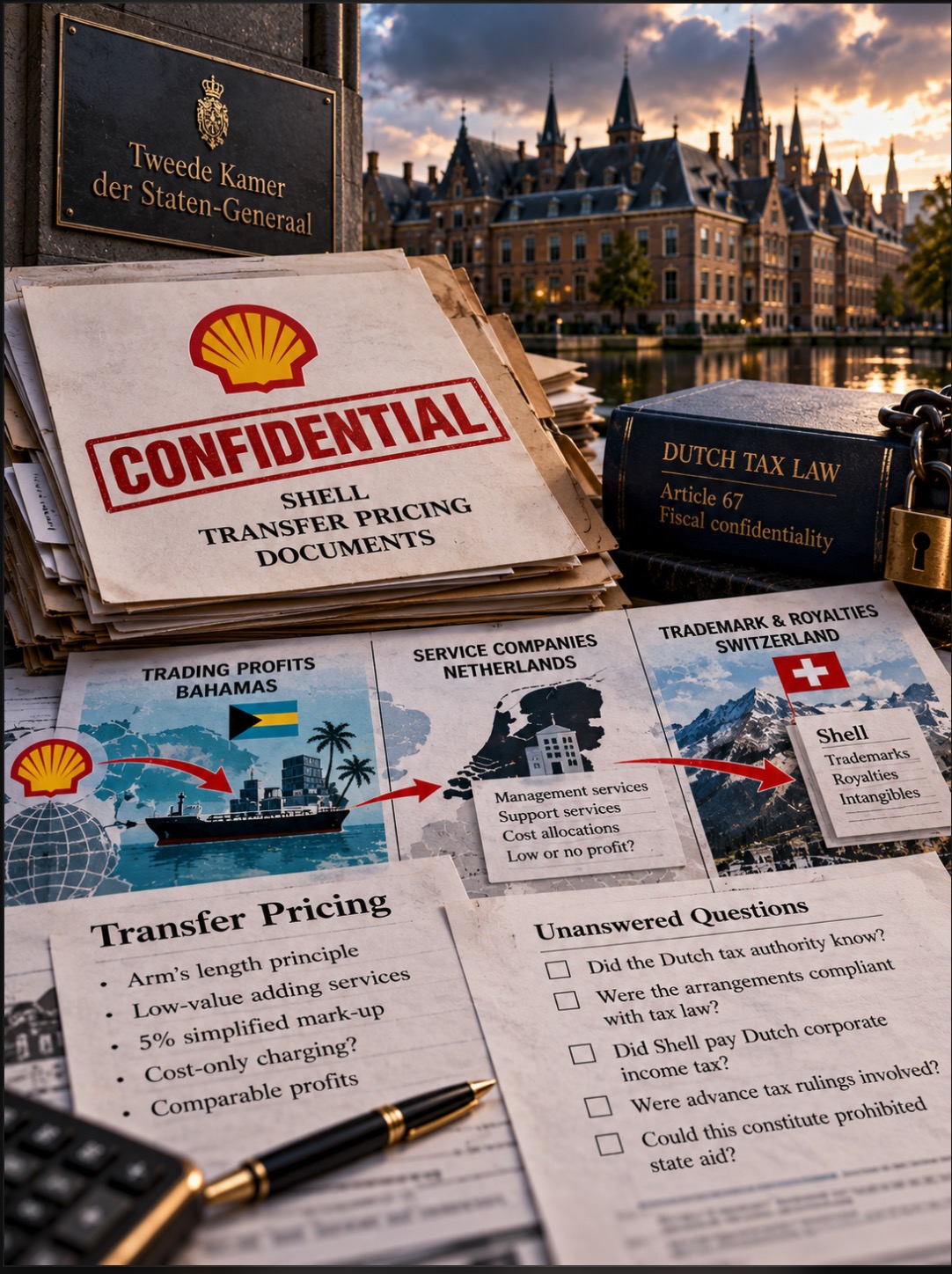
Particular attention has fallen on Shell Western Supply and Trading in the Bahamas, which, according to SOMO’s analysis, generated around $6.2 billion in profit between 2018 and 2023 with 37 employees. That is 104 times the average profit per employee across Shell entities.
Productivity experts have hailed the achievement. “If the rest of the Dutch economy performed like those 37 people, we could abolish income tax tomorrow,” said one fictional economist. “Although apparently that’s roughly what happened anyway.”
Shell has defended its arrangements, saying it complies with applicable law and OECD transfer-pricing principles. A fictional Shell press officer added that the Bahamas entity’s success was “a testament to teamwork, sunshine and an extremely favourable climate — and we mean the weather.”
Charity begins at home
The Shell Files also examined Dutch Shell entities that, according to Follow the Money, historically provided services to other group companies at cost, without a profit margin. A tax law professor has publicly called parts of those arrangements unlawful. Shell rejects allegations of illegality.
The government’s position is that routine intra-group services generally require a profit mark-up, that a simplified 5% mark-up applies to some low-value services, and that charging cost-only can still be acceptable in specific circumstances. Whether Shell’s arrangements fell into those specific circumstances is, of course, specific — and therefore secret.
“It’s a beautiful system,” said Van Zwijgen. “The rule is public. The exception is public. Whether anybody used the exception is the only part of the sentence we have to redact.”
The Swiss rule of thumb
On Shell’s Swiss trademark royalties, the State Secretary explained that a “rule of thumb” — such as the 25% rule examined by SOMO — is not prohibited, but is not sufficient by itself to prove an arm’s-length royalty. Proper analysis requires examining the DEMPE functions: Development, Enhancement, Maintenance, Protection and Exploitation.
Inspired, the Ministry has reportedly adopted its own DEMPE framework for parliamentary questions: Deflect, Explain the general law, Mention confidentiality, Point to Brussels, Exit.
State aid? Ask Brussels
On whether any favourable treatment could amount to illegal state aid, the government pointed out that this is a matter for the European Commission, while adding that it saw no indications of any problem.
“We cannot tell you what we found,” said Van Zwijgen. “But we can tell you we found no indications. These two statements are entirely compatible, provided you don’t think about them at the same time.”
The government also declined to set up an independent inquiry, citing existing internal controls. Asked who reviews the internal controls, Van Zwijgen said: “The internal controls. It’s very efficient. Like the Bahamas.”
Transparency, Dutch style
Under the emerging consensus, the following parties are free to discuss Shell’s tax arrangements in public: Shell, SOMO, Follow the Money, a law professor, Tax Notes, every newspaper in the Netherlands, MPs, foreign governments, readers of this website, and a man in a café in Utrecht who has strong views on DEMPE.
The only party unable to say anything is the one that actually knows what happened.
“People call this secrecy,” said Van Zwijgen. “We call it consistency. We were silent before the leak. We are silent after it. Very few institutions can say that.”
At the time of writing, the Ministry was reportedly considering classifying its own press release.
Satire. Van Zwijgen, the economist and the Shell press officer quoted above are fictional. The underlying facts — the Shell Files publication, the Bahamas figures (SOMO’s analysis), the 5 October 2026 parliamentary answers and Shell’s denial of wrongdoing — are as reported in the original article. Nothing here suggests that Shell or the Dutch tax authority has been found to have acted unlawfully; no such finding has been made.
*This website and sisters royaldutchshellgroup.com, shellnazihistory.com, royaldutchshell.website, johndonovan.website, shellnews.net, and shellwikipedia.com, are owned by John Donovan - more information here. There is also a Wikipedia segment, the Shell DPA Files, "Shell and the Spies", the Shell Leaks files, as well as books written and published by John Donovan - Kindle eBooks. Timeline of the Donovan Shell Feud. Toxic History of Royal Dutch Shell Group. Shell and the Donovans: The Full Media Record — 550+ Articles, 110 Books, 40 Years. *All created and supported by internet wizz, Nick Gill.