15 October 2026 | RoyalDutchShellPlc.com
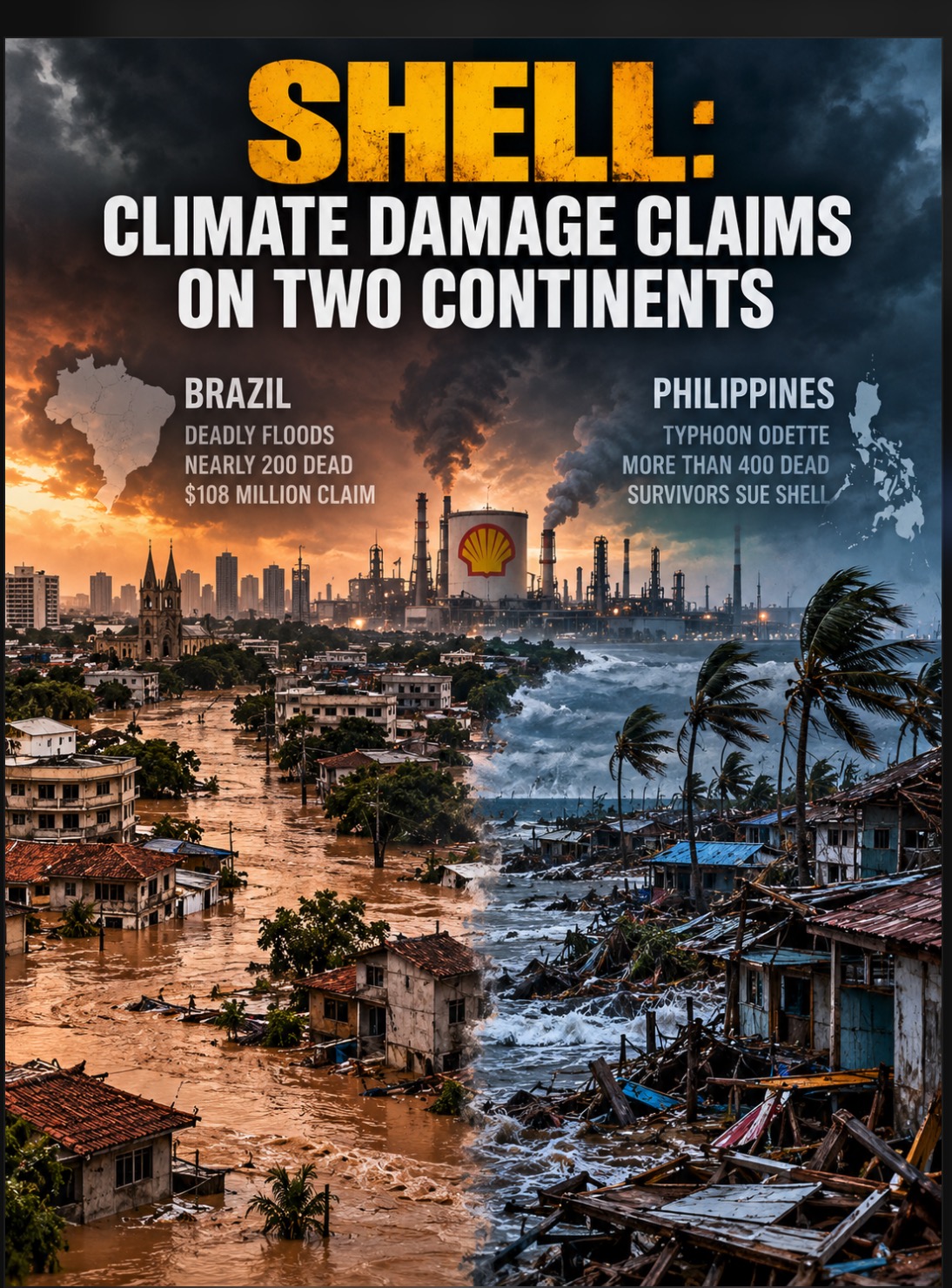
A remarkable new chapter in climate litigation is unfolding on opposite sides of the world. In Brazil, federal prosecutors and an environmental organisation are seeking approximately $108 million from a Shell subsidiary over catastrophic floods that killed nearly 200 people in 2024. In Britain, more than 100 survivors of a devastating Philippine typhoon are pursuing Shell for losses suffered in December 2021. The cases raise a question with potentially enormous consequences for the fossil fuel industry: can a major oil and gas producer be made legally responsible for a measurable proportion of the damage caused by an individual climate-related disaster?
Two disasters, two continents, one corporate defendant
On 15 October 2026, Agence France-Presse published an investigation examining the emerging lawsuits against Shell in Brazil and the Philippines.
The report, republished by Barron’s, highlights a developing legal strategy that differs substantially from traditional environmental litigation.
Historically, many major cases involving Shell have concerned identifiable pollution incidents, allegations of environmental damage near company facilities, or the conduct of particular subsidiaries.
These newer proceedings present a different challenge.
The plaintiffs allege that emissions associated with Shell’s worldwide fossil fuel business contributed to the warming of the planet, thereby increasing the severity or likelihood of particular extreme-weather events.
They argue that Shell should compensate victims for an appropriate share of the resulting harm.
The events occurred thousands of miles apart.
The legal systems are different.
The claimants suffered different losses.
But both cases seek to translate scientific evidence about climate change into legal responsibility for damage suffered by identifiable communities.
If the claimants succeed, the consequences could extend well beyond Shell.
BRAZIL: The $108 million lawsuit
On 9 October 2026, Brazilian federal prosecutors and the environmental organisation Instituto Preservar filed proceedings against Shell’s Brazilian subsidiary.
The claim concerns the devastating floods that struck Rio Grande do Sul in April and May 2024.
The disaster caused widespread destruction across southern Brazil.
Nearly 200 people died, approximately half a million were displaced, and entire communities suffered catastrophic damage.
The claimants seek compensation equivalent to approximately $108 million.
We reported the development in our article published on 10 October:
The new AFP investigation provides additional detail about the legal strategy.
Thales Miola, a lawyer representing Instituto Preservar, explained that the claimants selected Shell because of its size, historical emissions and established contribution to global fossil fuel production.
Shell is not Brazil’s largest oil company.
That distinction belongs to Petrobras.
But the plaintiffs argue that Shell’s historical contribution to global greenhouse gas emissions makes it an appropriate defendant.
The case could provide an important test of whether Brazilian law permits damages to be recovered from an individual fossil fuel producer for its alleged contribution to a climate-amplified disaster.
No court has yet established Shell’s liability in these proceedings.
The scientific calculation behind the Brazilian claim
The most interesting aspect of the Brazilian proceedings is the attempted use of climate-attribution science to calculate a company’s potential financial responsibility.
AFP reports that the claimants rely upon scientific research estimating that human-caused climate change increased the intensity of the rainfall associated with the 2024 disaster.
A peer-reviewed study published in npj Natural Hazards estimated that warming increased the rainfall intensity by approximately 12 per cent, although the study identified substantial uncertainty around the estimate.
An earlier World Weather Attribution investigation concluded that human-induced climate change made comparable extreme rainfall more than twice as likely and increased its intensity by approximately 6–9 per cent.
The studies used different methods and statistical assessments.
They should not be presented as producing identical estimates.
The Brazilian plaintiffs have adopted the approximately 12 per cent figure as part of their legal argument.
They also rely upon estimates from the Carbon Majors database attributing approximately 2.02 per cent of historical industrial carbon dioxide emissions to Shell.
The claimants seek to connect those two figures.
Their proposed approach is to calculate Shell’s share of the additional harm associated with climate change, using its estimated contribution to historical emissions.
In simplified terms, the argument involves applying Shell’s approximately two per cent historical emissions share to the climate-related portion of the disaster’s damage.
That is the plaintiffs’ proposed attribution framework.
It is not an accepted judicial formula for calculating damages.
A court would need to consider whether the scientific evidence, relevant Brazilian law and other evidence of causation justify the requested compensation.
The difference is fundamental.
Scientific evidence that climate change intensified rainfall does not automatically establish that an individual company is legally liable for a specified percentage of flood damage.
The plaintiffs must establish that legal connection.
Shell would be entitled to challenge both the legal reasoning and the claimed amount.
THE PHILIPPINES: Survivors of Typhoon Odette take Shell to court
The Philippine proceedings are particularly significant because they concern identifiable individuals seeking compensation for deaths, injuries and destruction of property.
On 16 December 2021, Super Typhoon Rai — known locally as Odette — struck the Philippines.
The storm devastated communities across the central and southern regions of the country.
More than 400 people died.
Millions were affected, and large numbers of homes and livelihoods were destroyed.
For those who survived, the consequences were often life-changing.
Families lost relatives.
Homes disappeared.
Fishing boats, farms and businesses were destroyed.
Communities faced the difficult task of rebuilding.
Four years later, a group of survivors decided to pursue Shell through the English legal system.
On 23 October 2025, international law firm Hausfeld announced that it had sent a formal Letter Before Action to Shell plc and The Shell Transport and Trading Company Limited.
At that stage, Hausfeld represented 67 individuals.
The letter outlined intended legal proceedings concerning losses allegedly intensified by climate change.
The firm identified claims involving property destruction, personal injuries, bereavement, psychological harm and lost livelihoods.
It also raised alleged violations of environmental and constitutional rights under Philippine law.
The law firm’s original announcement is available here:
Hausfeld: Shell Hit With Legal Action Over Climate Damages by Typhoon Odette Survivors
From a legal warning to High Court proceedings
The Philippine case subsequently advanced beyond its initial pre-action stage.
In December 2025, the claimants filed proceedings in the High Court in London.
Contemporaneous reporting indicated that the claimant group had expanded to more than 100 people.
AFP’s 15 October 2026 report describes approximately 100 survivors pursuing the claim.
This chronology is important.
The original October 2025 announcement concerned 67 individuals sending a legal warning.
The subsequent proceedings involved a larger group.
The two figures refer to different stages and should not be confused.
The claimants are represented by Hausfeld, with support from campaign organisations and other advocates.
They allege that Shell’s historical greenhouse gas emissions materially contributed to anthropogenic climate change and that climate change intensified the severity or likelihood of Typhoon Odette.
They seek financial compensation for losses allegedly attributable to that contribution.
The proceedings also raise questions concerning Shell’s knowledge of climate risks and its historical communications about those risks.
The case remains contested.
It has not resulted in a finding that Shell is legally responsible for the destruction caused by the typhoon.
The allegations concerning Shell’s historical knowledge
One particularly contentious element of the Philippine case concerns what Shell knew about climate change and when it knew it.
The claimants allege that Shell possessed substantial knowledge of the relationship between fossil fuel emissions and global warming long before climate change became a prominent issue in public policy.
They also allege that the company failed adequately to communicate the implications of that knowledge.
AFP interviewed Greg Lascelles, a lawyer at Hausfeld, who described Shell’s alleged history of misinformation as an aggravating factor in the case.
The claimants contend that Shell’s historical knowledge and conduct are relevant to establishing negligence under Philippine law.
They are also seeking to establish that the company’s commercial activities contributed to climate-related harm suffered by people far removed from Shell’s principal operating centres.
These allegations remain unproven in the proceedings.
Shell disputes the suggestion that it possessed unique knowledge of climate change.
The company argues that scientific understanding of climate change developed across governments, academic institutions, industry and wider society.
The legal distinction matters.
Evidence that a company was aware of climate risks does not, by itself, establish that the company committed an actionable wrong.
Equally, the existence of wider scientific knowledge does not automatically resolve allegations concerning particular corporate statements or omissions.
Those questions require examination of the relevant documents, applicable law and evidence.
Shell’s response: Climate litigation against individual companies is not the solution
Shell has publicly addressed the Philippine proceedings.
On its official website, the company acknowledges the suffering experienced by people affected by Typhoon Odette.
However, Shell rejects the proposition that litigation against individual corporations is an effective solution to the global energy transition.
The company argues that the production and use of fossil fuels result from decades of decisions involving governments, industries, businesses and consumers.
It maintains that no single company can be held responsible for the worldwide energy system.
Shell also emphasises the continuing need for affordable and reliable energy.
Its position is that reducing global emissions requires coordinated government policy, technological innovation, changes in energy demand and investment across the economy.
Shell intends to defend the Philippine claim.
The company’s explanation is available directly from its own website:
Shell: What Kind of Climate Lawsuits Have Been Filed Against Shell?
This is an important source because it allows readers to examine the company’s position without relying entirely upon descriptions supplied by its opponents.
The central legal problem: Who caused the damage?
Both cases confront an exceptionally difficult issue.
Climate change is a global process.
Greenhouse gases accumulate in the atmosphere.
Emissions produced in one country can contribute to changes affecting another country thousands of miles away.
That distinguishes climate litigation from many conventional pollution claims.
In an ordinary industrial pollution case, investigators may be able to identify a specific discharge from a particular facility and connect it with contamination of a nearby river or community.
Climate-related disasters are different.
The emissions contributing to global warming originate from millions of activities across numerous countries over many decades.
Individual storms and floods are influenced by atmospheric conditions, natural climate variability, geography, infrastructure, development patterns and social vulnerability.
The claimants therefore face a complex evidential task.
They must connect emissions associated with Shell to global warming.
They must connect global warming to changes in the relevant disaster’s probability or intensity.
And they must establish that those changes caused legally compensable damage under the law governing their claims.
That is a formidable challenge.
But the scientific evidence available to examine parts of that chain has improved substantially.
Researchers can now use observations and climate models to estimate how human-induced warming has changed the likelihood or intensity of certain types of extreme weather.
The legal question is whether and how those findings can support liability against a particular producer.
There is not yet a universally accepted judicial answer.
Why climate-attribution science matters
Climate-attribution research has become increasingly sophisticated.
Scientists can compare the probability of particular weather conditions in today’s warmer climate with estimates of their probability in a hypothetical climate without human-caused warming.
Depending upon the event and available evidence, such studies may identify measurable changes in intensity or likelihood.
The Brazilian flood research provides one example.
Comparable analyses have examined heatwaves, extreme rainfall, droughts and other events around the world.
However, the strength and precision of the findings vary considerably.
Some event types are much easier to assess than others.
Researchers also distinguish between the physical hazard and the disaster resulting from it.
A period of extreme rainfall may produce vastly different consequences depending upon land use, drainage systems, flood defences, population density and emergency preparedness.
The Brazilian floods illustrate that distinction.
Researchers identified climate change as an important contributor to rainfall intensity.
They also highlighted the roles of El Niño, inadequate infrastructure and social vulnerability.
These findings demonstrate why attributing a particular disaster’s total financial cost to climate change is not a straightforward exercise.
Nevertheless, attribution science provides increasingly relevant evidence for litigation.
It can help courts consider whether climate change materially contributed to particular environmental conditions.
The next question is how to attribute responsibility among potential defendants.
Shell’s historical share of emissions
Both sets of claimants rely upon the scale of Shell’s historical fossil fuel activities.
The Carbon Majors research programme examines emissions associated with major fossil fuel and cement producers.
Its datasets attribute historical emissions to identifiable producing entities.
Much of the emissions associated with oil and gas producers arise when customers burn the products they sell.
These are commonly described as downstream or Scope 3 emissions.
Shell is among the major companies identified in historical emissions research.
AFP reports that the Brazilian claimants rely upon an estimate attributing approximately 2.02 per cent of global historical carbon dioxide emissions from fossil fuels and cement production to Shell.
But this number requires careful interpretation.
An emissions attribution is not automatically a legal allocation of responsibility.
It does not establish that Shell should bear precisely the same percentage of every climate-related loss.
The answer depends upon the applicable legal duties, causation standards, evidence and remedy being sought.
The claimants argue that historical emissions provide a scientifically grounded basis for assigning a share of responsibility.
Shell disputes the attempt to impose liability upon an individual company for the consequences of worldwide fossil fuel consumption.
The courts must decide how, if at all, the emissions data translate into legally enforceable obligations.
The geographical implications are extraordinary
The two proceedings demonstrate how climate litigation is crossing national boundaries.
In Brazil, domestic prosecutors and an environmental organisation are pursuing a Shell subsidiary over damage suffered within Brazil.
In Britain, Philippine residents are bringing proceedings against Shell companies over damage suffered in the Philippines.
The legal foundations differ.
The Brazilian proceedings depend upon Brazilian law and the jurisdiction of Brazilian courts.
The Philippine claim is being pursued in England, while invoking alleged duties and rights arising under Philippine law.
That creates additional questions about jurisdiction, applicable law and remedies.
The mere fact that a multinational company is headquartered in one country does not automatically mean that its courts can resolve every claim arising elsewhere.
Nor does bringing proceedings in England establish that Philippine law imposes the liability alleged.
These matters may need to be considered in preliminary legal proceedings before any final determination of damages.
But the attempt itself is significant.
The claimants are seeking accountability through legal systems connected with Shell’s corporate presence rather than limiting proceedings to the countries where the disasters occurred.
That could influence the future development of transnational climate litigation.
Other industries may face similar claims
Shell is not the only company confronting climate-related damages claims.
AFP also identifies proceedings involving other major industrial producers.
Swiss cement company Holcim faces litigation concerning the consequences of rising sea levels for residents of an Indonesian island.
Pakistani farmers have brought proceedings in Germany involving major industrial companies.
The cases differ in their legal foundations and factual circumstances.
They should not be treated as interchangeable.
But they demonstrate a common development.
Claimants are attempting to recover compensation for specific climate-related harm from companies whose historical emissions can be estimated.
Noah Walker-Crawford, a researcher at the Grantham Research Institute on Climate Change and the Environment at the London School of Economics, described the cases to AFP as tests of whether such a legal strategy is viable.
His assessment is important.
These proceedings are not simply attempts to obtain compensation in two isolated disputes.
They may also establish whether comparable claims can proceed against other major industrial producers.
Success could encourage additional litigation.
Failure could reveal important limits within existing legal frameworks.
Either outcome would be significant.
COMMENTARY: The fossil fuel industry’s next legal frontier
Shell has faced environmental litigation for decades.
The Niger Delta has generated numerous legal disputes concerning pollution, environmental remediation and alleged responsibility for damage to communities.
The company’s Sakhalin operations have been the subject of extensive environmental controversy and regulatory action.
More recently, Shell has faced litigation concerning greenhouse gas emissions and its energy transition strategy.
But the Brazilian and Philippine cases represent a further development.
The claimants are not merely asking courts to order cleaner operations or lower future emissions.
They are seeking compensation for specific disasters that have already occurred.
That distinction is fundamental.
The litigation attempts to connect historical industrial emissions with present-day human losses.
The consequences could be profound if courts accept the proposed legal reasoning.
A company might face claims arising from climate-related events far beyond the countries in which it operates.
Potential liability could reflect decades of accumulated emissions rather than only current operating practices.
And claimants could seek compensation for injuries, lost property and destroyed livelihoods.
However, the difficulties are substantial.
Climate change is a collective global phenomenon.
Governments have encouraged and regulated fossil fuel production.
Industries and consumers have depended upon those fuels.
Many companies have contributed to emissions.
Determining how responsibility should be distributed requires more than identifying a major historical producer.
It requires a defensible legal framework.
That is why the outcome of these cases remains uncertain.
A difficult question for shareholders
For Shell shareholders, this emerging category of litigation deserves attention.
Traditional environmental liabilities can sometimes be estimated by reference to identifiable incidents, remediation costs or settlements.
Claims for climate-related damage may be considerably harder to quantify.
The scale of possible exposure depends upon whether courts accept the underlying legal theories and what limits they impose.
The Brazilian claim seeks approximately $108 million.
The Philippine claim seeks damages that have not been specified publicly in the same way.
Those figures cannot presently be used to calculate Shell’s overall future exposure.
Nor would it be reasonable to assume that comparable claims will necessarily succeed.
But shareholders have an interest in understanding whether such litigation could become a material financial risk.
They are also entitled to expect accurate disclosure of significant proceedings and candid discussion of relevant uncertainties.
Shell’s position that global climate change requires collective action is an important part of the debate.
It does not, however, eliminate the need to examine individual claims on their legal and evidential merits.
The historical knowledge question
One aspect of the Philippine proceedings also connects with an important theme running through the independent Shell archive.
What did senior corporate management know about the risks associated with its activities?
When was that knowledge acquired?
And how did the company communicate those risks?
The Philippine claimants allege that Shell understood important aspects of climate change decades ago.
They also challenge aspects of the company’s historical public communications.
The Brazilian proceedings reportedly cite a Shell document from 1986 recognising the contribution of fossil fuels to greenhouse gas emissions and global warming.
Such documents may be relevant to allegations concerning knowledge, foreseeability and corporate conduct.
But their legal significance cannot be assumed.
A contemporaneous internal report can establish that particular information was available within a company.
It does not automatically establish that later statements were deliberately misleading.
Nor does it, without further evidence, prove the elements of negligence or liability for a specific disaster.
The distinction between documentary knowledge and legal wrongdoing is essential.
The independent Shell archive has long preserved internal correspondence and historical corporate records.
The value of such material lies in enabling readers to distinguish what documents actually establish from what commentators or litigants infer.
That same standard should apply here.
The importance of reporting Shell’s defence
There is also a responsibility to present Shell’s position fairly.
The company rejects the proposition that individual corporate litigation offers an effective solution to global climate change.
It emphasises the continuing demand for fossil fuels and the need for coordinated policies across governments, industries and consumers.
Those arguments are relevant.
A legal system must avoid assigning responsibility without a proper basis in law and evidence.
But claimants are equally entitled to bring proceedings where they believe their rights have been violated.
They are entitled to present scientific evidence and arguments concerning corporate responsibility.
The courts must evaluate those competing positions.
The objective of independent reporting should not be to declare liability before the evidence has been tested.
It should be to explain the facts, identify the disputed issues and preserve the documentary record.
That is particularly important when the subject concerns catastrophic human losses and potentially enormous corporate liabilities.
Conclusion: Can a percentage of climate damage become a legal debt?
The two Shell lawsuits represent an important stage in the development of climate litigation.
In Brazil, prosecutors and an environmental organisation are attempting to translate climate-attribution research and historical emissions estimates into a claim for approximately $108 million.
In Britain, survivors of Typhoon Odette are pursuing compensation for personal and economic losses they allege were intensified by climate change associated with Shell’s historical fossil fuel activities.
Both cases raise difficult questions.
Can a company’s historical emissions be connected to a particular disaster with sufficient precision?
Does applicable law recognise a duty capable of supporting the claim?
Can courts determine what proportion of the resulting harm should be attributed to an individual company?
And how should responsibility be allocated when emissions arise from a worldwide energy system involving governments, businesses and consumers?
The scientific and legal questions are related.
But they are not identical.
A scientific attribution study may help establish how climate change affected a disaster.
It cannot, without an applicable legal framework, determine corporate liability.
The courts must make that determination.
For Shell, the significance is that climate litigation is moving beyond demands for future emissions reductions towards claims for compensation for disasters that have already destroyed lives, homes and livelihoods.
For the claimants, the cases offer a possible route to accountability.
For Shell, they present complex legal challenges that the company intends to defend.
For shareholders, they introduce another category of potential financial and reputational risk.
And for the wider fossil fuel industry, they may help establish whether climate-attribution science can underpin legally enforceable claims for disaster losses.
The outcomes remain uncertain.
But the legal questions are now before the courts.
Principal documentary and reporting sources
1. Agence France-Presse — 15 October 2026
Why Is Shell Facing Lawsuits Over Climate Disasters in Brazil and the Philippines?
The immediate basis for this article, including interviews with Brazilian and Philippine legal representatives and discussion of the developing climate-attribution strategy.
2. Barron’s — 15 October 2026
Why Is Shell Facing Lawsuits Over Climate Disasters in Brazil and the Philippines?
Republication of the AFP investigation by Ivan Couronne.
3. Hausfeld — 23 October 2025
Shell Hit With Legal Action Over Climate Damages by Typhoon Odette Survivors
The claimants’ legal representatives explain the original Letter Before Action, the losses alleged and the legal basis being advanced.
4. Hausfeld — December 2025
Survivors of Deadly Philippines Super Typhoon Take Shell to Court Over Climate Harms
Details of the commencement of High Court proceedings following the October legal notice.
5. Shell plc — Corporate Position
What Kind of Climate Lawsuits Have Been Filed Against Shell?
Shell’s published account of the Philippine case and its defence of its position in climate-related litigation.
6. AFP — 10 October 2026
Brazil Prosecutors Sue Shell for $108 Million Over Deadly 2024 Floods
Contemporaneous reporting of the Brazilian action.
7. World Weather Attribution — June 2024
Climate Change, El Niño and Infrastructure Failures Behind Massive Floods in Southern Brazil
Scientific assessment of the role of climate change in the rainfall and the additional importance of natural variability and infrastructure vulnerability.
8. npj Natural Hazards — 2026
Peer-reviewed scientific study estimating the influence of anthropogenic climate change on the probability and intensity of the extreme rainfall.
9. The Independent — 17 December 2025
Survivors Sue Shell in Landmark Case Over Deadly Typhoon in Philippines
Contemporaneous reporting of the Philippine High Court proceedings and accounts from affected communities.
10. RoyalDutchShellPlc.com — 10 October 2026
Our earlier coverage of the Brazilian proceedings.
Editorial and legal disclaimer
This article distinguishes authenticated corporate statements, scientific studies, contemporary journalism, claimants’ allegations and editorial commentary.
The Brazilian and Philippine proceedings remain contested. Neither has established that Shell is legally liable for the disasters concerned.
Scientific findings concerning the contribution of human-induced climate change to extreme weather do not automatically establish the legal responsibility of an individual fossil fuel producer for particular losses.
Historical emissions estimates are not judicial determinations of liability.
Allegations concerning Shell’s historical knowledge, communications and conduct are attributed to the claimants and have not been treated as proven findings of wrongdoing.
Shell’s publicly stated defence is included.
The website’s general disclaimer also applies.








