15 October 2026 | RoyalDutchShellPlc.com
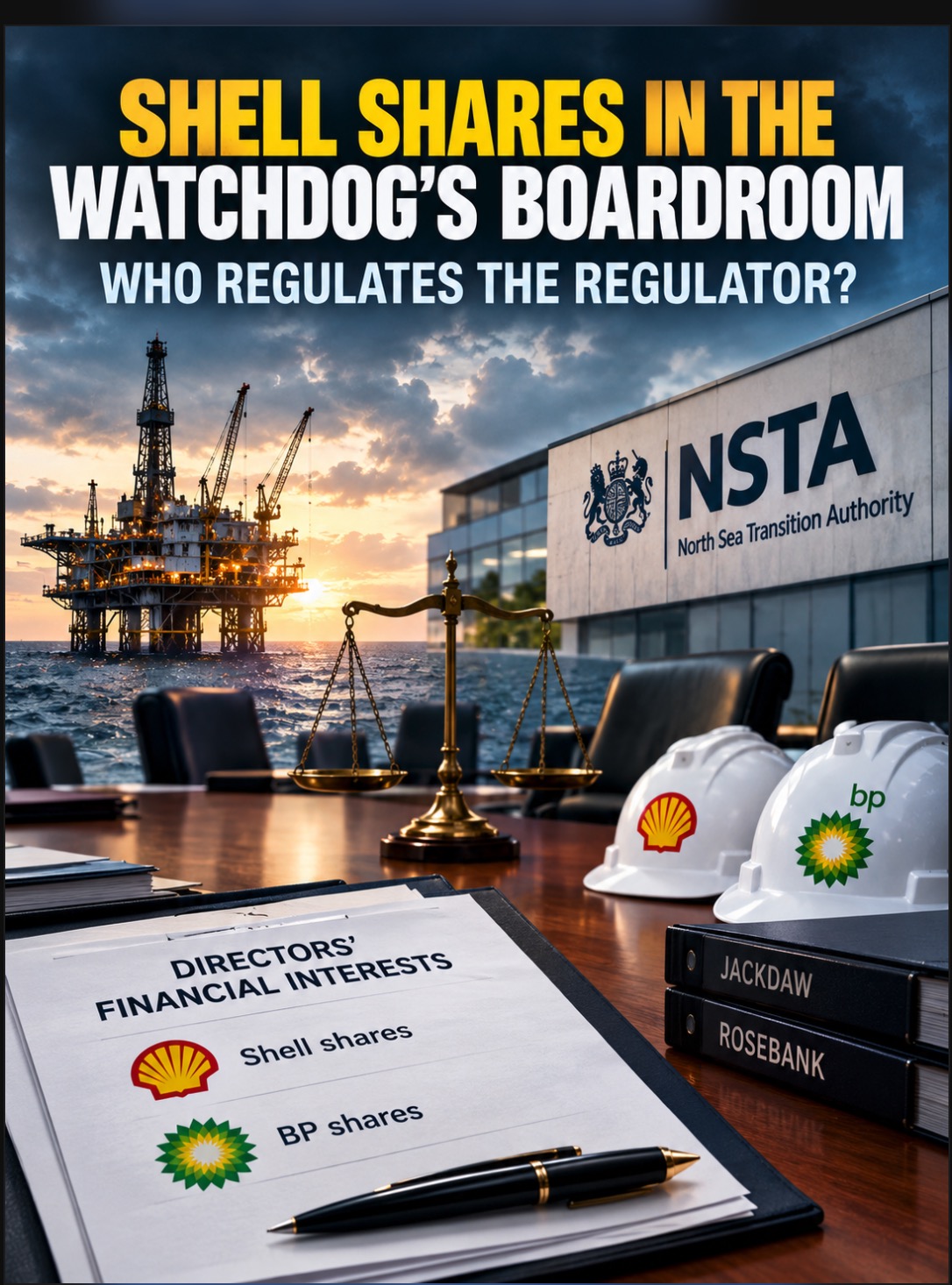
Who watches the watchdog when some of its directors own shares in the companies it regulates? An investigation published today by Scottish investigative journalism organisation The Ferret reveals that two recently appointed directors of the North Sea Transition Authority hold shares in Shell and BP worth more than £77,000 combined. One is a former Shell finance executive who remains involved in the company’s UK pension arrangements. The disclosures have prompted criticism from environmental campaigners and an academic expert in regulation. The authority insists that its directors’ interests are properly declared and do not compromise independent judgment. But with Shell-linked developments including Jackdaw and Rosebank awaiting fresh regulatory decisions, the investigation raises important questions about the appearance — as well as the reality — of regulatory independence.
The investigation that raises uncomfortable questions
On 15 October 2026, Scottish investigative journalism organisation The Ferret published an investigation by journalist Paul Dobson examining the financial interests and previous industry connections of directors at the North Sea Transition Authority (NSTA).
The NSTA is the UK body responsible for licensing and regulating offshore oil and gas activities.
Its responsibilities include decisions affecting petroleum exploration and production, the stewardship of existing fields, decommissioning and enforcement of industry obligations.
It also plays an increasingly important role in the development of offshore carbon storage and aspects of the energy transition.
The organisation must therefore balance substantial commercial, environmental and public-interest considerations.
That makes the independence of its decision-makers particularly important.
The Ferret’s investigation identifies financial interests declared in the NSTA’s latest annual report.
The relevant disclosures are publicly available.
They are not anonymous allegations or confidential information obtained through a leak.
They appear in an official document presented to Parliament.
The central question is whether disclosure and recusal arrangements provide sufficient safeguards when regulators hold financial interests in companies operating within the industries they oversee.
A former Shell executive with £58,510 in Shell shares
One of the directors identified is Ian Chisholm.
Chisholm joined the NSTA board as a non-executive director on 7 April 2026.
He also became chair of its Audit and Risk Committee.
According to the regulator’s annual report, Chisholm declared ownership of 1,633 ordinary shares in Shell.
The holding was valued at £58,510.
His declaration was made on 16 March 2026.
Chisholm previously held several finance positions within Shell.
His continuing connections include a role with Shell Pensions Trust Limited, where the NSTA’s annual report lists him as a member of the Investment and Funding Committee and chair of its ESG Forum.
That relationship is distinct from his ownership of Shell shares.
But it demonstrates that his association with Shell extends beyond previous employment.
For a director involved in overseeing a regulator’s audit and risk arrangements, these connections raise questions worth examining.
A financial interest in a company does not automatically prevent someone from exercising independent judgment.
Nor does previous employment establish improper influence.
However, a regulatory body must consider whether such interests create actual, potential or perceived conflicts.
The distinction is especially relevant when the company concerned operates major projects subject to decisions within the regulator’s remit.
The NSTA has determined that Chisholm’s declared shareholding does not impair his independent judgment.
Critics question whether that assessment is sufficient to maintain public confidence.
Source: NSTA Annual Report and Accounts 2025–26, Directors’ Financial Interests, page 32
A second director holds BP shares
The Ferret also identified the interests of Rebecca Wiles, another recently appointed non-executive director.
Wiles joined the NSTA board on 1 May 2026.
She previously worked for BP for more than 30 years.
The regulator’s annual report records that she held 3,348 BP ordinary shares, valued at £19,150 on 1 May 2026.
Wiles is also a non-executive director of Tullow Oil.
Tullow has interests connected with the oil and gas industry, including decommissioning activities in the North Sea.
As with Chisholm, the declared shareholding is a matter of public record.
There is no evidence in the material examined that Wiles concealed the interest.
Nor is there evidence that she improperly influenced a regulatory decision involving BP or Tullow.
The concern is more general.
Should someone who helps oversee a regulator be permitted to retain a financial interest in a company whose commercial activities fall within the regulatory sector?
The NSTA believes its safeguards are adequate.
Campaigners and regulatory specialists have raised objections.
The disagreement goes to the heart of how independence should be understood.
Other former oil executives on the board
The investigation extends beyond the two disclosed shareholdings.
Several other senior NSTA figures have substantial professional backgrounds in the energy industry.
Stuart Payne, the authority’s chief executive, previously held positions with Shell and Dana Petroleum.
Mitch Flegg, appointed as a non-executive director in May 2026, previously served as chief executive of Serica Energy.
He also served on the board of Offshore Energies UK, the trade association representing the offshore energy industry.
Malcolm Brown, another NSTA board member, spent approximately four decades working in the oil and gas industry and held senior positions at BG Group.
These appointments illustrate the extent to which the regulator draws upon experienced industry personnel.
That is not necessarily improper.
Regulating offshore petroleum production requires substantial knowledge of engineering, geology, finance, safety systems, commercial contracts and the management of complex industrial operations.
Experienced industry professionals may possess expertise that would be difficult to obtain elsewhere.
But the concentration of previous industry relationships can also create questions about institutional culture.
A regulator staffed by people who have spent much of their careers working within an industry must demonstrate that it can challenge that industry effectively.
Professional familiarity can help officials understand complex businesses.
It can also create the appearance of excessive closeness.
The issue is not whether former Shell or BP executives should automatically be excluded from public service.
It is whether the regulator’s governance arrangements provide adequate safeguards against conflicts and maintain public confidence.
The official disclosures confirm the figures
The NSTA’s 2025–26 Annual Report and Accounts provides independent primary-source confirmation of the disclosed financial interests.
The relevant section records the holdings of Chisholm and Wiles.
It also identifies other directors’ declared investments.
The report explains that directors must disclose interests upon appointment and annually thereafter.
They must also declare relevant conflicts at the beginning of board meetings.
Where a conflict arises in relation to an agenda item, the director concerned is not permitted to participate in the discussion.
The NSTA’s board states that it does not regard the declared holdings as sufficiently significant to impair independent judgment.
It also maintains that its regulatory powers could not materially influence the value of the shares concerned.
These are important safeguards and explanations.
They should not be omitted from any fair account of the controversy.
But the existence of disclosure procedures does not necessarily resolve every question about perceived conflicts.
There is a difference between complying with an internal governance policy and satisfying every reasonable expectation of public impartiality.
That distinction explains the criticism now being directed at the regulator.
Why Jackdaw and Rosebank make this particularly sensitive
The timing of The Ferret’s investigation is important.
Two major North Sea projects with Shell connections are awaiting new regulatory decisions.
They are Jackdaw and Rosebank.
Jackdaw is a gas and condensate development approximately 250 kilometres east of Aberdeen.
Shell originally developed the project, which is now associated with Adura, the joint venture combining Shell and Equinor’s UK offshore oil and gas interests.
Rosebank is a major oil and gas development west of Shetland.
It was originally associated principally with Equinor and Ithaca Energy and is now also within Adura’s portfolio.
Both projects received regulatory consent under the previous Conservative government.
Jackdaw was approved in 2022.
Rosebank received development consent in 2023.
Both subsequently became the subjects of legal challenges concerning the adequacy of their environmental assessments.
The NSTA was involved in the original consenting process.
That does not mean its board members personally approved the applications.
Regulatory decisions are made through established statutory and administrative procedures.
The distinction between institutional responsibility and an individual director’s participation is essential.
Nevertheless, the NSTA has an important role in decisions affecting these projects.
That makes questions about its independence particularly relevant.
The courts intervene
In January 2025, the Court of Session in Edinburgh ruled on challenges concerning the original consents for Jackdaw and Rosebank.
The proceedings followed the UK Supreme Court’s landmark 2024 judgment in R (Finch) v Surrey County Council.
That judgment established that environmental impact assessment must consider relevant downstream greenhouse gas emissions arising from the eventual use of extracted petroleum.
The earlier assessments for Jackdaw and Rosebank had not adequately addressed those emissions.
The Scottish court consequently ruled that the consents could not stand in their existing form.
The developers were allowed to continue certain work while fresh environmental assessment and consenting procedures were undertaken.
The judgments did not establish that the projects could never lawfully proceed.
They required the relevant environmental impacts to be reconsidered under the applicable legal framework.
Further environmental submissions were lodged in July 2026.
New decisions remain necessary.
The developers maintain that both projects can contribute to UK energy security and economic activity.
Environmental organisations argue that their climate implications and compatibility with national energy policy require careful scrutiny.
These competing positions form the background to the present governance controversy.
Project sources: Adura — Jackdaw and Adura — Rosebank.
Does holding Shell shares compromise regulatory independence?
The Ferret quotes Tessa Khan, executive director of environmental campaign organisation Uplift.
Khan argues that directors who hold financial interests in companies subject to regulation create unacceptable conflicts.
She questions whether the NSTA can adequately prioritise the public interest while directors retain investments in the industry.
Uplift was involved in the legal challenges concerning North Sea developments.
Its position is therefore informed by direct participation in the controversy surrounding offshore oil and gas approvals.
But its statements remain arguments made by a campaigning organisation.
They are not judicial findings of misconduct by NSTA directors.
The distinction is important.
There is no evidence in The Ferret’s investigation that Chisholm or Wiles personally intervened improperly in the Jackdaw or Rosebank decisions.
Indeed, both joined the board in 2026, after the original approvals issued in 2022 and 2023.
They cannot reasonably be held responsible for decisions made before their appointment.
The governance question is therefore prospective as well as institutional.
What safeguards will apply when current board members hold financial interests connected with companies whose projects may require further regulatory consideration?
And how can the public establish that those safeguards are being applied consistently?
An academic warns about perceived regulatory capture
The Ferret also interviewed Andrew Watterson, an academic specialising in regulation at the University of Stirling.
Watterson expressed concern about the NSTA’s close professional and financial connections with the oil and gas industry.
He suggested that the public might perceive the organisation as having been captured by the sector it regulates.
He also argued that directors should divest themselves of oil, gas and related industry shares to reinforce confidence in impartial decision-making.
The term regulatory capture has a specific meaning in discussions of public administration and governance.
It generally refers to circumstances in which a regulator comes to serve the interests of the regulated industry rather than the wider public interest.
Capture may arise through institutional relationships, information dependence, career incentives or other mechanisms.
However, an appearance of closeness is not proof of capture.
Establishing actual regulatory capture would require evidence concerning decisions, conduct, governance practices and the exercise of regulatory authority.
The disclosed shareholdings and previous employment connections justify examination.
They do not, by themselves, establish that the NSTA has been captured.
That distinction should remain central to the discussion.
The regulator’s defence: Industry expertise is essential
The NSTA has responded to the criticism.
It argues that the oil and gas industry is highly specialised and that direct experience within the sector is valuable when carrying out complex regulatory functions.
The authority states that its board includes professionals from a range of backgrounds.
It also points to experience gained in other industries and regulatory organisations.
The board is chaired by Liz Ditchburn, whose background includes senior public-sector responsibilities.
According to the NSTA, its conflict-of-interest procedures require directors to declare relevant interests and withdraw from affected discussions.
It maintains that the disclosed shareholdings do not materially compromise independent judgment.
The regulator also argues that none of its powers could materially affect the value of the Shell and BP shares identified.
This is an important consideration.
Shell and BP are large multinational companies with operations across numerous markets.
Their share prices are influenced by global oil and gas prices, financial results, investment decisions and wider economic conditions.
It would be difficult to establish that a particular NSTA decision would materially alter the value of either company’s shares.
But critics argue that materiality in financial terms is not the only consideration.
A conflict-of-interest framework may also need to address the appearance of divided loyalties.
That is the point at which the two sides disagree.
The NSTA emphasises disclosure, proportionate assessment and recusal.
Its critics favour stricter limits on financial holdings.
Neither position should be misrepresented.
The wider issue: Can a regulator be too close to its industry?
The Ferret previously examined financial and professional connections involving the North Sea regulator.
In 2021, when the organisation was still known as the Oil and Gas Authority, the publication reported that three directors held shares linked to the fossil fuel industry worth more than £225,000.
The latest investigation therefore does not concern an entirely new governance question.
It forms part of a continuing debate about the relationship between the regulator and the sector it oversees.
The organisation was established following the Wood Review, which examined how the UK could maximise economic recovery from declining North Sea resources.
Its responsibilities have subsequently expanded to include supporting the energy transition and regulating additional activities.
This creates a complex institutional position.
The authority must oversee an industry that remains economically important.
It must seek compliance with applicable laws and standards.
It must enforce obligations concerning decommissioning and other activities.
And it must operate within national energy and climate policy.
Some of those objectives can create competing pressures.
The NSTA’s official annual report acknowledges both the importance of continued energy production and the need to accelerate emissions reductions.
The board’s composition and governance arrangements must be considered against that broader mandate.
Evidence that the regulator does take enforcement action
A fair assessment must also recognise that the NSTA has used its enforcement powers against industry operators.
In April 2026, the regulator announced its largest financial penalty to date against EnQuest.
The penalty concerned failures associated with decommissioning inactive wells.
The case involved 33 wells that had not been decommissioned within the required arrangements.
This action illustrates that the NSTA does not simply approve industry requests or refrain from imposing penalties.
It has statutory responsibilities extending beyond licensing.
It also investigates non-compliance and enforces regulatory obligations.
That enforcement record is relevant when assessing broad allegations that the authority is unwilling to challenge the industry.
But individual enforcement actions do not automatically resolve governance concerns about financial interests.
The regulator must demonstrate impartiality across its responsibilities.
The existence of both industry expertise and enforcement activity forms part of the evidence.
So do the declared financial interests.
A balanced assessment requires consideration of all three.
COMMENTARY: Independence Must Be Demonstrated, Not Merely Asserted
The most revealing feature of The Ferret’s investigation is that the central facts are not disputed.
Ian Chisholm owns Shell shares.
Rebecca Wiles owns BP shares.
Both holdings were disclosed.
Both individuals have significant professional experience within the oil and gas industry.
And both sit on the board of an organisation responsible for regulating that industry.
The dispute concerns what those facts mean.
The NSTA believes the financial interests are insufficiently significant to impair independent judgment.
Its critics believe the holdings create an unacceptable appearance of conflict.
There is no need to allege corruption to recognise the legitimacy of this question.
Public confidence in regulation depends upon more than the absence of proven wrongdoing.
It also depends upon transparent procedures and credible safeguards.
The NSTA has disclosure and recusal arrangements.
But the existence of those policies raises further practical questions.
How frequently are relevant conflicts declared?
How are potential conflicts assessed?
Who determines whether a director must withdraw from a discussion?
Are those decisions independently reviewed?
And how much information can be published without compromising legitimate confidentiality?
These are ordinary governance questions.
They apply to financial regulators, environmental authorities, competition bodies and public institutions more generally.
The North Sea regulator should not be treated as an exception.
Shell’s perspective also matters
Shell is entitled to seek regulatory decisions concerning its lawful commercial activities.
The company is also entitled to benefit from the experience and expertise of former employees who subsequently enter public service.
There is nothing inherently improper about a former Shell executive becoming a regulator.
Former industry professionals can bring valuable knowledge.
But individuals moving into regulatory positions must operate under public-interest obligations distinct from those associated with their previous employment.
Those obligations include managing conflicts and maintaining institutional independence.
The same principle applies to former BP executives and personnel from other energy companies.
For Shell, the issue is not whether it has been shown to influence NSTA decisions improperly.
No such finding is established by the evidence examined here.
The issue is whether the regulator’s governance arrangements are sufficiently transparent to provide confidence in decisions affecting Shell and other major operators.
That distinction is particularly important where large infrastructure investments, environmental assessments and legal challenges are involved.
Jackdaw, Rosebank and public confidence
The pending decisions concerning Jackdaw and Rosebank make this an especially sensitive time.
The projects have substantial commercial significance.
Their developers argue that they can contribute to domestic energy security, employment and investment.
Environmental organisations challenge their climate implications and the adequacy of previous approvals.
The courts have already required fresh consideration of downstream emissions.
Against that background, the regulator’s independence must be demonstrable.
Any future approval or refusal should rest upon the relevant evidence, statutory requirements and transparent decision-making procedures.
The existence of a director’s Shell shareholding does not mean a project will receive preferential treatment.
Nor does a previous career at Shell establish institutional bias.
But where questions arise concerning conflicts, the public should be able to understand how those questions were resolved.
That is not an unreasonable expectation.
It is an essential part of regulatory accountability.
A possible reform worth examining
There are several ways public bodies can manage financial conflicts.
One is mandatory disclosure.
Another is recusal from affected decisions.
A stricter approach may involve limits upon directly held shares in companies subject to regulation.
Some organisations also use independently managed investment arrangements or restrictions on certain forms of financial interest.
Each approach has advantages and limitations.
A complete prohibition on all investments connected with a broad industrial sector could make recruitment more difficult.
It might also impose disproportionate restrictions on individuals holding diversified investments or pension interests.
Conversely, relying solely upon self-disclosure may be insufficient where financial interests are closely connected with regulatory responsibilities.
The appropriate framework requires consideration of the regulator’s powers, the nature of the interests and the practical ability to manage conflicts.
The Ferret’s investigation provides an opportunity to examine whether the NSTA’s existing arrangements meet that standard.
Why this belongs in the independent Shell archive
The historical relationship between Shell and public institutions has long been a subject of interest within this archive.
The documentary record includes disputes over environmental regulation, legal proceedings, government relations and corporate influence.
Those histories warrant careful treatment.
It would be inappropriate to use earlier controversies to imply that the present NSTA directors have acted improperly.
The evidence does not support such a conclusion.
But the historical record does reinforce the value of transparency.
Public confidence is strengthened when relevant financial interests, professional relationships, decisions and safeguards can be examined independently.
The Ferret’s investigation has provided an important public service by drawing attention to disclosures contained in the regulator’s own accounts.
The NSTA has responded and explained its position.
Readers can examine the evidence and assess the competing arguments.
That is how independent scrutiny should operate.
Conclusion: The Question Is Not Whether Shell Controls the Watchdog
The disclosures concerning Ian Chisholm and Rebecca Wiles are significant because they concern the governance of an important public regulator.
They establish that members of the NSTA board hold direct financial interests in major oil and gas companies.
They also establish continuing or previous professional connections with the industry.
The NSTA maintains that these interests are properly managed.
Campaigners and regulatory specialists question whether the safeguards are sufficiently robust.
No evidence examined for this article establishes that either director has improperly influenced a regulatory decision.
Nor has it been shown that the original Jackdaw and Rosebank consents were affected by their appointments.
Both directors joined the NSTA after those original decisions.
Nevertheless, the issue deserves scrutiny.
A regulator’s credibility depends upon its ability to demonstrate independence, particularly when making decisions involving powerful companies and substantial commercial interests.
Disclosure is important.
Recusal arrangements are important.
Industry knowledge is valuable.
But transparency concerning how conflicts are managed is equally necessary.
The real question is not whether Shell or BP secretly controls the North Sea regulator. The available evidence establishes no such thing.
The question is whether a regulator can maintain sufficient public confidence when some of its directors hold personal investments in companies operating within the industry it oversees.
That is a legitimate issue for Parliament, the regulator, the industry and the public.
And it deserves to be answered through evidence rather than assumption.
Principal Sources
1. The Ferret — Paul Dobson, 15 October 2026
Oil Watchdog Faces ‘Conflict of Interests’ Row Over Directors’ Shell and BP Shares
The original investigative report establishing the controversy, identifying the financial interests and recording responses from campaigners, academic experts and the NSTA.
Full credit for the original investigation belongs to Paul Dobson and The Ferret.
2. North Sea Transition Authority — Annual Report and Accounts 2025–26
Read the official NSTA annual report (PDF)
Primary-source confirmation of board appointments, declared financial holdings, outside positions and conflict-of-interest arrangements. The relevant disclosures appear in the Corporate Governance Report.
3. UK Government — 7 July 2026
NSTA Annual Report and Accounts 2025–26: Parliamentary Publication
Official government publication of the regulator’s annual accounts.
4. North Sea Transition Authority — Board of Directors and Leadership Team
NSTA Leadership and Governance
Official biographical information concerning the authority’s directors and senior executives.
5. Adura — Jackdaw Development
Jackdaw: Project Details and Environmental Documentation
Company information concerning the development, environmental assessments and fresh consenting process.
6. Adura — Rosebank Development
Rosebank: Project Details and Environmental Documentation
Company information concerning Rosebank and the environmental consultation material.
7. UK Parliament — House of Commons Library
Research on North Sea Oil and Gas Developments
Parliamentary research concerning North Sea developments, licensing, environmental assessment and the consequences of the Finch judgment.
8. UK Supreme Court — 2024
R (Finch) v Surrey County Council, [2024] UKSC 20
Judicial authority concerning consideration of downstream greenhouse gas emissions in environmental impact assessment.
Editorial and Legal Disclaimer
This article is based upon an investigation published by The Ferret, authenticated NSTA disclosures, company statements, official project records and judicial material.
The financial holdings and previous employment relationships discussed are documented facts.
Statements concerning conflicts of interest, regulatory independence and potential industry influence are attributed to the organisations or individuals making them.
No finding of corruption, improper influence, undisclosed conflict or unlawful conduct by Ian Chisholm, Rebecca Wiles, Shell, BP or the NSTA is alleged or established in the material examined.
The original Jackdaw and Rosebank consents predated the appointments of the two directors whose financial holdings form the principal subject of The Ferret’s investigation.
Editorial commentary is identified separately from the documented facts.
The website’s general disclaimer also applies.








