15 October 2026 | RoyalDutchShellPlc.com
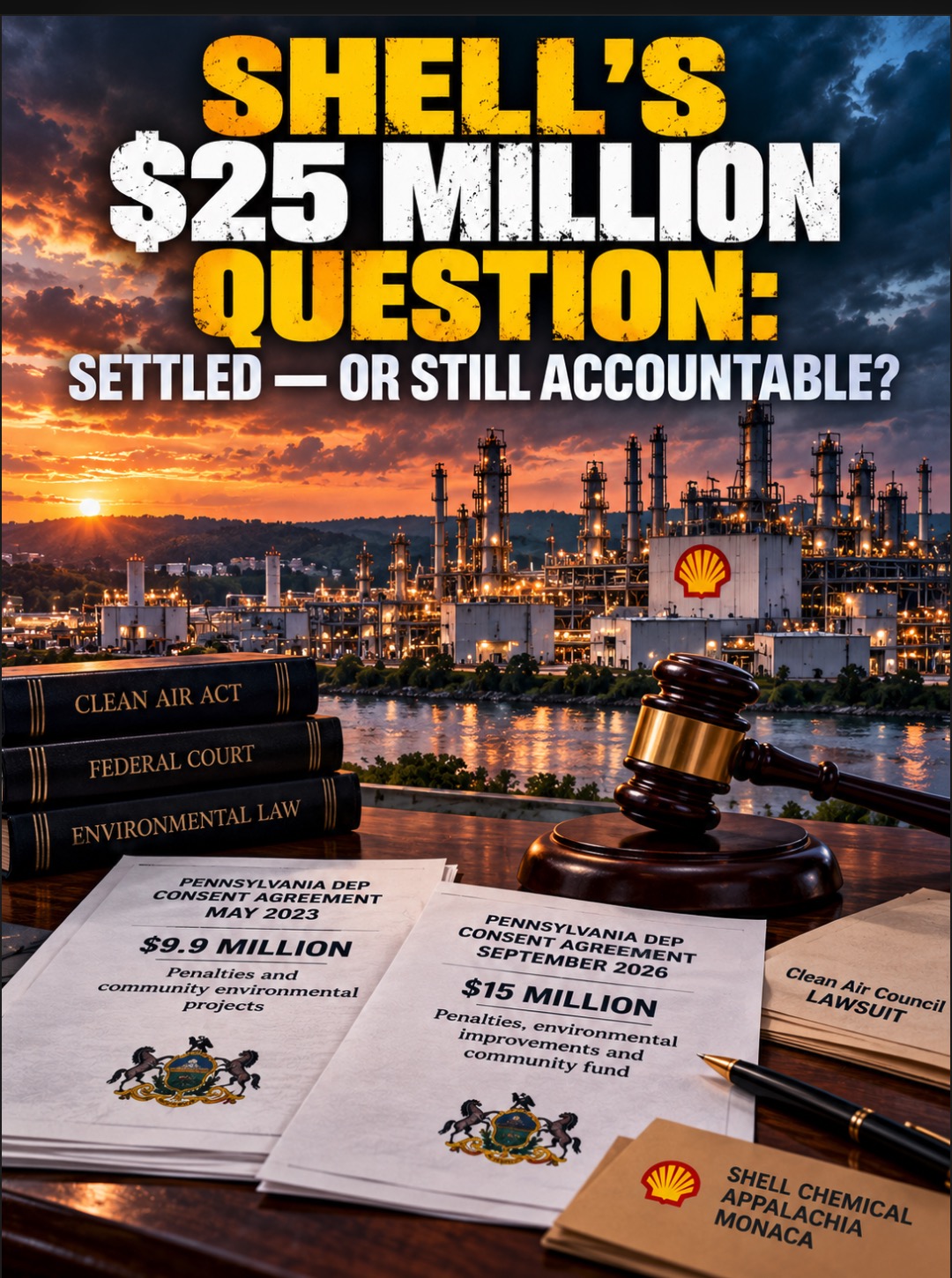
Shell is asking a federal court in Pennsylvania to dismiss an environmental lawsuit concerning pollution from its enormous Monaca plastics plant, arguing that state regulators have already addressed the alleged violations through two enforcement settlements worth nearly $25 million. The latest settlement, announced only six weeks ago, included Shell’s formal acknowledgement that it exceeded emissions limits and breached other environmental requirements. The company now contends that the Clean Air Council cannot pursue overlapping claims through a federal citizen lawsuit. But the environmental organisation’s action raises a significant question: when government regulators negotiate settlements with a polluter, should that prevent affected communities and campaign groups from seeking further enforcement through the courts?
A fresh legal development in Shell’s Pennsylvania pollution controversy
On 14 October 2026, energy industry publication Marcellus Drilling News reported that Shell Chemical Appalachia had asked a federal judge in Pittsburgh to dismiss a long-running environmental lawsuit.
The motion was filed on 9 October 2026.
The proceedings concern the Shell Polymers Monaca petrochemical complex in Beaver County, Pennsylvania.
The lawsuit was brought by the Clean Air Council, an environmental organisation based in Philadelphia, in May 2023.
The organisation alleges violations of environmental requirements associated with the plant’s operations, including its emissions.
Shell disputes the continuing legal basis for the lawsuit.
Its central argument is that Pennsylvania’s Department of Environmental Protection (DEP) has already addressed the relevant violations through two formal consent agreements.
Those settlements involved substantial financial commitments, environmental improvement requirements and continued regulatory oversight.
Shell maintains that federal law prevents the environmental organisation from pursuing duplicative enforcement where the state has already acted.
The dispute is independently confirmed by legal publication Law360, which reported the dismissal application on 13 October.
Law360 describes Shell’s contention that two DEP agreements already address the claims advanced in the lawsuit.
The court has not yet determined whether Shell’s arguments justify dismissal.
That distinction is important.
Shell has requested dismissal. The lawsuit has not been dismissed merely because that request was filed.
The plant at the centre of the dispute
The Shell Polymers Monaca complex is one of the most significant petrochemical investments in Pennsylvania’s recent industrial history.
Situated in Potter and Center townships near the Ohio River, the facility converts ethane extracted from natural gas into ethylene.
That ethylene is subsequently used to manufacture polyethylene, a plastic widely employed in packaging, consumer products and industrial materials.
Shell announced its final investment decision in 2016.
Construction involved thousands of workers, substantial infrastructure and extensive environmental permitting.
The complex began operating in autumn 2022.
It was promoted as a major industrial development capable of creating employment and strengthening the region’s manufacturing economy.
But the facility soon became controversial because of environmental compliance problems.
The commissioning period involved repeated emissions exceedances and other incidents reported to Pennsylvania regulators.
Environmental organisations and local residents expressed concerns about the implications for air quality and surrounding communities.
The Pennsylvania DEP maintains a dedicated Shell petrochemical complex information page, providing access to inspection reports, malfunction reports, notices of violation and enforcement records.
These official documents are particularly important because they allow readers to distinguish documented regulatory violations from broader allegations concerning the plant’s environmental impact.
The first major settlement: May 2023
The first significant agreement was announced on 24 May 2023.
Pennsylvania’s DEP entered into a consent order and agreement with Shell Chemical Appalachia concerning air-quality violations during commissioning.
Shell formally acknowledged exceeding total emissions limitations for air contaminants.
The agreement required the company to undertake corrective measures intended to reduce future exceedances.
It also imposed financial obligations approaching $10 million.
These included a civil penalty of approximately $4.9 million and a commitment of $5 million for environmental projects benefiting Beaver County.
The local environmental mitigation fund was intended to support improvements associated with the environment, health and quality of life.
Projects funded through the agreement have included solar energy installations, improvements to public spaces and other community initiatives.
This was more than a warning or informal undertaking.
It was a formal regulatory settlement involving acknowledged violations and enforceable obligations.
The DEP’s official settlement documentation records the agreement and its terms.
Nevertheless, the settlement did not end every legal question surrounding the plant.
The Clean Air Council had already initiated its federal proceedings.
The organisation’s lawsuit would continue despite the state’s enforcement action.
That overlap is now central to Shell’s dismissal application.
The second settlement: September 2026
On 4 September 2026, Pennsylvania’s DEP announced another major settlement with Shell.
This time, the amount was $15 million.
The agreement addressed violations occurring between 2023 and August 2026.
According to the department’s official announcement, Shell formally acknowledged that it had exceeded total emissions limitations and violated other environmental requirements.
The agreement included $7.5 million for a new Beaver County Environment and Community Fund.
Shell also committed to improvements designed to reduce the likelihood of future violations.
The requirements included submitting plans to improve the facility’s elevated flare system and completing upgrades to its wastewater treatment plant.
The company was also required to continue submitting monthly emissions reports, which the DEP would publish.
These obligations are important because the agreement was not simply a financial settlement.
It included operational changes, environmental mitigation measures and continuing regulatory reporting.
The DEP presented the agreement as evidence of its commitment to enforcing Pennsylvania’s environmental laws.
The authority also emphasised the state’s constitutional protection of clean air and pure water.
The primary source is the Pennsylvania DEP announcement of 4 September 2026.
Nearly $25 million — but not all of it in penalties
The two settlements together represent substantial financial commitments.
| Settlement | Total financial commitment |
|---|---|
| May 2023 | Approximately $9.9 million |
| September 2026 | $15 million |
| Combined | Approximately $24.9 million |
An important distinction must be retained.
The entire amount was not paid as regulatory fines.
The agreements include civil penalties and funds allocated to environmental and community projects.
That distinction matters because describing the settlements as $25 million in fines would misrepresent the financial arrangements.
The settlements also require corrective work beyond the monetary commitments.
Shell’s position is that these enforcement agreements address the underlying regulatory violations and provide mechanisms for preventing further non-compliance.
The Clean Air Council’s lawsuit raises the separate question of whether those state agreements legally prevent additional federal citizen enforcement.
The Clean Air Council’s lawsuit
The Clean Air Council commenced its federal proceedings in May 2023.
The action was filed in the United States District Court for the Western District of Pennsylvania.
The case is identified as:
Clean Air Council v. Shell Chemical Appalachia, LLC — Case No. 2:23-cv-00794.
According to the public case history, the organisation alleged that Shell’s new petrochemical facility had violated environmental requirements since operations began in late 2022.
The allegations concerned emissions and compliance with relevant permits.
Subsequent litigation involved disputes over Shell’s defences and discovery procedures.
The case therefore predates the September 2026 settlement by more than three years.
The environmental organisation initiated proceedings when the regulatory history of the plant was still developing.
Shell now argues that the subsequent state enforcement agreements have addressed the matters for which the organisation seeks relief.
This gives the legal dispute an unusual chronology.
The citizen lawsuit began in 2023.
A state settlement was completed that year.
Further violations were addressed through another settlement in 2026.
And Shell now seeks dismissal on the basis that the government’s enforcement measures have already dealt with the relevant matters.
The public case history is available through Law360’s case record.
Shell’s legal argument: The state has already acted
The central issue concerns the relationship between government enforcement and private citizen lawsuits under federal environmental legislation.
The Clean Air Act permits qualifying individuals and organisations to bring civil enforcement proceedings in specified circumstances.
Such proceedings can provide an additional mechanism for ensuring compliance with environmental requirements.
However, the legislation also contains restrictions intended to prevent inappropriate duplication of government enforcement.
The precise application of those restrictions depends upon the relevant statutory provisions, the enforcement actions involved and the relief being sought.
Shell argues that the Pennsylvania DEP has already addressed the violations through its consent agreements.
According to contemporary reporting, the company maintains that further proceedings brought by the Clean Air Council would improperly duplicate the state’s enforcement.
The company also challenges whether the organisation has demonstrated the legally required injury to its members.
This second argument concerns legal standing.
Federal courts generally require plaintiffs to demonstrate an injury sufficient to establish a justiciable dispute.
Organisations may sometimes rely upon injuries allegedly suffered by their members, provided the applicable requirements are satisfied.
Shell contends that the Clean Air Council has failed to establish the necessary basis for its claims.
These are arguments advanced in Shell’s dismissal motion.
They are not findings already accepted by the court.
The court must determine whether the relevant claims are barred, whether the requirements for standing are satisfied and whether any part of the action may continue.
Can a regulatory settlement prevent further environmental litigation?
The dispute raises an important question about how environmental enforcement works.
Government regulators possess statutory powers to investigate violations, impose penalties and require corrective action.
They also have discretion concerning how to allocate enforcement resources and negotiate settlements.
Citizen lawsuits serve a different, though sometimes overlapping, purpose.
They can allow individuals and organisations to pursue enforcement where statutory requirements permit.
That can provide an additional safeguard where communities believe environmental obligations have not been adequately enforced.
But it can also create potential overlap.
A company that has already entered an enforceable settlement may argue that another lawsuit concerning the same violations adds little practical benefit.
It may also contend that allowing multiple enforcement proceedings creates uncertainty and potentially duplicative liabilities.
Those concerns are not inherently unreasonable.
Equally, an environmental organisation may argue that a state settlement does not necessarily resolve every alleged violation or provide all the relief available under federal law.
A court must examine the actual agreements and claims.
A settlement covering particular violations does not automatically establish that every environmental claim involving the facility has been extinguished.
Conversely, the existence of a citizen lawsuit does not automatically entitle an organisation to pursue claims already subject to qualifying government enforcement.
The legal answer depends upon the statutory framework and specific facts.
This is the question at the heart of the Pennsylvania proceedings.
COMMENTARY: When Has a Polluter Done Enough?
Shell’s latest legal argument raises a broader issue extending beyond the Monaca complex.
When a company acknowledges environmental violations, pays substantial penalties and agrees to operational improvements, how should the legal system determine whether further enforcement is justified?
There are compelling considerations on both sides.
For regulators, settlements can provide practical remedies without prolonged litigation.
They may secure corrective work, monitoring commitments and financial resources for affected communities.
For companies, the ability to resolve identified violations through enforceable agreements provides a degree of legal and commercial certainty.
Without some limits on overlapping enforcement, companies could face repeated proceedings over the same conduct.
But environmental organisations have legitimate reasons to scrutinise negotiated settlements.
A financial agreement does not necessarily eliminate the possibility of future violations.
Nor does the payment of penalties automatically establish that every environmental consequence has been adequately addressed.
The public interest requires effective compliance, not simply financial payments following breaches.
The Monaca dispute illustrates that tension.
Shell has acknowledged exceeding emissions limits.
Pennsylvania regulators have imposed substantial financial and operational requirements.
Those facts are established.
But the Clean Air Council is pursuing its own legal action.
The court must decide whether that action remains legally permissible.
Why the September settlement matters
The second agreement is especially significant because it was announced only weeks before Shell sought dismissal.
It addressed violations extending through August 2026.
Shell can therefore point to relatively recent regulatory action covering a substantial part of the facility’s operating history.
The company’s argument is stronger than it would be if the only relevant settlement concerned violations during the original commissioning period.
But the existence of the second agreement also demonstrates that environmental compliance concerns did not end with the first settlement in 2023.
Further violations required another substantial regulatory response.
That is an important historical fact.
It does not prove that Shell is currently violating its permits.
Nor does it establish that the Clean Air Council’s lawsuit must succeed.
But it shows why the facility has remained under close environmental scrutiny.
The importance of the community funds
Another aspect of the settlements deserves attention.
The agreements include significant funding for environmental and community improvements in Beaver County.
The first arrangement created a $5 million mitigation fund.
The second provides another $7.5 million for community environmental purposes.
These commitments can produce tangible benefits.
Local residents may benefit from improved public facilities, environmental projects and investments addressing community needs.
The DEP has already reported the allocation of funds from the original settlement to local projects.
That is relevant when assessing whether government enforcement has produced meaningful outcomes.
But community funding is not identical to preventing future emissions violations.
A successful environmental enforcement programme must achieve both meaningful remediation and sustained compliance.
The ultimate test of Shell’s performance will be whether the facility operates within its legal limits and implements the required improvements.
Why shareholders should pay attention
For Shell shareholders, the dispute involves more than the financial value of the settlements.
The Monaca petrochemical complex represents a substantial industrial investment.
Repeated regulatory violations, litigation and operational improvement requirements create potential costs and uncertainty.
Those costs may include penalties, additional equipment, engineering work, monitoring requirements and legal expenses.
They may also affect public confidence in the company’s operations.
The legal proceedings introduce an additional question.
If Shell succeeds in dismissing the Clean Air Council lawsuit, it may reduce one category of litigation exposure.
But that would not eliminate the company’s continuing obligation to comply with environmental laws and permits.
Nor would dismissal retrospectively erase the violations acknowledged in the DEP settlements.
That distinction is essential.
Winning a procedural or statutory defence against a citizen lawsuit is not the same as proving that no environmental violations occurred.
Equally, the existence of acknowledged violations does not automatically establish that every subsequent lawsuit is legally justified.
Both propositions should be recognised.
Conclusion: Nearly $25 Million Later, the Court Must Decide
Shell’s Monaca petrochemical complex has now been the subject of two substantial Pennsylvania environmental enforcement settlements.
The first, in May 2023, involved approximately $9.9 million in financial commitments.
The second, announced in September 2026, added another $15 million.
Shell formally acknowledged emissions exceedances and other environmental violations.
It also agreed to undertake corrective measures and continue reporting to regulators.
Those are established facts.
The company now argues that these enforcement agreements prevent the Clean Air Council from pursuing overlapping claims in federal court.
The environmental organisation’s lawsuit began in May 2023 and remains subject to judicial proceedings.
The court has not yet ruled on Shell’s latest dismissal application.
The significance of the case extends beyond the financial amounts involved.
It concerns the relationship between public environmental regulators and private enforcement under federal law.
Government settlements can deliver penalties, corrective measures and community funding.
Citizen lawsuits can provide additional accountability where legally permitted.
But the law must establish when those mechanisms may operate together and when further proceedings are barred.
The question is not whether Shell has already paid substantial sums. It has.
The question is whether those payments and the accompanying enforcement agreements legally and adequately address the claims now before the federal court.
That decision belongs to the judiciary.
For Shell, the outcome could bring an important legal dispute closer to an end.
For environmental organisations, it may help clarify the boundaries of citizen enforcement where regulators have already negotiated substantial settlements.
And for residents near the Monaca complex, the most important measure of success will remain the same:
Whether the plant operates safely, complies with its environmental obligations and avoids further breaches.
Principal Sources
1. Marcellus Drilling News — 14 October 2026
Shell Asks Court to Toss Big Green Cracker Suit: DEP Already Acted
Industry reporting identifying Shell’s 9 October dismissal motion, the reliance upon Pennsylvania’s enforcement settlements and its challenge to the Clean Air Council’s standing.
2. Law360 — Matthew Santoni, 13 October 2026
Shell Says Enviro Group’s Suit Retreads Pa. Settlements
Independent legal reporting confirming Shell’s application to dismiss the lawsuit and its reliance upon the two DEP consent agreements.
3. Pennsylvania Department of Environmental Protection — 4 September 2026
The principal authenticated government source for the latest settlement, acknowledged violations, financial commitments and operational requirements.
4. Pennsylvania DEP — Shell Petrochemical Complex
Official Facility Information and Enforcement Records
Includes regulatory documents, the May 2023 consent agreement and other compliance material.
5. Pennsylvania DEP — Environmental Mitigation Community Fund
Community Fund Information and May 2023 Settlement Documents
Official information concerning the $5 million community fund created under the earlier enforcement agreement.
6. Law360 — Federal Court Proceedings
Clean Air Council v. Shell Chemical Appalachia, LLC — Case No. 2:23-cv-00794
Public litigation history identifying the parties, court and earlier developments in the case.
7. Pennsylvania DEP — Facility Background
Shell Chemical Appalachia Petrochemicals Complex
Official information about the plant, its operations and regulatory oversight.
Editorial and Legal Disclaimer
This article distinguishes authenticated government enforcement records, allegations made in litigation, Shell’s legal arguments, independent journalism and editorial commentary.
Shell’s acknowledgement of emissions exceedances and other environmental violations in the DEP consent agreements is an established matter of public record.
The Clean Air Council’s additional allegations remain subject to legal proceedings.
Shell’s assertion that the DEP settlements bar further citizen enforcement is a disputed legal position, not a ruling already made by the court.
The federal dismissal motion and the underlying consent agreements have not been independently examined in their entirety for this article. Details of Shell’s current arguments are attributed to the contemporary legal reporting cited above.
No conclusion is drawn that Shell has committed additional violations beyond those established in the cited regulatory documents, or that the Clean Air Council has proved its disputed claims.
The website’s general disclaimer also applies.








