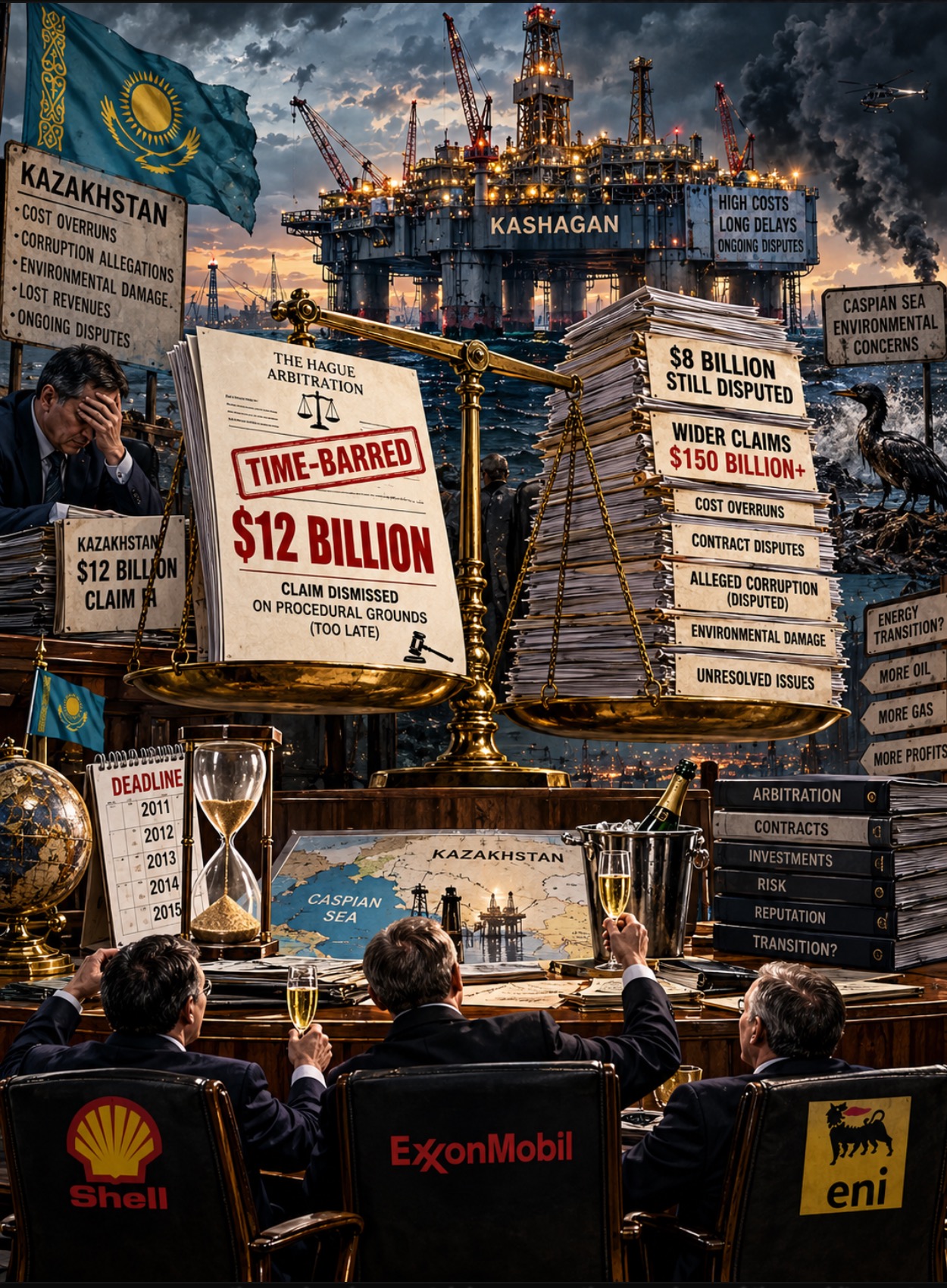
 The oil giants have apparently escaped a $12 billion claim because Kazakhstan was too late bringing it. But the wider Kashagan dispute is far from settled, and the embarrassing questions about cost overruns, alleged corruption, environmental damage and corporate accountability are not going away.
24 October 2026
There are moments when the international oil industry must struggle to contain its excitement.
A discovery of billions of barrels of crude oil? Excellent.
A spectacular dividend announcement? Even better.
But a tribunal reportedly disposing of $12 billion in disputed claims because the complainant missed a legal deadline?
Break out the champagne. Preferably something expensive enough to qualify as a recoverable project cost.
According to Zamin’s report of 23 October 2026, based on Bloomberg reporting, an international arbitration tribunal has rejected approximately $12 billion of Kazakhstan’s claims concerning disputed expenditure at the gigantic Kashagan oilfield in the Caspian Sea.
The reason was reportedly straightforward: Kazakhstan had waited too long to pursue the expenditure concerned, which dated from 2011 to 2015.
The important distinction is that the reported decision concerns the timeliness of the claims, not a comprehensive finding that the disputed expenditure was legitimate.
Somewhere in the global headquarters of the participating oil companies, one imagines that distinction is being celebrated with considerably less enthusiasm than the headline figure.
For Shell plc, ExxonMobil, Eni, TotalEnergies and their consortium partners, the decision represents an important procedural victory.
For Kazakhstan, it is a substantial setback.
For anyone interested in corporate accountability, however, the most interesting questions remain unanswered.
A $12 billion escape — but the lawyers have barely started
The latest reporting indicates that Kazakhstan had challenged approximately $20 billion in project costs.
Of that amount, approximately $12 billion has reportedly been excluded because the relevant claims were brought outside the permitted period.
The remaining approximately $8 billion in cost-related claims can continue.
This is not the end of the dispute.
Indeed, it is not even the end of the much larger financial confrontation between Kazakhstan and the international consortium operating Kashagan.
Reporting by Kursiv indicates that Kazakhstan is pursuing wider demands exceeding $150 billion, principally concerning alleged lost revenues and other disputes arising from the project’s development.
These figures concern overlapping categories within a wider legal conflict and should not simply be added together.
The full tribunal decision has not been publicly released, and the latest accounts depend on sources familiar with confidential proceedings.
That qualification matters.
Nevertheless, the emerging picture is remarkable.
A giant oil consortium has reportedly escaped $12 billion in claims without necessarily establishing that the underlying expenditure was beyond criticism.
Welcome to the wonderful world of international petroleum arbitration, where a calendar can sometimes be more valuable than an oilfield.
Kashagan: the oilfield that swallowed billions
The Kashagan oilfield, situated beneath the northern Caspian Sea, was discovered in 2000.
It was hailed as one of the most important oil discoveries in decades.
Unfortunately, the engineering and financial history that followed proved rather less glorious.
The offshore project presented formidable technical obstacles: high-pressure reservoirs, hazardous hydrogen sulphide, difficult weather conditions, shallow water and seasonal ice.
These difficulties were genuine.
They also contributed to extraordinary delays and escalating expenditure.
Production was originally expected during the mid-2000s. Initial production eventually began in September 2013, only to be suspended after serious pipeline problems.
Commercial production resumed in 2016.
By that point, the development had become internationally notorious for its vast costs and delays.
According to October 2026 reporting, approximately $55 billion had been invested in developing Kashagan, with production averaging about 400,000 barrels per day in 2025.
This was supposed to be a triumph of international engineering and corporate expertise.
Instead, Kazakhstan eventually found itself questioning billions in expenditure and the revenues it believed it should have received.
One might reasonably ask whether the original development was an oil project with a budget or a budget with an oil project occasionally attached.
The corruption allegations: an even more uncomfortable story
The most serious background material comes from the International Consortium of Investigative Journalists (ICIJ).
In an investigation published on 14 August 2026, ICIJ reported that Kazakhstan was alleging that approximately $10.7 billion in Kashagan contracts had been affected by self-dealing, unjustified cost increases or bribery.
The investigation described allegations involving major engineering and construction contracts awarded during the development of the field.
According to ICIJ, Kazakhstan contends that alleged misconduct and mismanagement contributed to delays and increased costs, thereby postponing the point at which the country would obtain larger revenues under the project’s production-sharing arrangements.
Those are serious allegations.
They must also be described accurately.
They are allegations advanced by Kazakhstan, not established findings of corruption against Shell or the other consortium members.
ICIJ reported that the tribunal had not determined the corruption allegations. The consortium disputed the government’s case and questioned aspects of its evidence.
The North Caspian Operating Company (NCOC) told ICIJ that its members considered their conduct consistent with contractual obligations, applicable laws and relevant standards.
That defence deserves to be recorded.
But so does the extraordinary fact that a major producing nation is challenging billions of dollars in expenditure associated with one of the largest petroleum developments on Earth.
The $12 billion procedural ruling does not, on the publicly available information, settle the merits of those wider allegations.
The production-sharing arrangement: who gets the money?
To understand why Kazakhstan is so exercised, it is necessary to examine the structure of the project.
Kashagan operates under a production-sharing agreement.
Such arrangements generally allow international investors to recover eligible development expenditures from production revenues before profits are divided according to agreed contractual terms.
In principle, the structure is understandable.
Companies undertake expensive, technically challenging projects and recover their investment before receiving their share of profits.
But what happens when project costs soar?
What happens when production begins years late?
And what happens when the government disputes whether substantial categories of expenditure should have been charged to the project at all?
Suddenly, every disputed billion matters.
The more expenditure legitimately recoverable under the agreement, the longer the government may have to wait for the level of revenue it originally anticipated.
ICIJ has previously reported Kazakhstan’s contention that, after initial royalty payments, the consortium was receiving approximately 98% of Kashagan oil revenue under the relevant cost-recovery arrangements.
That is Kazakhstan’s reported position, not a judicial finding that the arrangement was unlawful.
Nevertheless, it illustrates the extraordinary financial stakes.
One party sees enormous investment and contractual cost recovery.
The other sees years of delayed revenues and questionable expenditure.
The lawyers see an exceptionally complicated dispute.
And somewhere in the background, the accountants continue sharpening their pencils.
The environmental dispute: another $5 billion headache
The Kashagan controversy extends beyond development expenditure and alleged financial misconduct.
Environmental issues have created a separate and substantial confrontation.
Kazakhstan has pursued a disputed penalty of approximately $5 billion concerning sulphur storage associated with the project.
The consortium contests the penalty.
In July 2026, Kazakh authorities reportedly froze certain NCOC assets in connection with enforcement of the disputed environmental fine.
Bloomberg subsequently reported in October that ExxonMobil had opposed a possible settlement proposal concerning the environmental dispute.
These matters are separate from the reported $12 billion arbitration ruling.
They also demonstrate why describing Kashagan as a straightforward story of commercial success would be rather adventurous.
The project has generated substantial oil production.
It has also generated costly disputes over environmental compliance, project costs and the distribution of financial benefits.
The Caspian Sea is not merely a convenient place to install expensive petroleum infrastructure.
It is an environmentally sensitive region in which industrial activity carries significant ecological responsibilities.
Shell and its partners are entitled to contest disputed penalties and allegations.
The public is equally entitled to ask whether the environmental consequences of extracting oil have been adequately addressed.
ExxonMobil’s $80 billion bargaining position
An especially revealing development emerged in August 2026.
Bloomberg reporting carried by World Oil indicated that ExxonMobil had linked a potential $80 billion investment proposal for expanding Kashagan to resolving the consortium’s disputes with Kazakhstan.
The proposal reportedly concerned further development of the western portion of the reservoir, potentially through a venture involving state-owned KazMunayGas.
The commercial logic is understandable.
Few companies would willingly commit enormous new sums while facing unresolved disputes of such magnitude.
But the situation provides irresistible material for satire.
The international petroleum industry arrives with promises of investment, prosperity and technical expertise.
The host country later disputes the bills.
The investors dispute the government’s claims.
Environmental penalties follow.
And the next enormous investment opportunity becomes part of the discussion about resolving the previous enormous investment opportunity.
It is the petroleum equivalent of a hotel guest arguing about the minibar before negotiating to buy another hotel.
Shell shareholders: profits, exposure and accountability
Shell is not the sole participant in Kashagan, and the legal and financial implications must be considered in the context of the consortium’s contractual structure.
Nevertheless, Shell’s participation makes the controversy directly relevant to its shareholders.
Major institutional investment managers, including Vanguard and BlackRock, have long been prominent holders of Shell shares through investment funds and managed portfolios. Norges Bank Investment Management has also held significant exposure to the company.
Their precise current holdings and rankings require reference to the latest ownership disclosures.
For such investors, the relevant questions extend beyond a single headline announcing that $12 billion in claims have been rejected.
What potential liabilities remain?
How might ongoing arbitration affect future investments?
What environmental risks persist?
What can shareholders reasonably determine about contractual exposure when proceedings are confidential?
And how does a company reconcile its public emphasis on disciplined capital allocation and responsible operations with participation in a project associated with such extraordinary disputes?
None of these questions establishes misconduct.
They are ordinary questions of governance, financial disclosure and risk management.
Indeed, they are precisely the questions responsible institutional stewardship ought to address.
Shell shareholders are entitled to scrutinise a major investment that is simultaneously producing substantial hydrocarbons and generating enormous legal controversy.
A favourable procedural ruling is welcome news for the companies involved.
It is not necessarily the last word on the quality of the investment or the underlying conduct being challenged.
The Sakhalin comparison: different countries, familiar complications
Long-standing readers of this website may recognise an uncomfortable historical parallel.
Shell’s involvement in Russia’s Sakhalin-2 development produced its own combination of extraordinary expenditure, environmental controversy, government pressure and geopolitical intervention.
The circumstances were different, and the legal disputes must not be conflated.
But both projects demonstrate the hazards of undertaking enormous fossil-fuel developments in politically sensitive jurisdictions under complex contractual arrangements.
At Sakhalin-2, Shell and its partners faced escalating costs and pressure from the Russian authorities before Gazprom acquired a controlling stake in 2007.
The episode remains a substantial part of Shell’s corporate history.
Our continuing documentary series, The Shell Leaks Files, examines the Sakhalin experience using historical correspondence, contemporary reporting and archive materials.
The comparison is not an allegation that the same misconduct occurred in Kazakhstan.
Rather, it illustrates the recurring strategic problem.
International oil majors can possess extraordinary engineering expertise, vast financial resources and formidable legal departments.
None of those advantages makes them immune to political disputes, contractual confrontation or the consequences of contested environmental practices.
The industry may control the drilling equipment.
It does not control every subsequent chapter of the story.
What does this actually mean for Shell?
The immediate development is comparatively straightforward.
According to reports published on 22–24 October 2026, an international arbitration tribunal has rejected approximately $12 billion of Kazakhstan’s Kashagan cost claims because they were brought too late.
Approximately $8 billion in other cost claims remain live.
Much larger demands, concerning lost revenues and other contested matters, remain part of the wider dispute.
Separate environmental proceedings also continue.
The confidentiality of the arbitration limits independent assessment of the precise legal reasoning.
For now, it would therefore be premature either to declare Kazakhstan’s case vindicated or to suggest the consortium has been comprehensively exonerated.
The reported procedural victory is real and commercially important.
But it is not the end of the story.
And that brings us to the central question.
If disputed expenditure escapes examination because a claim was filed too late, who ultimately establishes whether that expenditure was reasonable?
That question is not answered merely by pointing to a deadline.
Nor should the existence of serious allegations be mistaken for proof.
The point is that the public deserves to understand the distinction.
The final verdict: a calendar is not a certificate of innocence
Shell and its Kashagan partners may reasonably welcome the reported rejection of $12 billion in claims.
They have every right to defend themselves against allegations they regard as unfounded.
Kazakhstan must also comply with applicable legal deadlines and contractual procedures.
That is how arbitration is supposed to work.
But the wider public-interest story remains extraordinary.
A project promoted as a magnificent petroleum achievement has become entangled in a dispute involving allegations of inflated expenditure, corruption, enormous lost revenues, environmental penalties and competing visions of future investment.
Now, with $12 billion reportedly removed from the immediate cost dispute, the participating companies have secured an important victory.
The lawyers can celebrate.
The shareholders can take some comfort.
The corporate communications departments can prepare carefully calibrated language about confidence in the project.
But there is a distinction worth preserving.
Winning because a claim was filed too late is not the same as proving that every disputed dollar was properly spent.
And until the remaining allegations and financial claims are resolved, Kashagan will remain a particularly expensive reminder that extracting oil is sometimes much easier than extracting the truth.
A fictional conversation: Sir Henri Deterding and John Donovan
The following exchange is fictional satire. Sir Henri Deterding died in 1939 and did not comment on contemporary events.
SIR HENRI DETERDING: Ach, Donovan! I am informed that Shell and its partners have escaped twelve billion dollars in claims.
JOHN DONOVAN: Apparently because Kazakhstan brought them too late.
DETERDING: Too late? Explain this extraordinary commercial achievement.
DONOVAN: The tribunal reportedly decided that the relevant claims were out of time.
DETERDING: Mein Gott. In my day, one discovered oil beneath the ground. Today, apparently, one discovers billions beneath a calendar.
DONOVAN: The other claims have not disappeared. There is still an enormous arbitration dispute, allegations of corruption and a separate environmental penalty.
DETERDING: Ja. So the champagne is premature.
DONOVAN: I would say so.
DETERDING: And what do the modern public relations gentlemen call this situation?
DONOVAN: Probably successful risk management.
DETERDING: Risk management! They spend decades constructing a giant oilfield, become entangled in financial and environmental disputes, and then congratulate themselves because twelve billion dollars of claims arrived after the permitted date?
DONOVAN: That appears to be the immediate good news.
DETERDING: Donovan, I built an oil empire. These people have built a legal profession.
DONOVAN: At least the lawyers are doing well.
DETERDING: Naturally. The oil may be difficult to extract, but the legal fees flow without interruption.
DONOVAN: There is talk of another eighty billion dollars of investment.
DETERDING: Ach! Perhaps they should resolve the argument about the previous billions before spending the next eighty.
DONOVAN: That would be sensible.
DETERDING: Sensible? In modern petroleum management? Na ja. You are becoming an optimist, Donovan.
Spoof Shell corporate statement
The following is parody, not an actual Shell statement.
Shell is delighted to confirm that international arbitration continues to demonstrate the importance of rigorous contractual governance, procedural discipline and extremely expensive legal representation.
The company remains committed to responsible energy development, constructive stakeholder engagement and the timely identification of occasions when other parties have failed to act in a timely manner.
Shell recognises that some claims remain unresolved.
However, the company considers that the reported removal of approximately $12 billion in disputed claims provides an excellent opportunity to emphasise its commitment to transparency without necessarily disclosing anything confidential.
We look forward to continued constructive discussions with Kazakhstan, our consortium partners, international investors, external counsel and anyone capable of explaining the production-sharing agreement without requiring three separate law degrees.
DISCLAIMER
This article is independent opinion, commentary and satire based on publicly reported information available as of 24 October 2026. The latest arbitration development is reported from confidential sources and has not been independently verified against a publicly released award. Allegations of corruption, improper expenditure, environmental misconduct and contractual breaches are disputed and must not be treated as established findings against Shell plc or any other consortium member. Fictional dialogue and spoof corporate statements are clearly identified as satire. Nothing in this article constitutes financial, investment or legal advice. Readers should consult the original reporting and relevant official disclosures. The website’s general disclaimer also applies
Principal sources
*This website and sisters royaldutchshellgroup.com, shellnazihistory.com, royaldutchshell.website, johndonovan.website, shellnews.net, and shellwikipedia.com, are owned by John Donovan - more information here. There is also a Wikipedia segment, the Shell DPA Files, "Shell and the Spies", the Shell Leaks files, the Independent Shell Archive, as well as books written and published by John Donovan - Kindle eBooks. Timeline of the Donovan Shell Feud. Toxic History of Royal Dutch Shell Group. Shell and the Donovans: The Full Media Record — 550+ Articles, 110 Books, 40 Years. *All conjured up by internet wizz, Nick Gill.








