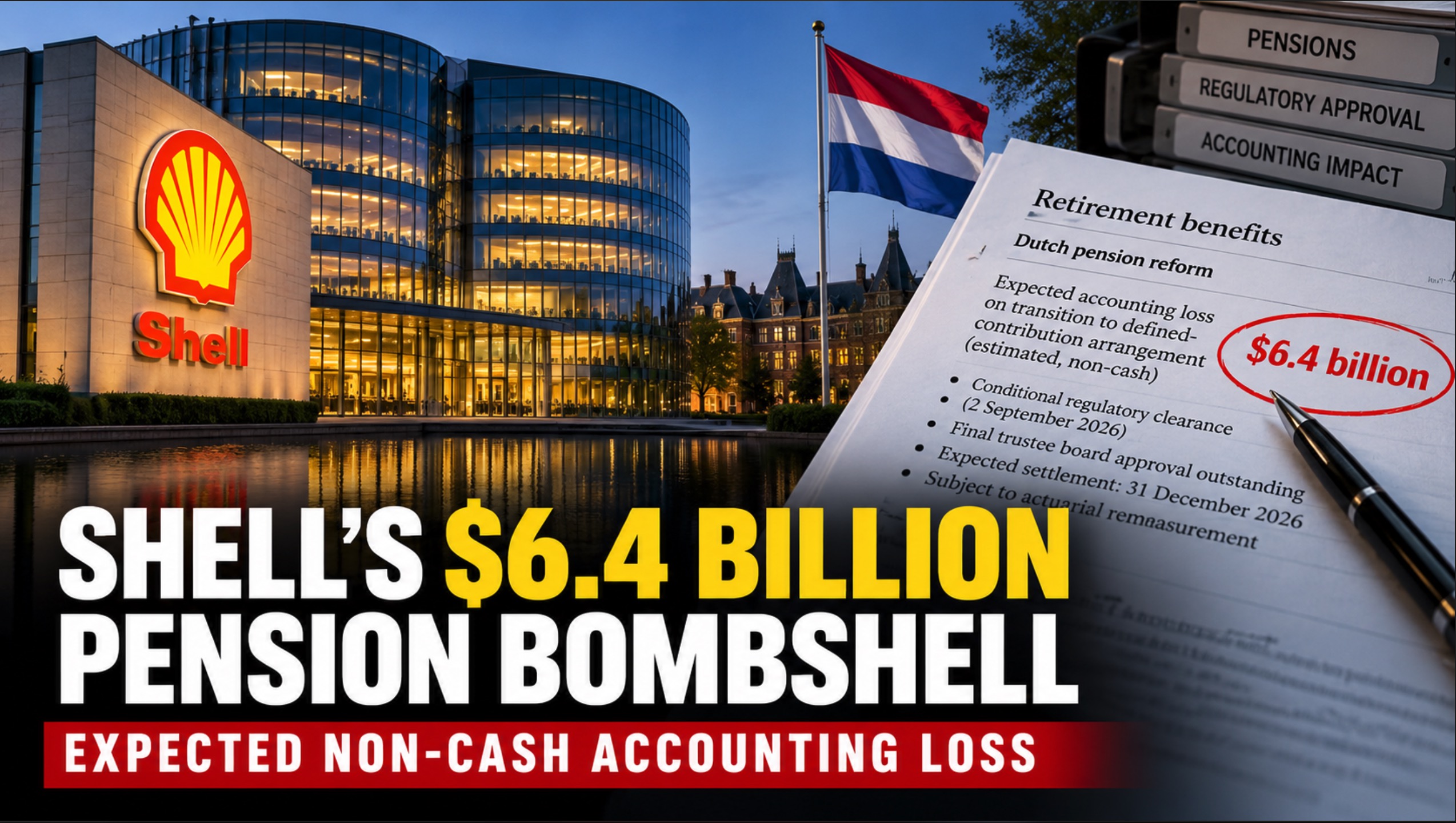
Shell’s latest financial statements reveal an anticipated $6.4 billion non-cash accounting loss arising from the transformation of its Dutch pension arrangements. The disclosure raises important questions about pension governance, regulatory oversight and the financial consequences of the transition — but it does not establish that pensioners will suffer corresponding losses.
By John Donovan — 30 October 2026
Just one day after Shell plc announced spectacular third-quarter earnings and another $5 billion share-buyback programme, a striking disclosure in the company’s financial statements deserves closer attention.
On page 33 of its report for the quarter ended 30 September 2026, Shell reveals that it expects to recognise an estimated $6.4 billion non-cash accounting loss in the fourth quarter of this year.
The anticipated charge arises from the restructuring of the Dutch pension arrangements operated by Stichting Shell Pensioen Fonds (SSPF).
The amount is extraordinary.
It is larger than Shell’s newly announced $5 billion share-buyback programme and comes at a time when the company is reporting exceptionally strong profits.
Yet this is not a straightforward case of Shell losing $6.4 billion in cash.
Nor does the disclosure establish that employees or pensioners face a corresponding reduction in their retirement benefits.
The explanation lies in a complicated intersection of Dutch pension reform, international accounting standards and the treatment of defined-benefit pension obligations.
Understanding what Shell has actually disclosed — and what remains unanswered — is essential.
The $6.4 billion disclosure
Shell’s financial statements describe the pending transition of its Dutch defined-benefit pension fund to a defined-contribution arrangement.
The company states that the transition is expected to take effect on 1 January 2027.
The associated accounting settlement is expected to occur on 31 December 2026.
At that point, according to Shell, the existing defined-benefit plan will cease to be recognised in the company’s accounts in its present form.
Under the relevant accounting treatment, Shell expects this derecognition to produce a substantial charge in its consolidated income statement.
The estimated amount, calculated at 30 September 2026, is $6.4 billion.
Shell explicitly describes the anticipated charge as non-cash.
It also warns that the figure remains subject to actuarial remeasurement during the fourth quarter and may therefore change.
This distinction matters.
A charge recorded in a corporate income statement does not necessarily represent a cash payment, an investment loss of the same amount or a reduction in the pensions payable to individual members.
Nevertheless, an accounting adjustment of this magnitude is financially material and deserves scrutiny.
Why is Shell changing its Dutch pension arrangements?
The background is a fundamental reform of the Netherlands’ pension system.
On 1 July 2023, the Dutch Wet toekomst pensioenen (Future Pensions Act) came into effect.
The legislation introduced a substantial restructuring of occupational pension arrangements, with existing schemes required to complete their transitions before 1 January 2028.
The reform changes how pension rights, investment risks and retirement outcomes are organised and communicated.
Shell’s Dutch pension fund has been preparing to comply with the new framework.
According to Shell’s financial statements, the SSPF trustee board formally accepted the transition plan in July 2025.
The planned effective date is 1 January 2027.
Importantly, Shell is not presenting this restructuring as an entirely voluntary decision to abandon its existing arrangements.
It forms part of a wider legislatively mandated transformation of the Dutch pension system.
Nevertheless, the financial and governance consequences for Shell remain significant.
Dutch regulator gives conditional clearance
Shell’s disclosure identifies an important regulatory development.
On 2 September 2026, De Nederlandsche Bank (DNB), the Dutch central bank and pension supervisor, issued its decision not to prohibit the transfer of accrued pension entitlements into the new pension arrangement.
The Dutch terminology is Besluit geen verbod op invaren.
The decision was conditional.
Shell states that the funding ratio at the point of transition must remain within an agreed range.
Moreover, final approval by the SSPF trustee board was still outstanding when the quarterly results were published.
Shell expects that decision during the fourth quarter of 2026.
Consequently, the proposed transition has not yet been presented by Shell as an unconditional, completed event.
The precise outcome remains dependent on the relevant conditions and approvals.
That distinction should not be overlooked.
What does a $6.4 billion non-cash loss actually mean?
This is perhaps the most important question.
Under International Accounting Standard IAS 19, Employee Benefits, companies must account for defined-benefit pension commitments according to prescribed rules governing pension obligations, pension assets, actuarial assumptions and the recognition of surpluses or deficits.
In a conventional defined-benefit arrangement, the sponsoring employer may remain exposed to certain risks associated with meeting promised pension benefits.
A defined-contribution arrangement generally involves a different allocation of risks and responsibilities.
However, the precise legal and economic consequences depend on the structure of the scheme.
Shell’s proposed transition involves the derecognition of its existing defined-benefit arrangement.
The company explains that the accounting consequences include the operation of the asset ceiling provisions of IAS 19.
These provisions can restrict how much of a pension fund surplus an employer is permitted to recognise as an asset in its financial statements.
Shell states that in the third quarter of 2025 it recognised an adjustment reducing the pension fund surplus recognised in its accounts to nil, together with a liability associated with minimum funding requirements.
That adjustment produced a loss in other comprehensive income.
The asset ceiling has continued to be monitored and remeasured.
With the expected transition at the end of 2026, a further accounting consequence is anticipated.
The resulting $6.4 billion charge is expected to pass through Shell’s fourth-quarter income statement.
But there is an essential distinction between an accounting loss and money physically leaving the company.
Shell’s disclosure does not establish that it must pay $6.4 billion into the pension fund, that the fund has lost $6.4 billion in assets, or that members’ pensions will be reduced by that amount.
Indeed, the company’s explanation suggests that the anticipated charge is principally associated with accounting recognition and derecognition as the scheme changes.
The correct interpretation requires examination of the detailed actuarial and accounting calculations.
Those calculations are not fully reproduced in the quarterly disclosure.
What about Shell’s existing pension position?
Shell provides additional context in the same financial report.
At 30 September 2026, its consolidated balance sheet recorded:
| Retirement benefits | 30 September 2026 | 31 December 2025 |
|---|---|---|
| Non-current pension-related assets | $5.737 billion | $5.052 billion |
| Non-current pension-related liabilities | $6.262 billion | $7.136 billion |
| Net recognised deficit | $525 million | $2.084 billion |
These figures concern Shell’s recognised retirement-benefit assets and liabilities across its relevant plans, rather than representing the funding position of SSPF alone.
Shell attributes the improvement in the net position principally to higher discount rates reducing the measured retirement-benefit obligations, partly offset by investment returns below expectations.
That improvement provides an important contrast with the impending $6.4 billion accounting charge.
It illustrates why the value of pension assets, the actuarial measurement of pension commitments and the accounting consequences of restructuring must be considered separately.
A large pension-related charge in the income statement does not necessarily mean that the underlying pension scheme has experienced an equivalent economic deterioration.
What will happen to Shell pensioners?
The central concern for many current and former employees will be understandable:
Will the transition affect the pensions they receive?
Shell’s quarterly financial disclosure does not provide enough information to determine how every category of member will be affected.
The transition involves accrued pension entitlements, but its implications for individuals depend on the final scheme rules, funding position, allocation mechanisms and relevant Dutch legal safeguards.
It would therefore be irresponsible to suggest that Shell’s pensioners are about to lose $6.4 billion in promised retirement benefits.
The company’s announcement makes no such claim.
Equally, it would be premature to conclude that every pension beneficiary will experience precisely the same economic outcome under the new arrangements.
Those questions require examination of the SSPF transition plan and the communications issued to members.
Independent pension specialists may also be able to explain the consequences more fully.
Why should Shell shareholders be interested?
There are several reasons.
First, the anticipated charge is substantial in absolute terms.
A $6.4 billion loss recorded in a quarterly income statement can materially affect reported statutory earnings.
Second, Shell’s management will need to explain the accounting consequences clearly so that investors do not confuse a non-cash pension adjustment with a deterioration in the company’s operating performance.
Third, the transition represents a major governance development involving pension trustees, a national regulator and the sponsor of a significant retirement arrangement.
Fourth, there are legitimate questions about the longer-term consequences of changing the nature of Shell’s pension obligations and associated financial risks.
Finally, the disclosure warrants attention because the accounting treatment is not intuitive.
Shareholders reading headlines about billion-dollar profits, share buybacks and pension losses may reasonably struggle to reconcile the figures.
Shell has an interest in ensuring that its explanations are sufficiently clear to prevent misunderstanding.
The contrast with Shell’s quarterly profits
The timing is noteworthy.
On 29 October 2026, Shell announced adjusted third-quarter earnings of $10.814 billion.
The same results included a $2.116 billion impairment relating to a European biogas asset and a $1.787 billion reversal of an earlier impairment associated with a North American Integrated Gas asset.
Our previous investigation examined the contrast between those two energy investments.
The pension disclosure introduces a different but equally significant issue.
Whereas the biogas impairment reflects revised expectations about the recoverable value of a commercial asset, the projected pension charge arises from a change in the accounting treatment of retirement arrangements.
These are fundamentally different financial events.
Nevertheless, all three demonstrate why investors should look beyond headline adjusted earnings and examine the accompanying financial statement notes.
Some of the most consequential information in corporate reporting appears not in the headline announcements, but in the explanations accompanying the accounts.
The Shell historical archive perspective
The Independent Shell Archive has long examined questions surrounding the company’s corporate governance, financial reporting, legal responsibilities and relationships with employees.
The pension disclosure is relevant to that historical record.
Shell’s relationship with its workforce has developed over more than a century, encompassing changing employment practices, restructuring, pension commitments and corporate governance arrangements.
The transition now under way in the Netherlands represents another significant chapter in that history.
There is no basis in the present disclosure for suggesting misconduct by Shell, its pension trustees or the Dutch regulator.
Nor is there evidence that the anticipated accounting charge conceals an undisclosed cash liability of the same amount.
What the disclosure does establish is that Shell expects a major financial reporting consequence from a fundamental change in its Dutch retirement arrangements.
For an independent archive concerned with preserving contemporaneous corporate evidence, that is sufficient reason to document the event carefully.
It will also be important to preserve the distinction between what Shell disclosed before the transition and what ultimately occurs when the final arrangements take effect.
That is the same documentary principle underpinning The Shell Leaks Files: preserve the original evidence, identify what was known at the time, and compare statements with subsequent developments.
Questions Shell should answer
In the interests of transparency, Shell could usefully provide fuller explanations addressing several questions.
1. How is the $6.4 billion calculated?
What are the principal accounting components of the expected loss, and how much arises from the reversal of previously recognised pension-related balances?
2. What is the expected cash impact?
Although Shell describes the charge as non-cash, are there separate contributions, payments or funding obligations associated with the transition?
3. What happens to pension obligations?
How will the transition alter Shell’s future exposure to pension funding requirements and actuarial risks?
4. What protections exist for pension members?
How will accrued entitlements and the interests of current employees, deferred members and existing pensioners be treated?
5. What remains subject to approval?
Which decisions must still be taken by the SSPF trustee board, and what would happen if the agreed funding conditions were not satisfied?
6. How will the charge affect reported earnings?
Will Shell classify the anticipated $6.4 billion expense as an identified item excluded from adjusted earnings, and what additional reconciliation information will be provided?
These are questions of financial reporting, governance and pension administration.
They are not allegations of wrongdoing.
A significant disclosure deserving a clear explanation
Shell’s financial statements provide an unusually stark figure: a projected $6.4 billion non-cash loss arising from a change in pension arrangements.
The company’s explanation identifies the accounting mechanism and the regulatory background.
But it leaves important questions about the detailed calculation and practical implications for the pension arrangements.
The transition has not yet been completed.
Final trustee approval remains outstanding, and the estimated loss may change before the expected settlement date.
For employees, pensioners and shareholders alike, the priority should be clarity rather than alarm.
The public record establishes that a substantial accounting adjustment is anticipated. It does not establish that pension beneficiaries face a corresponding loss.
The proper question is not simply why Shell expects to recognise a $6.4 billion loss, but how that figure arises, what financial responsibilities change, and whether the transition protects the interests of the people whose retirement arrangements are being transformed.
Those questions deserve answers before the new pension arrangements take effect.
And the Independent Shell Archive will preserve the disclosures so that the company’s explanations can be evaluated against the eventual outcome.
Principal sources
Shell plc — Third Quarter 2026 and Nine Months Unaudited Results, 29 October 2026
Official Shell financial statements and quarterly results
See Note 7, particularly page 33, under the headings Retirement benefits and Dutch pension reform. This is the principal source for the $6.4 billion estimate, regulatory decision, transition timetable and accounting explanation.
Shell’s official investor portal providing access to its regulatory and SEC disclosures.
Related Independent Shell Archive reporting
Our analysis of other material accounting developments disclosed in the same quarterly financial report.
Editorial note: This article is based primarily on Shell plc’s unaudited financial statements published on 29 October 2026 and supplied as part of its US regulatory reporting. The anticipated $6.4 billion pension-related charge is Shell’s estimate, not a completed loss. The estimate remains conditional and subject to change. The article does not allege that pension-fund assets or individual pension benefits have fallen by that amount, or that Shell or its pension trustees have acted improperly. Commentary and questions are independent editorial analysis.
Shell plc and Stichting Shell Pensioen Fonds are invited to provide factual corrections, accounting clarifications or information about the transition’s implications for pension members. Any substantive response will be considered for publication.
The next documentary checkpoint is the SSPF trustee board’s final decision and Shell’s fourth-quarter financial statements, when the company should be able to confirm the actual accounting treatment and amount.
*This website and sisters royaldutchshellgroup.com, shellnazihistory.com, royaldutchshell.website, johndonovan.website, shellnews.net, and shellwikipedia.com, are owned by John Donovan - more information here. There is also a Wikipedia segment, the Shell DPA Files, "Shell and the Spies", the Shell Leaks files, the Independent Shell Archive, as well as books written and published by John Donovan - Kindle eBooks. Timeline of the Donovan Shell Feud. Toxic History of Royal Dutch Shell Group. Shell and the Donovans: The Full Media Record — 550+ Articles, 110 Books, 40 Years. *All conjured up by internet wizz, Nick Gill.







