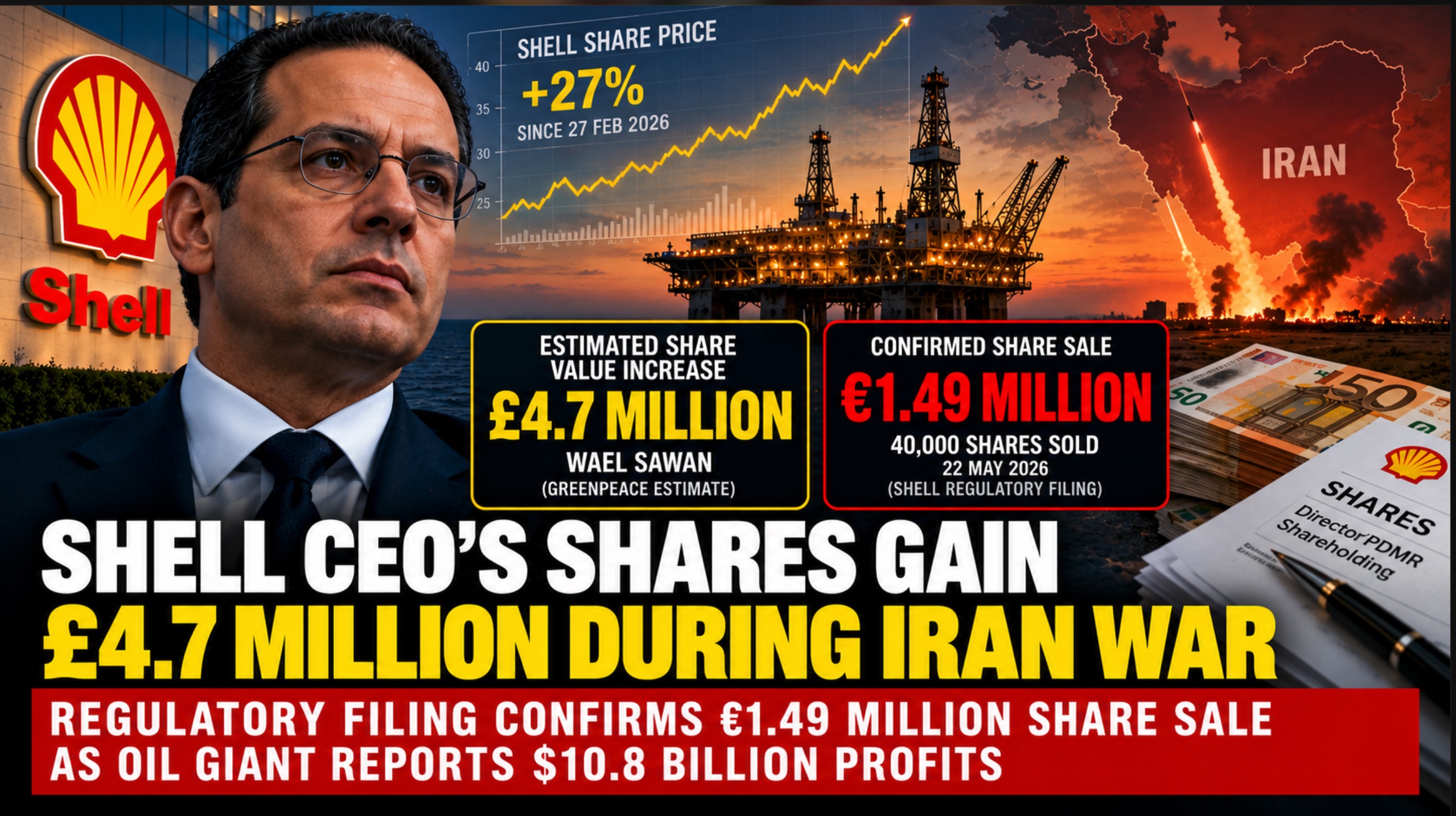
Greenpeace says four leading oil executives have enjoyed nearly £19 million in increased shareholding value during the Iran conflict. Shell chief executive Wael Sawan accounts for more than £4.7 million of that estimate. But the most revealing evidence comes from Shell’s own regulatory disclosures, which confirm a substantial share disposal in May 2026.
By John Donovan — 30 October 2026
As the Iran conflict continues to disrupt international energy markets, new research by Greenpeace UK has drawn attention to the personal financial benefits experienced by some of the world’s most senior oil executives.
According to the environmental organisation, the shareholdings of four major oil-company chief executives increased in value by nearly £19 million between late February and 28 October 2026.
Among them is Shell plc chief executive Wael Sawan.
Greenpeace estimates that the value of his Shell shareholding increased by more than £4.7 million over the period examined.
Separately, Shell’s own regulatory disclosures confirm that Sawan sold 40,000 ordinary shares on 22 May 2026, generating gross proceeds of €1,486,804.20 — approximately £1.3 million at the exchange rate used in Greenpeace’s reporting.
The timing has attracted attention because the transaction occurred during the Iran conflict and shortly before a reported suggestion by US President Donald Trump that a potential agreement with Iran had largely been negotiated.
There is, however, an important distinction between reporting the timing of a transaction and alleging improper conduct.
Neither Greenpeace’s analysis nor Shell’s regulatory notification establishes that Sawan possessed privileged information, anticipated a diplomatic announcement or breached securities regulations.
What the evidence does establish is a substantial increase in the reported value of executive shareholdings during an extraordinary period for international energy markets.
It also raises legitimate questions about the relationship between geopolitical disruption, shareholder returns and executive remuneration.
Greenpeace identifies nearly £19 million in executive shareholding gains
Greenpeace published its findings on 30 October 2026.
The organisation examined publicly available financial records relating to the chief executives of Shell, TotalEnergies, Harbour Energy and Equinor.
Its calculations cover the period between 27 February and 28 October 2026, using publicly disclosed shareholdings and closing market prices.
The resulting estimates are substantial.
| Chief executive | Company | Estimated increase in shareholding value |
|---|---|---|
| Patrick Pouyanné | TotalEnergies | £8.4 million |
| Linda Cook | Harbour Energy | £4.8 million |
| Wael Sawan | Shell | £4.7 million |
| Anders Opedal | Equinor | £1.03 million |
The figures are approximate and come from Greenpeace’s analysis, rather than a common accounting measure published by the four companies.
They represent increases in the estimated market value of shareholdings, not necessarily profits realised through sales.
The research does not include executives’ salaries or other benefits.
Greenpeace also reports that the four companies’ shares outperformed their respective domestic stock-market benchmarks during the period.
According to its calculations, Shell shares rose approximately 27%, while the FTSE 100 fell around 2%.
That contrast is central to the organisation’s argument.
While higher energy prices have created financial pressures for consumers and businesses, they have also contributed to stronger valuations for major energy producers.
Shell’s own records confirm Sawan’s €1.49 million share sale
The most important Shell-specific evidence is not Greenpeace’s interpretation.
It is Shell’s own official regulatory notification.
On 22 May 2026, Shell published a Director/PDMR Shareholding announcement identifying a transaction undertaken by its chief executive.
The details were precise:
- Executive: Wael Sawan
- Transaction date: 22 May 2026
- Transaction: Disposal of ordinary Shell shares
- Number sold: 40,000
- Price per share: €37.170105
- Total proceeds: €1,486,804.20
- Transaction location: Amsterdam
The disclosure was made under the applicable UK and European market-abuse disclosure regimes and was also furnished to the US Securities and Exchange Commission through Form 6-K.
These are independently verifiable facts.
The notification establishes the date, volume and value of the transaction.
It does not explain Sawan’s personal reason for selling.
It would therefore be inappropriate to speculate that the sale was motivated by geopolitical developments or expectations about future oil prices.
Sales by company directors are not inherently suspicious.
Executives may dispose of shares for numerous legitimate reasons, including taxation, diversification, personal financial planning or other circumstances.
The regulatory disclosure is nevertheless important because it enables shareholders and the public to examine significant transactions by individuals responsible for managing major listed companies.
The timing highlighted by Greenpeace
Greenpeace places particular emphasis on the fact that Sawan’s sale took place on 22 May 2026.
The organisation notes that this was the day before President Trump reportedly suggested that a potential US–Iran agreement had largely been negotiated.
That proximity is part of Greenpeace’s narrative.
But timing alone does not demonstrate foreknowledge, unusual trading behaviour or wrongdoing.
There is no evidence in the material reviewed that Sawan traded on inside information or acted improperly.
It is also worth remembering that share transactions by senior executives take place within a regulatory framework that includes disclosure obligations and restrictions on dealing.
The proper conclusion is that the transaction merits transparent reporting, not that its timing proves misconduct.
Another Shell disclosure: 82,987 conditional performance shares
An additional regulatory announcement provides important context.
On 21 May 2026, Shell announced that Sawan had received a conditional award of 82,987 performance shares under the Shell Share Plan 2023.
The award was made on 20 May and remained subject to performance conditions determined by the company’s Remuneration Committee and the committee’s discretion.
Shell’s chief financial officer, Sinead Gorman, received a conditional award of 10,964 shares under the same arrangement.
A conditional performance-share award should not be confused with an unconditional payment or an immediate cash benefit.
The shares may become deliverable only if the relevant conditions are satisfied.
Nevertheless, the award illustrates how executive remuneration can create substantial exposure to movements in the company’s share price.
It also provides context for the debate about whether executive reward should reflect improvements in shareholder value arising partly from factors beyond management’s control.
Those factors may include commodity-price changes, exchange-rate movements and geopolitical events.
Shell’s extraordinary third-quarter profits
The Greenpeace investigation arrives immediately after Shell’s announcement of exceptionally strong financial results.
On 29 October 2026, Shell reported:
- Adjusted earnings: $10.814 billion
- Income attributable to shareholders: $12.057 billion
- Operating cash flow: $21.043 billion
- Free cash flow: $16.322 billion
- New share-buyback programme: $5 billion
Adjusted earnings were almost double the $5.432 billion recorded in the corresponding quarter of 2025.
Shell attributed its strong performance to operational delivery in a volatile commodity-price environment, including exceptionally strong refining margins.
The company also acknowledged that the Middle East conflict had disrupted some operations.
Its financial reporting identifies the effects of reduced Qatari production, while LNG Canada contributed additional volumes.
These distinctions matter.
The conflict has not been an unqualified financial benefit to Shell.
It has created both commercial opportunities and operational difficulties.
Nevertheless, the company has demonstrated an ability to generate substantial earnings during a period of major international disruption.
The connection between geopolitical events, commodity prices and corporate profits therefore deserves serious examination.
A £4.7 million increase is not the same as £4.7 million received
The distinction between unrealised shareholding appreciation and money received from a sale is essential.
Greenpeace’s estimate that Sawan’s shares gained more than £4.7 million in value does not mean that he received that amount in cash.
The estimated gain reflects changes in the market valuation of his holdings over the research period, using Greenpeace’s methodology.
By contrast, the €1.486 million share disposal recorded by Shell represents a completed transaction.
Even that figure is gross proceeds, not necessarily Sawan’s net personal profit after acquisition costs, taxes or other relevant considerations.
The two figures should not simply be added together and described as a £6 million personal profit.
That would risk counting different financial concepts as though they were equivalent.
The distinction is particularly important when reporting on executive remuneration.
Clear evidence is more persuasive than exaggerated arithmetic.
Greenpeace demands additional fossil-fuel taxation
Greenpeace argues that the findings reinforce the case for additional taxation of fossil-fuel companies.
The organisation points to the financial pressures experienced by households and businesses when international oil and gas prices rise.
Its campaign position is that additional revenues from the fossil-fuel sector should help finance clean-energy investment and measures addressing climate-related damage.
Critics of additional windfall taxation, however, argue that poorly designed taxes can discourage investment, reduce future energy production and create uncertainty for projects involving significant long-term capital expenditure.
Those competing arguments are matters of public policy.
The Greenpeace research does not, by itself, establish which tax arrangements would achieve the best economic or environmental outcome.
It does provide evidence relevant to the wider debate about who benefits financially during periods of disruption to energy markets.
What should Shell shareholders ask?
The more immediate question for Shell shareholders concerns executive incentives and corporate governance.
Large listed companies commonly use shares and performance-based awards to align management interests with those of shareholders.
The principle is understandable.
If shareholders benefit from stronger performance, senior executives may also receive higher rewards.
But the design of such arrangements can produce complicated outcomes when share prices rise for reasons that management did not directly create.
An oil executive may benefit from higher commodity prices caused by geopolitical disruption even if the underlying improvement in shareholder returns does not result primarily from superior managerial decisions.
Equally, management may deserve recognition for protecting operations, maintaining cash generation and responding effectively to difficult market conditions.
The challenge for remuneration committees is to distinguish these influences.
For Shell, several questions arise.
First, how does the Remuneration Committee assess the contribution of management performance relative to movements in global oil and gas prices?
Second, how are exceptional geopolitical events considered when evaluating long-term incentive outcomes?
Third, what proportion of executive share awards is linked to operational, financial and energy-transition objectives?
Fourth, how does Shell ensure that incentives encourage decisions in the company’s long-term interests rather than simply rewarding short-term increases in market valuation?
Finally, what information is available to shareholders about the circumstances and applicable controls surrounding major executive share disposals?
These are questions of transparency and accountability, not allegations of misconduct.
Our archive reported Sawan’s share sale months ago
There is an important historical dimension to this story.
On 11 September 2026, royaldutchshellplc.com published:
Shell’s Upstream Boss Cashes In as the Oil-and-Gas Strategy Pays Off
That article examined share transactions involving Shell’s senior management and specifically identified Sawan’s 22 May disposal.
It recorded the same 40,000-share transaction and €1,486,804.20 proceeds now highlighted by Greenpeace.
The earlier article also made clear that the disclosure did not suggest improper conduct.
This is a useful example of the value of maintaining a searchable historical archive.
Today’s Greenpeace investigation introduces a broader calculation of executive shareholding gains during the Iran conflict.
But the underlying Shell share sale was already part of the public regulatory record and had already been examined by this website.
The distinction between an established historical fact and a new interpretation of that fact is important.
It helps prevent the public record from being distorted by the excitement surrounding a newly published campaign or news report.
The Shell Leaks Files perspective
The Independent Shell Archive and The Shell Leaks Files have repeatedly examined the relationship between corporate decision-making, financial rewards, public representations and shareholder accountability.
Historical internal communications and contemporaneous records demonstrate the importance of preserving original evidence.
That principle applies equally to modern regulatory disclosures.
Executive share transactions, remuneration awards, financial results and shareholder distributions form part of the permanent documentary record of how Shell is governed.
The objective is not to assume wrongdoing whenever a senior executive receives a substantial financial benefit.
It is to establish what happened, examine what the company disclosed and assess whether the available evidence supports the claims made about it.
The present case illustrates why that approach matters.
Greenpeace has published a campaigning interpretation of the financial benefits experienced by oil executives during a period of geopolitical instability.
Shell’s regulatory announcements provide independent evidence of Sawan’s share disposal and conditional performance-share award.
Shell’s quarterly results provide the financial context.
Together, those sources support a substantial story about executive remuneration and corporate accountability.
They do not establish improper trading.
A question of reward, responsibility and disclosure
The latest disclosures present a striking picture.
Shell has reported more than $10.8 billion in quarterly adjusted earnings.
Its chief executive has experienced an estimated £4.7 million increase in the value of his shareholding during the Iran conflict, according to Greenpeace.
The company’s own records establish that he sold shares worth almost €1.5 million in May.
And Shell has authorised another $5 billion in share repurchases.
None of these events is inherently improper.
They do, however, illustrate the scale of the financial interests involved when a major energy company operates in markets profoundly influenced by international conflict.
For shareholders, the central issue is whether executive incentives appropriately reward management performance and sustainable long-term value creation.
For the wider public, it is reasonable to ask how the benefits and costs of energy-market disruption are distributed.
The evidence does not justify accusing Shell’s chief executive of wrongdoing. It does justify asking whether executive reward arrangements sufficiently distinguish management achievement from the financial effects of global crises.
That is the question worth putting to Shell.
And it is one the company’s own regulatory disclosures help bring into focus.
Principal sources
1. Greenpeace UK — 30 October 2026
North Sea Oil Bosses Enjoy £19 Million Personal Windfall Since Outbreak of Iran War
Original Greenpeace investigation providing the estimated £19 million combined shareholding appreciation and the £4.7 million estimate relating to Wael Sawan.
Greenpeace — Oil Majors Share Gains Methodology, 28 October 2026
Supporting methodology supplied by Greenpeace. Its calculations and assumptions should be treated as the organisation’s estimates.
2. Shell plc — Official regulatory disclosure, 22 May 2026
Director/PDMR Shareholding — Wael Sawan
Primary corporate evidence confirming the sale of 40,000 ordinary shares for €1,486,804.20.
Shell plc — Form 6-K, 22 May 2026
The shareholding notification furnished to the US Securities and Exchange Commission.
3. Shell plc — Official regulatory disclosure, 21 May 2026
Director/PDMR Shareholding — Conditional Performance Share Awards
Primary evidence recording the conditional award of 82,987 performance shares to Wael Sawan.
4. Shell plc — 29 October 2026
Third Quarter 2026 and Nine Months Unaudited Results
Primary source for Shell’s quarterly adjusted earnings, cash flow, shareholder distributions and business performance.
5. Previous Independent Shell Archive reporting
Shell’s Upstream Boss Cashes In as the Oil-and-Gas Strategy Pays Off — 11 September 2026
Previous coverage confirming that Sawan’s May share disposal was already documented by this website.
Our detailed examination of Shell’s latest quarterly financial disclosures.
Editorial note: This article distinguishes Greenpeace’s estimates and campaigning claims from the financial transactions and other information confirmed in Shell’s official disclosures. An increase in the market value of a shareholding is not equivalent to a realised cash gain. A share disposal is not evidence of insider dealing or other misconduct. No such allegation is made against Wael Sawan. Shell plc is invited to provide any factual correction or explanation it wishes to place on the record.