AN INDEPENDENT DOCUMENTARY INVESTIGATION
Shell’s $1.45 billion North West Shelf disposal examined through corporate disclosures, financial analysis, historical records and Australian environmental decisions.
By John Donovan — 3 November 2026
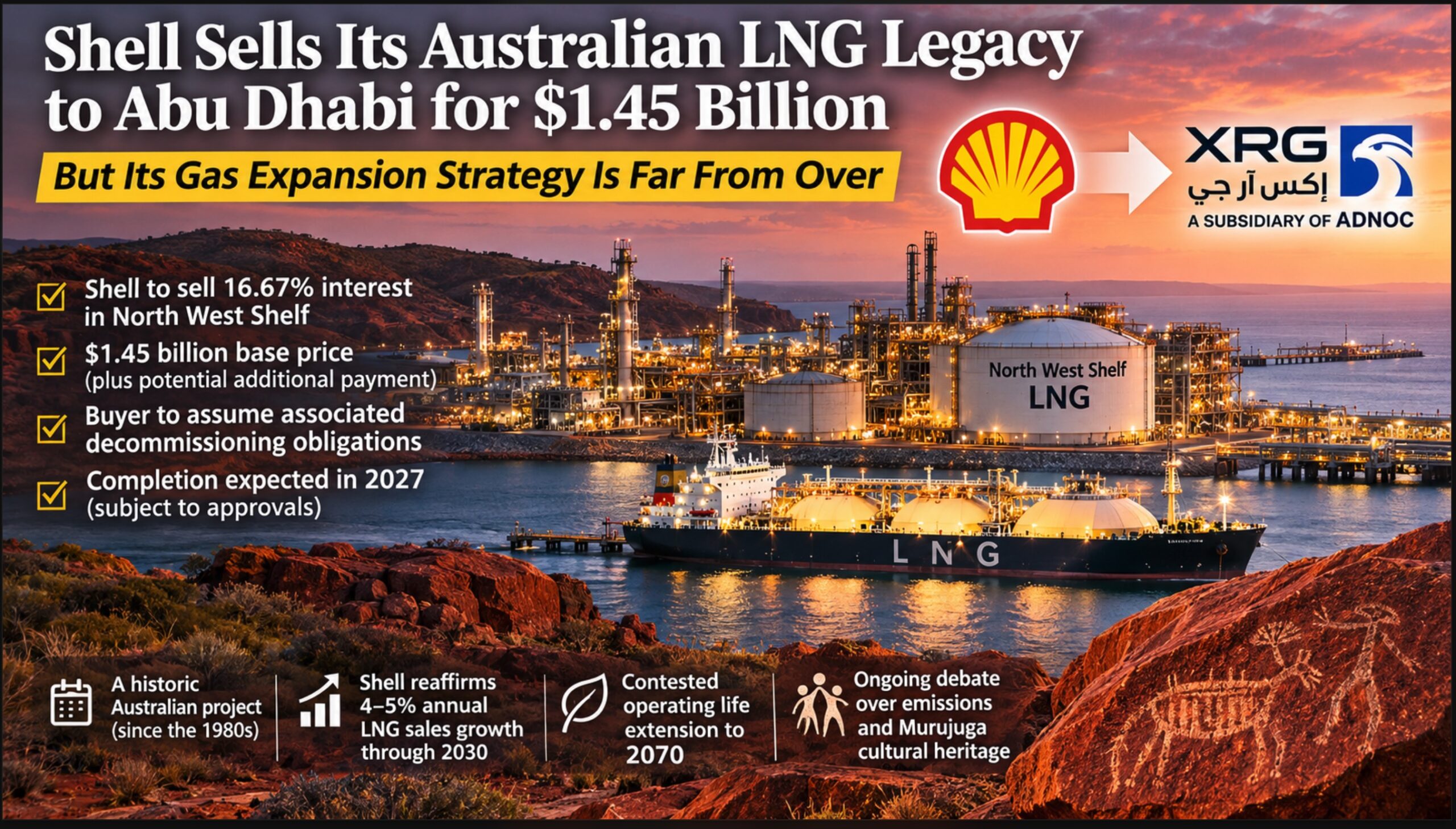
Shell has agreed to sell its 16.67% interest in Australia’s historic North West Shelf gas project to subsidiaries of ADNOC’s international investment company XRG for US$1.45 billion, with a possible additional payment. The deal transfers associated decommissioning obligations and marks the departure of a founding investor from one of Australia’s most important LNG developments. Yet Shell is not retreating from natural gas. It continues to target annual LNG sales growth of 4–5% through 2030, while the North West Shelf project itself has secured permission to operate until 2070 despite environmental controversy. The transaction raises questions about capital allocation, future liabilities, climate responsibility and the changing international ownership of major energy infrastructure.
Introduction: Shell departs from an Australian energy landmark
On Tuesday, 3 November 2026, Shell announced an agreement to sell its interest in Australia’s North West Shelf project.
The buyer is XRG P.J.S.C., the international energy investment company owned by Abu Dhabi National Oil Company, better known as ADNOC.
The transaction has a base consideration of US$1.45 billion, subject to customary adjustments, together with an additional payment dependent upon future milestones.
It involves Shell’s entire 16.67% non-operated interest in the North West Shelf development.
The sale is expected to be completed in 2027, subject to regulatory approvals and other conditions.
For Shell, the agreement represents another stage in its programme of concentrating investment in assets offering what it considers the most attractive commercial returns.
For Abu Dhabi, it represents another substantial investment in international natural gas infrastructure.
But there is a historical dimension that should not be overlooked.
Shell was one of the founding participants in the North West Shelf project.
The development helped transform Western Australia into a major international LNG exporter.
Shell’s departure therefore marks the end of an important chapter in its Australian energy history.
And yet the underlying project is not closing.
Far from it.
Its operators intend to continue processing natural gas for decades.
That distinction is central to understanding the significance of today’s announcement.
Source: Shell — Official Transaction Announcement, 3 November 2026
1. The transaction: What exactly is Shell selling?
The North West Shelf is not a single offshore platform or gas field.
It comprises several interconnected joint ventures and extensive infrastructure associated with offshore gas production, transportation, processing and export.
Shell’s announcement confirms that its sale includes interests in upstream production, pipelines and midstream facilities.
It also covers varying interests in related petroleum and pipeline titles, project agreements, offtake arrangements and companies associated with the development.
The participating companies include Woodside, Chevron, BP, Shell, Japanese interests represented through MIMI and China’s CNOOC.
Woodside operates the project.
Shell’s interest is non-operated, meaning that the company participates as an investor rather than acting as the principal operator responsible for day-to-day management.
This distinction is important.
Shell is not selling an entire LNG facility that it operates independently.
It is selling its participation in a complicated group of joint ventures.
The buyer is expected to assume the corresponding rights and obligations under the agreed transaction.
The terms also include arrangements concerning future decommissioning responsibilities.
The sale has an effective date of 1 January 2026, although completion is not expected until 2027.
The effective date determines the agreed economic reference point for the transaction. It does not mean ownership was legally transferred on that date.
The announcement provides no indication that the sale has already completed.
Until the necessary conditions have been satisfied, the transaction remains an agreed disposal awaiting completion.
2. The headline price is not necessarily the complete economic value
The announced base consideration is US$1.45 billion.
But that figure does not tell the entire financial story.
Shell has disclosed that the agreement includes an additional contingent payment linked to milestones.
The amount and detailed conditions of that payment have not been publicly disclosed.
It would therefore be misleading to include an assumed additional sum in the transaction’s value.
There is another important feature.
The buyers will assume associated decommissioning obligations and provide financial security in relation to those responsibilities.
Decommissioning can be a significant issue for mature offshore energy developments.
Eventually, producing facilities, pipelines and related infrastructure may require abandonment, dismantling, remediation or other work under the applicable regulatory requirements.
The timing and cost of those obligations can be uncertain.
They depend upon the condition of the infrastructure, the future use of facilities, regulatory requirements and the eventual decommissioning programme.
For a company selling a mature asset, transferring associated obligations can form an important part of the economic rationale.
The buyer’s assumption of obligations should not, however, be confused with an established release of Shell from every possible historical or statutory liability.
The precise allocation depends upon transaction documents and applicable law.
Shell’s announcement does not disclose a monetary valuation for the obligations being assumed.
It also does not provide enough information to calculate the net accounting gain or loss that Shell will recognise when the sale completes.
The confirmed terms are a $1.45 billion base payment, potential additional milestone consideration and an agreed allocation of associated decommissioning obligations.
Those are substantial terms.
But they do not justify inventing a total transaction value beyond what Shell has disclosed.
3. Why Shell is leaving now
Shell’s explanation is straightforward.
The North West Shelf is a mature asset whose original gas fields are experiencing declining production.
As those fields decline, spare processing capacity is becoming available at the Karratha Gas Plant.
The project’s future increasingly involves processing natural gas supplied by third parties.
This is described as a toll-processing model.
Under such an arrangement, the owner of processing infrastructure can provide services to other gas producers, subject to commercial agreements.
The plant remains valuable, but its commercial characteristics differ from those of a development principally processing gas from its original fields.
Shell’s Integrated Gas President, Cederic Cremers, said the agreement reflected the company’s commitment to disciplined capital allocation.
He described the disposal as a way to realise value from a mature, non-operated asset while concentrating investment elsewhere.
The logic is understandable from an investment perspective.
Shell can dispose of a minority position in a mature project and redirect capital towards assets it considers more commercially attractive.
That does not mean the North West Shelf has ceased to be valuable.
The fact that XRG is willing to pay $1.45 billion, with a possible additional payment, indicates that the buyer sees significant commercial potential.
The transaction therefore reflects different investment priorities rather than necessarily conflicting assessments of the project’s future.
Shell wishes to sell.
XRG wishes to acquire.
Both decisions can be commercially rational under different corporate strategies.
4. A historic project that helped establish Australia’s LNG industry
The North West Shelf development has a long history.
Shell’s participation dates back to the project’s formative period.
Production began in the 1980s, and LNG exports commenced in 1989.
The development became one of Australia’s most important international energy projects.
Its gas processing and export infrastructure helped establish Western Australia as a major supplier to Asian markets.
The Karratha Gas Plant remains central to the operation.
The project also supplies gas to the domestic market.
For decades, the development provided economic benefits through investment, employment, exports and government revenue.
Woodside states that the project has paid more than A$42 billion in royalties and excise since production began in 1984, measured across the whole development.
That figure illustrates the project’s economic importance.
But it is a project-wide historical amount.
It should not be attributed exclusively to Shell.
Nor does it represent the revenue or profit Shell earned from its particular interest.
The North West Shelf’s historical significance is nevertheless considerable.
Shell helped establish a major energy development that became a central part of Australia’s LNG export industry.
The sale therefore marks the departure of a founding investor from a project with which it has been associated for decades.
Source: Woodside — North West Shelf Project Extension
5. Shell is selling this LNG investment, not abandoning LNG
This is perhaps the most important strategic distinction.
Today’s transaction should not be interpreted as evidence that Shell is withdrawing from liquefied natural gas.
The company expressly reaffirmed its intention to grow LNG sales by 4–5% annually through 2030.
That target forms part of its wider strategy of concentrating investment in integrated gas and other businesses offering attractive returns.
Shell also retains major interests in Australia.
It operates the QGC project in Queensland.
It operates Prelude FLNG offshore Western Australia.
It is developing the Crux project.
And it continues to participate in Arrow Energy and Gorgon.
These businesses represent different forms of involvement in Australia’s gas industry.
Some are operated by Shell.
Others are joint ventures in which Shell participates alongside other investors.
The North West Shelf disposal therefore reduces Shell’s exposure to one mature, non-operated development.
It does not remove Shell from Australian gas production or LNG.
Indeed, the company’s own statement presents the sale as a means of supporting its broader integrated gas strategy.
This distinction matters when examining Shell’s public commitments concerning the energy transition.
Selling an interest in a gas project does not necessarily reduce global gas production.
The project may continue operating under different ownership.
The seller may also invest the proceeds in other gas developments.
A change in ownership is not, by itself, a reduction in fossil-fuel activity.
That is an analytical distinction, not an allegation that the transaction is improper.
6. Abu Dhabi’s XRG: A new international energy investor
The buyer is XRG, ADNOC’s international investment company.
ADNOC is Abu Dhabi’s state-owned energy group.
XRG was established to expand the group’s international investment activities, particularly in natural gas, chemicals and energy-related businesses.
The North West Shelf acquisition fits that strategy.
For XRG, the transaction provides access to an established Australian LNG development with extensive infrastructure and connections to Asian energy markets.
It also offers potential exposure to the project’s transition towards processing additional third-party gas.
That prospective business model may appeal to an investor seeking long-term infrastructure exposure.
The acquisition is also part of a broader pattern of international energy investment by Gulf-based companies.
Abu Dhabi possesses substantial financial resources and extensive experience in oil and gas production.
Its companies have increasingly pursued international opportunities.
Shell’s sale therefore illustrates a wider change in the ownership of global energy infrastructure.
An established European multinational is disposing of a mature minority interest.
An Abu Dhabi-backed investor is acquiring it.
The underlying gas facilities remain in Australia.
The commercial ownership changes.
The international energy relationships surrounding the infrastructure evolve.
This is not evidence that Australia has surrendered regulatory control over the project.
The development remains subject to Australian law, approvals and regulatory requirements.
But it does demonstrate the growing international reach of Abu Dhabi’s energy investment strategy.
Source: Reuters — Shell Agrees Sale of North West Shelf Stake, 3 November 2026
7. The Browse connection: Shell had already begun withdrawing
Today’s transaction also has an important connection with Shell’s earlier disposal of its interest in the Browse gas development.
In 2023, Shell sold its interest in the proposed Browse project.
The Browse development has been discussed as a potential source of additional gas for processing through existing North West Shelf facilities.
The concept involves transporting gas from offshore fields in the Browse Basin to the Karratha Gas Plant.
For Woodside, such arrangements could help maintain the commercial usefulness of the processing infrastructure as production from the original North West Shelf fields declines.
Shell’s departure from Browse therefore preceded its decision to sell the North West Shelf interest.
The two developments are related in the sense that Shell has been reducing exposure to parts of this particular Australian gas portfolio.
But the transactions should not be treated as a single combined sale.
They involved different interests and were agreed at different times.
Nor has the proposed Browse development automatically become an approved producing project merely because the North West Shelf’s operating-life extension has received approval.
Separate project development decisions and regulatory requirements remain relevant.
The important point is that Shell is retreating from a particular combination of mature and proposed assets in Western Australia.
It is not retreating from LNG globally.
8. The environmental controversy: Approval to operate until 2070
One of the most striking features of this transaction is the future operating life contemplated for the project.
In September 2025, the Australian government granted final federal environmental approval for the North West Shelf Project Extension.
The approval permits the project to continue operating towards 2070, subject to conditions.
The Western Australian environmental approval had been issued in December 2024.
The federal decision followed a lengthy assessment process.
Australian Environment Minister Murray Watt announced the final decision on 12 September 2025.
He said the approval was subject to 48 conditions intended to protect the internationally significant Murujuga rock art.
The Murujuga Cultural Landscape, on Western Australia’s Burrup Peninsula and surrounding area, contains an extraordinary collection of ancient Indigenous rock engravings.
The potential effect of industrial emissions upon this cultural heritage has been a major source of controversy.
Environmental campaigners have also challenged the project’s climate implications.
They argue that extending the life of major fossil-fuel infrastructure until 2070 is difficult to reconcile with efforts to reduce greenhouse-gas emissions.
The approval has therefore been politically and environmentally contentious.
But the regulatory position must be reported accurately.
The project has received the relevant environmental approvals for the extension, subject to conditions.
Opposition to the decision does not mean the extension was refused.
Nor does approval mean that every environmental concern has been resolved to the satisfaction of the project’s critics.
Both facts belong in a balanced account.
Source: Australian Government — North West Shelf Extension Final Approval, 12 September 2025
9. Indigenous heritage and the dispute over Murujuga
The Murujuga controversy deserves particular care.
The cultural landscape contains rock art of exceptional historical and cultural significance.
Some Indigenous custodians have strongly opposed the North West Shelf extension.
They have raised concerns about industrial emissions and the potential deterioration of the ancient engravings.
In September 2025, ABC News reported criticism from traditional custodian Raelene Cooper, who described the approval as a betrayal of Aboriginal people and future generations.
Other Indigenous representatives have taken a different position.
ABC also reported that Peter Hicks, chair of the Murujuga Aboriginal Corporation, welcomed aspects of the government’s decision and its protection arrangements.
It would therefore be inaccurate to portray all traditional custodians as holding an identical view.
The dispute concerns questions of cultural heritage, environmental science, consultation and the adequacy of regulatory safeguards.
The Australian government says its approval includes strict conditions.
Woodside maintains that the project has undergone extensive environmental assessment and that the required management plans will protect the relevant heritage values.
Critics argue that the conditions are insufficient and that continued industrial activity presents unacceptable risks.
These are substantial disagreements.
Shell’s sale does not determine their outcome.
The North West Shelf project will remain subject to its applicable approval conditions regardless of the change in ownership.
Source: ABC News — Traditional Custodians Challenge North West Shelf Approval, September 2025
10. Does selling the stake reduce Shell’s climate responsibility?
The transaction raises a broader question about the relationship between asset sales and corporate climate strategies.
Shell will cease to hold the relevant interest if the sale completes.
Its future financial exposure to the project will change.
The allocation of operational and decommissioning obligations will also change in accordance with the transaction and applicable law.
But the project’s facilities are not being dismantled as a consequence of the agreement.
The infrastructure is intended to continue operating.
The North West Shelf extension has been approved through to 2070, subject to conditions.
For global greenhouse-gas emissions, the relevant question is what happens to the underlying production and consumption of natural gas.
If the same gas is produced, processed and burned after a change of ownership, the change does not automatically eliminate the associated emissions.
It may change how emissions are attributed in corporate reports.
It may also change the parties responsible for managing and reporting operational emissions.
But emissions arising from physical activities do not disappear merely because the shareholder register changes.
This is an important distinction for investors and the public.
Corporate portfolio changes may affect a company’s financial exposure and reported emissions.
They do not necessarily produce equivalent changes in the real-world energy system.
That observation does not establish that Shell’s sale is misleading.
It establishes that the sale should be assessed as a financial and strategic transaction, not automatically characterised as a climate benefit.
11. The shareholder question: Is $1.45 billion a good price?
The transaction will naturally interest Shell shareholders.
But determining whether the sale represents good value requires more information than the headline price.
An investment assessment would need to consider the interest’s expected future cash flows, operating costs, capital expenditure requirements, remaining production, toll-processing revenues and future decommissioning costs.
It would also need to consider the contingent payment and the financial effect of transferring associated obligations.
Shell has not disclosed sufficient transaction-level information to calculate all those values independently.
The base consideration alone therefore cannot establish whether the sale is exceptionally attractive or disappointing.
However, the company’s rationale is clear.
Shell considers that it can allocate capital more effectively elsewhere.
That may be particularly relevant because the North West Shelf is moving away from its original production model.
An investor comfortable with mature infrastructure and future toll-processing revenues may place a different value on the asset from a company concentrating on other integrated gas opportunities.
The reported price is therefore evidence of an agreed transaction.
It is not, without further financial information, proof that Shell has sold too cheaply or that XRG has overpaid.
There is another important consideration.
Decommissioning obligations can become substantial as infrastructure ages.
The buyer’s assumption of associated obligations may therefore improve the transaction’s attractiveness to Shell beyond the cash consideration alone.
But without an authenticated breakdown, no reliable monetary value should be assigned to that benefit.
For shareholders, the appropriate questions concern the total economic terms, accounting consequences, regulatory conditions and eventual deployment of the sale proceeds.
Those matters should become clearer as the transaction progresses towards completion.
12. A broader pattern in Shell’s portfolio
Shell’s decision fits a wider pattern in the company’s management of its global assets.
The company has repeatedly emphasised capital discipline, shareholder returns and investment in businesses capable of delivering attractive financial performance.
It has also continued to identify LNG as an important source of future growth.
These positions are not necessarily contradictory.
A company can increase its overall LNG exposure while selling particular gas interests.
The important questions concern where it invests, what returns it expects and how its portfolio changes over time.
Shell’s own statement makes clear that the North West Shelf sale is intended to support its strategy.
But the transaction also illustrates the difficulty of assessing the energy transition through corporate divestments alone.
Shell is reducing its interest in one gas project.
XRG is acquiring that interest.
The project remains authorised to operate for decades.
Shell continues to plan further LNG growth.
The resulting picture is one of changing ownership and investment priorities, not a straightforward global retreat from natural gas.
EDITORIAL ASSESSMENT: SHELL LEAVES, BUT THE GAS BUSINESS CONTINUES
There is a certain historical irony in today’s announcement.
Shell helped establish one of Australia’s most important LNG developments.
It participated in the project’s growth and commercial success.
Now, as the original fields decline and the infrastructure moves towards a different business model, Shell is selling its interest.
The buyer is not a renewable-energy company acquiring the facilities for dismantling.
It is the international investment arm of Abu Dhabi’s national oil company.
The transaction therefore represents a transfer of established gas infrastructure from one major energy investor to another.
For Shell, the sale may offer an attractive combination of immediate consideration, potential future payment and reduced exposure to mature-asset obligations.
For XRG, it offers participation in a major Australian energy development with infrastructure capable of supporting future processing arrangements.
Neither interpretation requires an allegation of improper conduct.
But the transaction also invites scrutiny of Shell’s wider strategic messaging.
The company continues to promote LNG as an important element of its energy portfolio.
It intends to increase LNG sales through 2030.
At the same time, it is disposing of a historic Australian LNG interest.
The distinction is between exiting an asset and exiting a business.
Shell is doing the former.
It is not doing the latter.
The North West Shelf’s environmental controversy adds another dimension.
The project’s operating-life extension to 2070 has attracted substantial criticism over greenhouse-gas emissions and Indigenous cultural heritage.
Those concerns will not disappear because Shell’s interest changes hands.
They remain relevant to the project’s operator, continuing participants, prospective new investor and Australian regulators.
The implications for Shell shareholders are also broader than the cash payment.
The decommissioning arrangements, contingent consideration and future use of capital may prove important.
But their full financial consequences remain uncertain.
The central conclusion
Shell’s decision can reasonably be understood as a commercial withdrawal from a mature, non-operated asset.
It should not be described as an abandonment of LNG.
Nor should it be portrayed as a completed disposal before regulatory approvals have been obtained.
The announced consideration is substantial.
The transfer of associated decommissioning obligations is potentially important.
The project’s environmental controversies remain unresolved in the wider public debate.
And the buyer’s identity illustrates the expanding international investment ambitions of Abu Dhabi’s energy sector.
Shell is leaving the North West Shelf shareholder group. It is not leaving Australia’s gas industry, and the North West Shelf is not leaving the LNG business.
That is the most important distinction in today’s announcement.
PRINCIPAL SOURCES
1. Shell plc — Shell Agrees to Sell Interest in North West Shelf Project, 3 November 2026
The primary corporate announcement confirms the 16.67% interest, the $1.45 billion base consideration, the contingent payment, the assumption of associated decommissioning obligations, the effective date and the expected completion in 2027.
Read Shell’s original announcement
2. Reuters — Shell Agrees Sale of North West Shelf Stake for $1.45 Billion, 3 November 2026
Independent contemporaneous reporting of the agreement and Shell’s continuing LNG growth strategy.
3. Woodside Energy — North West Shelf Project Extension
The operator’s explanation of the project’s long-term operating plans, environmental approvals, gas processing infrastructure and economic contribution.
Read Woodside’s project information
4. Western Australian Environmental Protection Authority — North West Shelf Project Extension
Official project documentation describing the proposal to continue processing gas and fluids until approximately 2070.
Read the official environmental assessment record
5. Australian Government — Final Approval of North West Shelf Project Extension, 12 September 2025
The federal government’s decision and explanation of the conditions imposed in relation to the Murujuga cultural landscape.
Read the ministerial statement
6. ABC News — Final Approval of Woodside’s North West Shelf Extension, 12 September 2025
Independent reporting on the approval, environmental controversy and differing responses among Indigenous representatives.
7. ABC News — Traditional Custodian Challenges North West Shelf Approval, 15 September 2025
Contemporary reporting of criticism concerning the protection of ancient Murujuga rock art and the government’s conditions.
8. ABC News — Climate Advocates Respond to North West Shelf Approval, 28 May 2025
Reporting on environmental opposition and concerns about the project’s climate implications.
DOCUMENTARY DISCLAIMER
This article is based upon Shell’s authenticated announcement of 3 November 2026, contemporaneous Reuters reporting, statements from the North West Shelf operator, Australian government environmental records and independent reporting concerning the project’s environmental controversy.
The announced transaction is an agreement to sell, not a completed transfer of ownership.
Completion is expected in 2027 and remains subject to regulatory approvals and other conditions.
The US$1.45 billion amount is the disclosed base consideration. Additional contingent consideration is acknowledged, but no undisclosed amount is assumed.
The buyer’s assumption of associated decommissioning obligations is reported from Shell’s announcement. The article does not claim that every possible historical or statutory obligation of Shell has been extinguished.
Financial analysis concerning capital allocation and potential shareholder benefits is identified as commentary rather than a verified accounting outcome.
The North West Shelf extension’s environmental approvals are acknowledged, as are the objections raised by environmental organisations and Indigenous custodians.
Differing views among Indigenous representatives are distinguished.
The article does not allege that Shell, XRG, Woodside or any other project participant has acted unlawfully in connection with the announced sale.
The transfer of ownership is distinguished from changes in physical gas production or greenhouse-gas emissions.
Shell’s plans for LNG sales growth are reported as forward-looking corporate expectations, not guaranteed outcomes.
Relevant factual corrections and responses from Shell, XRG, Woodside and other interested parties are welcome.
The website’s general disclaimer also applies.