 Shell sold the German battery pioneer in August. By October, Sonnen GmbH had filed for insolvency. Yet across the Atlantic, the company’s American operation is helping launch an innovative electricity-grid project. The contrast raises fresh questions about what survives when a former clean-energy flagship is dismantled.
4 November 2026
By the Donovan–Shell Archive
There is something rather extraordinary about the continuing Sonnen saga.
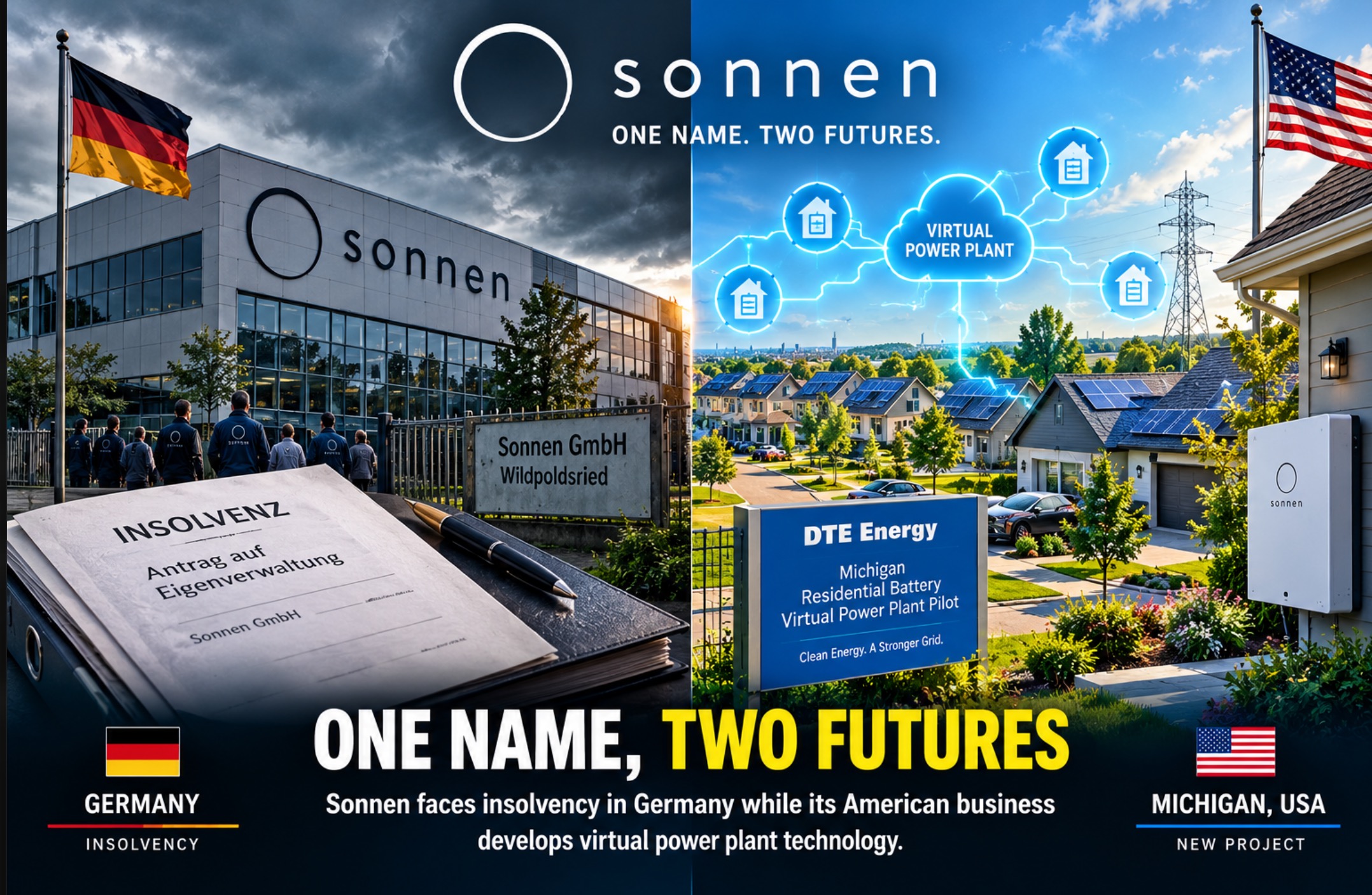
In Germany, the former Shell-owned battery-storage pioneer is struggling through insolvency proceedings.
In America, a business operating under the same name is helping launch what its partners describe as Michigan’s first residential battery virtual power plant pilot.
Same technological heritage. Same familiar Sonnen name.
Two remarkably different corporate fortunes.
And somewhere in the background stands Shell plc, the oil and gas giant that acquired Sonnen in 2019 as part of its clean-energy ambitions, then sold the business in August 2026.
For anyone attempting to understand Shell’s energy transition, the story has become increasingly revealing.
The German operations illustrate the financial difficulties of building a competitive battery-storage manufacturer.
The American project demonstrates that the technology and expertise associated with Sonnen may still have substantial commercial potential.
The distinction matters.
Because Sonnen’s German insolvency does not mean its technology has become obsolete.
Quite the opposite.
A new development in Michigan
On 29 October 2026, DTE Energy and Sonnen announced the launch of a two-year residential battery virtual power plant pilot at Veridian at County Farm, an all-electric residential development near Ann Arbor, Michigan.
The project has been approved by the Michigan Public Service Commission.
It will connect battery systems in nearly 100 homes, allowing DTE to investigate whether coordinated household storage can improve electricity-grid reliability and help reduce costs.
The announcement was subsequently reported by pv magazine USA on 3 November.
The project is relatively modest in scale.
It is a pilot, not a nationwide commercial rollout.
But its significance lies in the technology being demonstrated.
Rather than treating household batteries as isolated devices, Sonnen’s system allows them to operate collectively as a distributed electricity resource.
Individual homes can store electricity generated by rooftop solar panels.
When grid conditions require additional flexibility, software can coordinate participating batteries to help balance supply and demand.
This arrangement is known as a virtual power plant, or VPP.
The batteries remain physically distributed among individual homes, but their combined capacity can be managed as a single flexible resource.
Such systems could become increasingly important as electricity networks accommodate more renewable generation, electric vehicles and changing patterns of demand.
That is the technology Sonnen was developing when Shell acquired the company.
And it is now being demonstrated in Michigan while the German business faces an uncertain future.
A neighbourhood designed around electricity
Veridian at County Farm is not a conventional housing development.
According to DTE, the community occupies approximately 14 acres and includes 170 mixed-income homes.
Its design incorporates rooftop solar panels, geothermal systems, electric heat pumps, all-electric appliances and electric-vehicle-ready charging facilities.
Homes are equipped with Sonnen battery systems.
The new pilot will coordinate batteries in nearly 100 of those homes.
DTE hopes to establish whether the technology can provide useful grid services during periods of increased electricity demand.
The utility will also investigate potential benefits for reliability and customer affordability.
Those benefits remain objectives to be tested.
The announcement does not establish that the pilot has already delivered measurable reductions in electricity costs.
Nevertheless, it represents a practical application of the distributed-energy technology that originally made Sonnen attractive to Shell.
Blake Richetta, chairman and chief executive officer of Sonnen Inc., described the project as a demonstration of a more decentralised and digitally managed electricity system.
DTE chief executive Joi Harris emphasised the potential for coordinated residential batteries to make better use of existing electricity resources.
These are reasonable objectives.
They also underline an important distinction between a company’s financial difficulties and the continuing usefulness of its technology.
Meanwhile, Germany faces a very different reality
The American announcement followed Sonnen GmbH’s German insolvency filing by just seven days.
On 22 October, approximately 400 employees at Sonnen’s headquarters in Wildpoldsried, Bavaria, were informed that the company had applied for insolvency.
The filing came only two months after Shell sold Sonnen to investment vehicle Tiven, associated with Aurelius co-founder Gert Purkert.
The German company’s financial difficulties had developed over several years.
As previously reported, Sonnen group revenue fell dramatically between 2023 and 2024, while losses and restructuring costs mounted.
Shell had provided substantial financial support before deciding to dispose of the business.
The October filing was an application for insolvency under self-administration, rather than proof that every Sonnen group company had entered the same proceedings.
That distinction is important.
The available information indicates that different legal entities within the Sonnen organisation face different circumstances.
It would be inaccurate to describe the entire international business as having entered one uniform insolvency process.
German customer services were expected to continue, although questions remain about the longer-term treatment of warranties, support contracts and other obligations.
The American operation, meanwhile, has continued pursuing its own commercial activities.
Sonnen USA is not Sonnen GmbH
On 27 October, a Sonnen USA spokesperson clarified to Energy-Storage.news that the American business would continue operating as Sonnen Inc.
The spokesperson also explained that Sonnen Intelligence GmbH was a newly established German entity intended to support the American business’s research and development.
This clarification is significant because it helps explain how the American operation can continue pursuing projects while Sonnen GmbH faces insolvency in Germany.
It does not, however, answer every question about the restructuring.
In particular, the publicly available information does not establish whether valuable intellectual property, trademarks, software rights or other assets have been transferred between entities, or what consideration might have been paid.
Nor does the Michigan project demonstrate that any such transfer was improper.
These are separate matters requiring documentary evidence.
The American business’s continuing operations are established.
The detailed financial and legal arrangements underlying the international restructuring remain less transparent.
What happened to Shell’s original vision?
Shell acquired Sonnen outright in 2019 after making an earlier investment in 2018.
At the time, household battery storage and virtual power plant technology appeared to offer an attractive opportunity for an international energy company seeking to expand beyond conventional oil and gas.
The commercial proposition was straightforward.
As renewable electricity generation increased, customers would need better ways to store and manage energy.
Networks would need greater flexibility.
Digital technology could connect individual devices into larger coordinated systems.
Sonnen was developing precisely those capabilities.
The Michigan project illustrates why that original investment thesis was not necessarily mistaken.
There remains a market for the technology.
The difficulty was translating technological promise into sustainable financial performance across the wider business.
Sonnen’s German operations encountered severe competitive and financial pressures.
Shell eventually decided to sell.
Its former subsidiary subsequently filed for insolvency.
Yet Sonnen’s American operation is continuing to pursue opportunities in an expanding market for distributed electricity resources.
The story is therefore more complicated than a simple failure of battery technology.
It is also a story about capital allocation, corporate restructuring and the different commercial conditions facing clean-energy businesses in different countries.
An uncomfortable question for Shell
Shell is entitled to argue that selling a financially troubled subsidiary was a legitimate commercial decision.
No multinational company can be expected to finance unlimited losses indefinitely.
But the continuing development of Sonnen’s technology makes the history of Shell’s investment worth examining.
How much capital did Shell ultimately commit?
What financial return did it receive from the disposal?
Could a different ownership or restructuring arrangement have preserved more of the German business?
And what lessons has Shell drawn from an acquisition once associated with its ambitions in the electricity market?
These are questions about corporate strategy and accountability, not allegations of misconduct.
There is currently no established evidence that Shell acted unlawfully in disposing of Sonnen.
Nor does the American project’s launch establish that Shell should necessarily have retained ownership.
It does, however, demonstrate that the technology associated with Sonnen remains commercially relevant.
The company that Shell once acquired as a symbol of the energy future has not simply disappeared.
Instead, its activities are following different paths.
In Germany, restructuring and insolvency.
In America, new projects and potential growth.
The irony of Shell’s energy transition
Shell continues to emphasise investment discipline, shareholder returns and the importance of its established oil and gas businesses.
Its broader strategy places substantial weight on LNG, upstream production and competitive financial performance.
Against that background, the Sonnen disposal is understandable as a commercial decision.
But it also illustrates the difficulties involved in transforming a traditional energy company through acquisitions of emerging technologies.
Buying an innovative business is relatively straightforward.
Making it consistently profitable is much harder.
Supporting it through a prolonged period of intense competition is harder still.
And explaining its eventual disposal while continuing to promote an energy-transition narrative requires considerable corporate communications expertise.
Shell certainly possesses plenty of that.
The more interesting question is whether its former clean-energy investments will ultimately deliver greater value under different ownership.
The Michigan project offers one small piece of evidence that Sonnen’s technological capabilities remain useful.
It does not yet establish whether the American operation will achieve lasting profitability.
That remains to be demonstrated.
What happens next?
The Sonnen story remains unfinished.
The German insolvency process may eventually clarify the financial position of the company, the treatment of creditors and the future of its remaining operations.
Further information may also emerge concerning the August sale, subsequent restructuring and relationships between the German and American entities.
Customer warranties and service continuity remain important practical concerns.
Meanwhile, the Michigan pilot will provide an opportunity to evaluate whether residential batteries can deliver measurable benefits when coordinated as part of an electricity network.
The project’s commercial significance will depend on its actual performance, operating costs and potential for expansion.
For now, one conclusion is justified.
Sonnen’s German financial difficulties have not extinguished the technological ambitions that originally attracted Shell.
The American operation is continuing to develop them.
And that creates an uncomfortable contrast for a former owner that has already moved on.
Shell sold the company.
Germany inherited the insolvency proceedings.
America is testing the technology.
The energy transition, it seems, has a remarkable ability to survive changes of corporate ownership.
Whether the same can be said for all the employees, customers and creditors affected by those changes remains a much more serious question.
A brief fictional exchange: Sir Henri Deterding and John Donovan
The following dialogue is fictional satire. Sir Henri Deterding died in 1939.
SIR HENRI DETERDING: Donovan! I understand our German battery company is insolvent.
JOHN DONOVAN: Shell’s former battery company, Sir Henri. Yes.
DETERDING: Ach. A most unfortunate development.
DONOVAN: But its American operation has just launched a new electricity-grid project.
DETERDING: The same technology?
DONOVAN: Essentially the same field of technology. Household batteries working together as a virtual power plant.
DETERDING: And Shell sold this business?
DONOVAN: In August.
DETERDING: Mein Gott. First we purchase the future. Then we sell the future. Now the future is working in America?
DONOVAN: That is one way of putting it.
DETERDING: And what is Shell doing?
DONOVAN: Concentrating on businesses offering stronger returns.
DETERDING: Ja. A sensible ambition. But perhaps next time they should ask the future whether it intends to become profitable before purchasing it.
DONOVAN: That might spoil the acquisition announcement.
DETERDING: Ach, Donovan. You are becoming cynical.
DONOVAN: Years of studying Shell, Sir Henri.
DETERDING: Then I shall forgive you.
Principal sources
DTE Energy, 29 October 2026: DTE Energy and Sonnen launch Michigan’s first residential battery virtual power plant pilot
pv magazine USA, 3 November 2026: All-electric community in Michigan launches DTE-managed VPP pilot
Energy-Storage.news, updated 27 October 2026: Sonnen files for insolvency in Germany two months after Shell disposal
Handelsblatt, 22 October 2026: German battery manufacturer Sonnen files for insolvency
Donovan–Shell Archive, 24 October 2026: Shell’s Green Dream Goes Bust: Battery Pioneer Sonnen Files for Insolvency Just Two Months After Oil Giant Sells It
DISCLAIMER
This article is independent news analysis, opinion and commentary, incorporating clearly identified fictional satire. It is based on publicly available information as of 4 November 2026. Sonnen GmbH’s insolvency proceedings and Sonnen Inc.’s American business activities concern distinct legal entities. The continuation of American operations does not establish wrongdoing in any restructuring, disposal or asset transaction. No allegation of unlawful conduct by Shell plc, Tiven, Aurelius or any individual is made. Projected benefits of the Michigan pilot are not presented as verified outcomes. This article is not financial, investment or legal advice.