By the Donovan–Shell Archive
16 November 2026
Researched and drafted with assistance from ChatGPT.
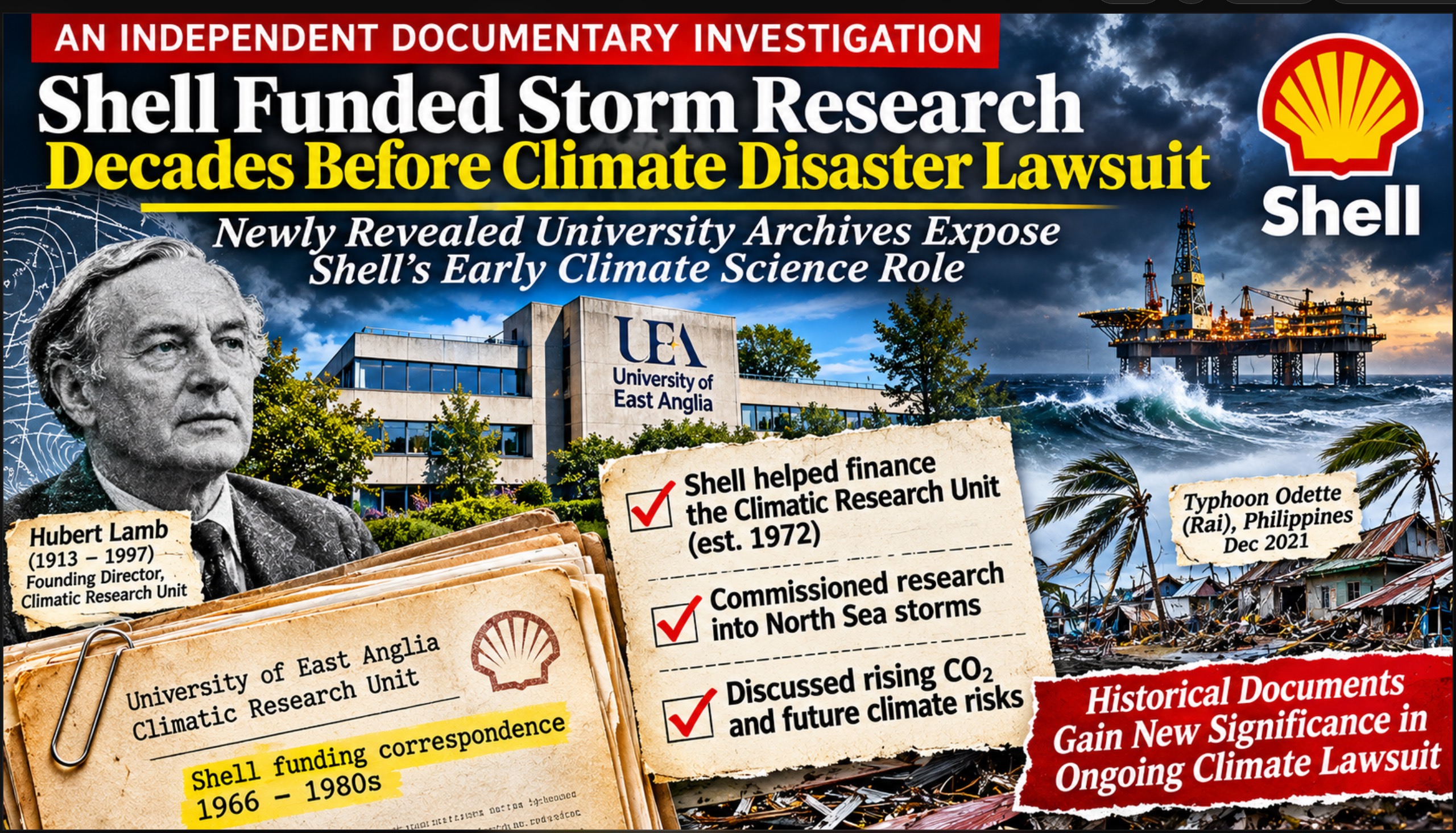
A newly published investigation has uncovered further details of Shell’s decades-old relationship with British climate scientists, including financial support for the establishment of the University of East Anglia’s Climatic Research Unit and commissioned studies examining severe storms, rising carbon dioxide levels and changing global weather patterns. The historical records acquire particular significance as more than 100 survivors of a devastating Philippine typhoon pursue Shell through the English courts. But what do the documents actually establish, and how should they be assessed against Shell’s defence?
Introduction: A new chapter in the history of what Shell knew
On 16 November 2026, investigative journalist Rebecca John published a detailed examination of historical Shell climate research in collaboration with Rolling Stone.
The investigation, entitled Big Oil, Climate Change, and a ‘Smoking Gun’, draws upon original correspondence, research papers and other documents preserved by the University of East Anglia.
Its central revelation concerns Shell’s relationship with the Climatic Research Unit, established in Norwich in 1972 under pioneering British climatologist Hubert Lamb.
The newly examined records trace Shell’s involvement from early discussions about climate forecasting in the 1960s through commissioned research into North Sea storms and future climatic conditions.
The findings are significant partly because Shell was not merely receiving occasional scientific warnings.
It was helping finance research, requesting information and commissioning investigations intended to improve its understanding of climatic risks.
The distinction matters.
An unsolicited scientific warning might be overlooked or misunderstood.
A research programme financed by a company to assist its own planning creates a more direct documentary record of the scientific information being sought and communicated.
Nevertheless, financing research is not itself evidence of wrongdoing.
Nor does a historical document discussing climate risks automatically establish that Shell knew the precise consequences of future global warming.
The historical evidence must be examined in its original scientific, corporate and chronological context.
That is the purpose of this independent documentary assessment.
1. September 1966: Shell begins seeking expert climate advice
The story begins with an apparently ordinary commercial problem.
During the 1960s, Shell needed to anticipate changing weather patterns because seasonal temperature variations affected demand for heating oil.
Several severe European winters had raised questions about the volume of petroleum products the company should store.
Building additional storage facilities would involve substantial capital expenditure.
But investing in unnecessary capacity could also prove costly.
Shell therefore had an economic reason to seek better climate forecasting.
According to the correspondence examined by DeSmog and Rolling Stone, Shell executive R. O. Chalkley contacted Hubert Lamb in September 1966 after reading his work concerning climatic variability.
Chalkley was involved in long-term planning for the Shell Group.
The correspondence developed into discussions about a possible specialist centre for climatic studies.
Independent academic research supports the broad historical account.
A University of East Anglia doctoral thesis by Elliot Honeybun-Arnolda, submitted in July 2022, identifies Shell Petroleum as an early financial supporter of the Climatic Research Unit and references Chalkley’s original correspondence preserved under archive reference UEA/JONES/40.
That research also explains that Shell wanted better information about long-term climate variability because of its implications for oil storage and energy demand.
The relevance of this finding is not that Shell’s initial purpose was environmental protection.
It was commercial planning.
But an interest in changing weather patterns created direct connections between the petroleum industry and scientists investigating the Earth’s climate.
Those connections would subsequently become much more significant.
2. The 1969 documents: Shell’s involvement in establishing a climate research centre
The DeSmog investigation identifies correspondence concerning discussions held in October 1969 between Hubert Lamb and senior Shell executives.
Those reportedly involved included Monroe Spaght, a senior Royal Dutch/Shell executive, and Lord Victor Rothschild, who held a leading position in Shell’s research organisation.
The discussions concerned the proposed establishment of a specialist climate research centre at the University of East Anglia.
Shell subsequently approved an initial contribution of £10,000, later increased to £20,000, according to the newly reported correspondence.
Other organisations also provided financial support.
The Climatic Research Unit opened in 1972.
This history is independently supported by the university’s own archival catalogue.
The University of East Anglia identifies a collection bearing the reference UEA/JONES/40, covering the period 1963–1971.
The catalogue describes 214 items principally comprising correspondence between Hubert Lamb and Professor Keith Clayton concerning the establishment and financing of the Climatic Research Unit.
Correspondence involving Sir Solly Zuckerman is also identified.
Primary archival catalogue: University of East Anglia — UEA/JONES/40: Climatic Research Unit.
The catalogue does not independently verify every figure or interpretation reported by DeSmog.
It does, however, establish the existence, provenance and general nature of the underlying historical collection.
This is an important difference from an investigation relying exclusively on retrospectively reconstructed corporate history.
The relevant contemporary correspondence has been preserved within an identifiable academic archive.
3. An early research proposal explicitly raised fossil-fuel carbon dioxide
One of the most important documents examined by DeSmog is a proposal associated with the creation of the climate research centre.
The proposal recognised that human activity, including fossil-fuel combustion, was altering atmospheric carbon dioxide concentrations.
It contemplated investigating the climatic consequences of such changes.
This is particularly significant because it places awareness of the relationship between fossil-fuel combustion and atmospheric change within the discussions surrounding a research institution receiving Shell’s financial support.
It also reinforces the historical context of Shell’s separately commissioned research by scientist James Lovelock.
The Donovan–Shell Archive has previously examined the Lovelock report of June 1966.
That document investigated the possible large-scale atmospheric effects of fossil-fuel combustion.
The newly reported Climatic Research Unit correspondence adds another strand to the record.
Rather than relying solely on one scientist’s report, it shows the development of an enduring relationship between Shell and an academic institution specialising in climatic research.
However, an important distinction remains.
The presence of scientific warnings within a research proposal does not establish that every Shell executive accepted every proposed scientific conclusion.
Nor does it establish that the company’s subsequent corporate policy was determined by that proposal.
Those questions require examination of internal decision-making, correspondence and other evidence.
What the records do establish is that Shell’s engagement with climate science began long before climate change became a prominent subject of international public controversy.
4. The North Sea storms project: Shell commissions research into physical risks
The most distinctive new evidence concerns the research undertaken for Shell into North Sea storms.
During the 1970s, offshore oil and gas operations were becoming an increasingly important part of the company’s business.
The North Sea presented substantial engineering challenges.
Severe weather could threaten drilling platforms, offshore installations, workers and production infrastructure.
According to the documents examined by DeSmog, Shell provided £15,921 in 1975 for a research project investigating historical North Sea storms.
The work was intended to improve understanding of severe weather and identify patterns that might assist future operational planning.
This part of the historical account can be cross-checked against the university’s own archive catalogue.
The Hubert Lamb collection includes a file identified as LAMB/1/21, concerning storms over the North Sea and other northern European seas.
Its contents include research proposals, correspondence concerning historical storms, an interim report and records relating to the severe storm of November 1981.
Most importantly, the university’s catalogue expressly identifies proposed research funding from Shell.
Primary archival catalogue: University of East Anglia — LAMB/1/21: Storms over the North Sea.
The catalogue confirms that Shell-funded historical storm research forms part of the archived material.
The original individual documents and their full scientific findings require separate examination.
Nevertheless, this is an unusually direct documentary connection between a major petroleum company’s commercial infrastructure concerns and academic research into changing climatic risks.
5. A warning concerning increasing storminess
The research did not remain confined to examining storms from previous centuries.
The newly reported correspondence indicates that Hubert Lamb continued updating Shell on developments affecting the North Sea.
In 1981 and 1982, Lamb communicated information about serious storms and evidence suggesting increased storminess during the second half of the twentieth century.
According to DeSmog’s examination of his handwritten notes, Lamb identified indications of greater storminess since the 1950s.
The research was ultimately developed into a substantial historical study.
In 1991, Cambridge University Press published Historic Storms of the North Sea, British Isles and Northwest Europe, by Hubert Lamb in collaboration with Knud Frydendahl.
The book’s publication is independently verifiable through library catalogue records.
Bibliographic record — Historic Storms of the North Sea, British Isles and Northwest Europe, 1991.
There is an important qualification.
Evidence of increasing storminess during a particular historical period is not automatically proof that anthropogenic climate change caused the observed increase.
Meteorological research distinguishes observed weather trends from conclusions about their causes.
Lamb himself recognised the difficulty of establishing the precise causes of changes in North Sea storm patterns.
That scientific caution should be preserved.
But the documented significance remains: Shell commissioned and received information concerning changes in severe-weather risks affecting its operations.
The distinction between identifying a risk and determining its precise cause is central to interpreting the record responsibly.
6. Shell’s research relationship extended into the 1980s
The Climatic Research Unit’s work extended beyond historical North Sea storms.
According to the new investigation, Shell supported further research examining possible climatic conditions in a world with substantially higher atmospheric carbon dioxide.
This included work associated with scenarios for a warmer world during the early 1980s.
Such studies explored consequences extending beyond changes in average temperature.
Alterations in atmospheric circulation could affect rainfall patterns, winds, agriculture and energy consumption.
These were matters of both scientific importance and direct commercial interest.
In November 1985, a Shell representative, M. H. Griffiths, reportedly met Thomas Wigley, who had succeeded Lamb as director of the Climatic Research Unit.
The discussion subsequently appeared in internal Shell documentation concerning the greenhouse effect.
The account examined by DeSmog indicates that the scientific briefing included warnings about rising temperatures, sea levels, rainfall and tropical storms.
This part of the evidence connects the university research programme with a separate collection of Shell internal climate documents that became publicly available through earlier investigative work.
In 2018, Dutch journalist Jelmer Mommers published previously confidential Shell climate records.
The Climate Investigations Center subsequently preserved an indexed collection of those documents.
Climate Investigations Center — Shell Climate Document Index.
The newly reported university correspondence is therefore not the first evidence that Shell examined climate change internally.
Its importance lies in providing additional provenance and context.
It helps identify the scientists, institutions, research programmes and exchanges of information that contributed to the company’s developing understanding.
7. The central contradiction: research into storms and public doubts about climate science
The historical research becomes particularly contentious when compared with the petroleum industry’s subsequent public communications.
During the 1990s, the Global Climate Coalition opposed aspects of proposed international measures to reduce greenhouse-gas emissions.
Shell participated in the coalition through its United States operations.
In 1995, an AccuWeather report commissioned by the coalition disputed claims that climate change was increasing the occurrence of extreme weather events.
The surviving report and associated correspondence are preserved by Climate Files.
Climate Files — 1995 Global Climate Coalition and AccuWeather report.
These records deserve attention alongside the newly reported Climatic Research Unit material.
On one side of the historical record, Shell sponsored scientific investigations concerning changing weather patterns, atmospheric carbon dioxide and potential operational risks.
On the other, a trade organisation to which Shell belonged promoted arguments questioning aspects of climate science and the case for regulatory intervention.
However, it would be inaccurate to conclude that every Global Climate Coalition statement was personally written or specifically approved by Shell.
Corporate membership, financial participation, direct authorship and formal endorsement are different matters.
A convincing historical investigation must establish which actions and statements can actually be attributed to Shell.
Another material development occurred in 1998.
Shell announced that it would withdraw from the Global Climate Coalition because of differences concerning climate policy and the Kyoto Protocol.
That withdrawal was reported contemporaneously.
Oil & Gas Journal — Shell Withdraws from Global Climate Coalition, 4 May 1998.
The withdrawal is part of the documentary record and should not be concealed.
It demonstrates that Shell’s position was not static throughout the period.
The historical question is therefore more precise than whether Shell supported or opposed climate science in a general sense.
It concerns the relationship between the company’s private research, its participation in organised industry advocacy and the evolution of its public position.
8. Why this matters to the Philippine typhoon litigation
These historical documents have acquired renewed importance because Shell is defending proceedings in England concerning the consequences of Super Typhoon Rai, known locally as Odette.
The typhoon struck the Philippines in December 2021.
It caused extensive destruction, loss of life and displacement.
Survivors subsequently pursued claims against Shell in relation to losses they allege were intensified by human-caused climate change.
On 11 December 2025, law firm Hausfeld announced that proceedings had been filed in the English High Court on 9 December on behalf of more than 100 claimants.
The defendants identified by Hausfeld are Shell plc and The Shell Transport and Trading Company Limited.
The claimants seek compensation for losses including damage to property, injuries, bereavement, psychological harm and lost earnings.
Primary legal-source statement: Hausfeld — Survivors of Deadly Philippines Super Typhoon Take Shell to Court, 11 December 2025.
The litigation raises several distinct questions.
Can scientific evidence establish that anthropogenic climate change materially affected the probability or severity of this particular disaster?
Can a legally relevant contribution to that broader phenomenon be attributed to the activities of an individual company?
Does the applicable law recognise a duty whose breach could make the company responsible for some of the resulting losses?
And what relevance, if any, should be attached to evidence concerning Shell’s historical scientific knowledge and public communications?
Those questions should not be collapsed into one.
The existence of scientific evidence connecting climate change with extreme weather does not automatically establish a particular company’s legal liability.
Nor does evidence that a company understood climate risks decades ago resolve questions concerning duties, causation, limitation periods, applicable law or damages.
The claimants must establish their case through the legal process.
Shell is entitled to challenge their allegations.
As of 16 November 2026, the material reviewed does not establish a judicial finding that Shell is liable for the damage caused by Typhoon Odette.
9. What does attribution science actually establish?
The Philippine proceedings involve an area of climate science known as extreme-event attribution.
Researchers investigate how human-caused climate change may have altered the probability or intensity of particular weather events.
This commonly involves comparing climate conditions influenced by human activity with a modelled world without that influence.
A study by Ben Clarke, Sihan Li, Ralf Toumi and Nathan Sparks examined the effects of anthropogenic climate change on weather conditions associated with Typhoon Odette.
An updated preprint was published in February 2026.
Its authors reported evidence that extreme rainfall and powerful winds associated with storms of this type had become more likely under contemporary climatic conditions.
Their analysis also acknowledged substantial uncertainty, particularly in estimates concerning extreme rainfall.
The published material was a discussion-stage scientific preprint and should not be represented as an uncontested final scientific determination.
This research provides a scientific context for the litigation.
But even if a particular event can be shown to have been intensified by climate change, allocating legal responsibility for particular losses to an individual producer involves additional scientific, factual and legal questions.
That is precisely where the present dispute remains contested.
10. Shell’s response: scientific knowledge was not unique to the company
Fairness requires careful consideration of Shell’s own published position.
The company maintains an official webpage explaining its response to climate litigation, including the Typhoon Odette proceedings.
Shell acknowledges the suffering experienced by those affected by the disaster.
However, it disputes the scientific and legal basis for attributing responsibility for a single extreme-weather event to an individual company and its customers.
Shell also rejects the suggestion that it possessed unique knowledge concerning climate change.
The company points out that climate science has been the subject of public investigation and debate for many decades.
It argues that reducing global emissions requires coordinated action by governments, businesses and consumers rather than litigation against individual energy producers.
Shell further emphasises that the production and use of oil and gas are lawful activities and that its products provide energy relied upon throughout society.
Primary corporate source: Shell plc — What Kind of Climate Lawsuits Have Been Filed Against Shell?.
These arguments must be assessed on their merits.
One important point concerns Shell’s assertion that climate science was not exclusively known to the company.
That is historically correct in the limited sense that scientists, governments and academic institutions were publicly investigating atmospheric carbon dioxide and climate change long before the 1990s.
But it does not render Shell’s internal research irrelevant.
The evidentiary question is not simply whether the company possessed scientific information unavailable anywhere else.
It is what information Shell actually received, how its senior personnel understood that information and how the company subsequently responded.
The newly reported university correspondence may help reconstruct that history.
It does not, by itself, establish that Shell unlawfully concealed scientific findings.
Nor does it determine the outcome of the Philippine litigation.
11. What independent archival verification establishes
There are two important reasons why the University of East Anglia collections deserve particular attention.
The first is provenance.
An original letter preserved in a university archive has a different evidentiary status from an anonymous allegation about what Shell executives might have discussed.
The second is chronological continuity.
The records cover a period extending from the early interest in climatic forecasting through the establishment of an academic research institution and subsequent studies examining severe weather.
The archives identify two especially important collections.
UEA/JONES/40 concerns the establishment and financing of the Climatic Research Unit between 1963 and 1971.
LAMB/1/21 concerns North Sea storm research, including material referring explicitly to Shell funding.
The existence and broad contents of those collections have been independently confirmed through the university’s public archival catalogues.
The exact wording and full context of individual manuscript documents, however, have not all been independently examined by the Donovan–Shell Archive.
Some material has been assessed through reproductions and descriptions published in the new DeSmog investigation.
That distinction is important for documentary integrity.
The independent investigation by Rebecca John and her collaborators should receive full credit for identifying and examining the newly reported records.
Our purpose is to assess their significance alongside independently accessible academic, corporate and legal evidence.
12. The relevance of the Donovan–Shell Archive’s existing research
The Donovan–Shell Archive has already published substantial material concerning Shell’s historical knowledge of climate change.
On 29 October 2026, it examined the launch of ExposeShell, a project bringing together previously dispersed documents about the company’s research and communications.
That assessment focused particularly on the 1966 Lovelock material and previously disclosed internal Shell reports.
ExposeShell Under the Microscope — 29 October 2026.
The archive has also reported the developing litigation concerning the Philippine typhoon and the separate climate-damage claim brought against Shell in Brazil.
Shell Faces Climate Disaster Claims on Two Continents — 15 October 2026.
The newly examined University of East Anglia correspondence provides a different documentary contribution.
It identifies the institutional relationships through which Shell helped finance climate research and received information relevant to its operations.
This makes it possible to move beyond a relatively simple proposition—that Shell was warned about climate change—and examine the company’s direct participation in the development and application of climate knowledge.
It also raises a broader historical question concerning the petroleum industry’s contribution to scientific research.
Companies may fund research for legitimate commercial purposes.
Such funding can produce important public scientific knowledge.
But the relationship between research sponsorship, corporate planning and subsequent communications deserves examination when the same companies later become involved in disputes about the consequences of their products.
That is a legitimate subject for independent historical inquiry.
DOCUMENTARY FINDINGS
What is established
The Climatic Research Unit at the University of East Anglia was established in 1972 under Hubert Lamb.
Shell was among the organisations providing financial support for its establishment.
The university’s official catalogue confirms that records concerning the centre’s establishment and funding are preserved in collection UEA/JONES/40.
A separate university collection, LAMB/1/21, confirms the existence of historical North Sea storm research material explicitly associated with Shell funding.
Shell commissioned or supported climate-related research over a period extending into the 1980s.
The company subsequently participated in the Global Climate Coalition through its United States operations and withdrew in 1998.
More than 100 Philippine typhoon survivors have commenced proceedings in England against Shell entities.
Shell disputes the claimants’ allegations and denies that scientific or legal responsibility for the disaster can credibly be attributed to an individual company.
What is reported by the new investigation
The DeSmog and Rolling Stone investigation identifies specific funding amounts, correspondence, research discussions and scientific warnings from archival documents.
These include Shell’s involvement in financing the Climatic Research Unit, its support for the North Sea storms project and communications concerning changing weather risks.
The precise details of individual documents are attributed to that investigation where their complete originals have not been separately examined.
What is not established
The historical records do not, by themselves, establish that Shell deliberately concealed every scientific warning it received.
They do not prove that Shell endorsed every statement subsequently issued by the Global Climate Coalition.
They do not establish that Shell’s historical conduct caused a specified percentage of the losses associated with Typhoon Odette.
They do not amount to a judicial finding of negligence, deception or liability.
And they do not eliminate the scientific uncertainties that existed when the original research was undertaken.
Editorial assessment
The new evidence significantly strengthens the historical record of Shell’s active engagement with climate science.
Its importance lies in documenting a sustained relationship between a major petroleum company and researchers investigating climate variability, storm risks and the possible consequences of rising atmospheric carbon dioxide.
The evidence also justifies scrutiny of the relationship between private research, commercial risk management and public industry communications.
Whether the documents establish legal liability in any present-day proceedings is a separate question for the courts.
Conclusion: The difference between knowing about a risk and being responsible for its consequences
The latest University of East Anglia documents add an important dimension to the history of Shell and climate science.
They show a company investing in scientific understanding because climatic change could have direct consequences for its business.
Shell had practical reasons to anticipate colder or warmer winters, changing energy demand and severe storms affecting offshore installations.
It financed research intended to address those uncertainties.
But the scientific enquiries were not confined to the company’s immediate commercial requirements.
They contributed to wider investigations into climatic conditions, atmospheric carbon dioxide and the possible consequences of human activity.
The records therefore provide another link in the documentary chain connecting Shell’s internal planning with the evolution of modern climate science.
They also make the subsequent history of petroleum-industry lobbying particularly relevant.
A company can legitimately commission research and disagree with proposed government policies.
But historians and investigators are entitled to ask whether the scientific information available to the company was reflected accurately in its public positions and those of organisations it supported.
That question must be answered through documents, not assumptions about corporate motives.
The Philippine litigation introduces a different and more demanding test.
Its claimants are seeking to establish legal responsibility for identifiable losses arising from a catastrophic natural disaster allegedly intensified by climate change.
Historical knowledge may form part of their case.
It is not a substitute for proving the other elements required by law.
Shell’s defence must likewise be considered fairly.
The company is correct that climate change is a global issue involving many countries, industries and consumers.
The legal significance of those facts remains contested.
What can now be stated with confidence is that Shell’s relationship with climate science was considerably more extensive than the passive receipt of occasional warnings.
The company helped finance research institutions and commissioned work that could inform decisions about its infrastructure and commercial operations.
The newly identified university records offer an opportunity to reconstruct that relationship in considerably greater detail.
For the Donovan–Shell Archive, the next historical question is not merely what Shell knew.
It is how scientific information travelled from independent researchers into the company’s internal planning and, ultimately, how the corporation’s public positions developed.
The newly reported University of East Anglia correspondence provides valuable evidence for that enquiry.
The continuing litigation will determine whether the historical information carries any particular legal consequences.
Those are different questions.
Both deserve rigorous documentary examination.
PRINCIPAL DOCUMENTARY SOURCES
1. DeSmog / Rolling Stone, 16 November 2026. Rebecca John, Big Oil, Climate Change, and a ‘Smoking Gun’. Original investigative reporting examining the newly identified university records.
2. University of East Anglia Archives. UEA/JONES/40 — Climatic Research Unit. Official archival catalogue for correspondence concerning the unit’s establishment and funding.
3. University of East Anglia Archives. LAMB/1/21 — Storms Over the North Sea. Official catalogue identifying historical storm research and proposed Shell funding.
4. University of East Anglia, July 2022. Elliot Honeybun-Arnolda, Scientising the Environment: The School of Environmental Sciences, University of East Anglia, 1967–1990. Academic examination of the institution’s history and early sponsorship.
5. Shell plc. What Kind of Climate Lawsuits Have Been Filed Against Shell?. Corporate account of its position concerning the Philippine claim and other climate litigation.
6. Hausfeld, 11 December 2025. Survivors of Deadly Philippines Super Typhoon Take Shell to Court. Legal representatives’ announcement confirming commencement of proceedings.
7. EGUsphere, 3 February 2026. The Influence of Anthropogenic Climate Change on Super Typhoon Odette and Its Impacts in the Philippines. Scientific preprint concerning extreme-event attribution.
8. Climate Investigations Center. Shell Climate Document Index. Index of earlier disclosed internal Shell climate documents.
9. Climate Files. 1995 Global Climate Coalition and AccuWeather Report. Preserved historical industry materials concerning climate science and severe weather.
10. Oil & Gas Journal, 4 May 1998. Shell Withdraws from Global Climate Coalition. Contemporaneous account of the company’s withdrawal.
DOCUMENTARY DISCLAIMER
This article is an independent documentary examination of historical climate research associated with Shell and its relevance to contemporary public debate and litigation.
The investigation draws upon original reporting by Rebecca John for DeSmog and Rolling Stone, official University of East Anglia archival catalogues, academic historical research, published corporate statements, legal representatives’ announcements and scientific literature.
The Donovan–Shell Archive independently verified the existence and general descriptions of the principal university archive collections. It has not conducted a complete independent examination of every original manuscript described in the DeSmog investigation.
Specific statements about the wording of unpublished correspondence and particular funding arrangements are attributed to the reporting that examined those documents.
Historical climate research findings are interpreted in the context of scientific understanding at the time. No assertion is made that preliminary research established every conclusion subsequently adopted by modern climate science.
Statements issued by the Global Climate Coalition are distinguished from statements directly attributable to Shell.
The Philippine Typhoon Odette litigation remains contested. The existence of proceedings does not establish liability.
Shell’s official position is acknowledged and linked. The company disputes the allegations and the scientific and legal basis for attributing the consequences of a particular extreme-weather event to an individual corporation.
The article does not determine whether Shell or any predecessor company breached a legal duty, misrepresented scientific evidence, unlawfully concealed information or caused a particular claimant’s losses.
The Donovan–Shell Archive welcomes authenticated documentary evidence, factual corrections and responses from Shell plc, the University of East Anglia, the relevant researchers, legal representatives and other affected parties.
Substantiated corrections will be considered fairly.
The article is independent historical and documentary analysis, not a judicial determination or legal advice.
Site-wide disclaimer also applies.








