AN INDEPENDENT DOCUMENTARY INVESTIGATION
By the Donovan–Shell Archive
20 November 2026
Researched and drafted with assistance from ChatGPT.
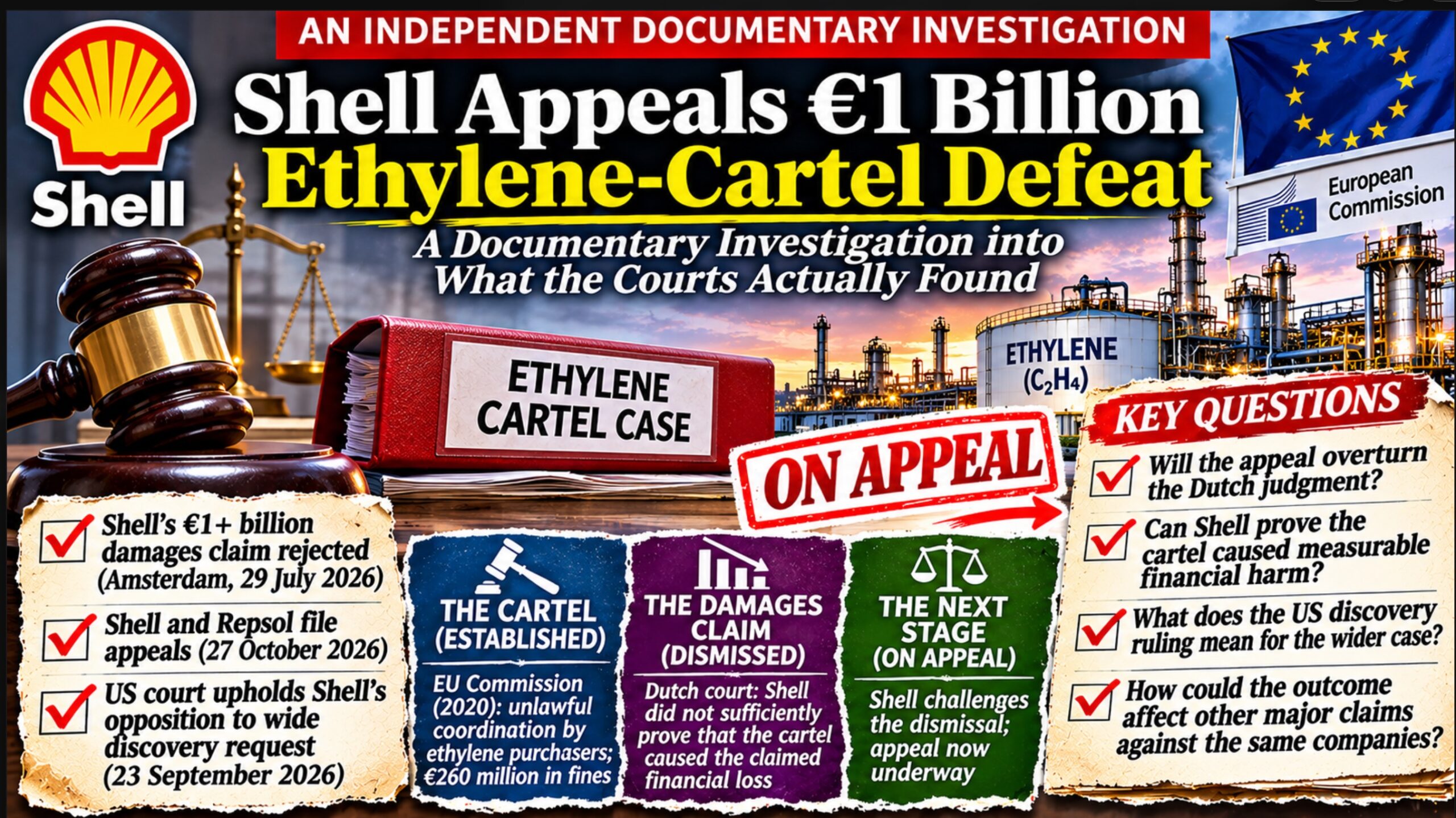
Shell’s attempt to recover more than €1 billion from companies involved in an unlawful European ethylene-buying cartel is not over. Newly examined US regulatory filings confirm that Shell has appealed an Amsterdam court judgment rejecting its damages claim. A separate American federal appellate ruling reveals another dimension of the dispute: an unsuccessful attempt by cartel participants to obtain extensive documents and testimony from a Shell affiliate. Together, the European Commission’s original infringement decision, the Dutch judgment, the American court records and the latest SEC disclosure expose an important distinction between proving that companies participated in an illegal cartel and establishing that their conduct caused measurable financial harm.
Introduction: The billion-euro case returns
On 29 July 2026, the Amsterdam District Court rejected a damages claim exceeding €1 billion brought by Shell Chemicals Europe B.V.
The action arose from a cartel involving companies purchasing ethylene, an important raw material used in the petrochemical industry.
The European Commission had already established that four groups of ethylene purchasers had participated in prohibited information exchanges intended to influence the price they paid.
The Commission imposed fines totalling approximately €260 million in July 2020.
But when Shell subsequently sought compensation for allegedly receiving artificially low prices for ethylene and related products, the Dutch court reached a different conclusion about the financial consequences.
The judges found that Shell had not sufficiently established that the unlawful conduct caused the losses it claimed.
Shell’s damages action was dismissed.
That appeared to be an important victory for the defendants.
The matter has now taken a further turn.
A quarterly report filed by Celanese Corporation with the United States Securities and Exchange Commission on 3 November 2026 confirms that Shell and Repsol each filed notices of appeal on 27 October.
The SEC disclosure also identifies a wider collection of related claims involving major international chemical and energy companies.
Primary source: Celanese Corporation — Form 10-Q filed 3 November 2026, Contingencies section.
This is an important new development.
The original dismissal remains a judicial decision of the Amsterdam District Court, but it is now subject to appellate challenge.
No appellate reversal has been established.
Nor does filing an appeal demonstrate that Shell’s original damages calculation was correct.
The next stage will concern whether the judgment should stand.
1. The original cartel: What the European Commission established
The history begins well before Shell’s damages proceedings.
On 14 July 2020, the European Commission adopted a settlement decision in Case AT.40410, concerning the European ethylene purchasing market.
The companies involved belonged to the Celanese, Clariant, Orbia and Westlake groups.
The Commission found that the purchasers had exchanged commercially sensitive information and coordinated their negotiating strategies during the period from December 2011 to March 2017.
Their conduct concerned the Monthly Contract Price, commonly known as the MCP.
This benchmark influences the prices paid under certain commercial contracts for ethylene and related chemical products.
Unlike a conventional selling cartel, in which suppliers coordinate to raise prices charged to customers, the companies in this case coordinated on the purchasing side.
Their objective was to influence the benchmark downwards, improving the terms on which they acquired ethylene.
The Commission concluded that this conduct infringed Article 101 of the Treaty on the Functioning of the European Union.
The companies acknowledged their participation and agreed to settle.
The financial consequences were substantial.
Clariant received a fine of €155.769 million.
Celanese received a fine of €82.307 million.
Orbia received a fine of €22.367 million.
Westlake received full immunity from fines because it disclosed the cartel to the Commission and cooperated under its leniency programme.
The combined penalties imposed on the other three groups amounted to approximately €260.443 million.
Primary evidence: European Commission — Antitrust: Commission Fines Ethylene Purchasers €260 Million in Cartel Settlement, 14 July 2020.
The Commission’s findings establish the infringement.
They are not merely allegations made by Shell.
But the original decision contains an important qualification.
The Commission did not establish how much the prohibited conduct actually changed the prices paid for ethylene.
That distinction became central to the subsequent litigation.
2. Shell’s allegation: Years of selling ethylene too cheaply
Shell Chemicals Europe was one of the businesses seeking compensation following the Commission’s decision.
Its argument was that the cartel participants had unlawfully depressed the Monthly Contract Price, causing Shell to receive less revenue than it otherwise would have earned.
Shell’s claim covered the period of unlawful conduct and an additional period during which it alleged that the effects continued.
The company maintained that the financial consequences extended beyond the immediate transactions negotiated by the cartel participants.
Its claim exceeded €1 billion.
Shell sought to hold the defendants jointly liable for the alleged losses.
That is a serious financial claim.
But it is important to distinguish three separate propositions.
First, the European Commission established that the purchasing cartel was unlawful.
Second, Shell alleged that the unlawful conduct lowered the prices it received.
Third, Shell sought substantial monetary compensation for the resulting alleged losses.
The first proposition had already been established through the Commission’s decision.
The second and third remained matters requiring evidence in the civil proceedings.
The Amsterdam judges examined that evidence in detail.
Primary judicial source: Amsterdam District Court — Shell Chemicals Europe v Celanese and Others, judgment of 29 July 2026, ECLI:NL:RBAMS:2026:7691.
The published judgment is extensive.
It records competing economic reports, the examination of confidential commercial information, procedural applications and hearings held in March and June 2026.
The case was therefore not dismissed because the court refused to consider the evidence.
The court assessed the competing arguments and concluded that Shell had not sufficiently demonstrated the causal connection needed to support its damages claim.
3. Why did the Dutch court reject Shell’s claim?
The central dispute concerned the economic effect of the cartel.
Shell relied heavily upon expert reports prepared by AlixPartners.
Those reports used a statistical approach known as difference-in-differences.
Broadly speaking, the method compares the behaviour of prices in a market affected by a particular event with prices in a comparison market.
The objective is to estimate what might have happened without the event.
In Shell’s case, the experts compared the development of ethylene prices in northwestern Europe with prices in northeastern and southeastern Asian markets.
Shell argued that this analysis demonstrated that the European benchmark had been artificially depressed.
Its theory was that prices would have been substantially higher without the cartel.
The defendants challenged that analysis.
They argued that the markets being compared were insufficiently similar and that the statistical results did not reliably establish the financial effect claimed by Shell.
The Amsterdam judges accepted significant elements of those objections.
According to the court’s official explanation published on 30 July, the Asian markets were not sufficiently comparable with northwestern Europe for the conclusions Shell sought to draw.
The court also examined how the Monthly Contract Price was actually established.
The benchmark depended upon matching agreements reached by two separate pairs of buyers and sellers.
Cartel participants did not control every transaction or every participant in the market.
The court noted that the companies involved collectively purchased approximately 15% of the available ethylene.
Sellers also had alternative customers.
Furthermore, the principal economic factors affecting ethylene prices — including crude-oil-derived feedstock costs, supply and demand — were generally known to market participants.
These circumstances weakened the proposition that the unlawful information exchanges had successfully controlled the benchmark in the manner alleged.
The judges therefore concluded that Shell had not sufficiently established that it suffered the claimed damage as a result of the infringement.
Official court explanation: Netherlands Judiciary — Ethylene Cartel Has Not Been Shown to Have Caused Damage, 30 July 2026.
The distinction is essential.
The court did not find that the cartel was lawful.
It did not overturn the European Commission’s infringement decision.
It did not excuse the companies’ prohibited conduct.
It found that the evidence presented in these civil proceedings did not establish the compensation claims.
An illegal cartel and a successful civil damages claim are not legally interchangeable.
4. The November SEC filing reveals Shell’s next move
The latest development comes from Celanese Corporation’s regulatory disclosures.
Its Form 10-Q for the quarter ended 30 September 2026 was filed with the Securities and Exchange Commission on 3 November.
Although the accounting period ended in September, the filing includes subsequent litigation developments.
Under its discussion of legal contingencies, Celanese confirms that Shell and Repsol filed separate notices of appeal on 27 October 2026.
The company states that it intends to defend the judgments.
This is direct confirmation from a defendant in the proceedings that the litigation has moved beyond the original trial outcome.
The disclosure is especially important because it establishes the date of the appeal notices.
However, the full notices of appeal and any detailed appellate submissions have not been independently obtained for this investigation.
Consequently, it is not possible to state precisely which alleged errors of law, evidential assessment or economic reasoning Shell will advance.
It would be inappropriate to invent the grounds of appeal.
The documented position is narrower.
Shell has challenged the dismissal.
Celanese intends to oppose that challenge.
The appellate court has not yet delivered a decision reversing or affirming the judgment.
Primary source: SEC — Celanese Corporation Form 10-Q, accession 0001306830-26-000133.
For Shell, the decision to appeal indicates that it has not accepted the Amsterdam judgment as the final resolution of its claim.
That does not establish the likelihood of success.
It establishes the company’s decision to continue pursuing the litigation.
5. A separate battle in America: The defendants seek Shell’s documents
The Dutch proceedings are only part of the documentary record.
A related legal dispute reached the United States Court of Appeals for the Third Circuit.
The parties seeking evidence were Vestolit GmbH and Celanese Europe B.V., two companies defending the Dutch litigation.
Their application concerned Shell Chemical LP, an American Shell entity.
The applicants sought assistance under Section 1782 of Title 28 of the United States Code.
That provision can allow parties involved in foreign legal proceedings to obtain evidence from persons or businesses located within American judicial jurisdiction.
The defendants wanted documents and testimony they considered relevant to their defence of Shell’s European claim.
The requested material was extensive.
According to the American appellate court, the application sought documents concerning 30 broad categories of information.
It also sought the deposition of a Shell Chemical representative covering 22 topics.
The requests extended across approximately fifteen years and involved other Shell companies and geographical markets.
The Delaware District Court rejected the application.
Vestolit and Celanese appealed.
On 23 September 2026, the Third Circuit affirmed the lower court’s decision.
Authenticated American court record: United States Court of Appeals for the Third Circuit — Vestolit GmbH and Celanese Europe B.V. v Shell Chemical LP, Case 25-3549, judgment filed 23 September 2026.
This is a particularly interesting result because it occurred in litigation connected with the same underlying European dispute.
Shell had lost the substantive damages action in Amsterdam.
Yet an American Shell affiliate successfully resisted the defendants’ attempt to obtain additional evidence through the US judicial system.
There is no contradiction in those outcomes.
The courts were deciding different legal questions.
6. Why the American judges refused the discovery application
The Third Circuit examined whether the Delaware court had properly exercised its discretion under the American statute.
The appeal concerned the scope and appropriateness of the evidence request.
It was not an appeal against the Dutch judgment itself.
The American judges considered several factors.
One concerned whether the requested evidence was genuinely unavailable through the Dutch proceedings.
Another concerned the attitude of the foreign court towards the disclosure being sought.
The judges also examined whether the American application was an attempt to circumvent restrictions or decisions in the foreign litigation.
Finally, they considered the breadth and burden of the requests.
The court noted that the Dutch tribunal had previously characterised similar requests as a fishing expedition.
It also considered representations indicating that documents held by Shell Chemical LP could be produced by its European affiliate if required by the Dutch court.
This mattered because the American entity’s status as a separate legal company did not automatically establish that American discovery was necessary.
The applicants also faced criticism concerning the manner in which they had pursued the evidence.
The appellate court noted that they had declined earlier opportunities to pursue similar disclosure through the Dutch proceedings and had not informed the Dutch court of the American application.
The judges considered the extensive demands for documents and testimony insufficiently justified.
The Third Circuit therefore upheld the refusal.
Its decision was expressly designated nonprecedential.
That designation limits the opinion’s authority as binding precedent within the circuit, although the decision remains legally operative for the parties involved.
The ruling should not be misrepresented as a finding that Celanese or Vestolit had acted unlawfully in seeking evidence.
Nor does it prove that Shell possessed damaging documents which it successfully concealed.
The court assessed the application under the relevant procedural principles and concluded that the lower court had not abused its discretion by refusing it.
7. Two courts, two different questions
The relationship between the Dutch and American decisions is central to understanding the case.
The Amsterdam court examined whether the established competition-law infringement caused Shell a compensable financial loss.
The American court examined whether the defendants could compel an American Shell entity to provide additional evidence for use in those foreign proceedings.
The first concerned the substance of the damages claim.
The second concerned the availability and scope of evidence-gathering assistance.
The American judges did not find that Shell had suffered cartel damage.
They did not overturn the Amsterdam judgment.
They did not calculate the value of the ethylene transactions.
And they did not decide the merits of Shell’s subsequent appeal.
Equally, the Dutch court’s rejection of the damages claim did not automatically entitle the defendants to obtain every document they sought from a separate American entity.
The distinction illustrates how a single international commercial dispute can produce different outcomes in different jurisdictions without those outcomes being legally inconsistent.
It also highlights the complexity of proceedings involving multinational corporate groups.
Shell Chemicals Europe was the claimant in the Netherlands.
Shell Chemical LP was the entity from which evidence was sought in America.
Those companies are related, but their separate legal identities and procedural positions matter.
8. The wider litigation: Fourteen claims, multiple countries and major industrial companies
Celanese’s November SEC disclosure identifies a much wider legal controversy.
According to the company, fourteen claims had been filed against it and other ethylene purchasers since 2023.
The parties bringing proceedings include major names in the international chemicals and energy industries.
In the Netherlands, the filing identifies proceedings associated with Shell, Repsol, TotalEnergies, OMV, Borealis, LyondellBasell and Versalis interests.
In Germany, related claims have been brought by companies including BASF, Dow, ExxonMobil, BP, MOL Group and Braskem.
Celanese reports that the Shell and Repsol cases were the two claims dismissed in July.
Both are now subject to appeal notices.
The remaining proceedings involve other parties, claims and evidence.
The Dutch court’s reasoning may be important to those cases, but its judgment should not automatically be treated as deciding every outstanding dispute.
Different claimants may rely upon different commercial transactions, time periods, economic models and legal arguments.
The German courts also operate within their own procedural frameworks, although the underlying European Commission infringement decision remains relevant.
Celanese states that it will vigorously defend the proceedings.
It also acknowledges uncertainty about the ultimate consequences and says it cannot currently estimate their possible financial impact.
That is the defendant company’s disclosed position.
It is not an independent assessment of the eventual liability of all the businesses concerned.
The wider litigation demonstrates why Shell’s appeal matters beyond the immediate €1 billion claim.
The legal and economic interpretation of the cartel’s effects remains relevant to other substantial claims arising from the same infringement.
Primary source: Celanese — SEC quarterly disclosure, November 2026.
9. What the appeal may now test
The precise grounds of Shell’s appeal have not been verified.
Nevertheless, the July judgment identifies the principal issues on which the original case turned.
The first concerns the economic comparison between European and Asian ethylene markets.
Shell’s claim relied upon the proposition that the comparative evidence could establish what European prices would have been without the cartel.
The trial court rejected the reliability of that comparison for the purposes advanced.
The second concerns the operation of the Monthly Contract Price.
The court examined whether the cartel participants possessed sufficient influence over the benchmark to produce the alleged effects.
The third concerns causation.
Even where unlawful coordination is established, the claimant must still establish the connection between that conduct and the harm for which compensation is sought.
The fourth concerns the quantification of any loss.
A damages estimate depends upon assumptions about market conditions and the prices that would otherwise have prevailed.
Whether the appellate court will revisit these matters, and on what grounds, cannot be confirmed from the available appeal notice disclosure alone.
These are the issues identified by the trial judgment, not a representation of Shell’s unpublished appellate arguments.
It would also be premature to suggest that an appeal necessarily involves a complete retrial of every economic question.
The appellate process will be governed by Dutch procedural law and the grounds properly advanced by the parties.
Until fuller appellate documents or a judgment become available, the appropriate conclusion is that the first-instance ruling remains under challenge.
10. What the Donovan–Shell Archive previously reported
The archive has followed this dispute over several years.
On 19 October 2023, it reported that Clariant was resisting Shell’s billion-euro damages claim.
Earlier archive coverage — Clariant Rejects Shell’s Billion-Dollar Ethylene Damages Claim.
On 30 July 2026, it reported the Amsterdam court’s rejection of Shell’s claim.
The present investigation does not replace those reports.
It updates the record using documents that were not available when the July judgment was first reported.
The October appeal notices establish that Shell has elected to challenge the dismissal.
The September American appellate judgment supplies a separate procedural development.
And the November SEC filing places the proceedings within a larger group of international claims.
There is also an important lesson in the available evidence.
Reporting a major court victory or defeat at the time it occurs is necessary.
But a documentary archive should also preserve the subsequent legal history.
A trial judgment may be appealed.
A procedural application may be rejected.
A regulatory finding may remain binding even though a civil damages action fails.
Recording those distinctions accurately is more useful than treating every development as a conclusive victory for one side.
11. What the documentary evidence establishes
The documents support several firm conclusions.
The European Commission established in July 2020 that four corporate groups participated in prohibited coordination involving ethylene purchases.
Those companies acknowledged their participation in the infringement proceedings.
Three received fines totalling approximately €260.443 million.
Westlake obtained immunity from financial penalties through the Commission’s leniency programme.
Shell Chemicals Europe subsequently claimed more than €1 billion in damages.
On 29 July 2026, the Amsterdam District Court dismissed that claim after examining the competing economic evidence.
The court concluded that Shell had not sufficiently demonstrated the alleged financial harm.
On 23 September 2026, the US Court of Appeals for the Third Circuit upheld the rejection of a separate application by Vestolit and Celanese Europe seeking documents and testimony from Shell Chemical LP.
On 27 October 2026, according to Celanese’s subsequent SEC filing, Shell and Repsol filed notices of appeal against the Dutch judgments.
The wider competition damages litigation remains active.
The documents do not establish several other propositions.
They do not establish that the cartel was lawful.
They do not establish that Shell will succeed in its appeal.
They do not establish the grounds upon which Shell is challenging the judgment.
They do not establish that the September American decision was a judgment on the underlying cartel’s economic effects.
They do not establish the future outcome of other claimants’ proceedings.
They do not establish that the €1 billion claimed by Shell is money it has already lost according to an enforceable court finding.
And they do not establish that any of the parties has engaged in misconduct during the subsequent civil proceedings.
The distinctions matter because there are several layers of legal and economic disagreement.
Each has its own evidential requirements.
Conclusion: Proving an unlawful cartel is not the same as proving a billion-euro loss
The ethylene-cartel dispute offers an unusually clear example of the difference between regulatory enforcement and private financial compensation.
The European Commission established an infringement.
The companies involved acknowledged their participation.
Substantial fines followed.
Those findings are not erased by the Amsterdam court’s judgment.
But when Shell sought to convert the infringement into a claim for more than €1 billion, a different question arose.
Had the illegal conduct actually caused Shell the financial losses alleged?
The Dutch judges concluded that the evidence did not establish that proposition.
They were unconvinced by the economic comparison upon which Shell relied and examined the practical limitations on the cartel participants’ ability to influence the benchmark price.
Shell has now appealed.
That is a significant development, but not a finding that the trial judgment was wrong.
The separate American proceedings add another dimension.
Shell successfully resisted an extensive attempt by defendants to obtain evidence from a US affiliate.
The American judges upheld that procedural result without determining the commercial merits of Shell’s European claim.
For an international business such as Shell, the distinction between these outcomes is important.
Legal disputes involving major multinational companies rarely fit neatly into a narrative of total victory or complete defeat.
Shell has experienced an adverse substantive judgment in Amsterdam.
It has obtained a favourable procedural ruling in the United States.
And it is now pursuing appellate review in the Netherlands.
The wider litigation continues to involve some of the world’s largest chemical and energy businesses.
The central unresolved issue is whether the established unlawful conduct produced the particular financial harm for which Shell seeks compensation — and whether the Dutch appellate court will consider the trial court’s treatment of that question correct.
For the Donovan–Shell Archive, the appropriate documentary conclusion is clear.
The cartel infringement is established.
Shell’s billion-euro damages claim was rejected at first instance.
That rejection is now being challenged.
The litigation remains unresolved.
The public interest is best served by preserving all four facts, rather than allowing any one of them to obscure the others.
Principal documentary sources
1. Celanese Corporation — SEC Form 10-Q, filed 3 November 2026. Primary regulatory disclosure confirming Shell’s and Repsol’s 27 October appeal notices and identifying related international proceedings.
2. Amsterdam District Court — Official Explanation of the Ethylene-Cartel Judgments, 30 July 2026. Judicial summary explaining why the court dismissed the claims.
3. Amsterdam District Court — Shell Chemicals Europe v Celanese and Others, ECLI:NL:RBAMS:2026:7691. Published Dutch-language judgment containing the court’s detailed factual and economic reasoning.
4. United States Court of Appeals for the Third Circuit — Case 25-3549, 23 September 2026. Authenticated federal appellate opinion concerning the unsuccessful request to obtain discovery from Shell Chemical LP.
5. European Commission — Ethylene Cartel Settlement, 14 July 2020. Original regulatory announcement setting out the infringement, participants, fines and leniency arrangements.
6. European Commission — Competition Case Register, AT.40410 Ethylene. Official competition case reference.
7. Clariant — Second-Quarter 2026 Announcement and Court Judgment Response, 31 July 2026. Defendant’s contemporary corporate response.
8. Donovan–Shell Archive — Dutch Court Dismisses Shell’s Claim Against Clariant, 30 July 2026. Earlier reporting establishing the archive’s coverage of the first-instance result.
Documentary disclaimer
This article is an independent documentary investigation based upon publicly available European Commission records, published Dutch judicial findings, an authenticated United States federal appellate opinion, securities-regulatory disclosures and relevant contemporaneous corporate statements.
The European Commission’s 2020 infringement decision established participation in prohibited ethylene purchasing coordination. That finding is distinguished throughout from the separate issue of whether Shell Chemicals Europe suffered compensable financial harm.
The Amsterdam District Court dismissed Shell’s damages claim on 29 July 2026. Celanese Corporation’s Form 10-Q, filed with the US Securities and Exchange Commission on 3 November 2026, reports that Shell and Repsol each filed notices of appeal on 27 October 2026.
The actual notices of appeal and subsequent appellate submissions have not been independently examined for this investigation. No claims are made about the specific grounds advanced or the likely result.
The United States Court of Appeals judgment delivered on 23 September 2026 concerns a separate application for discovery under American law. It does not determine the merits of the Dutch damages claim or the outcome of Shell’s later appeal.
Where positions are disputed, the article distinguishes the findings of courts and regulators from submissions made by companies and their representatives.
Financial amounts claimed in litigation are not presented as established losses or amounts awarded.
No allegation is made that Shell plc, Shell Chemicals Europe, Shell Chemical LP, Celanese, Clariant, Orbia, Vestolit, Westlake or any other party has engaged in unlawful conduct beyond what has been established by the relevant regulatory or judicial decisions.
This article is not legal advice, an assessment of investment value or a prediction of litigation outcomes.
The Donovan–Shell Archive welcomes factual corrections, further authenticated court documents and responses from the companies and legal representatives concerned.
Substantiated corrections and relevant additional evidence will be considered fairly.
I consider this investigation suitable for publication because it advances the July 2026 archive coverage with an independently verified appeal development and a related federal appellate decision. It is based principally on primary court and regulatory records, rather than repeated press reporting. The distinction between an established antitrust infringement and proof of compensable loss is the central documentary finding.
The article has not been published. It is provided for your editorial decision.
*This website and sisters royaldutchshellgroup.com, shellnazihistory.com, royaldutchshell.website, johndonovan.website, shellnews.net, and shellwikipedia.com, are owned by John Donovan - more information here. There is also a Wikipedia segment, the Shell DPA Files, "Shell and the Spies", the Shell Leaks files, the Independent Shell Archive, as well as books written and published by John Donovan - Kindle eBooks. Timeline of the Donovan Shell Feud. Toxic History of Royal Dutch Shell Group. Shell and the Donovans: The Full Media Record — 550+ Articles, 110 Books, 40 Years. *All conjured up by internet wizz, Nick Gill.