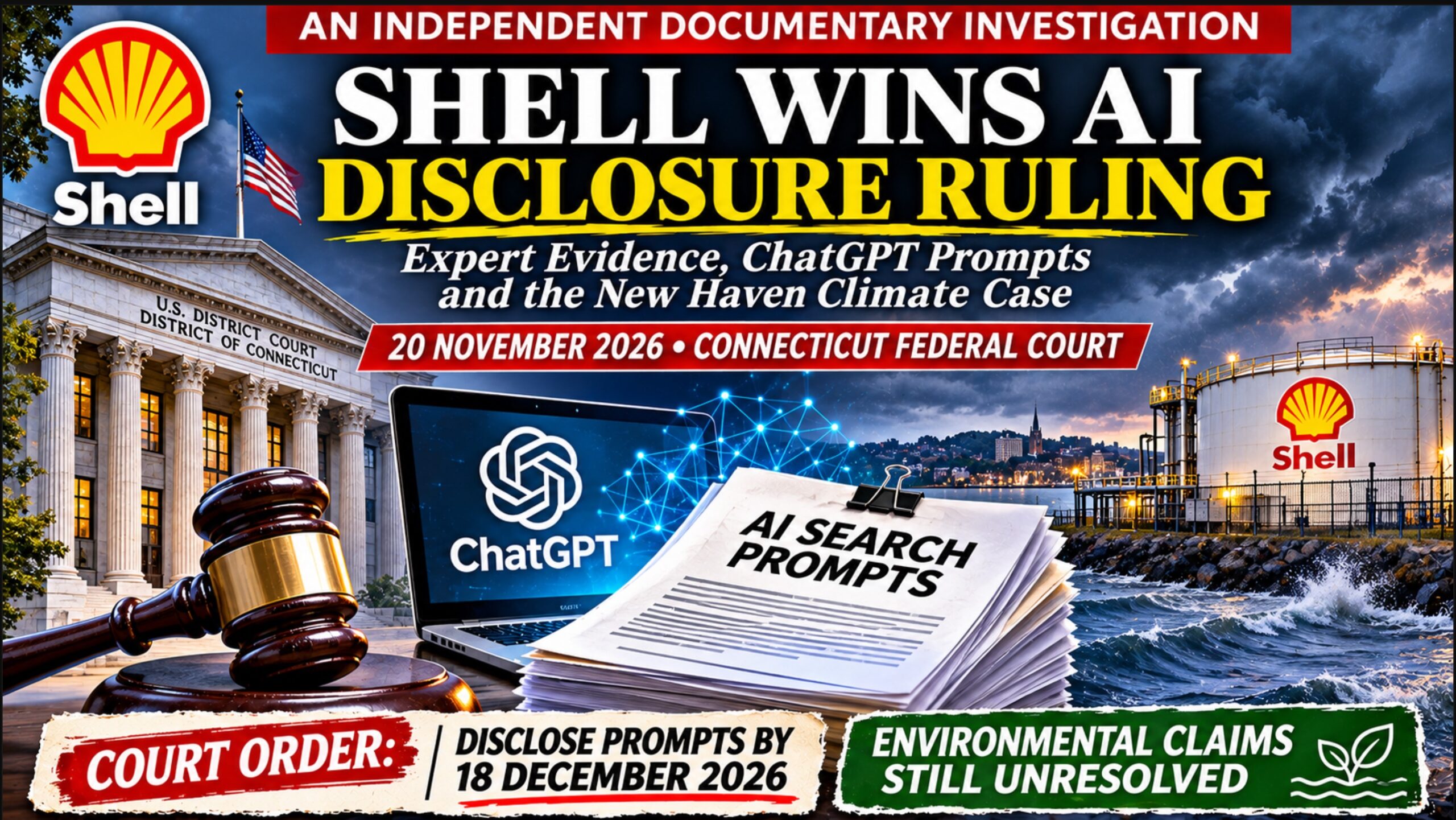
AN INDEPENDENT DOCUMENTARY INVESTIGATION
By the Donovan–Shell Archive
20 November 2026
Researched and drafted with assistance from ChatGPT.
A federal judge in Connecticut has upheld an order requiring an environmental organisation suing Shell-related companies to disclose artificial-intelligence prompts used in the preparation of an expert report. The ruling concerns Harvard historian Naomi Oreskes, whose research assistant employed ChatGPT to identify potentially relevant documents from the companies’ litigation records. The judgment raises important questions about AI-assisted research, the preservation of digital evidence and the transparency of expert methodology. But it does not determine whether Shell’s New Haven petroleum terminal complies with environmental law — or establish that the expert’s conclusions are wrong.
A new ruling in a five-year environmental lawsuit
On 20 November 2026, United States District Judge Vernon D. Oliver issued a 13-page memorandum and order in Conservation Law Foundation, Inc. v. Equilon Enterprises LLC and Others.
The proceedings concern a bulk petroleum storage terminal in New Haven, Connecticut.
The Conservation Law Foundation (CLF), an environmental organisation operating in New England, alleges that the defendants have failed to comply with federal environmental requirements intended to protect nearby communities and waterways.
Its allegations include the risks of flooding and severe storms affecting the terminal.
The defendants dispute the claims.
The latest ruling does not address whether those allegations have been proved.
Instead, it concerns a dispute over the evidence prepared by one of CLF’s expert witnesses.
Judge Oliver upheld an earlier order issued by Magistrate Judge Thomas O. Farrish on 18 May 2026.
The order requires CLF to revise its discovery responses to address artificial-intelligence prompts or queries used by historian Naomi Oreskes and her research team in preparing her expert report.
Judge Oliver rejected CLF’s objections, lifted the stay that had temporarily suspended the earlier order, and set 18 December 2026 as the deadline for compliance.
This is an identifiable procedural victory for the defendants.
It is not a ruling that Shell’s environmental conduct was lawful.
Original judicial document: US District Court for the District of Connecticut — Memorandum and Order, 20 November 2026, Document 1032.
What the New Haven lawsuit is actually about
The litigation began on 7 July 2021.
CLF alleges that the New Haven terminal’s location and operating arrangements create risks of petroleum products or hazardous substances entering nearby communities and waterways during flooding or extreme weather.
The organisation has relied upon provisions of two federal environmental statutes.
The first is the Clean Water Act, which regulates discharges of pollutants into waters of the United States.
The second is the Resource Conservation and Recovery Act, which addresses, among other matters, the handling and disposal of solid and hazardous waste.
CLF’s case concerns alleged failures in environmental planning and compliance at a particular industrial facility.
It is not simply a claim seeking compensation for the global consequences of climate change.
That distinction is important.
The litigation examines whether obligations imposed by existing environmental laws have been met in circumstances where climatic and flooding risks may affect industrial infrastructure.
The defendants are entitled to dispute the factual allegations, the interpretation of the relevant permits and the legal duties CLF seeks to enforce.
The court’s November order confirms that the remaining defendants are Equilon Enterprises LLC, trading as Shell Oil Products US; Triton Terminaling LLC; and Motiva Enterprises LLC.
It also records that Shell Oil and Shell Petroleum were dismissed as parties by stipulation in February 2025.
Accordingly, it would be inaccurate to describe every company historically named in the proceedings as a continuing defendant.
CLF’s allegations remain contested.
The recent AI disclosure ruling does not resolve the environmental claims.
Historical source: Conservation Law Foundation — Gulf and Shell Sued for Climate Inaction, 7 July 2021.
Why a historian became an important witness
Naomi Oreskes is a professor of the history of science at Harvard University.
Her academic work includes the history of climate science, scientific controversy and the relationship between scientific knowledge, commercial interests and public policy.
CLF retained her as an expert witness.
The November judgment explains that her report drew upon documents produced during the litigation.
These materials formed part of the historical and factual record she was asked to examine.
In a major corporate lawsuit, such records can include extensive collections of correspondence, technical reports, policies and other business documents.
Identifying which documents are relevant to a particular historical question can be a demanding task.
A researcher must distinguish meaningful evidence from irrelevant material, duplicates and documents that lack the necessary context.
Oreskes used the assistance of computational scientist Alexander A. Kaurov to help with this process.
The method employed has now become the subject of an important judicial decision.
ChatGPT as a tool for finding documents
According to Judge Oliver’s memorandum, Kaurov processed litigation documents within a Microsoft Azure cloud environment created specifically for the project.
He used ChatGPT to search the material and identify documents that Oreskes could examine.
The system was not described as replacing her professional historical judgement.
Instead, AI was used as an intermediate document-selection tool.
Oreskes explained in her deposition that the purpose was to identify material potentially relevant to particular questions, including documents discussing sea-level rise.
She and Kaurov discussed the searches to be conducted.
Kaurov ran the analysis.
Oreskes then reviewed the documents identified.
That sequence matters.
It would be inaccurate to suggest that the judgment establishes that ChatGPT wrote her expert conclusions.
It does not.
The court’s concern was that the prompts used to search and narrow the documentary record could influence which documents the expert ultimately considered.
A search asking for correspondence about sea-level rise might identify one selection of documents.
A differently worded search might identify another.
A search that inadvertently excludes relevant terminology could overlook important material.
The resulting selection could therefore shape the evidence available for subsequent professional assessment.
The defendants argued that understanding this process was necessary to evaluate the expert’s methodology.
The court agreed that the process was subject to appropriate discovery.
Shell’s argument: The search process is part of the methodology
The defendants sought access to the prompts and related materials because they considered them relevant to assessing Oreskes’s opinions.
American federal procedural rules require retained experts to disclose the basis and reasons for their opinions and the facts or data considered when forming them.
The defendants argued that the AI-assisted workflow fell within those requirements.
The dispute was not simply about obtaining a copy of Oreskes’s finished report.
The defendants wanted to understand the method used to select the underlying evidence.
This is a familiar issue in expert litigation.
A statistical expert may be questioned about the dataset selected for analysis.
A scientific expert may be asked to explain testing methods and underlying assumptions.
A historian may be examined about the selection, interpretation and completeness of the documents relied upon.
The presence of generative AI introduces an additional technical element.
Search instructions may affect which records are retrieved and which are overlooked.
Judge Oliver concluded that the document-selection process was relevant and proportionate to the needs of the proceedings.
The ruling therefore treats the prompts as potentially important evidence concerning the construction of the expert’s analysis.
It does not presume that using AI was improper.
The May 2026 order — and why November matters
The dispute was already known before the latest judgment.
On 18 May 2026, Magistrate Judge Thomas Farrish granted the defendants’ motion to compel disclosure of the AI prompts.
CLF objected.
On 3 June, Judge Oliver stayed the order while those objections were considered.
The parties subsequently presented their arguments, including at a hearing on 3 November 2026.
The new judgment resolves that particular challenge.
Judge Oliver affirmed the magistrate’s order in its entirety.
This is the decisive development reported on 20 November.
Earlier discussions concerned whether the initial order would survive judicial review.
That uncertainty has now been resolved at the district-court level.
The original disclosure obligation is no longer stayed.
CLF has been directed to comply by 18 December.
This distinction is important because the Donovan–Shell Archive previously examined the original controversy.
Its articles included:
Shell’s New Courtroom Hobby: Fighting Climate Lawsuits One AI Prompt at a Time — 2 June 2026.
Shell Discovers a New Kind of Drilling: Mining an Expert Witness’s AI Prompts — 1 July 2026.
Those reports concerned the earlier discovery decision and its uncertain status.
The November order now provides a new, authoritative judicial determination.
The disagreement over protected expert notes
One of CLF’s principal arguments concerned an agreement made between the parties governing discovery.
The agreement protected certain categories of expert drafts, communications, notes and preliminary discussions from disclosure.
CLF argued that the requested AI materials fell within those protections.
Judge Oliver rejected that interpretation.
The court observed that the agreement did not expressly address artificial intelligence.
It also accepted the distinction drawn by the magistrate between a note concerning the preparation of an expert’s draft opinion and a prompt used to instruct an AI system to select material.
That distinction was central to the outcome.
A search prompt may determine which documents enter the analytical process before an expert begins developing conclusions.
The court concluded that the agreement did not clearly exclude such prompts from disclosure.
This was an interpretation of the actual agreement governing the parties.
It should not be presented as a universal rule that all communications with every AI system are discoverable in every legal proceeding.
Privilege, confidentiality, relevance, proportionality and the terms of applicable agreements remain important.
But the decision demonstrates why the wording of an agreement drafted to protect conventional expert materials may not automatically resolve questions arising from newer research technologies.
The procedural objections also failed
CLF raised objections concerning the form and timing of the defendants’ discovery requests.
Some requests had been communicated by email rather than through the formal service method CLF subsequently argued was required.
Judge Oliver concluded that CLF had not raised the procedural objection with sufficient specificity at the appropriate stage.
The court therefore found that the objection had been waived.
CLF also argued that the defendants had pursued the information too late.
That argument was rejected.
The judgment records that the defendants sought relevant materials shortly after learning about the AI process during the expert’s deposition.
They subsequently engaged in repeated discussions before bringing their dispute to the magistrate.
Judge Oliver considered that history sufficient to support the earlier decision to entertain the disclosure request.
The ruling should not be characterised as judicial approval of every discovery practice the defendants used.
It concerns the particular objections, procedural history and record before the court.
The missing prompts: A particularly important complication
The most revealing aspect of the case may be the difficulty of locating the actual prompts.
The judgment records that Kaurov did not preserve complete standalone prompt-and-output logs.
According to the evidence presented, the AI searches involved an interactive process.
Prompts and queries were revised while documents were being examined.
The dedicated technical environment did not retain a complete record in the form now sought by the defendants.
CLF therefore argued that the court should not compel production of materials that might no longer exist.
The judge acknowledged a familiar legal principle: courts generally do not require parties to produce records that never existed or are genuinely unavailable.
But this case presented an additional consideration.
Both Oreskes and Kaurov had supplied evidence that prompts or queries were used.
The court found sufficient reason to require CLF to respond to the discovery requests in accordance with the magistrate’s order.
That does not mean the court determined that a complete recoverable prompt history presently exists.
Nor did it find that Oreskes or Kaurov deliberately destroyed relevant evidence.
There is no established judicial finding in this order of intentional concealment, fabricated documents or bad-faith destruction of records.
The practical question is what responsive material can actually be identified and produced, and how any unavailable material is addressed under the court’s order.
That issue may become clearer after the December compliance deadline.
Why AI-assisted research creates a new evidentiary problem
The case exposes a difficulty that extends beyond litigation involving Shell.
Traditional documentary researchers can preserve a list of search terms, archival references and the records selected for examination.
A researcher using generative AI may instead conduct a series of conversational searches.
Each instruction can affect subsequent results.
A system may rank documents, identify passages or suggest additional lines of inquiry.
The researcher may then refine the request.
This can be efficient.
But unless the process is adequately recorded, a later reviewer may struggle to reconstruct why certain documents were selected.
There is also a distinction between a document’s existence and the accuracy of an AI-generated description of that document.
A reliable historical investigation should ultimately return to the original document.
The model’s summary is not a substitute for the source.
The same principle applies to legal expert evidence.
If AI helps identify relevant documents, the expert must still establish what those documents actually say and why they support the opinions expressed.
The November judgment does not prohibit AI-assisted research.
It demonstrates that the process used may itself become relevant evidence when the resulting work is presented through an expert witness.
What the ruling means for the Donovan–Shell Archive
There is a direct lesson for independent investigations involving substantial corporate archives.
The Donovan–Shell Archive contains decades of correspondence, internal communications, contemporary reports and legal records.
AI can assist with identifying names, dates, patterns and potentially relevant passages within large collections.
It may also help cross-reference documents and organise a complex chronology.
But the evidentiary standard should not change merely because the search method becomes more sophisticated.
A responsible documentary investigation should preserve the underlying records, identify their provenance and distinguish original text from machine-generated interpretation.
Where AI materially influences the selection of evidence, recording the search method can strengthen transparency and make later verification easier.
This is especially relevant where a publication may eventually be cited by journalists, historians, lawyers or researchers.
However, an independent news archive is not automatically subject to the same procedural duties as an expert witness in a federal lawsuit.
The Connecticut ruling does not impose a general legal obligation upon journalists or historical researchers to publish all their AI prompts.
Its direct legal effect concerns discovery in the particular proceedings before Judge Oliver.
The broader lesson is methodological rather than an asserted universal legal requirement.
Documentary research becomes more credible when its conclusions can be traced to authentic sources and independently examined.
That remains true whether the initial search was conducted manually, through a conventional database or with AI assistance.
What has happened to the underlying environmental allegations?
The central environmental dispute remains unresolved by the November order.
CLF alleges that the New Haven terminal has not adequately addressed risks associated with flooding, extreme storms and potential pollutant releases.
The defendants contest the allegations.
These questions concern the facility, relevant permits and applicable federal environmental requirements.
The AI disclosure ruling does not establish whether the terminal is unsafe.
It does not determine that hazardous materials have been discharged unlawfully.
It does not rule that the defendants have failed to comply with the Clean Water Act or Resource Conservation and Recovery Act.
And it does not reject CLF’s remaining claims.
The underlying proceedings must be assessed separately from the dispute over expert evidence.
That distinction is particularly important because a successful discovery motion may receive considerable publicity even though it does not decide liability.
The legal significance of the November decision lies in how the expert’s evidence can be examined.
The environmental outcome remains a separate issue.
A Shell-related procedural victory — not an environmental vindication
There should be no reluctance to report that the defendants prevailed on the discovery dispute.
They sought disclosure of AI prompts used in preparing an opposing expert report.
CLF resisted.
The magistrate ordered disclosure.
CLF challenged the order.
Judge Oliver upheld it.
Those are established events.
At the same time, the victory should be described precisely.
Shell-related defendants have obtained an order concerning expert discovery.
They have not obtained a judgment dismissing the environmental claims.
Nor has the court found that the expert’s historical opinions are incorrect.
The defendants may use disclosed information to assess or challenge aspects of her methodology, subject to the applicable rules and any further orders.
Whether any such challenge ultimately affects the expert evidence or the result of the litigation remains unknown.
The decision is significant without requiring exaggeration.
DOCUMENTARY FINDINGS
Established by the 20 November 2026 court order
Judge Vernon Oliver rejected CLF’s objections to Magistrate Judge Farrish’s May 18 discovery order.
The judge affirmed the earlier order in its entirety and lifted the stay.
CLF must comply with the disclosure order by 18 December 2026.
Naomi Oreskes and Alexander Kaurov used an AI-assisted process to identify documents from the litigation materials.
Kaurov used ChatGPT within a dedicated Microsoft Azure environment.
The court concluded that prompts or queries used in this process were discoverable under the federal rules governing expert disclosure and discovery.
The parties’ agreement protecting certain expert drafts, notes and communications did not clearly exempt the prompts.
Established limitations
Complete standalone prompt-and-output logs were not preserved.
The judgment does not establish that a full prompt history remains recoverable.
It does not find deliberate destruction or concealment of evidence.
It does not determine that Oreskes’s report contains fabricated sources or unreliable conclusions.
It does not decide CLF’s environmental claims.
Positions of the parties
The defendants argued that the prompts formed part of the methodology behind the expert’s work and should be disclosed.
CLF argued, among other matters, that the materials were protected by the parties’ agreement, that the requests were procedurally defective or untimely, and that some records might not exist.
The court rejected those objections under the circumstances of this case.
Independent editorial assessment
The ruling is important because it recognises that AI-assisted document selection can influence an expert’s analysis and may therefore be subject to evidentiary scrutiny.
Its broader significance lies in the need to preserve provenance, document research methods and maintain a verifiable connection between original records and published conclusions.
It is not a blanket ruling against artificial intelligence in research.
CONCLUSION: THE QUESTION IS NOT WHETHER AI MAY BE USED, BUT WHETHER ITS ROLE CAN BE EXAMINED
The Connecticut judgment marks an important development in the legal treatment of AI-assisted expert evidence.
It arose from a conventional environmental dispute involving a petroleum storage terminal.
But the contested issue moved into unfamiliar territory.
How should a court examine the process by which an expert uses artificial intelligence to select documents from a large corporate archive?
The defendants argued that the process was part of the methodology underlying the expert’s opinions.
The plaintiff resisted disclosure.
The magistrate agreed with the defendants, and Judge Oliver has now upheld that decision.
The court did not prohibit the use of ChatGPT.
It did not conclude that the historian’s professional judgement had been replaced by a computer.
Nor did it decide that the expert’s opinions were wrong.
Instead, it concluded that the prompts and queries involved in selecting evidence were relevant to the expert-discovery process.
The additional difficulty is that complete records of those prompts were not retained.
That makes the dispute more than a theoretical argument about AI and the law.
It concerns the practical consequences of using an evolving digital research process without preserving a complete record of the instructions employed.
For Shell, the ruling is a procedural success.
For the Conservation Law Foundation, it creates an additional discovery obligation in an already contested environmental lawsuit.
For historians, journalists and independent documentary investigators, it provides a valuable warning.
AI can help find evidence. It cannot remove the responsibility to preserve, authenticate and accurately interpret that evidence.
That principle should apply with particular force when research concerns disputed corporate conduct, historical allegations or legal accountability.
The next identifiable milestone is 18 December 2026, when CLF must comply with the court’s order.
The question of what records can actually be produced remains open.
So does the underlying environmental lawsuit.
Those distinctions should govern any future reporting.
PRINCIPAL DOCUMENTARY SOURCES
1. US District Court for the District of Connecticut — 20 November 2026
Memorandum and Order, Document 1032, Case No. 3:21-cv-00933.
The original 13-page judicial decision. Principal source for the ruling, procedural chronology, expert methodology, objections and compliance deadline.
2. Magistrate Judge Thomas O. Farrish — 18 May 2026
Original discovery order, ECF No. 970, identified and quoted in the 20 November memorandum.
The later judgment confirms the substance and disposition of the earlier order. The complete standalone text of ECF No. 970 has not been separately reproduced in this investigation.
3. Conservation Law Foundation — 7 July 2021
Gulf and Shell Sued for Climate Inaction.
The claimant organisation’s original account of the New Haven environmental proceedings and their concerns about flooding and pollution risks.
4. US District Court — 13 June 2025
Primary judicial background concerning the stormwater permitting dispute and the continued progression of the litigation.
5. Reuters — 20 November 2026
Expert’s AI Prompts in Environmental Lawsuit Must Be Disclosed, US Judge Rules.
Contemporary independent legal reporting of the newly issued order.
6. Donovan–Shell Archive — 2 June 2026
Shell’s New Courtroom Hobby: Fighting Climate Lawsuits One AI Prompt at a Time.
Earlier archive coverage of the original magistrate’s discovery decision.
7. Donovan–Shell Archive — 1 July 2026
Shell Discovers a New Kind of Drilling: Mining an Expert Witness’s AI Prompts.
Further contemporaneous archive analysis when the original order remained subject to objections and a stay.
DOCUMENTARY DISCLAIMER
This article is an independent documentary investigation based principally on the memorandum and order signed by US District Judge Vernon D. Oliver on 20 November 2026 in Conservation Law Foundation, Inc. v. Equilon Enterprises LLC and Others, Case No. 3:21-cv-00933, together with identified earlier court proceedings, public statements and contemporary news reporting.
The judicial ruling concerns discovery of materials used in preparing an expert witness report. It is not a determination of the environmental merits of the litigation.
The defendants’ success in obtaining an order concerning AI prompts is not represented as a finding that the expert’s opinions are false, that the plaintiff acted dishonestly or that Shell-related companies complied with all applicable environmental obligations.
The order records that complete standalone prompt-and-output logs were not preserved. No allegation of deliberate destruction, concealment or fabrication is made.
Descriptions of Naomi Oreskes’s and Alexander Kaurov’s research methods are based on the court’s account of their evidence and related filings. Their use of AI to select potentially relevant documents is distinguished from the authorship and evaluation of the expert’s substantive conclusions.
The litigation concerns specifically identified corporate defendants. Shell Oil and Shell Petroleum were dismissed as parties in February 2025, while claims remain pending against Equilon Enterprises LLC, Triton Terminaling LLC and Motiva Enterprises LLC as described in the judicial record.
The environmental allegations remain disputed. No finding of pollution liability, statutory breach or unlawful conduct is inferred from this procedural judgment.
Discussion of the implications for AI-assisted archival research represents independent editorial analysis. The ruling is not presented as imposing a general disclosure duty on journalists or independent historians outside the relevant legal proceedings.
The Donovan–Shell Archive uses AI assistance in preparing documentary investigations and seeks to maintain clear source attribution, distinguish original records from generated analysis and correct substantive errors.
Shell, the Conservation Law Foundation, Naomi Oreskes, Alexander Kaurov and other relevant parties are invited to provide factual corrections, authenticated documents or additional context.
Substantiated corrections and additional evidence will be considered fairly.
This article is independent documentary reporting and analysis, not a judicial finding beyond the cited court orders or legal advice.
*This website and sisters royaldutchshellgroup.com, shellnazihistory.com, royaldutchshell.website, johndonovan.website, shellnews.net, and shellwikipedia.com, are owned by John Donovan - more information here. There is also a Wikipedia segment, the Shell DPA Files, "Shell and the Spies", the Shell Leaks files, the Independent Shell Archive, as well as books written and published by John Donovan - Kindle eBooks. Timeline of the Donovan Shell Feud. Toxic History of Royal Dutch Shell Group. Shell and the Donovans: The Full Media Record — 550+ Articles, 110 Books, 40 Years. *All conjured up by internet wizz, Nick Gill.







