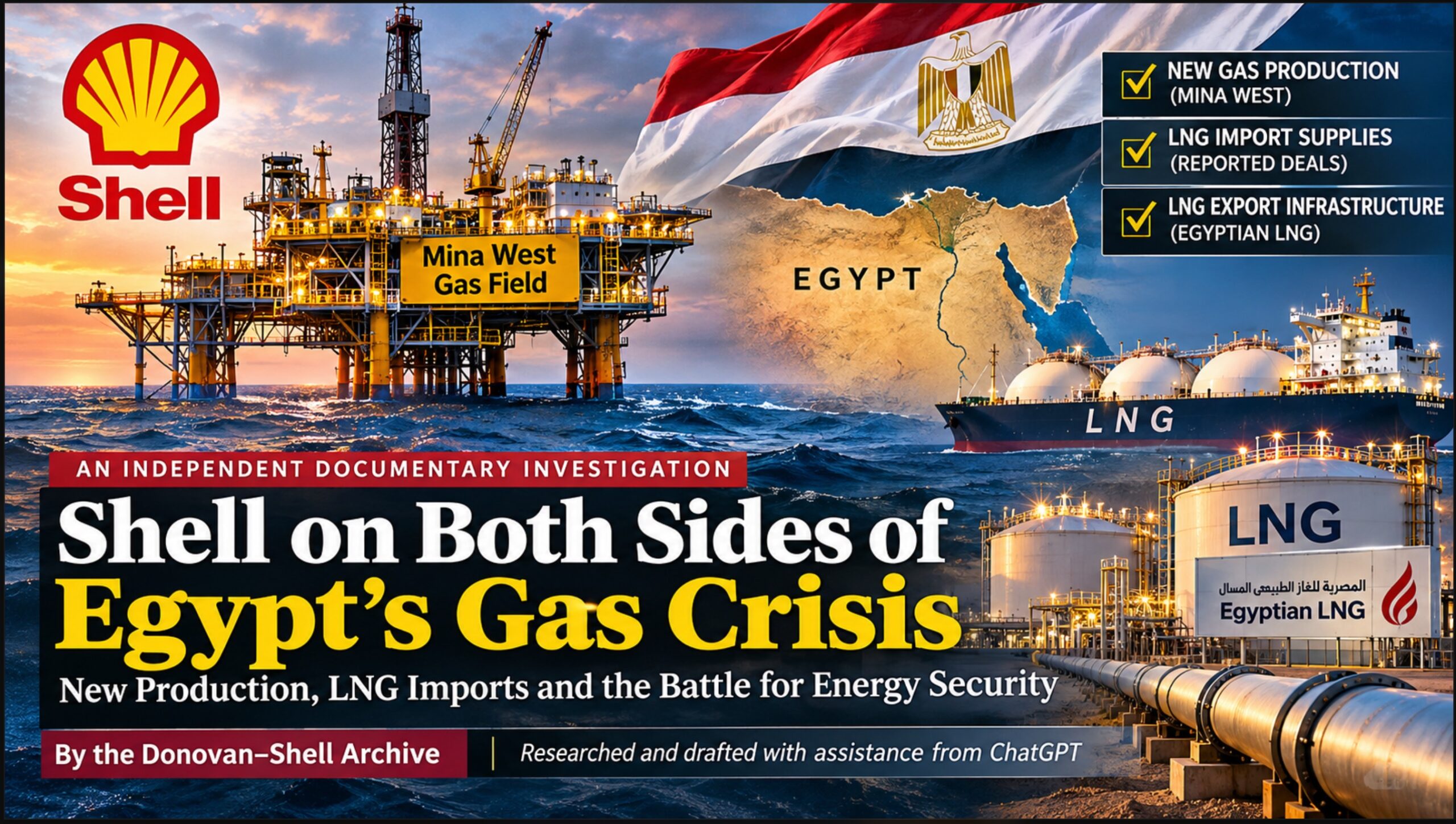
AN INDEPENDENT DOCUMENTARY INVESTIGATION
By the Donovan–Shell Archive
24 November 2026
Researched and drafted with assistance from ChatGPT.
Shell has brought a new offshore gasfield into production in Egypt, where domestic natural gas output has suffered a dramatic decline. Egyptian government figures confirm that two new wells are producing a combined 160 million cubic feet of gas per day. Meanwhile, Shell is among the international energy companies reported to have been negotiating substantial LNG supply agreements with Egypt. The company also participates in Egypt’s LNG export infrastructure. These overlapping commercial roles reveal the complexity of an energy crisis in which the same multinational company can help alleviate a country’s domestic gas shortage while also participating in the international market from which that country purchases replacement supplies.
A new gasfield enters production
On 15 November 2026, Shell Egypt announced the commencement of natural gas production from the Mina West field in the Mediterranean Sea.
The development is located within the North East El Amriya concession and was brought into production approximately three years after discovery.
Shell holds a 60% participating interest, with the remaining 40% held by the Egyptian subsidiary of Kuwait Foreign Petroleum Exploration Company, KUFPEC.
A new seven-kilometre pipeline connects the field to existing West Delta Deep Marine infrastructure. Gas is processed at the Burullus facility before entering Egypt’s domestic gas network.
The final investment decision was announced on 30 June 2025.
The ability to use existing infrastructure helped accelerate the development, avoiding the need to construct an entirely separate gas-processing system.
Shell’s original announcement identified an anticipated gross production rate of 160 million standard cubic feet per day.
Primary source: Shell Egypt — First Gas from Mina West, 15 November 2026.
Shell Egypt
The Egyptian government subsequently confirmed production figures
An important additional development occurred on 19 November.
Egypt’s State Information Service published a statement sourced to the Ministry of Petroleum and Mineral Resources confirming that both Mina West wells had entered production.
According to the ministry, Mina West-2 was producing approximately 60 million cubic feet of gas per day, having entered production around two months ahead of schedule.
Mina West-1 was producing approximately 100 million cubic feet per day.
The ministry reported combined condensate production of approximately 3,000 barrels per day.
This provides stronger documentary evidence than the original announcement of anticipated production alone.
Although the figures have not been independently audited for this investigation, they establish that the Egyptian government has reported achievement of the project’s anticipated initial gas production rate.
The distinction remains that initial production figures do not guarantee sustained output throughout the field’s producing life.
Government source: Egyptian State Information Service — Petroleum Minister Says Egypt Is Beginning to Reap the Benefits of Returning Investment, 19 November 2026 — Spanish-language edition.
SIS
The $390 million development
Earlier government disclosures provide additional information that was not included in Shell’s November first-gas announcement.
On 28 May 2026, Egypt’s Ministry of Petroleum estimated investment in the initial development phase at approximately $390 million.
Preliminary estimates identified recoverable resources of approximately 245 billion cubic feet of gas and five million barrels of condensate.
These are government estimates, not independently established final development costs or audited reserve figures.
Nevertheless, they provide an indication of the project’s scale.
The development represents substantial investment in Egypt’s domestic energy infrastructure at a time when the country urgently needs additional gas production.
Primary source: Egyptian State Information Service — Promising Production Results from New Gas Field in Mediterranean Sea, 28 May 2026.
SIS
Three more offshore wells are planned
Mina West is not an isolated investment.
On 18 November 2026, Italian engineering and drilling contractor Saipem announced two offshore drilling contracts with a combined value of approximately $181 million.
One was awarded by Burullus Gas Company, the Egyptian joint venture involving Shell, PETRONAS and the state-owned Egyptian General Petroleum Corporation.
It covers the drilling of three offshore wells, with operations expected to commence during the first quarter of 2027.
The other contract concerns a separate TotalEnergies drilling campaign offshore Suriname.
An important qualification is necessary.
The $181 million figure covers both contracts. It is not the disclosed value of Shell’s Egyptian drilling programme alone.
The announcement nevertheless confirms continuing investment in Egyptian offshore gas resources involving Shell and its partners.
Primary source: Saipem — New Offshore Drilling Contracts Worth Approximately $181 Million, 18 November 2026.
Saipem
A separate investment decision points towards 2028
In August 2026, Shell and its Egyptian and Malaysian partners announced a final investment decision on Phase 12a of the West Delta Deep Marine concession.
The development involves three deepwater gas wells connected to existing subsea infrastructure, with first production anticipated in 2028.
Shell’s August disclosure identifies Burullus Gas Company as the operating joint venture, owned as follows:
-
Egyptian General Petroleum Corporation — 50%.
-
BG Delta Limited, a Shell subsidiary — 25%.
-
PICL Egypt — 25%.
The announcement also records that the West Delta Deep Marine development began producing gas in 2003.
Six additional wells entered production during 2024 and 2025 through earlier development phases.
The November Saipem contract is consistent with the continuing programme of offshore investment. However, its announcement does not explicitly identify the three contracted wells as Phase 12a, and the two disclosures should not be treated as conclusively describing the same work.
Primary source: Shell Egypt — Final Investment Decision on Phase 12a of West Delta Deep Marine, 24 August 2026.
Shell Egypt
Why Egypt desperately needs the additional gas
The significance of these investments becomes clearer when examined against the country’s declining domestic production.
Reuters reported on 16 November, citing figures from the Joint Organisations Data Initiative, that Egypt’s natural gas production had fallen from approximately 214.7 billion cubic feet in August 2021 to 112.6 billion cubic feet in August 2026.
That represents a decline of approximately 48%.
Production in August 2026 was also around 10.5% below the corresponding month in 2025.
The decline has serious implications for a country that depends heavily upon natural gas for electricity generation and industrial activity.

Egyptian natural gas production in two comparable months, in billion cubic feet. Source: JODI figures reported by Reuters, 16 November 2026.
Source: Reuters — Shell Starts Gas Production from Egypt’s Mina West Field.
ZAWYA
Mina West is therefore a welcome addition to domestic supply.
But its reported daily production is equivalent to only around 4.4% of Egypt’s average daily production during August 2026.
That comparison illustrates the scale of the national challenge. It is not a forecast of the project’s eventual contribution.
New wells may slow the overall decline without necessarily reversing it, particularly when production from established fields continues to diminish.
Shell is also reported to be negotiating LNG supplies to Egypt
This is where Shell’s involvement becomes particularly interesting.
On 21 July 2026, Reuters reported that Egypt was negotiating with several international energy companies to secure substantial medium-term LNG supplies.
Those companies reportedly included Shell, TotalEnergies, BP and commodity trader Hartree Partners.
Egypt was seeking between 15 and 18 LNG cargoes per month under arrangements potentially extending for several years.
Reuters calculated that the proposed purchases could cost Egypt between $8 billion and $11 billion annually at the price assumptions used in its report.
Those estimates concerned the proposed overall procurement programme, not Shell’s individual share.
The negotiations were reported by industry and trading sources. The contracts had not been finalised at the time of publication.
Shell declined to comment to Reuters.
This investigation has not established whether the proposed longer-term agreements have subsequently been concluded or what volumes might ultimately be allocated to Shell.
Nevertheless, the reporting demonstrates that Shell has been identified as a potential supplier of imported gas to the same country in which it is developing domestic gas resources.
Source: Reuters — Egypt in Talks with Energy Majors for Multi-Year LNG Supply Deal, 21 July 2026.
MarketScreener+1
A reported $3 billion precedent
There is already a documented commercial precedent for such arrangements.
In February 2025, Reuters reported that Egypt had agreed approximately $3 billion of LNG purchases from Shell and TotalEnergies, involving a combined 60 cargoes.
Independent reporting by S&P Global Energy also identified the agreements, citing market sources.
The individual financial allocation between the two suppliers was not established.
The figure therefore should not be interpreted as $3 billion of revenue for Shell alone, still less as $3 billion of profit.
It does, however, illustrate the potential scale of Egypt’s dependence on international energy suppliers when its domestic production cannot satisfy demand.
Sources:
Reuters — Egypt Signs $3 Billion LNG Agreements with Shell and TotalEnergies, 6 February 2025
S&P Global Energy — Egypt Secures $3 Billion LNG Deal with Shell and TotalEnergies, 7 February 2025.
Global Banking & Finance Review+1
The latest development: LNG cargoes reportedly turn away from Egypt
On 23 November 2026, Egyptian business publication EnterpriseAM reported that three LNG tankers previously heading towards Egypt had changed course.
The publication cited Bloomberg reporting and shipping information compiled with commodity intelligence provider Kpler.
Two vessels were reportedly redirected towards Europe, while a third changed course towards a route serving Asian markets.
The reporting comes amid substantial pressure on Egypt’s energy import expenditure.
Earlier Reuters reporting, published on 30 October, also identified Egyptian purchases of six high-sulphur fuel oil cargoes for delivery during November and December as the country responded to elevated LNG prices.
These developments illustrate Egypt’s vulnerability to conditions in the international fuel market.
There is no evidence in the sources examined establishing that Shell controlled the diverted cargoes or was responsible for their redirection.
Nor does a vessel’s change of destination necessarily establish that a contractual obligation has been breached.
The relevance to Shell’s Egyptian investments lies in the wider market circumstances: additional domestic gas can help reduce a country’s exposure to expensive or uncertain imported supplies.
Sources:
EnterpriseAM — Three LNG Cargoes Bound for Egypt Turn Away as Europe Outbids Cairo, 23 November 2026
Reuters — Egypt Buys Six Fuel Oil Cargoes for Year-End Delivery as LNG Prices Climb, 30 October 2026.
EnterpriseAM Egypt+1
Shell’s third commercial role: Egyptian LNG exports
The corporate structure becomes more complicated when Egypt’s export infrastructure is examined.
Shell is also a shareholder in Egyptian LNG, the joint venture operating liquefaction facilities at Idku, east of Alexandria.
The operator identifies its shareholders as including Shell, PETRONAS, TotalEnergies and Egyptian state petroleum organisations.
Idku has two liquefaction trains, each with a stated annual capacity of 3.6 million tonnes of LNG.
This gives the facility a combined nameplate capacity of approximately 7.2 million tonnes per year.
That figure represents installed capacity, not current annual exports.
Primary source: Egyptian LNG — Corporate and Shareholder Information.
egyptianlng.com
The existence of substantial export infrastructure in a country experiencing domestic gas shortages may initially appear contradictory.
However, Egypt’s position has changed considerably over time.
The US Energy Information Administration’s historical country analysis records that Egypt has alternated between importing and exporting substantial quantities of natural gas, depending upon domestic production, consumption and the availability of regional supplies.
The development of major offshore resources, particularly Zohr, previously supported Egypt’s export ambitions.
Subsequent production difficulties and rising domestic demand have increased dependence on imports.
Source: US Energy Information Administration — Egypt Country Analysis.
U.S. Energy Information Administration (EIA)
Shell’s participation in Egyptian LNG consequently reflects an investment made within an energy system whose supply balance has changed considerably.
Importing and exporting LNG during the same broad period does not, in itself, establish commercial irrationality or misconduct.
Seasonal demand, contractual commitments, infrastructure constraints and commercial arrangements may all influence the movement of gas.
Egypt’s government cleared $6.1 billion in outstanding payments
Another important part of the documentary record concerns money owed to international petroleum companies.
On 10 June 2026, Egypt’s government announced that it had cleared overdue payments to foreign oil and gas investment partners.
According to Petroleum Minister Karim Badawi, those outstanding obligations had reached approximately $6.1 billion in June 2024 before being reduced to zero by June 2026.
In October, the minister reiterated that the clearance of outstanding dues formed part of the government’s efforts to restore investor confidence and stimulate new production.
These announcements provide an important explanation for Egypt’s efforts to encourage companies such as Shell to expand their investments.
International producers require confidence that their contractual entitlements will be honoured.
Egypt, meanwhile, needs additional domestic production to reduce the financial burden of imported energy.
The $6.1 billion figure relates to outstanding obligations across the petroleum sector. It is not an amount identified as having been paid exclusively to Shell.
Government sources:
SIS+1
The commercial logic of Shell’s integrated gas strategy
Viewed together, the documentary evidence identifies three distinct Shell interests in Egypt.
The company participates in upstream production, international LNG marketing and established liquefaction infrastructure.
These different businesses may have different commercial exposures.
Domestic production can help Egypt reduce its dependence on imported gas.
International LNG supply can generate commercial opportunities when domestic production falls short.
Export infrastructure can provide access to overseas markets when gas is available for liquefaction.
This is broadly consistent with Shell’s integrated gas strategy.
In its 3 November 2026 announcement concerning the proposed sale of its Australian North West Shelf interest, Shell reiterated its target of growing LNG sales by 4–5% annually through 2030.
Source: Shell — Agreement to Sell North West Shelf Interest, 3 November 2026.
Shell Global
The Donovan–Shell Archive recently examined another aspect of this strategy in Malaysia, where new offshore gas production is being connected to established LNG export infrastructure.
Archive investigation — Shell’s Solar-Powered Gas Giant, 19 November 2026.
Egypt provides a different illustration of the same multinational business model.
Here, the immediate challenge is not simply securing gas for international customers. It is supplying a domestic market experiencing substantial production decline.
Does Shell have a conflict of interest?
The existence of overlapping commercial interests invites legitimate questions about incentives, contractual transparency and the allocation of risks.
However, the available evidence does not establish an improper conflict of interest.
There is no documentary basis for suggesting that Shell deliberately restricted Egyptian domestic gas production to create opportunities to sell imported LNG.
Indeed, the Mina West development and continuing offshore investment demonstrate that Shell is participating in efforts to increase domestic production.
Equally, it would be premature to conclude that Egypt necessarily obtains the best possible commercial terms from international LNG suppliers.
That would require examination of contracts, procurement arrangements, competing offers and pricing mechanisms.
Those documents have not been obtained for this investigation.
The appropriate question is not whether Shell should participate in both domestic gas production and international trading.
It is whether the arrangements under which it participates deliver the intended benefits to Egypt and distribute commercial risks appropriately.
The questions that remain unanswered
A more complete assessment would benefit from disclosure of the actual sustained production rates at Mina West, the contractual pricing of gas delivered into Egypt’s domestic network and the final development expenditure.
Further information concerning the proposed medium-term LNG procurement programme would also be valuable.
In particular, it remains unclear what volumes, prices and payment obligations might apply to any new Shell supply agreements.
The arrangements governing the availability of gas for domestic consumption and LNG exports would merit examination alongside the country’s continuing import requirements.
From an environmental perspective, increased domestic gas production could reduce the need for some imported LNG and its associated liquefaction and transport requirements.
However, that potential benefit depends on which supplies are displaced and the lifecycle emissions of the competing sources.
No project-specific comparative emissions assessment has been obtained.
Domestic gas production also remains a source of greenhouse-gas emissions, particularly when the fuel is ultimately consumed.
Neither the commercial nor environmental benefits should therefore be quantified beyond what the available evidence supports.
Documentary findings
What is established
Shell announced the start of Mina West production on 15 November 2026. Egypt’s government subsequently reported combined production of 160 million cubic feet of gas per day and 3,000 barrels of condensate.
Shell and its partners are pursuing additional offshore developments. Saipem has confirmed a new Egyptian drilling contract awarded by a joint venture involving Shell.
Shell participates in Egypt’s LNG export infrastructure at Idku.
Egyptian government disclosures establish that the country has been attempting to restore investment confidence by settling outstanding obligations to international petroleum companies.
What has been reported but remains subject to commercial confidentiality
Reuters and S&P Global have reported substantial Egyptian LNG purchase arrangements involving Shell and TotalEnergies.
Reuters has also reported negotiations for further medium-term supplies involving Shell and other energy companies.
The final terms and Shell-specific financial allocation of those prospective agreements have not been established.
Recent vessel diversions have been reported in the context of Egypt’s LNG procurement difficulties, but Shell’s involvement in those particular cargo movements has not been established.
What the evidence does not establish
The documents examined do not establish that Shell has manipulated Egyptian gas production, improperly influenced domestic supply arrangements, unlawfully profited from energy shortages or breached LNG supply contracts.
Nor do they establish that Mina West will eliminate Egypt’s dependence on imported natural gas.
Conclusion: A company positioned on both sides of an energy shortage
Mina West represents a genuine operational achievement.
Shell and its partners have brought additional gas into production relatively quickly by connecting newly developed resources to established infrastructure.
Egypt’s government has confirmed initial production at the anticipated rate.
That development is particularly valuable in a country whose domestic gas production has declined substantially.
But the broader documentary record reveals an important feature of the international energy industry.
A multinational company can simultaneously help a country increase its domestic energy production, participate in supplying its imported energy requirements and hold interests in infrastructure intended to export energy internationally.
Those activities are not inherently incompatible.
They do, however, illustrate the different perspectives of the parties involved.
For Egypt, the immediate priority is reliable and affordable energy.
For Shell, its investments form part of a geographically diversified commercial portfolio incorporating production, processing and trading.
Those interests can coincide, but they are not identical.
The eventual success of Egypt’s energy strategy should be assessed through sustained production figures, import expenditure, contractual transparency, security of supply and environmental performance.
The most important measure of Mina West’s contribution will not be the announcement that another gasfield has entered production. It will be whether developments such as this can help reverse Egypt’s growing dependence on expensive imported energy.
That outcome remains uncertain.
Principal documentary sources
Shell Egypt — 15 November 2026
Shell Egypt Delivers First Gas from Mina West
Egyptian Ministry of Petroleum and Mineral Resources — 19 November 2026
Government Statement Confirming Production from Both Mina West Wells — Spanish-language edition
Egyptian State Information Service — 28 May 2026
Development Investment and Preliminary Resource Estimates
Saipem — 18 November 2026
New Offshore Drilling Contracts in Egypt and Suriname
Shell Egypt — 24 August 2026
West Delta Deep Marine Phase 12a Investment Decision
Reuters — 16 November 2026
Shell Starts Gas Production from Egypt’s Mina West Field
Reuters — 21 July 2026
Egypt in Talks with Energy Majors for Multi-Year LNG Supply Deal
S&P Global Energy — 7 February 2025
Egypt Secures $3 Billion LNG Deal with Shell and TotalEnergies
EnterpriseAM — 23 November 2026
Three LNG Cargoes Bound for Egypt Turn Away
Egyptian LNG
Official Corporate, Infrastructure and Shareholder Information
US Energy Information Administration
Egyptian State Information Service — 10 June 2026
Government Announces Settlement of Outstanding Petroleum Sector Payments
Documentary disclaimer
This article is an independent documentary investigation based upon publicly available corporate announcements, Egyptian government statements, international energy statistics, historical records and contemporaneous reporting available as of 24 November 2026.
Production figures are attributed to their original sources and have not been independently audited by the Donovan–Shell Archive. Initial production rates should not be interpreted as guaranteed long-term output.
The estimated $390 million development investment and preliminary recoverable resource figures are attributed to the Egyptian authorities.
The approximately $181 million announced by Saipem represents the combined value of two separate drilling contracts in Egypt and Suriname. It is not represented as the value of Shell’s Egyptian contract alone.
Reported LNG purchase agreements and negotiations are distinguished from independently verified contractual terms. The financial estimates discussed are not presented as Shell-specific revenue or profit.
No allegation is made that Shell caused Egypt’s gas shortage, deliberately restricted domestic production, controlled the recently diverted LNG cargoes, breached supply agreements or engaged in unlawful commercial conduct.
The investigation examines overlapping commercial interests and their implications for energy security, rather than alleging improper conduct.
The Donovan–Shell Archive welcomes authenticated documents, substantiated corrections and responses from Shell, the Egyptian authorities and other organisations concerned.
This investigation has been researched and drafted with assistance from ChatGPT. It constitutes independent documentary journalism and editorial analysis, not financial advice, legal advice or a determination of legal liability.
*This website and sisters royaldutchshellgroup.com, shellnazihistory.com, royaldutchshell.website, johndonovan.website, shellnews.net, and shellwikipedia.com, are owned by John Donovan - more information here. There is also a Wikipedia segment, the Shell DPA Files, "Shell and the Spies", the Shell Leaks files, the Independent Shell Archive, as well as books written and published by John Donovan - Kindle eBooks. Timeline of the Donovan Shell Feud. Toxic History of Royal Dutch Shell Group. Shell and the Donovans: The Full Media Record — 550+ Articles, 110 Books, 40 Years. *All conjured up by internet wizz, Nick Gill.