AN INDEPENDENT DOCUMENTARY INVESTIGATION
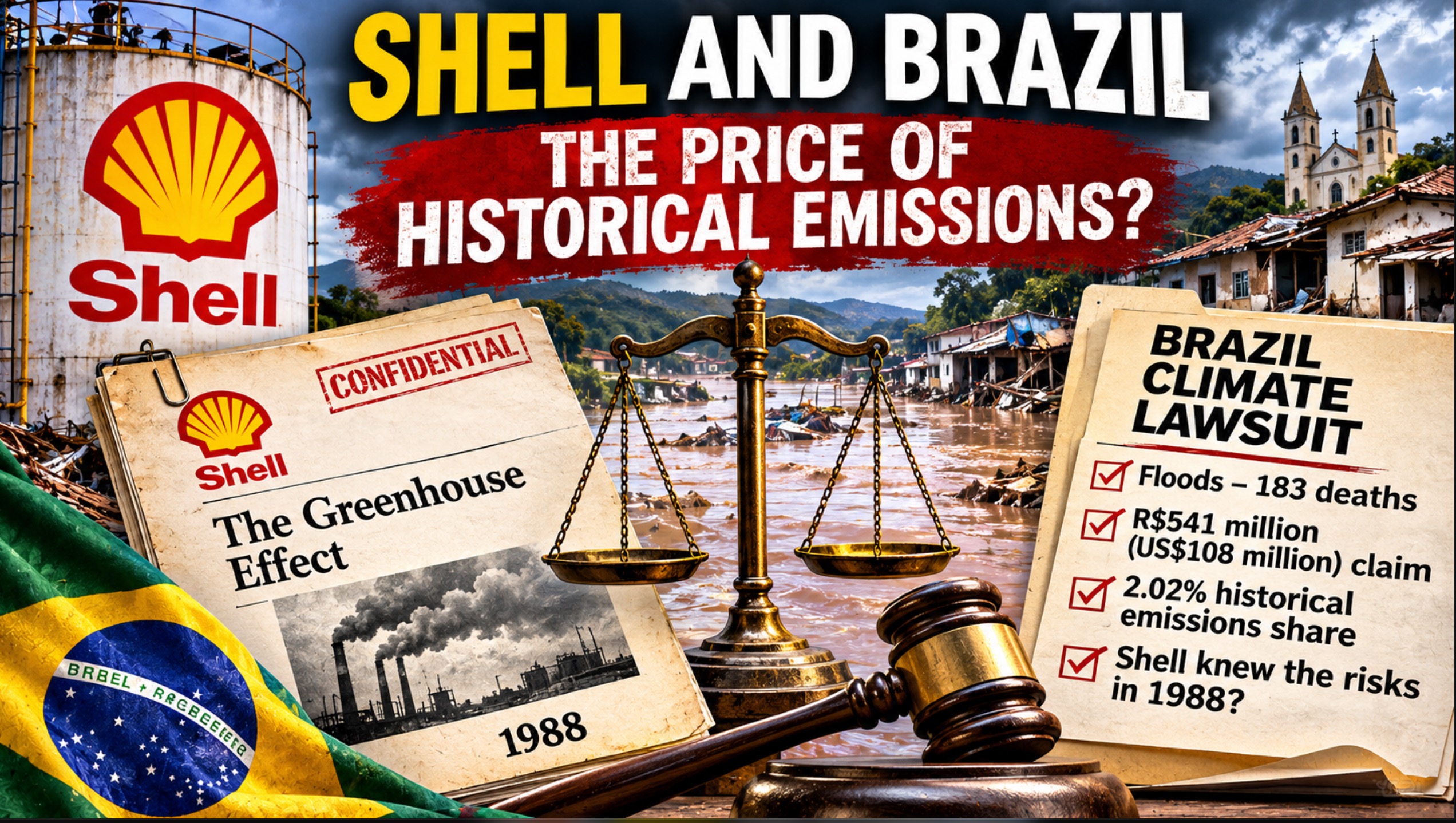
Can an international oil company be held financially responsible for a proportion of the damage caused by a climate-related disaster? Brazil’s unprecedented lawsuit against Shell brings together historical corporate emissions, climate attribution science, environmental liability law and evidence of what Shell knew about global warming almost four decades ago.
25 November 2026
By the Donovan–Shell Archive
The catastrophic floods that devastated southern Brazil in April and May 2024 are now at the centre of a potentially internationally significant legal battle over corporate climate responsibility.
On 9 October 2026, Brazil’s Federal Public Prosecutor’s Office, together with the environmental organisation Instituto Preservar, filed a civil action against Shell Brasil Petróleo Ltda in the federal court in Porto Alegre.
The claim is valued at 541,036,800 Brazilian reais, equivalent to approximately US$108 million when originally reported by AFP.
The lawsuit does not allege that Shell was solely responsible for the disaster. Instead, the claimants maintain that the company should bear a proportionate share of the costs arising from its historical contribution to climate change.
On 24 November, Professor Danielle de Andrade Moreira, a visiting senior fellow at the London School of Economics’ Grantham Research Institute, published an important legal analysis of the case.
Her commentary provides an opportunity to examine how climate science is increasingly being translated into potentially enforceable claims for corporate compensation.
For Shell, this litigation raises a question that extends well beyond Brazil:
Can a multinational energy company be made to pay for a measurable proportion of the environmental damage associated with the historical consumption of its products?
That question remains for the courts to determine.
lse.ac.uk+2
The Brazilian disaster: the human cost
The scale of the Rio Grande do Sul flooding was extraordinary.
According to figures cited by Brazil’s federal prosecutors:
-
478 of the state’s 497 municipalities were affected.
-
Approximately 2.4 million people were impacted.
-
Around 600,000 people were displaced, according to subsequent scientific research.
-
The figures cited in the legal documentation record 183 deaths.
Homes, businesses, agricultural land, infrastructure and essential public services suffered extensive damage.
The economic consequences will continue long after the floodwaters have disappeared.
The people affected are at the centre of this litigation. For them, the debate about historical carbon emissions is not an abstract argument conducted in corporate boardrooms or scientific conferences.
It concerns the destruction of homes, livelihoods and communities.
Ministério Público Federal+1
The official court reference
The Brazilian Federal Public Prosecutor’s Office has published details of the proceedings, including the formal case number.
Case: 5069002-52.2026.4.04.7100
Claimants: Ministério Público Federal and Instituto Preservar.
Defendant: Shell Brasil Petróleo Ltda.
Jurisdiction: Federal court, Porto Alegre, Rio Grande do Sul, Brazil.
Filing date: 9 October 2026.
The official announcement is available through the Brazilian Federal Public Prosecutor’s Office.
The initial petition is also indexed by the Climate Litigation Database.
Identifying the actual proceedings is important. This is an identifiable civil action with specified claimants, a named defendant and a documented compensation claim, rather than simply a campaign calling for Shell to pay compensation.
No judgment establishing Shell’s liability has been identified.
Ministério Público Federal+1
How prosecutors calculated the compensation claim
Perhaps the most significant aspect of the lawsuit is the methodology used to calculate the requested damages.
The claimants begin with approximately R$111.6 billion allocated by Brazil’s federal government in response to the disaster.
They then apply two percentages derived from separate areas of scientific research.
The first is the estimated 12% increase in rainfall intensity associated with human-induced global warming.
The second is Shell’s estimated 2.02% historical share of global carbon dioxide emissions from fossil fuels and cement production.
The resulting calculation is:
The claimants’ proposed compensation calculation
R$111.6 billion
Government disaster-response allocation
Multiply by 12%
R$13.392 billion
Illustrative climate-related proportion
Multiply by Shell’s estimated 2.02% emissions share
R$270,518,400
Requested material damages
R$270,518,400 in collective non-material damages
R$541,036,800
Total initial claim valuation
This is the claimants’ proposed methodology, not a court-approved assessment.
The arithmetic can be independently reproduced. Whether the underlying assumptions are scientifically and legally appropriate is a separate question.
In particular, a 12% increase in rainfall intensity does not necessarily translate into a 12% increase in financial damage. Flooding and infrastructure failures can respond disproportionately to changes in rainfall.
The courts may therefore need to examine not only the attribution science but also the validity of its application to economic losses.
Similarly, the additional collective non-material damages represent a separate legal claim rather than an independently calculated physical loss.
The significance of the case is that prosecutors have presented a specific, quantifiable approach to corporate climate compensation. Its ultimate validity remains untested.
The Climate Litigation Database+1
The science behind the lawsuit
In January 2026, the scientific journal npj Natural Hazards, part of the Nature Portfolio, published a peer-reviewed study entitled:
The researchers examined the contribution of human-induced global warming and the preceding El Niño conditions to the exceptional rainfall.
Their central estimates suggested that global warming had approximately doubled the likelihood of such an extreme rainfall event and increased its intensity by around 12%.
However, responsible reporting requires examination of the uncertainty surrounding those estimates.
The published uncertainty interval for the change in rainfall intensity extended from a 13% reduction to a 43% increase. The estimated change in the likelihood of the event also had a very wide uncertainty range.
The research separately identified El Niño as an important factor.
Furthermore, the authors emphasised the importance of exposure and vulnerability in determining the eventual human consequences of extreme weather.
These qualifications matter.
The research does not establish that Shell individually caused the floods. Nor does it suggest that greenhouse gas emissions were the only factor responsible for the disaster.
Instead, it seeks to determine how changes in the global climate influenced the characteristics of an extreme weather event.
Translating that conclusion into a legal obligation for a particular company is the next, and considerably more complicated, stage.
nature.com
Shell’s 2.02% historical emissions share
The claimants rely on the Carbon Majors database, which traces emissions to major fossil-fuel and cement producers.
The distinction between producer-attributed emissions and direct industrial emissions is fundamental.
Much of the carbon dioxide attributed to an oil company arises when its products are ultimately consumed by customers, rather than from its own refineries, offices or extraction facilities.
The database methodology seeks to account for this wider historical contribution.
The 2.02% figure cited in the Brazilian litigation relates to the global Shell group and the historical accounting period from 1854 to 2024.
It is not a measurement of emissions generated exclusively by Shell Brasil.
This creates a central legal question: whether a Brazilian operating subsidiary can be held liable for historical emissions associated with the activities of the entire international corporate group, including corporate predecessors.
Shell specifically disputes that approach.
The courts must determine whether the legal relationships between the companies, the emissions accounting and the claimed environmental damage provide a sufficient basis for liability.
A numerical estimate of historical emissions is evidence relevant to that question, but it is not itself an allocation of legal responsibility.
Ministério Público Federal+1
What Shell knew in 1988
The historical dimension of the Brazilian lawsuit deserves particular attention.
In 1988, Shell produced a confidential internal report entitled The Greenhouse Effect.
The document was prepared by Shell’s Greenhouse Effect Working Group and drew on earlier research conducted within the company.
The report examined scientific understanding of the relationship between fossil-fuel consumption, atmospheric carbon dioxide concentrations and global warming.
It considered potential environmental consequences, implications for the energy industry and possible responses by governments and businesses.
One particularly significant passage stated:
“by the time the global warming becomes detectable it could be too late to take effective countermeasures”
The original document is publicly accessible through Climate Files: 1988 Shell Confidential Report — The Greenhouse Effect.
The report also attempted to quantify the emissions associated with Shell’s products. Its estimate for 1984 was approximately 4% of global carbon emissions.
That historical estimate and the Carbon Majors figure cited by the Brazilian claimants are based on different accounting periods and methodologies. They should not be treated as directly comparable.
Nevertheless, the existence of the 1988 report establishes that climate-related risks were being examined within Shell decades before the Brazilian floods.
climatefiles.com
This does not establish that Shell anticipated the particular disaster in Rio Grande do Sul, nor that its individual corporate decisions were unlawful.
But it is important evidence when examining the historical development of corporate knowledge, foreseeable environmental risks and the evolution of business strategy.
The report is especially relevant to an independent historical archive because it allows contemporary corporate representations to be assessed against documentary evidence originating within the company itself.
Brazil’s legal framework: why fault may not be decisive
Professor Moreira’s commentary identifies an important distinction between Brazilian environmental liability law and the negligence-based arguments frequently associated with litigation elsewhere.
Brazilian environmental civil liability operates on a strict-liability basis.
Under such a framework, establishing negligence is not necessarily a prerequisite for a successful damages claim.
However, claimants must still establish the legally necessary connection between the defendant, the relevant activities and the damage.
The Brazilian proceedings test whether established domestic principles concerning pollution and environmental compensation can be extended to disaster-specific climate damages.
They also test the extent to which the legal concept of an indirect polluter can encompass the activities of an international corporate group.
Professor Moreira argues that the Brazilian framework provides significant grounds for pursuing such claims.
That represents her legal analysis. It does not mean that the federal court has accepted her interpretation or that the claimants have already satisfied the required evidential tests.
lse.ac.uk+1
Shell’s response — the company’s position must be recorded
An important development since our original October article is the availability of Shell’s own published response specifically addressing the Brazilian litigation.
On its corporate website, Shell states:
“it is not scientifically or legally credible to attribute a specific weather event to the activities of a single company.”
Shell also disputes the applicability of the claimants’ legal attribution theories under Brazilian law.
The company argues that the global energy system reflects decisions made over decades by governments, businesses and consumers.
It further maintains that it is reducing operational emissions while supplying energy required by society.
Shell also challenges the attempt to attribute emissions dating back to 1854 to a Brazilian subsidiary incorporated considerably later.
Its full position is available through Shell Global — What kind of climate lawsuits have been filed against Shell?.
Shell Global
Shell’s objections deserve proper consideration.
But there is also an important distinction between holding one company exclusively responsible for an entire disaster and seeking partial compensation from one contributor to a wider problem.
Brazil’s prosecutors explicitly reject the former approach.
Their legal case rests on the latter.
Whether that distinction is sufficient to overcome Shell’s objections will be one of the defining issues in the proceedings.
International precedents: the German RWE case
The litigation brought by Peruvian farmer Saúl Luciano Lliuya against German energy company RWE provides a particularly relevant comparison.
In May 2025, the Higher Regional Court of Hamm rejected his compensation claim on the facts of the case.
However, its reasoning indicated that a major emitter could, in principle, face proportionate liability for climate-related damage under the applicable German legal framework.
The case therefore illustrates both the potential and the limitations of this emerging form of litigation.
Recognition of a possible legal route to compensation does not remove the need to establish the particular facts necessary to succeed.
Nor does the German court’s reasoning automatically determine the outcome of proceedings under Brazilian law.
Other international climate compensation cases identified in Professor Moreira’s analysis include litigation involving Swiss cement producer Holcim and claims against Shell arising from Typhoon Odette in the Philippines.
Together, these proceedings represent a shift towards examining whether historical corporate emissions can support claims for identifiable losses in particular communities.
lse.ac.uk
What happens if the Brazilian claim succeeds?
The compensation sought is substantial, but the wider significance could exceed the amount involved in this particular dispute.
A successful judgment might encourage other claimants to examine similar legal approaches following floods, storms, droughts and other climate-related disasters.
Each subsequent case would still require consideration of its own applicable law, scientific evidence and circumstances.
Nevertheless, a judicially accepted methodology for allocating part of a disaster’s costs to a historical emitter could influence future litigation.
For Shell and other fossil-fuel producers, the potential implications extend to corporate risk assessment, insurance, accounting disclosures and long-term investment decisions.
Historical emissions could become relevant not merely to environmental reporting but to the assessment of potential future liabilities.
That possibility deserves particular scrutiny from institutional investors and corporate directors.
Where would the money go?
The claimants are not simply requesting that Shell pay a large sum into an unspecified government account.
The official prosecutorial announcement proposes a dedicated financial mechanism, overseen by the court, to support recovery and reduce vulnerability to future disasters.
The requested measures encompass reconstruction, climate adaptation, disaster prevention and assistance for affected populations.
The claimants also envisage independent technical assistance and community participation in determining how funds would be used.
These are proposed remedies, not arrangements already approved by the court.
If accepted, they could make the proceedings significant not only for the assessment of corporate liability but also for the administration of climate-related compensation.
Ministério Público Federal
Shell’s continuing fossil-fuel expansion
The Brazilian litigation is unfolding against the background of Shell’s current business strategy.
Shell’s 2025 annual report, published in 2026, outlines plans to expand LNG sales by 4–5% annually through to 2030 and maintain liquids production at approximately 1.4 million barrels per day.
The company simultaneously maintains its commitment to reducing emissions and improving the efficiency of its operations.
Integrated Annual & Sustainability Report
Earlier today, the Donovan–Shell Archive reported new Venezuelan oil and gas service orders involving a planned $400 million investment.
The announced objectives include increasing hydrocarbon production and reducing gas flaring.
There is no suggestion that this Venezuelan development caused the earlier Brazilian disaster.
However, the two stories illustrate the competing considerations facing the energy industry.
Companies continue investing in the production of hydrocarbons while courts are increasingly being asked to consider their potential liability for the consequences associated with historical emissions.
Operational efficiency and reduced methane leakage can deliver genuine environmental improvements.
But the larger question concerns the cumulative climate consequences of continuing fossil-fuel production and consumption.
The Brazilian case demonstrates why that question is increasingly relevant to corporate governance as well as environmental science.
Questions for institutional shareholders
Major institutional investors in international oil companies, including asset managers such as BlackRock and Vanguard, have reason to examine the development of climate compensation litigation.
The issue is not simply whether Shell will ultimately win or lose this particular case.
A broader assessment should consider how the company identifies, evaluates and discloses potential climate-related legal exposure.
Relevant questions include:
-
How does Shell assess claims based on historical emissions associated with its products?
-
What assumptions underpin its evaluation of potential climate litigation liabilities?
-
How does the company assess the legal implications of historical internal climate research?
-
What consideration is given to differences between national environmental liability regimes?
-
How are climate litigation risks incorporated into long-term capital allocation decisions?
These questions do not imply that Shell should recognise the Brazilian claim as an established financial liability.
They concern the adequacy of corporate risk management in an evolving legal environment.
What remains to be established
The Donovan–Shell Archive will be particularly interested in the following documentary developments: Shell’s formal defence, judicial decisions concerning admissibility and causation, competing expert scientific evidence, the assessment of material damages and any ruling on the responsibility of the Brazilian subsidiary for historical group emissions.
The publication of a court-approved compensation methodology would be especially significant.
Equally, a judgment rejecting the claim could provide important guidance concerning the limitations of this developing area of environmental law.
Both outcomes deserve accurate reporting.
The ultimate question: who pays?
For generations, the commercial benefits of fossil-fuel production have been distributed among companies, shareholders, governments, employees and consumers.
The costs associated with climate-related disasters are also widely distributed, although their burden can fall especially heavily on communities with limited resources to recover.
The Brazilian proceedings seek to establish whether one historical contributor to global emissions should be required to bear a calculated share of those costs.
Shell rejects the scientific and legal basis of the claim.
The prosecutors maintain that an individual corporate contribution can be identified without attributing the entire disaster to a single company.
The scientific evidence, the financial methodology and the applicable law must now withstand judicial scrutiny.
For the families affected by the floods in Rio Grande do Sul, the outcome is about considerably more than an academic argument over carbon accounting.
For the international fossil-fuel industry, it could help define the future relationship between historical emissions and corporate environmental accountability.
Shell’s historical climate documents establish that the company was examining the risks of global warming nearly four decades ago. The question now confronting the Brazilian court is whether the consequences of those risks can be translated into a legally enforceable obligation to compensate affected communities.
That is a question worth following wherever the evidence leads.
Documentary sources and further reading
24 November 2026 — London School of Economics, Grantham Research Institute: Counting the ‘drops’: Brazil’s first climate liability case against an oil major
10 October 2026 — Brazilian Federal Public Prosecutor’s Office: Official announcement concerning the civil action against Shell Brasil
Climate Litigation Database: Ministério Público Federal and Instituto Preservar v. Shell Brasil Petróleo Ltda — initial petition record
2026 — npj Natural Hazards: Climate change and El Niño behind extreme precipitation leading to major floods in southern Brazil in 2024
Shell Global: Shell’s official response to climate litigation, including the Brazilian proceedings
Carbon Majors: Historical corporate emissions database
1988 — Shell internal corporate documentation: The Greenhouse Effect — confidential Shell report
Shell Annual Report and Accounts 2025: Corporate annual reporting and strategy
10 October 2026 — Donovan–Shell Archive: Shell Faces Historic $108 Million Climate Lawsuit in Brazil Over Floods That Killed Nearly 200 People
25 November 2026 — Donovan–Shell Archive: Shell’s $400 Million Venezuelan Oil and Gas Expansion — An Independent Investigation into Production Growth, Gas Flaring and Geopolitical Risk
DISCLAIMER
This article constitutes independent documentary research, news analysis and editorial commentary, prepared with AI-assisted research and drafting. It is based on publicly available information as of 25 November 2026 and does not constitute financial, investment, scientific or legal advice.
The Brazilian proceedings concern contested civil allegations. No judgment establishing Shell’s liability for the 2024 Rio Grande do Sul floods has been identified.
The damages methodology is the claimants’ proposal, not a judicially approved calculation. Scientific estimates are subject to uncertainty, and evidence attributing climate change to historical emissions does not automatically establish legal responsibility for a particular disaster.
The historical Shell documentation is included for its evidential relevance and does not, by itself, establish unlawful conduct.
Shell’s published response has been incorporated in the interests of accuracy, balance and fairness.
Shell plc, Shell Brasil, the claimants, scientific researchers and other relevant parties are invited to provide factual corrections, additional documentation or responses for consideration and publication.