AN INDEPENDENT DOCUMENTARY INVESTIGATION
Shell is advancing a substantial oil and gas development in Venezuela, combining increased hydrocarbon production with plans to reduce gas flaring. The announcement raises important questions about environmental accountability, investment priorities and the risks of returning to one of the world’s most politically complicated oil-producing countries.
25 November 2026
By the Donovan–Shell Archive
Shell’s return to Venezuela’s oilfields is gathering momentum.
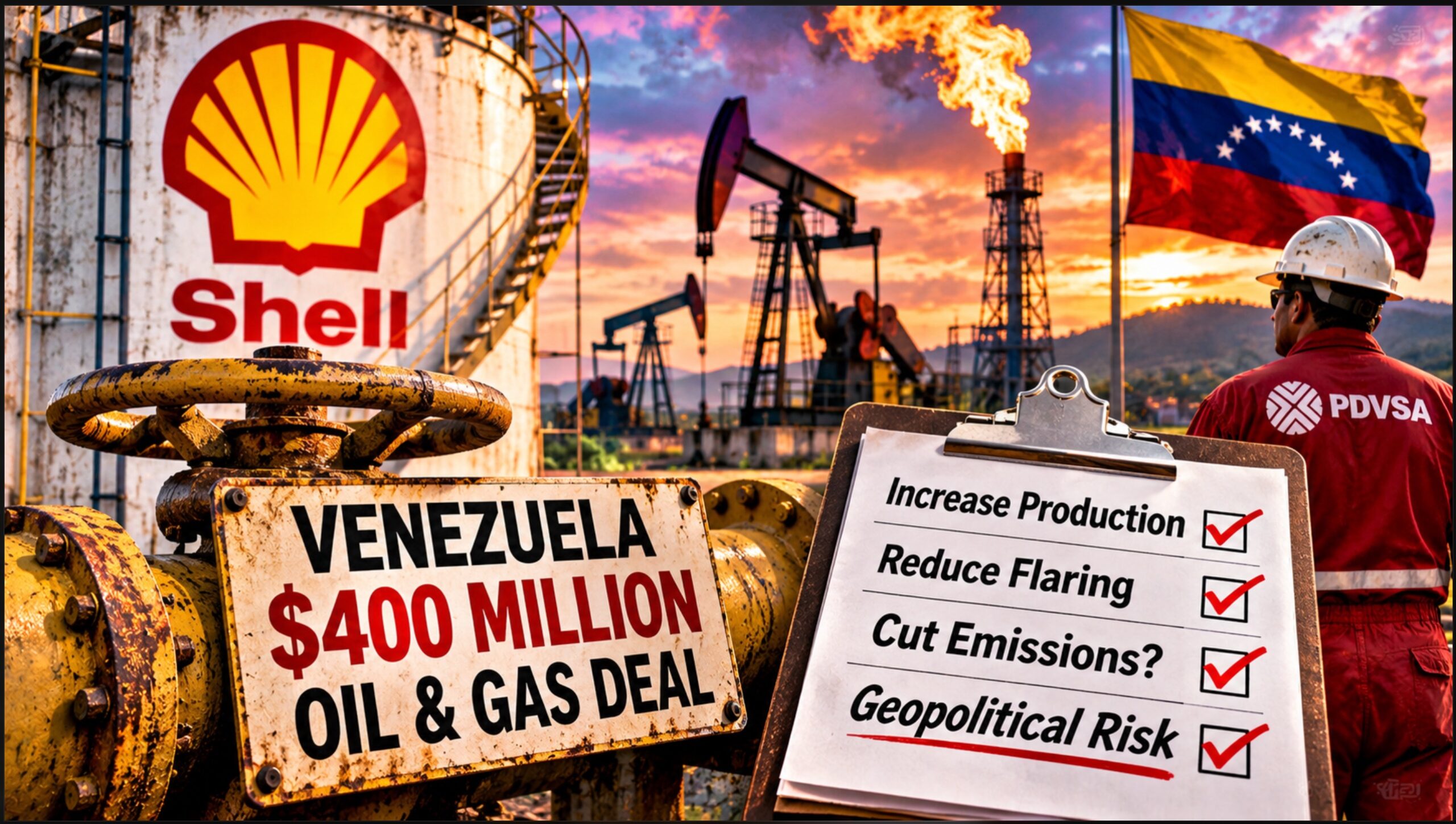
New service orders involving a planned investment of US$400 million have been signed between Shell and Venezuela’s state-owned oil company, Petróleos de Venezuela (PDVSA), covering the Carito-Pirital oil and gas producing area in northern Monagas.
The signing took place on 24 November, with details reported by several Venezuelan publications on 25 November.
The stated objectives are to increase oil and natural gas production, improve operational efficiency and reduce the wasteful flaring and venting of natural gas.
The environmental component deserves recognition. Unnecessary gas flaring represents both a waste of valuable resources and a significant source of pollution.
But reducing emissions from the extraction of fossil fuels is not the same as reducing dependence on fossil fuels.
That distinction lies at the heart of Shell’s evolving energy strategy.
The $400 million agreement: what has actually been disclosed?
According to Venezuelan reporting, the signing was overseen by acting president Delcy Rodríguez.
The documents were signed by PDVSA president Héctor Obregón, Shell regional vice-president Adam Lowmass and Shell’s vice-president in Venezuela, Elías Nucette.
The investment forms part of the technical and financial cooperation between Shell and PDVSA.
finanzasdigital.com+2
However, several commercially important details remain undisclosed:
-
Shell’s precise share of the $400 million investment.
-
The financing structure and allocation of financial risks.
-
The anticipated increases in daily oil and gas production.
-
The timetable for implementation.
-
The contractual remuneration and ownership arrangements.
-
Quantified targets for reductions in methane emissions, flaring and venting.
-
Independent environmental verification arrangements.
It would therefore be inaccurate to describe the announcement as confirmation that Shell alone has committed $400 million of its own capital.
The disclosed figure relates to the planned investment associated with the project.
From preliminary discussions to operational agreements
The latest development is not an isolated announcement. It represents another stage in a process that has been gathering pace throughout 2026.
On 5 March, Reuters reported that Shell had signed agreements covering Venezuelan onshore and offshore hydrocarbon opportunities.
Those arrangements also involved Venezuelan engineering company VEPICA and international contractors KBR and Baker Hughes.
Further Reuters reporting on 10 March identified the Carito and Pirital fields as important targets for Shell’s expansion.
Northern Monagas is particularly attractive because its oilfields can produce lighter grades of crude useful for blending with Venezuela’s heavier oil.
investing.com+1
On 11 June, Venezuela announced additional agreements with Shell, including participation in the offshore Loran gas development and arrangements covering procurement, production expansion and flare-reduction equipment.
The offshore Loran field was reported to contain approximately seven trillion cubic feet of natural gas.
More recently, Venezuelan reporting identified five operational service orders signed earlier in November in the Carito-Pirital area, including work associated with production facilities and measurement equipment.
The $400 million announcement consequently represents a further progression towards implementation.
It is no longer merely a discussion about hypothetical future investment opportunities.
Nevertheless, signing service orders is not equivalent to completing the projects or achieving their production and environmental targets.
Contrapunto.com+2
Shell’s Venezuelan history: a relationship stretching back more than a century
Shell’s interest in Venezuelan oil is hardly new.
Its corporate predecessors were among the pioneers of the country’s commercial petroleum industry in the early twentieth century.
The development of the Zumaque I well in 1914 and the spectacular Barroso II oil blowout in 1922 helped establish Venezuela as a major petroleum-producing nation.
What followed was a long relationship between international oil companies and successive Venezuelan governments, punctuated by changing concession arrangements, taxation, nationalisation and political upheaval.
Venezuela nationalised its petroleum industry in 1976, establishing PDVSA as the central institution of the country’s oil economy.
International participation subsequently evolved through various contractual and investment arrangements.
For Shell, the current expansion represents another chapter in a relationship that has survived extraordinary political and economic changes.
The oil remains underground.
The governments, contractual arrangements and geopolitical circumstances above it have proved considerably less permanent.
Gas flaring: genuine environmental improvement or convenient corporate publicity?
Gas flaring occurs when natural gas associated with oil production is burned rather than captured and put to productive use.
Venting involves releasing gas directly into the atmosphere.
Both practices have environmental consequences, although their emissions characteristics differ.
Venting can release methane, a particularly powerful greenhouse gas over shorter periods. Flaring generates carbon dioxide and can also release unburned methane when combustion is incomplete.
Capturing previously wasted gas can therefore deliver genuine environmental and economic benefits.
If Shell’s Monagas project achieves independently measurable reductions in flaring and methane emissions, those improvements should be acknowledged.
There is no environmental virtue in burning useful gas unnecessarily.
But there is a second question.
What happens to the total emissions associated with the development if overall oil and gas production increases substantially?
A facility can become more efficient while the wider enterprise continues expanding its fossil-fuel output.
Lower emissions per barrel do not necessarily mean lower total emissions.
Moreover, gas recovered rather than flared may ultimately be burned elsewhere, producing additional carbon dioxide.
A credible environmental assessment must consider the complete picture, including production volumes, operational emissions, methane leakage and the eventual consumption of the hydrocarbons.
The appropriate response to Shell’s environmental claims is neither automatic applause nor automatic dismissal.
It is independent measurement.
Venezuela’s long history of unrealised gas ambitions
A November 2026 analysis by the Atlantic Council provides important historical context for the latest announcement.
Venezuela has pursued international gas-development and export opportunities for decades, with repeated proposals encountering financing, commercial, infrastructure and political obstacles.
The early Cristóbal Colón LNG initiative, involving Shell, Exxon and Mitsubishi, emerged around 1990 but did not deliver its original ambitions.
Subsequent projects were similarly affected by changing economic and political circumstances.
More recent opportunities involve potential connections between Venezuelan offshore gas reserves and Trinidad and Tobago’s established gas-processing and LNG infrastructure.
Shell’s onshore Monagas activities could complement that wider regional gas strategy, although the precise commercial arrangements for the newly announced project have not been disclosed.
The Atlantic Council’s historical analysis provides a useful reminder: Venezuela has accumulated a considerably longer record of announcing gas export projects than of successfully delivering them.
Issuu+1
This time may prove different.
But the appropriate test remains completed infrastructure, actual production, commercially sustainable operations and independently verified environmental performance.
The geopolitical risk has not disappeared
The 2026 agreements have followed substantial changes in Venezuela’s political circumstances and in its relationship with the United States.
Shell has previously experienced disruption to its Venezuelan gas plans as American sanctions policy and licensing arrangements changed.
Its offshore Dragon gas development has been particularly exposed to these uncertainties.
International energy companies must consider applicable sanctions, authorisations, payment mechanisms, dealings with state-owned entities and the enforceability of contractual rights.
Infrastructure investment also involves long-term exposure to political and regulatory conditions that can change much faster than an oilfield can be developed.
The latest agreements demonstrate that Shell is prepared to pursue the opportunities now available.
They do not establish that all future regulatory or geopolitical risks have been resolved.
Nor should the Monagas service orders be confused with a final investment decision for the separate Dragon offshore project.
Two Shell stories on the same day
There is a particularly striking coincidence in today’s energy news.
On 25 November, the Donovan–Shell Archive reported that Shell’s former Australian battery business, Sonnen Australia, had entered liquidation following a creditors’ meeting.
On the same day, news emerged of Shell’s participation in a $400 million Venezuelan oil and gas development.
One concerns the collapse of a business acquired during Shell’s expansion into household electricity storage.
The other concerns the expansion of conventional hydrocarbon production.
There is no evidence that the proceeds of the Sonnen disposal are directly financing the Venezuelan investment.
Nor is Shell responsible for every subsequent commercial decision taken by Sonnen’s new owners.
Nevertheless, the juxtaposition illustrates the changing composition of Shell’s business interests.
The company once promoted household battery technology as part of its future in electricity.
Its latest Venezuelan agreements demonstrate the enduring importance of oil and natural gas to its strategy.
The contrast is commercially revealing without requiring any suggestion of a direct causal connection.
Questions for BlackRock, Vanguard and Shell’s other institutional investors
Major institutional investors in Shell, including BlackRock and Vanguard, have a legitimate interest in understanding the environmental and financial characteristics of the company’s expanding Venezuelan operations.
Among the issues deserving scrutiny are the contractual allocation of capital, exposure to geopolitical disruption, environmental liabilities and the credibility of emissions-reduction commitments.
How will Shell measure the project’s environmental performance?
Will independently verified methane and flaring data be published?
Will production increases outweigh operational emissions savings?
What safeguards exist against changes in sanctions and licensing arrangements?
And what happens if the long-term commercial assumptions underpinning the investment prove incorrect?
These are ordinary questions of corporate governance and risk management.
They are not objections to the existence of the project itself.
The test of Shell’s environmental credibility
The Venezuelan project could reduce waste, improve industrial efficiency, support local employment and generate economic benefits.
Those potential advantages deserve recognition.
But the announcement should not be mistaken for proof that Shell’s operations have already become environmentally cleaner.
The necessary performance data have not yet been disclosed.
The Donovan–Shell Archive would welcome publication of the project’s environmental baseline, methane measurements, flare-reduction targets, capital commitments and implementation timetable.
Such information would allow investors, environmental researchers and the wider public to assess whether the project delivers its stated benefits.
Shell has announced another substantial fossil-fuel development accompanied by environmental ambitions. Its credibility will depend on whether those ambitions can be translated into measurable results.
In Venezuela, where ambitious petroleum and natural gas projects have been discussed for generations, that distinction is particularly important.
The agreements have been signed.
The environmental benefits remain to be demonstrated.
Documentary sources and further reading
-
BNamericas, 25 November 2026: Shell signs US$400mn Venezuela orders to lift output, cut flaring
-
Finanzas Digital, 25 November 2026: PDVSA and Shell sign $400 million service orders for Carito-Pirital
-
Contrapunto, 25 November 2026: Venezuela and Shell sign $400 million agreements to increase oil and gas production in Monagas
-
Reuters, 10 March 2026: Chevron and Shell advance major Venezuelan oil production agreements
-
Reuters, 11 June 2026: Venezuela advances agreements with Shell, including Loran gas field
-
Society of Petroleum Engineers, 16 June 2026: Shell expands Venezuela position with new project agreements
-
Atlantic Council, November 2026: Venezuela’s natural gas opening: From stranded endowment to strategic asset
-
Donovan–Shell Archive, 24 October 2026: Shell’s Green Dream Goes Bust: Battery Pioneer Sonnen Files for Insolvency Just Two Months After Oil Giant Sells It
DISCLAIMER
This article constitutes independent documentary research, news analysis and editorial commentary, prepared with AI-assisted research and drafting. It is based on publicly available information as of 25 November 2026 and does not constitute financial, investment or legal advice.
The announced $400 million figure relates to the planned Venezuelan development. Shell’s individual financial contribution, detailed contractual terms and anticipated production increases have not been independently established.
Environmental improvements are stated project objectives, not independently verified achievements. No allegation of unlawful conduct by Shell, PDVSA or any individual is made.
Relevant organisations are invited to submit factual corrections, additional documentation or responses for consideration and publication.
Accompanying satire
Sir Henri Deterding and John Donovan: The Venezuelan Return
An entirely fictional conversation.
Sir Henri: Ach, Donovan! At last, Shell remembers what an oil company does.
Donovan: Produces oil?
Sir Henri: Precisely! A revolutionary concept, apparently.
Donovan: They are also promising to reduce gas flaring.
Sir Henri: Very sensible. Burning something that could otherwise be sold is exceptionally bad business.
Donovan: And the climate implications of increasing production?
Sir Henri: You always insist upon reading the second half of the document.
Donovan: Meanwhile, their former Australian battery business is in liquidation.
Sir Henri: Batteries yesterday, Venezuela today. Does the modern Shell have a strategy or merely a revolving door?
Donovan: Perhaps the shareholders should ask.
Sir Henri: Mein Gott. You will be encouraging them to read the annual report next.
Satirical disclaimer: This dialogue is fictional and does not reproduce authentic statements or quotations by either individual.