Just three months after Shell sold its German battery business, Sonnen’s Australian subsidiary faces winding up. For households that invested in its technology, the uncertainty surrounding warranties, servicing and long-term technical support has become more serious.
25 November 2026
By the Donovan–Shell Archive
The Australian chapter of Shell’s once-celebrated investment in household battery technology has taken a serious turn.
Sonnen Australia Pty Limited has entered creditors’ voluntary liquidation, according to newly published Australian insolvency records dated 25 November 2026.
The development follows the company’s second creditors’ meeting on 24 November and comes barely three months after Shell completed the sale of its Sonnen business to Tiven.
For Shell, Sonnen is a former investment.
For Australian households that purchased Sonnen batteries, the consequences of the business failure are considerably more immediate.
Who will honour their warranties? Who will repair their batteries? Who will maintain the software on which their energy systems depend?
The corporate transaction has long since been completed. The customer relationship has not.
From administration to liquidation
A new insolvency notice, published today, records a deemed special resolution to wind up Sonnen Australia Pty Limited.
The published records identify the following details:
-
Company: Sonnen Australia Pty Limited.
-
Australian company number: 611337547.
-
Liquidation commencement: 24 November 2026.
-
Notice publication: 25 November 2026.
-
Notice reference: 8601025.
-
Named joint liquidators: Hugh Armenis and Jason Lloyd Porter.
-
Notice lodged by: SV Partners.
The development is corroborated by two separate insolvency-information services drawing on Australian Securities and Investments Commission records. The complete original ASIC filing and liquidators’ report have not yet been independently examined by this publication.
Insolvency Notices+1
The Australian business has nevertheless reached a materially different stage from that described in our previous articles.
It is no longer simply a question of whether voluntary administration might produce a corporate rescue.
The liquidation records indicate that the winding-up process has commenced.
The collapse of an ambitious clean-energy venture
The contrast with Sonnen’s earlier ambitions could scarcely be more striking.
The German battery manufacturer once planned to produce 10,000 battery units annually at premises associated with the former Holden automotive manufacturing operation in Adelaide.
It was a compelling industrial vision: traditional car manufacturing giving way to advanced battery technology, renewable electricity and household energy independence.
Shell acquired Sonnen outright in 2019 as part of its expansion into the electricity sector.
For an oil and gas multinational increasingly under pressure over its environmental record, Sonnen offered an attractive demonstration of its ambitions beyond fossil fuels.
The acquisition generated considerable optimism.
Shell’s ownership ended in August 2026, when the sale to Tiven was completed. The precise financial terms have not been established from publicly available transaction documents.
By October, Sonnen’s German business had filed for insolvency, while its Australian subsidiary had entered voluntary administration.
Now the Australian operation faces liquidation.
McKercher Corporation+2
The grand vision of household energy independence has collided with a rather more traditional corporate destination: the liquidator’s office.
The chronology of a corporate retreat
2018: Sonnen establishes its Australian battery manufacturing operation in Adelaide.
2019: Shell completes its acquisition of Sonnen.
August 2026: Shell completes the disposal of Sonnen to Tiven, a family office associated with Aurelius co-founder Gert Purkert.
20 October 2026: Sonnen Australia enters voluntary administration.
22 October 2026: Sonnen GmbH’s German insolvency filing is reported.
24 October 2026: The Donovan–Shell Archive publishes its initial investigation into the collapse.
30 October 2026: The first Australian creditors’ meeting takes place.
19 November 2026: Australian energy publication Renew Economy documents customer-support uncertainty.
24 November 2026: Sonnen Australia’s liquidation commencement date, according to subsequently published insolvency records.
25 November 2026: The winding-up notice is published.
Less than three months separate Shell’s disposal of the business from the commencement of liquidation in Australia.
That timing warrants scrutiny, although it does not establish that Shell or the purchaser engaged in improper conduct.
Customers left seeking answers
On 19 November, journalist Sophie Vorrath of Renew Economy reported the experience of an Australian customer who owned two Sonnen Evo batteries and was encountering uncertainty over technical support.
The investigation examined correspondence indicating that a previous support partnership involving Enervision had ended and that the customer’s installer was exploring alternative arrangements.
Our subsequent article highlighted the potential consequences for customers who depend on specialist maintenance, manufacturer support and software services.
Today’s liquidation development makes those concerns more pressing.
However, several important distinctions must be maintained.
Liquidation does not automatically mean that installed Sonnen batteries will stop operating. Nor does it necessarily eliminate all statutory consumer rights or obligations owed by retailers and installers.
Australian Consumer Law provides consumer guarantees that exist independently of voluntary manufacturer warranties.
Depending on individual circumstances, customers may retain enforceable rights against their suppliers, even when the original manufacturer or warrantor becomes insolvent.
Nevertheless, the practical challenges associated with enforcing claims, obtaining replacement components and securing ongoing technical assistance cannot be ignored.
The Australian Competition and Consumer Commission provides guidance for consumers confronted with business insolvency.
The question now is whether comprehensive arrangements can be established to support existing Sonnen customers.
What happens to employees and creditors?
The liquidators will have to examine the company’s financial affairs, assets, liabilities and potential creditor recoveries.
Among the matters deserving further examination are outstanding employee entitlements, supplier debts, customer warranty claims, spare-parts inventories and any commercially valuable assets remaining within the Australian company.
The full extent of employee losses and creditor exposure has not yet been established by documentation available to this publication.
It would therefore be premature to speculate about the amounts involved or the prospects of recovery.
The liquidators’ findings should provide a much firmer evidential foundation.
Meanwhile, in America
As the Donovan–Shell Archive previously reported, Sonnen’s American operation continues to announce commercial initiatives involving household battery technology and virtual power plants.
These include a residential energy-storage pilot in Michigan and further technology integration initiatives announced during November.
The contrasting fortunes of Sonnen’s international operations deserve examination.
Germany faces insolvency proceedings. Australia has entered liquidation. The American operation continues to pursue commercial opportunities.
These are different legal entities, however, and the apparent resilience of the American operation does not establish that assets or intellectual property were improperly transferred from elsewhere.
Any such allegation would require supporting transaction documents, corporate records and independently verified evidence.
The location, ownership and valuation of Sonnen’s intellectual property remain legitimate subjects for further investigation.
Questions for Shell, Tiven and Aurelius
The liquidation raises a series of questions that extend beyond the immediate financial failure of the Australian company.
What assessment was undertaken of Sonnen’s financial condition before Shell completed its disposal?
What arrangements accompanied the sale concerning financing, existing liabilities and customer support?
Did Shell retain any contractual obligations relating to warranties or transitional services?
What provisions were made for Sonnen’s international subsidiaries?
Were significant assets or intellectual-property rights transferred before or after the transaction, and, if so, on what commercial terms?
What financial exposure, if any, remains with Shell?
These questions are not allegations of misconduct.
They are matters of legitimate corporate accountability concerning a business acquired, promoted and subsequently sold by one of the world’s largest energy companies.
No fresh substantive response from Shell, Tiven or Aurelius addressing today’s Australian liquidation has been identified.
A matter for Shell’s institutional shareholders
Major institutional investors in Shell, including BlackRock and Vanguard, have a legitimate interest in understanding how the company evaluates, manages and disposes of businesses acquired as part of its energy-transition strategy.
The issue is not whether every corporate acquisition must succeed. Commercial failures are inevitable.
The issue is whether appropriate lessons are learned, whether the financial consequences are adequately disclosed and whether sufficient attention is given to customers and other stakeholders when businesses are sold.
Investors deserve more than an attractive presentation at the beginning of an acquisition and an announcement of disposal at the end.
They also deserve an understanding of what happened in between.
A green investment with an increasingly uncomfortable legacy
Shell has spent years presenting itself as a company capable of participating in the transition towards a lower-carbon energy system.
Its subsequent strategic emphasis on oil and gas production, LNG and shareholder returns has intensified scrutiny of that ambition.
Sonnen’s technology remains potentially valuable. Household battery storage has an important role in electricity systems increasingly dependent on renewable generation.
The failure of individual Sonnen businesses should not be mistaken for a failure of the underlying technology.
But the distinction also exposes an uncomfortable corporate reality.
A multinational can dispose of an unsuccessful investment and redirect its capital elsewhere.
A household with a battery attached to its garage wall cannot necessarily move on quite so easily.
That is why the liquidation of Sonnen Australia deserves attention beyond the financial pages.
Shell’s exit from Sonnen may have been completed in August. The consequences of that investment are still unfolding in November.
The Donovan–Shell Archive will continue examining developments in Australia, Germany and the United States, with particular attention to the liquidators’ findings, customer warranties, employee entitlements, asset ownership and the financial circumstances surrounding Shell’s disposal.
Documentary sources and previous coverage
-
19 November 2026 — Renew Economy: Home battery trailblazer quietly enters administration, leaving Australian customers out in the cold
-
Australian Competition and Consumer Commission: Consumer guidance when a business goes bust
-
24 October 2026 — Donovan–Shell Archive: Shell’s Green Dream Goes Bust: Battery Pioneer Sonnen Files for Insolvency Just Two Months After Oil Giant Sells It
-
4 November 2026 — Donovan–Shell Archive: Sonnen’s German Business Faces Insolvency — But Its American Arm Launches a New Battery-Grid Project
-
19 November 2026 — Donovan–Shell Archive: Shell’s Former Battery Business Leaves Australian Customers Facing Support Uncertainty — As Sonnen Creditors Prepare to Meet
DISCLAIMER
This article constitutes independent news reporting, analysis and editorial commentary, prepared with AI-assisted research and drafting. It is based on publicly available information as of 25 November 2026 and does not constitute financial, investment or legal advice.
The Australian liquidation is reported on the basis of published insolvency-notice records. The complete original ASIC filing and detailed liquidators’ report have not yet been independently obtained.
The timing of the insolvencies following Shell’s disposal of Sonnen does not, in itself, establish wrongdoing or legal liability on the part of Shell plc, Tiven, Aurelius or any individual.
Questions concerning asset transfers, financing, contractual obligations and customer protection remain subjects for further documentary examination. No allegation of unlawful asset stripping is made.
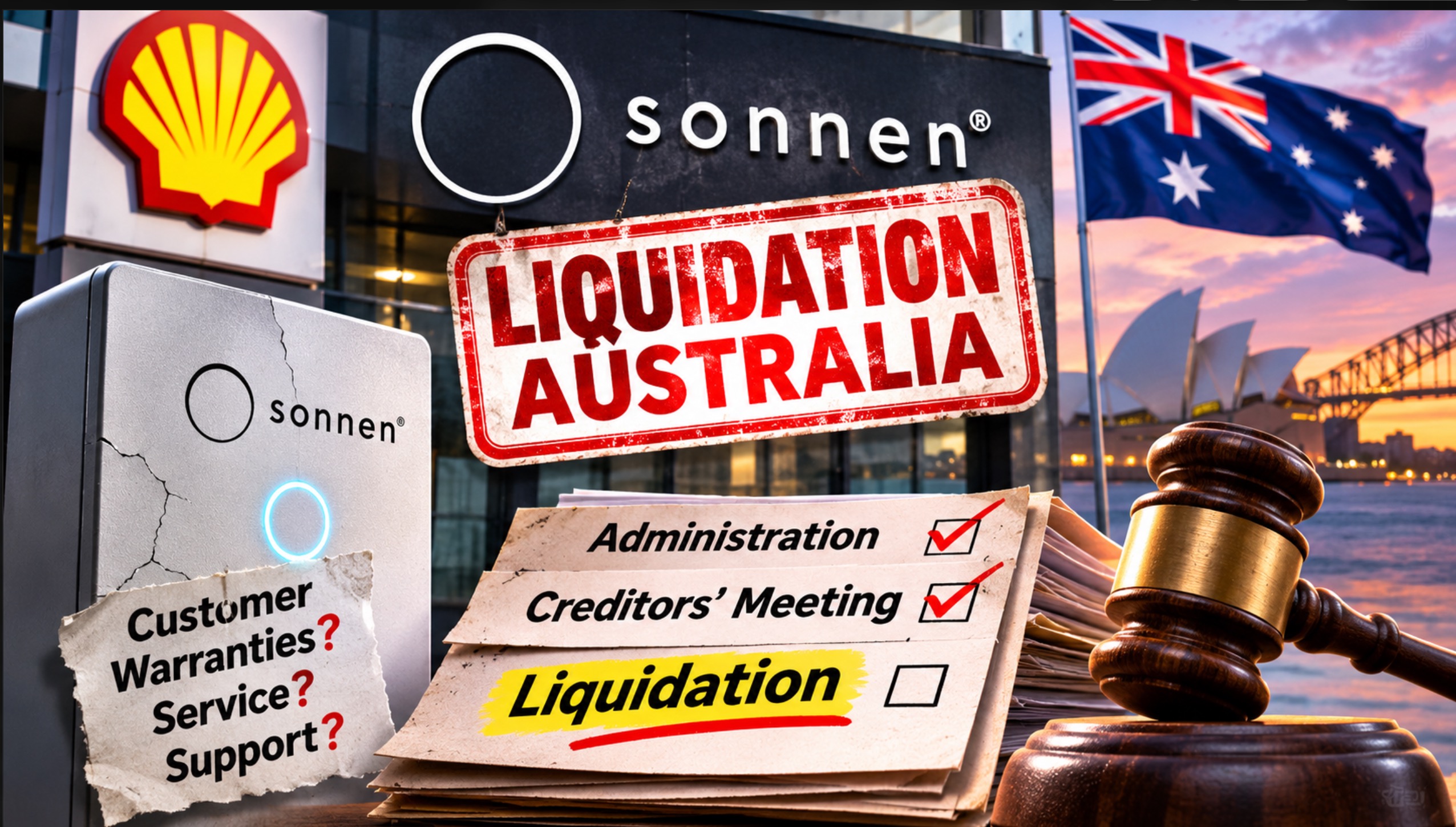
The accompanying AI-generated editorial illustration is symbolic and does not constitute photographic evidence of damaged batteries or judicial proceedings.
Relevant companies and insolvency practitioners are welcome to submit factual corrections, clarifications or responses for consideration and publication.