By the Donovan–Shell Archive
25 November 2026
Researched and drafted with assistance from ChatGPT.
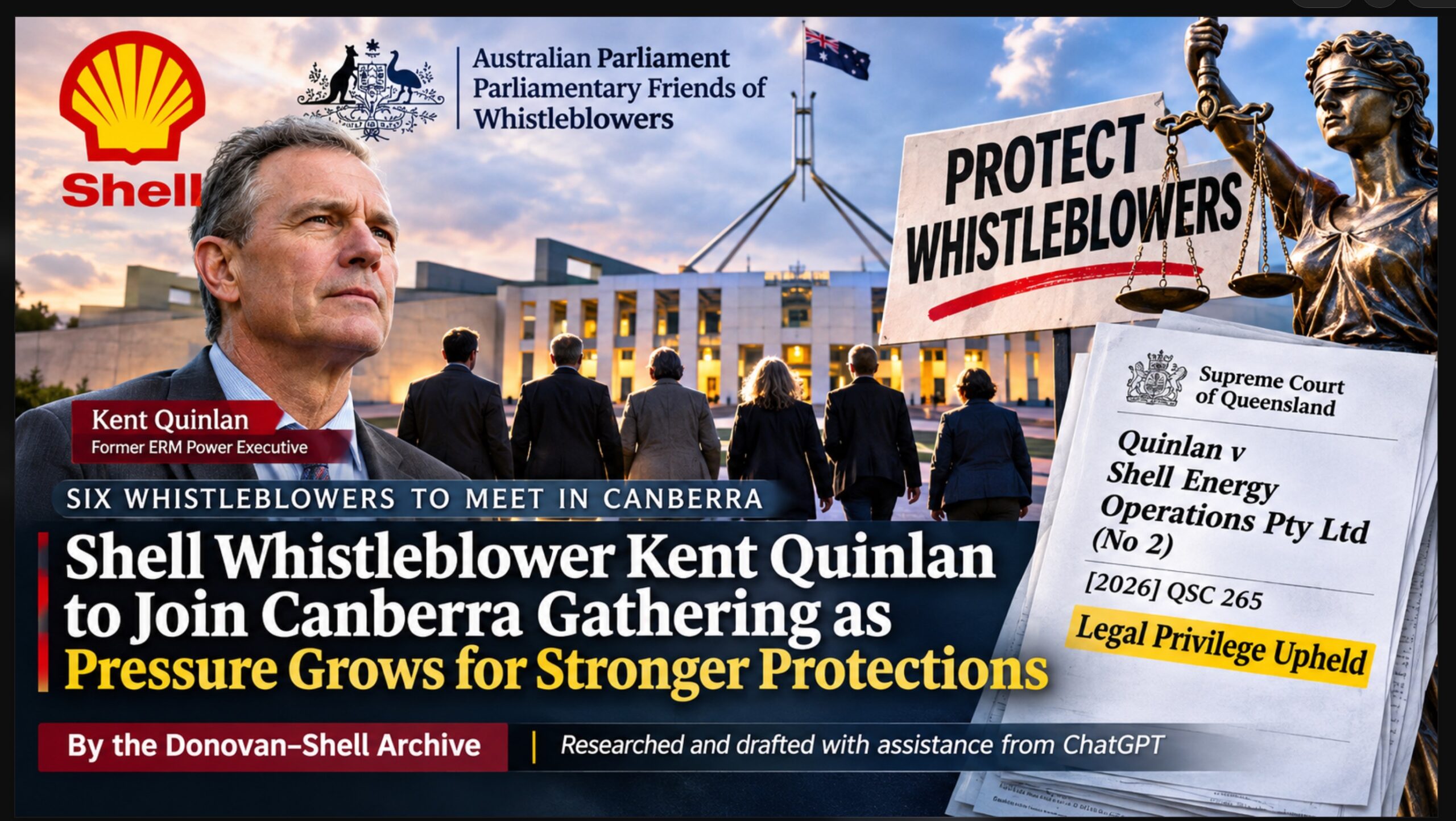
Former ERM Power executive Kent Quinlan, whose long-running legal dispute with Shell Energy has attracted the attention of Australia’s corporate regulator and parliamentary oversight committee, is expected to join five other prominent whistleblowers outside Parliament House in Canberra on Thursday 26 November. The gathering comes just two weeks after a Queensland Supreme Court ruling allowed Shell to retain legal professional privilege over 68 disputed documents, leaving Quinlan’s underlying allegations unresolved.
Six whistleblowers, one parliamentary message
Six Australian whistleblowers are preparing to gather outside Parliament House in Canberra on Thursday 26 November 2026 to press for stronger protections for people who expose suspected wrongdoing.
The meeting is scheduled for 3:30 pm to 4:00 pm at the main entrance to Parliament House.
According to a media invitation circulated by former ClubsNSW whistleblower Troy Stolz on 24 November, the participants represent disputes involving the corporate sector, banking, taxation, gambling, defence and local government.
The six named attendees are:
- Kent Quinlan — former ERM Power executive involved in ongoing litigation with Shell Energy.
- Troy Stolz — former ClubsNSW employee who raised concerns about anti-money-laundering compliance.
- Richard Boyle — former Australian Taxation Office employee whose disclosures became a prominent test of Australian public-sector whistleblower protections.
- Jeff Morris OAM — former Commonwealth Bank financial planner whose disclosures contributed to scrutiny of misconduct in the financial advice industry.
- Sharon Kelsey — former Logan City Council chief executive whose experiences have attracted attention in debates about local-government accountability and whistleblower protection.
- Julia Delaforce — former Australian Defence Force clerk who has raised concerns about Defence procedures and the treatment of whistleblowers.
The organisers say that participants have faced legal battles, professional consequences, loss of employment and other personal costs after reporting suspected misconduct.
Those descriptions are drawn from the invitation and should not be treated as independent findings concerning every participant’s individual allegations.
The gathering is intended to draw attention to a central question posed by the organisers:
Who protects Australians who expose wrongdoing?
The parliamentary connection
The gathering coincides with growing parliamentary interest in Australia’s whistleblower protection arrangements.
The Australian Parliament has established a cross-party Parliamentary Friends of Whistleblowers group.
Its officially listed co-chairs are Senator David Pocock, Senator Deborah O’Neill, Andrew Wilkie MP and Senator Paul Scarr.
The group is intended to provide a non-partisan forum for parliamentarians to engage with organisations and individuals concerned about whistleblower protection and reform.
Among the stakeholders identified in Parliament’s official information are the Human Rights Law Centre, Transparency International and Griffith University.
The organisers of Thursday’s gathering have invited the parliamentary group’s co-chairs and supporters to meet the whistleblowers and hear directly about their experiences.
Their email refers to a parliamentary committee hearing scheduled for Friday 27 November.
However, the Donovan–Shell Archive has not independently confirmed the hearing’s programme or whether any of the six whistleblowers will give formal evidence.
The gathering itself is an independently organised event, not a formally announced parliamentary committee evidence session.
Official source: Australian Parliament — Parliamentary Friendship Groups
Why Kent Quinlan’s participation matters to Shell
For Shell, the significance of the gathering lies in the continuing litigation involving Kent Quinlan and Shell Energy Operations Pty Ltd, formerly ERM Power Ltd.
Quinlan worked for ERM Power between 2008 and 2014.
He alleges that he made protected disclosures concerning suspected corporate misconduct, including electricity transactions, financial reporting and possible insider trading.
He also alleges that his identity as a whistleblower was improperly disclosed and that he suffered detrimental treatment.
These allegations are contested and have not been established by a final judgment determining the substantive claims.
Shell acquired ERM Power in 2019, several years after many of the events complained of.
That chronology is important. The original allegations largely concern conduct predating Shell’s acquisition, while the current litigation involves the company under Shell ownership.
Quinlan’s involvement in the Canberra gathering places his dispute alongside other prominent cases in which individuals have questioned whether Australia’s legal and regulatory institutions provide adequate practical protection for whistleblowers.
The gathering does not establish that Shell breached whistleblower laws.
It does, however, provide a new public and parliamentary context in which the unresolved allegations may receive attention.
Senator Paul Scarr has already challenged ASIC over the case
The parliamentary dimension is particularly significant because one of the co-chairs of Parliamentary Friends of Whistleblowers has already raised Quinlan’s litigation directly with Australia’s corporate regulator.
On 4 September 2026, Senator Paul Scarr questioned Australian Securities and Investments Commission Chair Sarah Court during a hearing of the Parliamentary Joint Committee on Corporations and Financial Services.
Scarr referred specifically to Quinlan v Shell Energy and the allegations of corporate misconduct raised in the proceedings.
He questioned whether ASIC should be examining the matter.
The exchange was subsequently documented by the Donovan–Shell Archive using the parliamentary Hansard transcript.
Scarr urged Court to take the allegations seriously and assess whether regulatory action might be appropriate.
Court agreed that ASIC would look at the matter.
That response was significant, but its meaning must not be exaggerated.
It was not an announcement that ASIC had commenced a formal investigation, nor was it an endorsement of Quinlan’s allegations.
Nevertheless, it placed the case before the chair of Australia’s principal corporate regulator during parliamentary scrutiny.
The fact that Scarr is also a co-chair of Parliamentary Friends of Whistleblowers gives the planned Canberra gathering an additional point of relevance.
There is currently no confirmation that Scarr will attend Thursday’s meeting or discuss the Shell litigation with Quinlan.
Archive source: Official Hansard Confirms Senator Paul Scarr Urged ASIC to “Take a Serious Look” at Quinlan v Shell Energy — 7 October 2026
Shell’s recent legal victory has not ended the dispute
The Canberra gathering follows an important judgment delivered by the Supreme Court of Queensland on 11 November 2026.
In Quinlan v Shell Energy Operations Pty Ltd (No 2) [2026] QSC 265, Justice Soraya Ryan dismissed Quinlan’s application seeking access to 68 documents over which Shell asserted legal professional privilege.
Fifty of the documents identified Quinlan as a whistleblower.
Quinlan had argued that the disclosures of his identity in the disputed communications potentially breached the confidentiality protections contained in the legislation applicable at the time.
He challenged Shell’s privilege claims, including by invoking the exception relating to communications made in furtherance of improper or unlawful conduct.
Justice Ryan personally inspected the documents.
She concluded that legal professional privilege applied and that the exception relied upon by Quinlan did not defeat the privilege claims.
The judgment was a clear procedural victory for Shell.
But it did not resolve the fundamental allegations underlying Quinlan’s case.
The court did not determine that Quinlan’s original disclosures were unfounded.
Nor did it conclude that he had suffered unlawful retaliation.
Those matters remain distinct from the privilege dispute.
The Donovan–Shell Archive examined the judgment in detail on 12 November.
The full legal significance of the November ruling should therefore not be confused with a final resolution of the litigation.
The wider question: protection in law versus protection in practice
The broader issue raised by the Canberra gathering concerns the effectiveness of Australia’s whistleblower protection arrangements.
Corporate and public-sector whistleblowers are covered by different legislative frameworks.
Australia has undertaken reforms designed to strengthen confidentiality protections and prevent retaliation.
But the existence of statutory rights does not automatically mean individuals can enforce them quickly, affordably or effectively.
Whistleblower disputes can involve expensive litigation, complex evidentiary questions, claims of confidentiality, disputes over access to documents and prolonged uncertainty.
Those difficulties do not necessarily demonstrate that an employer or public institution has acted unlawfully.
Legal professional privilege, for example, is an established protection intended to preserve confidential communications between lawyers and their clients.
The Queensland Supreme Court’s November judgment demonstrates that privilege may remain applicable even where a whistleblower challenges the circumstances in which relevant communications were created.
The wider policy question is whether the existing framework provides an adequate balance between legitimate legal protections, corporate accountability and the ability of individuals to pursue whistleblower claims.
That is a question for lawmakers, regulators and the courts to consider within their respective responsibilities.
It is also a question that the organisers of the Canberra gathering plainly want brought to the attention of Parliament.
Why the gathering deserves attention
The Thursday meeting has significance beyond the identities of those attending.
It brings together people whose disputes arose in different institutions but who share concerns about the personal and professional consequences of exposing suspected wrongdoing.
Their experiences cannot automatically be treated as equivalent.
The legislation governing a Defence disclosure may differ substantially from the legislation governing corporate misconduct.
The procedural history and outcome of each case must also be examined separately.
Nevertheless, the organisers argue that the practical experiences of whistleblowers should inform legislative reform.
That is a legitimate subject for parliamentary examination.
It is particularly relevant when individuals involved in current litigation are seeking to draw attention to the difficulties they say they have encountered.
For Quinlan, the event provides an opportunity to place his experience in a broader national context.
For Shell Energy, the underlying litigation remains a contested legal proceeding in which allegations should not be mistaken for established wrongdoing.
For ASIC and Parliament, the issue concerns the adequacy of corporate oversight and the effectiveness of the mechanisms available when serious allegations are reported.
What happens next?
The immediate question is whether Thursday’s gathering leads to substantive engagement with parliamentarians.
The organisers have invited members of the Parliamentary Friends of Whistleblowers group to attend.
They hope to discuss practical safeguards and independent oversight mechanisms.
Whether any of those discussions take place, and what commitments might emerge, remains to be established.
A further question concerns the parliamentary committee proceedings referenced in the invitation.
The official programme, any witness appearances and any published evidence will need to be examined before conclusions can be drawn.
For the Donovan–Shell Archive, the most relevant developments will be whether Quinlan’s case receives renewed parliamentary attention and whether ASIC provides further information about the questions Senator Scarr raised in September.
Any subsequent regulatory decision, court judgment or formal legislative proposal would provide a stronger evidentiary basis for further investigation.
Conclusion
The planned gathering outside Parliament House represents a new stage in public campaigning for stronger Australian whistleblower protections.
It brings Kent Quinlan’s continuing dispute with Shell Energy into the company of other prominent cases involving public institutions and corporate accountability.
The event does not change the legal status of his allegations.
Nor does it reverse Shell’s recent victory in the Queensland Supreme Court concerning legal professional privilege.
But the combination of continuing litigation, earlier parliamentary questioning of ASIC and a new organised appeal for legislative reform makes the gathering worthy of attention.
The question for Parliament is whether Australia’s whistleblower laws provide meaningful protection in practice, rather than merely promising protection on paper.
The six participants intend to put that question directly before Australia’s political representatives.
Whether the encounter produces substantive action remains to be seen.
Sources and documentary references
1. Troy Stolz — Media invitation, dated 24 November 2026
Meet Australian Whistleblowers in Canberra.
The invitation and accompanying media notice were supplied directly to the Donovan–Shell Archive. They identify the six intended attendees and provide the arrangements for the planned 26 November gathering.
2. Australian Parliament — Parliamentary Friends of Whistleblowers
https://www.aph.gov.au/About_Parliament/Parliamentary_Friendship
Official confirmation of the parliamentary friendship group, its co-chairs and stated purpose.
3. Australian Parliament — Parliamentary Joint Committee on Corporations and Financial Services
Official committee information, including its oversight role and public hearing records.
4. Donovan–Shell Archive — 7 October 2026
Earlier documentary examination of Senator Scarr’s questioning of ASIC Chair Sarah Court.
5. Supreme Court of Queensland — 11 November 2026
Quinlan v Shell Energy Operations Pty Ltd (No 2) [2026] QSC 265.
Judgment concerning 68 documents withheld on legal professional privilege grounds. The judicial findings relate to the disclosure application and do not determine the substantive allegations.
6. Donovan–Shell Archive — 12 November 2026
Shell Wins the Battle Over 68 Whistleblower Documents
Detailed examination of the court’s ruling and its limitations.
7. ABC News — 31 March 2026
Kent Quinlan Asks Supreme Court to Force Shell to Hand Over Company Documents
Contemporaneous coverage of the legal dispute and the allegations advanced before the Queensland Supreme Court.
Documentary disclaimer
This article is an advance report based upon an independently supplied media invitation, official parliamentary information, published judicial findings and previous documentary reporting.
The gathering described is scheduled for 26 November 2026. Attendance by the named individuals, parliamentary representatives or other invited parties has not yet been independently confirmed as having occurred.
The organisers refer to a parliamentary committee hearing on 27 November 2026. The Donovan–Shell Archive has not independently verified that date against a current official programme, and no claim is made that Kent Quinlan or the other participants have been invited to give formal evidence.
Allegations made by Kent Quinlan concerning corporate misconduct, breaches of whistleblower confidentiality and retaliatory treatment remain contested. They are not presented as findings of wrongdoing by a court.
The November 2026 Queensland Supreme Court decision concerning legal professional privilege is distinguished from the unresolved substantive litigation.
Shell Energy Operations Pty Ltd was formerly ERM Power Ltd. Many of the events underlying Quinlan’s allegations predate Shell’s acquisition of ERM Power in 2019. The article does not attribute historical conduct to Shell plc or its present management without supporting evidence.
The experiences and claims of the other five whistleblowers are described principally as presented in the organisers’ invitation. Their individual allegations are not independently adjudicated in this report.
Shell Energy, Kent Quinlan, the event organisers, ASIC and relevant parliamentary representatives are invited to provide factual corrections, responses and further documentary material.
Researched and drafted with assistance from ChatGPT. This article is independent reporting and analysis, not a legal determination or legal advice.