
THE SHELL LEAKS FILES: 20 SEPTEMBER 2026
SLF-2007-063
The Sakhalin Papers LIII: The Missing LNG Cargoes — Shell’s Contract Was Supposed to Run Until 2028. Then It “Stood Terminated”
Shell entered the Sakhalin LNG business as both shareholder and buyer. Public agreements envisaged long-term deliveries through 2028. After Russia transferred Sakhalin II to a new domestic operator in 2022, Shell stopped receiving the cargoes. In February 2023 it said it was considering its legal options. Its subsequent annual report went further: Shell said the old Sakhalin Energy company had failed to perform, had thereby renounced the LNG purchase contract, and that the contract “stood terminated.” No public record located for this file establishes that Shell has since received compensation for the lost deliveries.
Archive reference: SLF-2007-063
Collection: The Sakhalin Papers
Principal authenticated records: Shell Annual Report and Accounts 2022; Shell Form 20-F 2023; Shell Form 20-F 2025
Contemporaneous reporting: Interfax, Reuters, Energy Intelligence and S&P Global
Related legal record: Russian restructuring of Sakhalin II and the continuing Moscow proceedings examined in the previous instalment
Evidence standard: Shell’s characterisation of contractual renunciation is attributed to Shell. It is not presented as a judicial finding. No inference is made that the absence of a publicly identified damages award proves that no confidential arbitration, negotiation or settlement process ever existed.
Introduction
The previous Shell Leaks File dealt with a contract that did not concern Sakhalin LNG.
Russia is currently seeking approximately €1.5 billion from Shell Energy Europe over disputed pipeline-gas payments from 2022.
This file turns to the other contract.
This one really did concern Sakhalin.
And unlike the pipeline-gas dispute, the public record contains a remarkably clear statement from Shell about what happened to it.
The Sakhalin LNG contract was supposed to continue until 2028.
The cargoes stopped during the third quarter of 2022.
By the following year, Shell’s own annual report said the contract had been renounced through non-performance and:
“stood terminated.” (SEC)
That is a much more consequential statement than merely saying Shell had withdrawn from the Sakhalin II shareholding.
It means the 2022 Russian restructuring severed another commercial relationship that had been expected to survive for years.
1. Shell was not merely a shareholder in Sakhalin II
For much of Sakhalin II’s history, Shell occupied several different positions simultaneously.
It was an investor.
It supplied technology and expertise.
It participated in project governance.
And it was also an LNG buyer.
That purchasing relationship dated back well before commercial LNG production began.
In 2004, Sakhalin Energy and Shell Eastern Trading announced a long-term agreement under which Shell would purchase 37 million tonnes of LNG over twenty years, initially intended principally for the North American market through the Energia Costa Azul terminal in Baja California. Contemporary industry reporting described plateau supply of approximately 1.6 million tonnes per year. (Energy Intelligence)
The commercial structure subsequently evolved.
On 8 April 2009, Gazprom and Royal Dutch Shell announced another package of LNG and gas agreements.
Under those arrangements, Shell Eastern Trading and Gazprom Global LNG were each to purchase approximately:
1 million tonnes of LNG per year
from Sakhalin Energy.
Deliveries were scheduled from 2009 until:
2028
The arrangements also included an equivalent pipeline-gas component for Shell’s European portfolio. (Energy Intelligence)
The precise contractual evolution between the earlier 2004 agreement and the 2009 arrangements is not fully reconstructed from the public documents examined here.
But one point is beyond serious dispute:
Shell possessed a long-term Sakhalin LNG purchasing relationship scheduled to run until 2028.
2. The contract became part of Shell’s global LNG machine
That mattered because Shell does not treat individual LNG cargoes merely as isolated shiploads.
Its LNG business operates as a portfolio.
Shell’s annual reports describe a trading system in which equity production and third-party purchases can be combined, redirected and optimised through a global shipping and terminal network.
A cargo originally associated with one supply source can therefore contribute to obligations or trading opportunities somewhere else.
Shell explains that if a customer does not require a scheduled cargo, the company may redirect it; similarly, if Shell needs another cargo, it can procure one from third parties. (SEC)
The Sakhalin purchase contract therefore represented more than gas physically leaving Prigorodnoye.
It represented a recurring block of LNG within a much larger international trading portfolio.
At the publicly reported plateau rate of approximately one million tonnes per year, several million tonnes of future contracted supply remained when deliveries stopped in 2022.
The precise financial value of those future cargoes cannot responsibly be calculated from the public evidence.
The contract price formula is not before us.
Nor are Shell’s hedging arrangements, destination flexibility, replacement-purchase costs, mitigation measures or any confidential contractual provisions governing termination.
3. Then came the June 2022 presidential decree
On 30 June 2022, President Vladimir Putin issued the decree that fundamentally altered Sakhalin II’s corporate structure.
The existing operator was the Bermuda-incorporated:
Sakhalin Energy Investment Company Ltd.
Russia created a replacement domestic company:
Sakhalin Energy LLC.
Under the Russian restructuring, the project’s assets, licences, rights, obligations and personnel were transferred into the new company.
Gazprom remained.
Mitsui and Mitsubishi ultimately elected to participate in the replacement structure.
Shell did not. (euronews)
Shell had already announced after Russia’s invasion of Ukraine that it intended to exit its Russian ventures and withdraw in a phased manner from Russian hydrocarbons.
But leaving the shareholding and terminating every outstanding commercial contract were not necessarily the same legal act.
That distinction now became critical.
4. Other Sakhalin customers were offered new contracts
The Russian restructuring did not cause Sakhalin II LNG exports generally to cease.
Instead, customers had to deal with the new operator.
Reuters reported in August 2022 that Japanese utilities holding long-term Sakhalin contracts were being offered replacement arrangements by the newly established Russian company. (The Japan Times)
JERA subsequently signed an agreement with the new operator.
Its spokesperson told Reuters that key commercial terms including volume, price and payment currency remained essentially the same as before. (Journal Chrétien – Actualité chrétienne)
Tokyo Gas also entered a long-term contract with Sakhalin Energy LLC.
Mitsui and Mitsubishi remained as shareholders in the new structure. (euronews)
This creates an important comparison.
The project continued.
Japanese buyers continued.
Japanese shareholders continued.
Shell did not.
5. Shell’s cargoes stopped in the third quarter of 2022
The first authenticated Shell record is strikingly terse.
Shell’s 2022 Annual Report and Accounts states that the company still held two long-term LNG offtake contracts with Russian entities.
Then it records:
the counterparty under one contract stopped delivering cargoes during the third quarter of 2022. (Shell)
The report did not identify the counterparty in that sentence.
But the identity soon became clear.
It was Sakhalin.
Interfax reported Shell’s clarification on 2 February 2023.
One Russian LNG contract involved Novatek and Yamal LNG.
The other was the Sakhalin contract running until 2028.
Shell confirmed that it was no longer receiving the cargoes due under the Sakhalin arrangement. (Interfax)
6. Shell initially said it was evaluating its legal options
Shell’s February 2023 statement is important because it captures the company’s position before the later annual-report wording became more definitive.
Shell said that, as it understood the Russian decree, the licences, assets, liabilities and personnel of the old Sakhalin Energy company had been transferred into the new Russian entity.
Shell was no longer receiving the LNG cargoes.
And the company said it was continuing to monitor developments and evaluate what options were available within the legal framework. (Interfax)
That was not yet an announcement of a settlement.
Nor was it an announcement of a damages claim.
It was a reservation of position.
The contractual consequences were still being assessed.
7. Shell’s 2023 annual report went considerably further
Shell’s 2023 Form 20-F later supplied the clearest legal formulation identified for this file.
It said that in February 2023 Shell had concluded that the old Sakhalin Energy Investment Company had:
renounced the long-term LNG purchase contract through failure to perform.
Shell then stated the consequence:
the contract:
“stood terminated.”
(SEC)
That wording deserves care.
It represents Shell’s legal position.
No court judgment located for this instalment independently determines that Sakhalin Energy breached the contract or that Shell’s interpretation of renunciation was legally correct.
But the wording nevertheless establishes something important.
Shell did not regard the Sakhalin LNG agreement as merely suspended.
By its own 2023 reporting, Shell regarded it as terminated.
8. A contract scheduled to survive until 2028 had disappeared five years early
The distinction is substantial.
Industry contract records continued to identify the historical Sakhalin arrangement as approximately 1 million tonnes per year with a 2028 expiry date. S&P Global’s later contract table continued to record Shell on that basis when describing the original Sakhalin II contract portfolio. (S&P Global)
That table should not be interpreted as evidence that Shell was still receiving LNG.
Shell’s own filings say the opposite.
It is useful because it preserves the nominal contractual horizon.
The original commercial arrangement extended to 2028.
Shell says performance ended in 2022 and that the contract was terminated in 2023.
In practical terms, the 2022 restructuring cut across a supply relationship with years still left to run.
9. The physical LNG did not disappear
This is another critical distinction.
The project continued producing LNG.
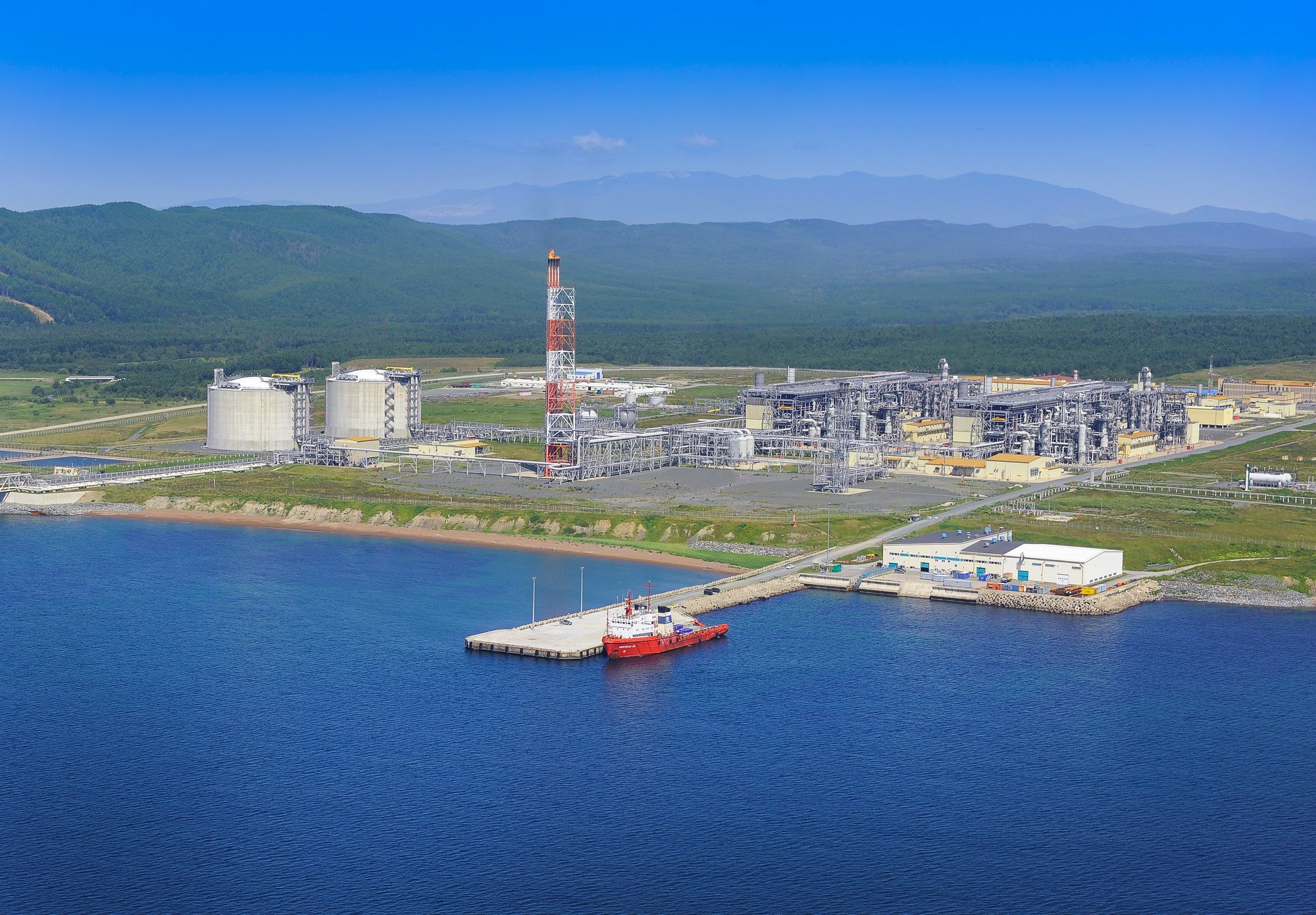
Gazprom describes Sakhalin II’s Prigorodnoye plant as having two LNG trains with design capacity of approximately 9.6 million tonnes per year. (Gazprom)
Sakhalin Energy had previously produced substantially above that nominal design capacity: more than 11.6 million tonnes in 2020, according to the company’s own reporting. (Gazprom)
And after Shell’s departure, production continued under the Russian operator.
Gazprom was still describing the Sakhalin II LNG plant as successfully operating in October 2024. (Gazprom)
Thus Shell did not lose its contracted cargoes because the LNG facility stopped producing.
The commercial relationship changed while the physical asset continued to operate.
10. The Japanese buyers illustrate what might otherwise be misunderstood
Because Japanese purchasers entered replacement arrangements with the new operator, it would be wrong to describe the 2022 events as a general cancellation of all Sakhalin II sales contracts.
Different counterparties made different choices and faced different circumstances.
Japan regarded Sakhalin II as significant to its energy security.
JERA, Tokyo Gas and other Japanese buyers pursued continuity.
Shell had already committed publicly to withdrawing from Russian hydrocarbons and declined participation in the replacement Russian project company. (S&P Global)
The resulting contractual paths diverged.
That is established.
Why every legal and commercial choice was made behind closed doors is not.
11. Shell’s withdrawal policy did not automatically erase existing contracts
There is an apparent paradox here.
On one hand, Shell announced that it would withdraw from Russian hydrocarbons.
On the other, it complained that Sakhalin LNG cargoes were no longer being delivered.
Those positions are not necessarily inconsistent.
Shell repeatedly distinguished between new or spot Russian purchases and pre-existing long-term contractual obligations.
Its 2022 reporting states that it stopped spot purchases of Russian crude, LNG and refined products while existing contractual relationships were being wound down in accordance with legal obligations and contractual provisions.
The Sakhalin contract therefore had to be legally dealt with.
A corporate policy announcement could not simply rewrite the contract.
Neither could a change in Russian corporate structure necessarily determine its treatment under whatever governing law and dispute-resolution provisions the LNG agreement contained.
Those provisions have not been located publicly for this file.
12. What did Shell actually lose?
At minimum, Shell lost continued performance under a long-term LNG purchase agreement that had been expected to continue until 2028.
Public sources place the later contractual volume at approximately one million tonnes annually. (Energy Intelligence)
But translating that into a damages figure would require information not publicly available.
Among the missing variables are:
the contract pricing formula;
the exact quantity schedule;
destination and diversion rights;
take-or-pay provisions;
force majeure clauses;
sanctions provisions;
termination rights;
replacement cargo costs;
Shell’s hedging position;
and any obligation to mitigate losses.
Accordingly, this archive does not attach a speculative dollar or euro amount to the missing cargoes.
The documentary finding is narrower:
Shell lost contractual LNG supply that was scheduled to continue for years.
13. Did Shell ever obtain compensation?
No publicly identified judgment, arbitral award, settlement announcement or Shell disclosure located for this instalment establishes that Shell subsequently received compensation specifically for the terminated Sakhalin LNG purchase contract.
That absence requires qualification.
International LNG agreements commonly contain confidential dispute-resolution provisions.
Any arbitration could itself be private.
Negotiations could also remain confidential.
The absence of a public record therefore does not prove that Shell never pursued a claim.
What can be said is that Shell’s later published reports do not identify the Sakhalin LNG purchase agreement as an active Russian supply contract.
14. By 2023 only the Novatek contract remained
The contrast in Shell’s own reporting is unusually clear.
At the end of 2022 Shell said it had two long-term Russian LNG purchase contracts.
One was Sakhalin.
The other was a Novatek-linked agreement associated with Yamal LNG. (Shell)
Shell’s 2023 annual report then said the Sakhalin contract had been renounced and terminated.
It added that Shell still held one long-term LNG purchase contract with a Novatek entity. (SEC)
Shell’s 2024 report repeated the same position.
So did its 2025 Form 20-F, published in March 2026. (SEC)
The accounting trail therefore tells the story almost mechanically:
Two Russian LNG contracts.
Then:
Sakhalin stops performing.
Then:
Sakhalin contract terminated.
Then:
one Russian LNG contract remains.
15. The surviving contract is not Sakhalin
This is important because it prevents another possible confusion.
Shell’s latest reporting still acknowledges a long-term Russian LNG purchase contract.
That does not mean the Sakhalin agreement revived.
The remaining contract is with a Novatek entity.
The original Novatek deal was signed in 2015 and contemplated approximately 900,000 tonnes of LNG annually for more than twenty years from the Yamal LNG project. (LNG Industry)
The Sakhalin purchase contract, by contrast, is no longer identified by Shell as active.
That distinction will matter in the next instalment.
16. The current Moscow lawsuit is about something else
Another distinction is essential.
The continuing Moscow lawsuit examined yesterday seeks approximately €1.5 billion from Shell Energy Europe for alleged unpaid pipeline gas supplied by Gazprom Export in 2022.
That litigation should not be confused with the missing Sakhalin LNG cargoes.
The Sakhalin LNG purchase agreement concerned liquefied gas supplied from the Russian Far East under a separate commercial relationship.
The Gazprom Export dispute concerned pipeline gas destined for Germany and the post-invasion rouble-payment mechanism.
Russia has subsequently linked the pipeline-gas dispute to money associated with Shell’s former Sakhalin equity interest.
But the public record examined for these files does not show the €1.5 billion claim as damages arising from the missing Sakhalin LNG cargoes. (Interfax.ru)
Keeping those transactions separate is crucial.
Documentary Findings
Established
Shell had a long-term commercial relationship under which it purchased LNG produced by Sakhalin II. (Energy Intelligence)
Publicly announced 2009 arrangements contemplated approximately one million tonnes per year being purchased by Shell from Sakhalin Energy through 2028. (Energy Intelligence)
Russia transferred the Sakhalin II operating structure from the Bermuda-incorporated Sakhalin Energy Investment Company to a new Russian entity in 2022. (S&P Global)
Japanese shareholders Mitsui and Mitsubishi entered the replacement company, and several Japanese LNG purchasers entered replacement supply arrangements with the new operator. (euronews)
Shell did not enter the replacement operating company.
Shell’s 2022 Annual Report states that a Russian LNG counterparty stopped delivering cargoes during the third quarter of 2022. (Shell)
Shell subsequently confirmed that the affected contract was the Sakhalin LNG agreement. (Interfax)
In February 2023 Shell said it was monitoring the contract and considering its legal options. (Interfax)
Shell’s 2023 Form 20-F subsequently stated that Sakhalin Energy Investment Company had renounced the LNG purchase contract through non-performance and that the contract stood terminated. (SEC)
Shell’s latest annual reporting identifies only one remaining long-term Russian LNG purchase contract, with a Novatek entity. (SEC)
The Sakhalin II LNG plant continued operating after Shell ceased receiving cargoes. (Gazprom)
Shell’s stated legal position
Shell treated Sakhalin Energy Investment Company’s non-performance as contractual renunciation.
Shell treated the long-term Sakhalin LNG purchase contract as terminated.
Those are authenticated statements of Shell’s position.
They are not substituted here for an independent court or arbitral determination.
Not established
It is not established from the public record examined here that a court or arbitral tribunal found Sakhalin Energy liable to Shell for breach of the LNG purchase contract.
It is not established that Shell received damages or compensation for the undelivered Sakhalin cargoes.
It is not established that Shell received no compensation through any confidential arrangement.
It is not established how many individual cargoes Shell would ultimately have taken between the third quarter of 2022 and the original 2028 contractual expiry.
It is not established what financial value should be attached to those lost deliveries.
It is not established which later Sakhalin cargoes, if any, corresponded physically or commercially to volumes that might otherwise have been supplied to Shell.
And the pending €1.5 billion Moscow claim against Shell Energy Europe concerns a different pipeline-gas relationship and should not be described as litigation over the missing Sakhalin LNG cargoes.
Commentary
The missing cargoes reveal another reason the phrase:
“Shell left Sakhalin in 2022”
is inadequate as history.
Shell had spent decades embedding itself in Sakhalin II.
Its relationship with the project consisted of layers.
Ownership.
Management.
Technology.
Project finance.
LNG production.
Trading.
Long-term purchasing.
Those layers did not disappear simultaneously.
Shell announced its withdrawal from Russian investments in February 2022.
Its significant influence over Sakhalin Energy disappeared shortly afterwards.
Russia transferred the project to a new operating entity.
Shell declined to join it.
But an LNG purchase contract still existed.
Then the cargoes stopped.
Then Shell considered its legal options.
Then Shell formally recorded the contract as renounced and terminated.
That is not a single exit event.
It is an unwinding.
And even four years later, other Russian contractual and legal relationships remain unresolved.
Another archival lesson
The story also demonstrates why annual reports deserve to be read alongside headline news.
The headline in 2022 was:
Shell exits Russia.
The accounts revealed something much more complicated.
Shell still had Russian LNG contracts.
One supplier stopped delivering.
The Sakhalin contract disappeared.
The Novatek contract survived.
A separate Gazprom pipeline-gas dispute later became €1.5 billion litigation.
Shell’s former Sakhalin equity compensation became entangled in that lawsuit.
And the old Bermuda company remains on Shell’s books even though Shell says it no longer possesses Sakhalin II’s operating rights.
None of those details fits comfortably into the simple phrase:
“Shell left.”
That is precisely why the documentary chronology matters.
Source Record
Shell’s Annual Report and Accounts 2022 is the principal authenticated record for the cessation of cargo deliveries. It states that Shell still held two long-term LNG offtake contracts with Russian entities and that one counterparty stopped delivering cargoes during the third quarter of 2022. (Shell)
Shell Annual Report and Accounts 2022
The SEC-hosted Shell Form 20-F 2023 contains the clearest later contractual statement: Shell said Sakhalin Energy Investment Company had renounced the long-term LNG purchase contract through non-performance and that the contract stood terminated. It also records that one long-term LNG purchase contract with a Novatek entity remained. (SEC)
Interfax reported Shell’s 2 February 2023 clarification that it was no longer receiving cargoes due under the Sakhalin contract and was evaluating its legal options. (Interfax)
Interfax — Shell says Sakhalin LNG deliveries have ceased, 2 February 2023
Contemporaneous Reuters reporting documents the different route taken by Japanese purchasers and shareholders, several of whom continued under contracts with the replacement Russian operator. (euronews)
Reuters — Russia approves Mitsubishi participation in new Sakhalin II operator
Reuters — Japanese utilities receive replacement Sakhalin contracts
Energy Intelligence’s contemporaneous 8 April 2009 report records the Shell-Gazprom arrangements under which each company was to purchase about one million tonnes annually from Sakhalin Energy from 2009 through 2028. (Energy Intelligence)
Energy Intelligence — Gazprom and Shell sign Sakhalin LNG agreements, 8 April 2009
Gazprom’s current Sakhalin II project record confirms the continuing operation and 9.6 million-tonne design capacity of the Prigorodnoye LNG facility. (Gazprom)
Gazprom — Sakhalin II project record
Shell’s latest authenticated annual report, for 2025, continues to state that Shell has one long-term Russian LNG purchase contract with a Novatek entity while retaining its shares in the old Bermuda-incorporated Sakhalin Energy Investment Company. (SEC)
Archive disclaimer: Shell’s characterisation of contractual renunciation and termination is attributed to Shell. No publicly identified judgment or arbitral award located for this file independently determines liability under the Sakhalin LNG purchase agreement. The absence of publicly reported compensation is not treated as proof that no confidential claim, negotiation or settlement existed.
Site-wide disclaimer applies.
Next instalment
The Sakhalin Papers LIV: The Russian LNG Contract That Survived — Why Shell Still Lists a Novatek Deal More Than Four Years After Announcing Its Russian Withdrawal
The Sakhalin agreement disappeared.
The other Russian LNG contract did not.
In June 2015, Novatek announced a deal under which Shell International Trading Middle East would purchase approximately:
900,000 tonnes of Yamal LNG every year
for:
more than twenty years.
Shell announced in March 2022 that it intended to withdraw in a phased manner from Russian hydrocarbons.
Yet Shell’s 2025 Annual Report, published in March 2026, still says:
Shell holds one long-term LNG purchase contract with a Novatek entity. (SEC)
That raises the next documentary question:
Why did the Sakhalin LNG contract terminate while the Novatek/Yamal contract survived — and what does “phased withdrawal from Russian hydrocarbons” mean when one of Shell’s Russian LNG agreements may still have more than a decade left to run?
*This website and sisters royaldutchshellgroup.com, shellnazihistory.com, royaldutchshell.website, johndonovan.website, shellnews.net, and shellwikipedia.com, are owned by John Donovan - more information here. There is also a Wikipedia segment, the Shell DPA Files, "Shell and the Spies", the Shell Leaks files, as well as books written and published by John Donovan - Kindle eBooks. Timeline of the Donovan Shell Feud. Toxic History of Royal Dutch Shell Group. Shell and the Donovans: The Full Media Record — 550+ Articles, 110 Books, 40 Years. *All created and supported by internet wizz, Nick Gill.