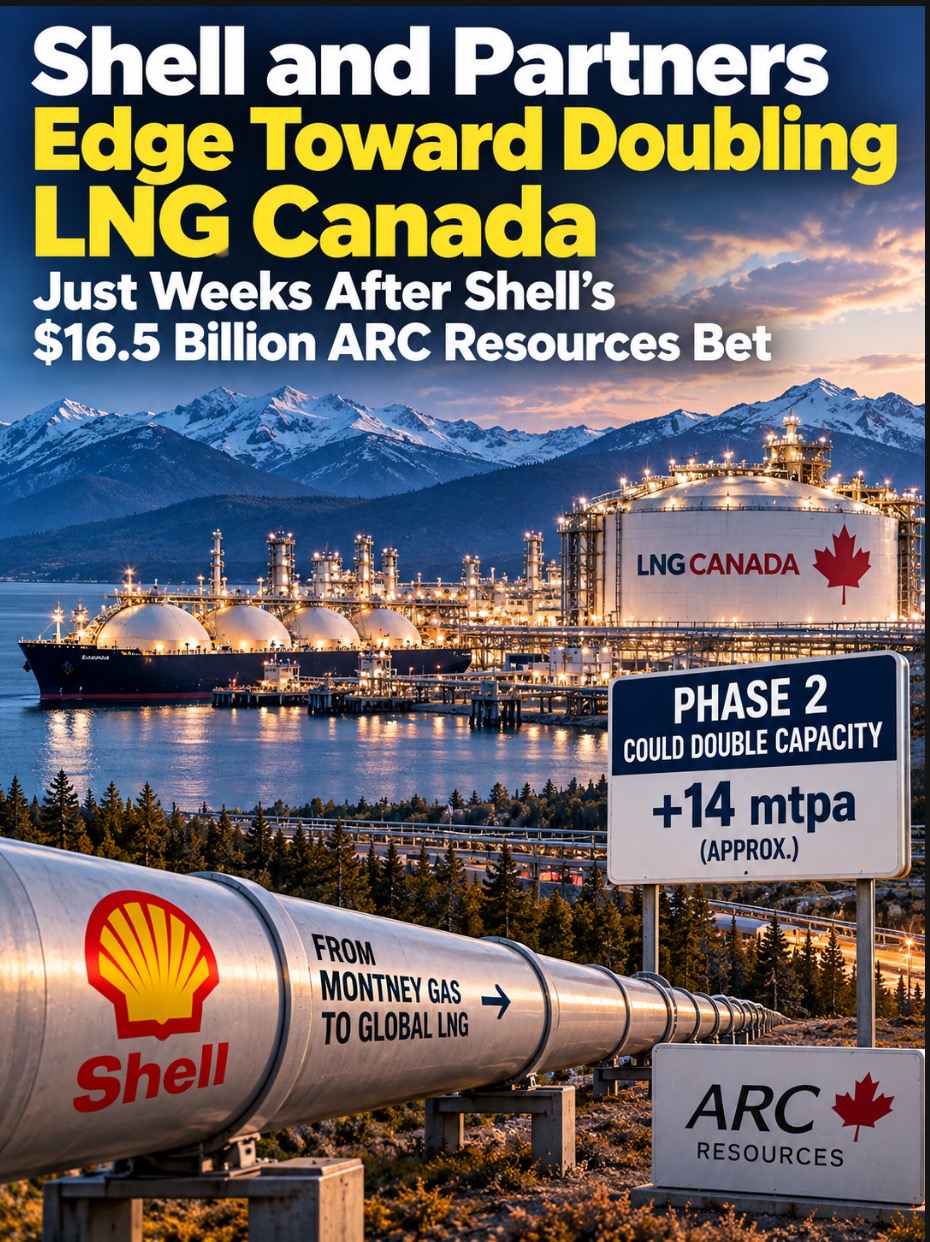
Shell and Partners Edge Toward Doubling LNG Canada — Just Weeks After Shell’s $16.5 Billion ARC Resources Bet
Shell and its partners appear to be moving rapidly towards one of the biggest LNG investment decisions in Canada since the original LNG Canada project was sanctioned.
According to a new report carried by the Financial Post, shareholders in the Shell-led LNG Canada project are poised to approve a doubling of the Kitimat export terminal’s capacity, potentially as soon as next week.
If the reported decision goes ahead, LNG Canada’s maximum production capacity would rise from approximately 14 million tonnes per annum to 28 million tonnes per annum.
That would not simply be another expansion project.
It would reinforce the increasingly obvious strategic connection between Shell’s enormous Canadian natural-gas resources, its recently completed acquisition of ARC Resources and its ambition to supply growing international LNG markets.
Phase 2 edges closer to reality
Only a week ago, Reuters reported that the LNG Canada partners could take a final investment decision on Phase 2 by early October.
The latest reporting goes further.
People familiar with the discussions are now reported as saying that the shareholders are preparing to make the financial commitment to proceed, with an announcement potentially coming as soon as the week beginning 28 September.
No formal final investment decision had been announced by Shell at the time of writing.
That distinction matters.
Shell’s own project portfolio continues to list LNG Canada Expansion as a “key pre-FID option,” with proposed additional capacity of 14 million tonnes per annum.
So this remains a reported imminent decision rather than a completed one.
But the direction appears increasingly clear.
From 14 million tonnes to 28 million
LNG Canada’s first phase has capacity of approximately 14 million tonnes per annum.
Phase 2 would add roughly another 14 million tonnes, effectively doubling the terminal’s potential output to approximately 28 million tonnes annually. Reuters reported on 17 September that the expansion could receive a final investment decision as early as October.
The terminal at Kitimat, British Columbia, provides Canadian gas producers with something they historically lacked: direct access to international LNG markets from Canada’s Pacific coast.
That geography is important.
LNG Canada can supply Asian customers without Canadian gas first having to travel south into the United States and then through US Gulf Coast export terminals.
For Shell, whose global LNG operations are already central to its strategy, a doubled Canadian export facility would therefore represent substantially more than additional production capacity.
It would strengthen the company’s control over a chain stretching from vast Canadian gas reserves to international LNG buyers.
Then came ARC Resources
The timing becomes particularly interesting when viewed alongside Shell’s acquisition of ARC Resources.
Shell completed that transaction on 2 September 2026.
The acquisition added approximately 370,000 barrels of oil equivalent per day of liquids and natural-gas production and significantly expanded Shell’s position in Canada’s prolific Montney basin.
Shell valued the transaction at approximately $16.5 billion including ARC’s net debt and leases.
That is a huge commitment to Canadian hydrocarbons.
And the relationship between ARC’s gas resources and Shell’s LNG ambitions was never particularly difficult to spot.
When announcing the ARC acquisition, Shell explicitly identified the potential for the enlarged Canadian gas resource base to support LNG growth.
Now, only weeks after completing the purchase, reports suggest that the partners in Shell’s flagship Canadian LNG export operation are approaching a decision to double its capacity.
Viewed together, the transactions start to look less like separate corporate events and more like components of the same strategic picture:
More Montney gas.
More LNG export capacity.
More access to international gas prices and Asian customers.
From Canadian gas field to global LNG cargo
The commercial logic is straightforward.
Western Canada contains enormous natural-gas resources.
But abundant supply has historically contributed to periods of relatively depressed Canadian gas prices.
LNG exports provide producers with another outlet.
Instead of selling all their gas into the North American market, producers can potentially convert it into LNG and sell it into international markets where pricing dynamics can be very different.
Shell therefore has an unusually interesting position.
It owns upstream Canadian gas resources.
It has substantially increased those resources through ARC.
It holds a 40% interest in LNG Canada.
And Shell is one of the world’s largest LNG traders.
If Phase 2 proceeds, those pieces become even more closely connected.
Shell is not alone
LNG Canada is a joint venture.
Shell holds 40%, alongside Malaysia’s Petronas, PetroChina, Mitsubishi Corporation and Korea Gas Corporation.
A final investment decision therefore requires the participating companies to commit substantial additional capital.
That makes reports that the partners are now approaching approval especially significant.
The existing plant only began exports in 2025, meaning the partners have been able to observe actual operating performance before committing to a second phase.
By June 2026, LNG Canada had already shipped its 100th cargo.
The project has therefore moved remarkably quickly from Canada’s long-discussed ambition of becoming a major LNG exporter towards consideration of doubling its flagship terminal.
A significant Indigenous investment option
There is another important component to Phase 2.
In July, LNG Canada announced an agreement giving MNT Investments LP, representing the economic development organisations of five neighbouring First Nations, an option to invest up to C$1 billion in infrastructure associated with the proposed expansion.
The participating nations are the Gitga’at First Nation, Gitxaała Nation, Haisla Nation, Kitselas First Nation and Kitsumkalum.
Under the proposal, MNT Investments could acquire a majority interest in a special-purpose entity that would purchase the LNG storage tank planned for Phase 2 and lease the infrastructure back to LNG Canada.
LNG Canada described the arrangement as potentially one of Canada’s largest Indigenous ownership stakes in major energy infrastructure.
Crucially, however, that transaction is conditional upon the LNG Canada partners approving Phase 2.
An FID would therefore unlock more than simply construction activity.
The bigger Shell strategy
This development also fits neatly with the portfolio transformation we reported separately.
Shell has been selling billions of dollars of assets while directing capital towards businesses management believes can generate stronger long-term returns.
Its $16.5 billion ARC Resources acquisition represents one side of that strategy.
A further major commitment to LNG Canada would reinforce another.
Shell has repeatedly identified LNG as a key growth business.
Unlike some of the renewable-energy ventures that Shell has acquired, reorganised or sold over recent years, LNG remains firmly embedded in the company’s long-term plans.
And Canada offers Shell something particularly valuable: huge gas resources combined with Pacific access to Asia.
The energy-transition paradox
There is an unavoidable broader point.
Shell frequently presents itself as operating within the global energy transition.
Yet one of its most consequential current strategic moves is potentially to double the capacity of a huge fossil-fuel export facility designed to operate for decades.
Supporters of LNG argue that natural gas can replace higher-emitting coal in electricity generation and provide reliable energy while renewable systems expand.
Critics counter that enormous new LNG infrastructure risks locking in fossil-fuel production and associated greenhouse-gas emissions far into the future.
Those arguments will continue.
What is beyond dispute is the scale of the investment contemplated at Kitimat.
If Phase 2 receives approval, Shell and its partners will be making another substantial long-term commitment to natural gas.
The pieces are falling into place
Less than a month after completing the ARC Resources acquisition, Shell may therefore be on the verge of another defining Canadian decision.
ARC supplies an enormous upstream resource base.
The Montney supplies the gas.
LNG Canada provides the liquefaction and Pacific export route.
Shell’s global trading organisation connects those cargoes with international customers.
Seen in isolation, the individual transactions are impressive.
Seen together, they reveal something considerably more significant.
Shell appears to be constructing an increasingly integrated Canadian gas-to-LNG machine — from the Montney wellhead all the way to the international LNG tanker.
And if the latest reports are correct, Shell and its partners may be about to press the button that doubles its capacity.
Sources: Financial Post/Bloomberg reporting on the prospective LNG Canada Phase 2 investment decision; Reuters, 17 September 2026; Shell plc project and ARC Resources acquisition disclosures; LNG Canada, July 2026 Indigenous equity-option announcement.