13 October 2026 | RoyalDutchShellPlc.com
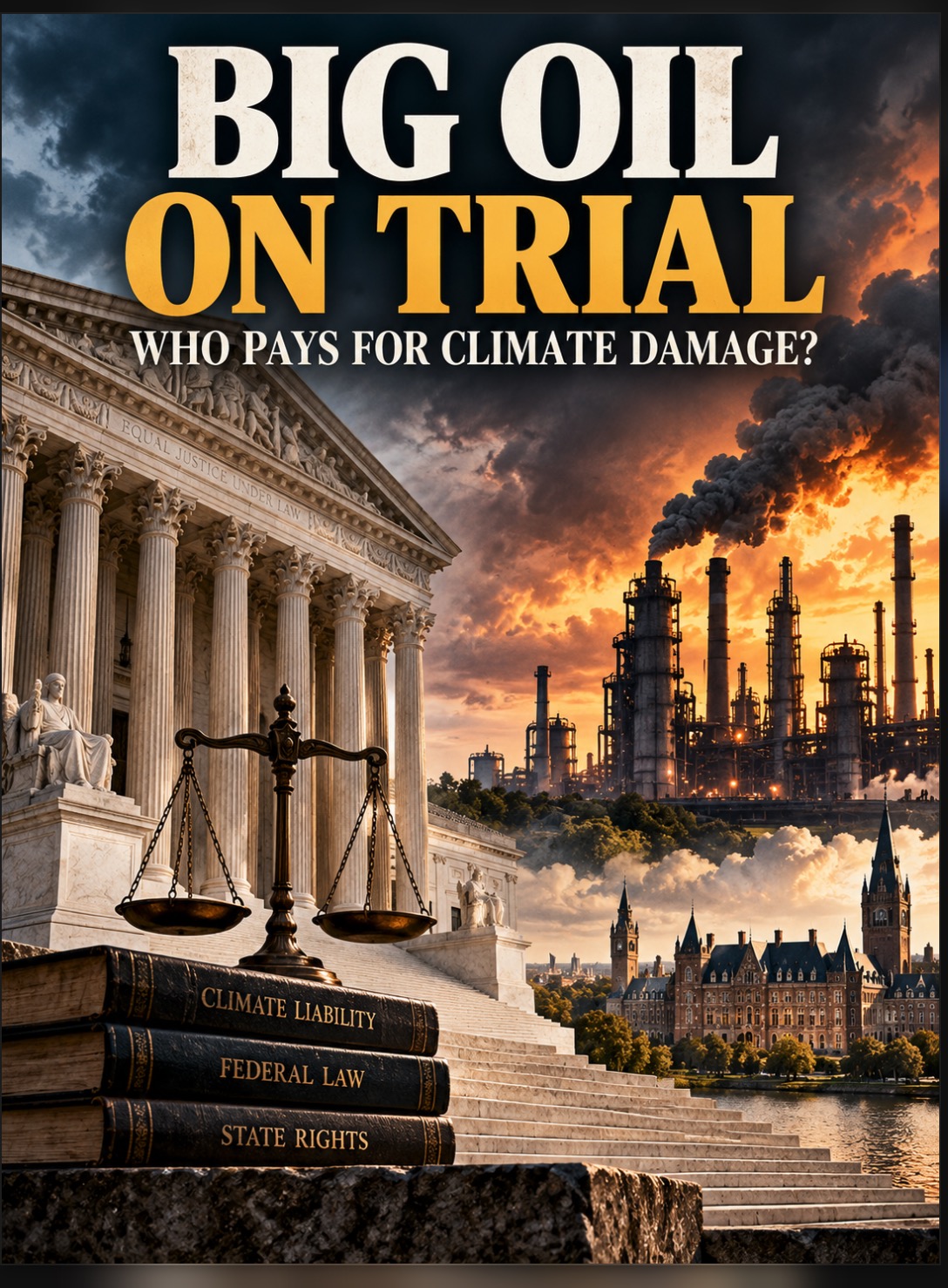
Two of the world’s most consequential courts are considering questions that could reshape the legal responsibilities of the fossil fuel industry. In Washington, the US Supreme Court is examining whether communities can pursue climate-damage claims against ExxonMobil and Suncor under state law. In the Netherlands, Shell is defending itself before the Dutch Supreme Court against demands for enforceable greenhouse gas reductions. The proceedings are legally distinct, but they expose the same underlying conflict: how far can courts go in holding major energy companies responsible for their contribution to climate change?
The US Supreme Court enters the climate liability battle
An article published by Forbes on 12 October 2026, written by energy commentator Ian Dexter Palmer, draws attention to a potentially far-reaching legal confrontation involving ExxonMobil and Suncor Energy.
The case originated in Colorado in 2018.
Boulder County, the City of Boulder and San Miguel County brought proceedings against the two fossil fuel companies, seeking compensation for climate-related harms allegedly associated with their products and conduct.
The plaintiffs argue that the companies contributed to climate change and should help meet the resulting costs.
Those costs include measures associated with worsening heat, wildfire risks, flooding and other climate-related consequences.
ExxonMobil and Suncor dispute the legal basis of the claims.
The companies argue that state-law proceedings seeking damages for the consequences of greenhouse gas emissions across the United States and internationally intrude upon matters governed by federal law.
The dispute has now reached the highest court in the United States.
But the precise question before the justices requires careful explanation.
What the Supreme Court is actually deciding
The case is formally titled Suncor Energy (U.S.A.) Inc. v County Commissioners of Boulder County, No. 25-170.
On 23 February 2026, the Supreme Court agreed to review the case.
It subsequently scheduled oral arguments for 5 October.
Those arguments have now taken place.
The Supreme Court’s official docket confirms the procedural history.
The Court is considering whether federal law prevents Colorado’s state-law claims from proceeding.
The companies argue that claims based upon the effects of interstate and international greenhouse gas emissions cannot properly be governed by individual states’ laws.
They invoke principles concerning federal authority, the Clean Air Act and the federal government’s responsibilities in international affairs.
Boulder and the other plaintiffs maintain that their claims fall within traditional state-law powers to address harms and seek compensation.
The Supreme Court is also examining whether it has jurisdiction to decide the dispute at this procedural stage.
This is not yet a trial determining whether ExxonMobil caused particular losses or how much compensation it should pay.
The immediate issue is whether the claims can proceed within the relevant legal framework.
That distinction is central.
If the Court accepts the companies’ arguments, it could substantially restrict certain state-law climate-damages lawsuits.
If the municipalities prevail, their claims could continue towards further proceedings on liability and damages.
A ruling allowing the lawsuits to proceed would not itself establish that ExxonMobil or Suncor had committed a legal wrong.
What happened during the October hearing?
The justices heard arguments on 5 October 2026.
According to Associated Press reporting, several justices questioned the implications of allowing individual state courts to adjudicate claims involving emissions generated across national and international boundaries.
Chief Justice John Roberts and Justice Brett Kavanaugh raised concerns relevant to the potentially broad consequences of the litigation.
The arguments also explored whether state-law claims might interfere with federal regulation of greenhouse gas emissions.
Supporters of the municipalities argue that federal environmental legislation does not automatically eliminate every state-law remedy for damages.
The Court must distinguish between a state attempting to regulate emissions beyond its borders and a state seeking to provide compensation for injuries allegedly suffered within its territory.
That is not a simple distinction.
A damages award can affect corporate behaviour even where a state has not directly imposed an emissions standard.
Justice Samuel Alito recused himself from the proceedings.
His absence leaves eight justices participating.
An evenly divided decision could leave the Colorado Supreme Court’s judgment standing without establishing a nationwide Supreme Court precedent.
No final decision had been announced as of 13 October 2026.
The Court’s official recording and transcript of the hearing provide the primary record of the arguments.
Why ExxonMobil and Suncor are concerned
The immediate case involves specific Colorado communities.
But the implications extend much further.
Numerous climate-related lawsuits have been filed in American courts against major fossil fuel producers.
Their legal theories vary.
Some seek compensation for climate-related damage.
Others allege that companies misled consumers or investors about climate risks.
Still others challenge particular business practices or environmental representations.
These cases cannot all be treated as legally identical.
Nevertheless, the Supreme Court’s interpretation of federal preemption could influence how some of them proceed.
For the energy industry, the concern is the possibility of substantial and unpredictable liabilities arising from claims brought across multiple jurisdictions.
For communities seeking compensation, the concern is that broad interpretations of federal law could prevent them from obtaining a hearing on their allegations.
Both sides recognise the significance of the case.
Its outcome could help define the boundary between federal authority and state-level accountability.
The fossil fuel industry’s defence
The companies argue that climate change is a global phenomenon.
Greenhouse gases mix in the atmosphere, and the effects of emissions are not confined to the jurisdiction where they originate.
Petroleum products are produced, distributed and consumed across international markets.
The companies therefore contend that allowing individual states to impose liability for worldwide emissions could create inconsistent obligations.
They also argue that decisions concerning national energy policy, international relations and the regulation of emissions properly belong to federal institutions.
That is a serious constitutional argument.
The production and consumption of energy are fundamental economic activities.
Assigning responsibility for global emissions through state-law damages claims raises complicated questions about causation, legal authority and the allocation of costs.
But the municipalities respond that complexity does not necessarily eliminate an injured community’s right to seek compensation.
Their case also involves allegations concerning the companies’ knowledge of climate risks and their conduct in marketing fossil fuel products.
Those allegations remain contested.
The companies have not been found liable for the climate damages claimed in this proceeding.
Colorado’s argument: Why should taxpayers pay everything?
From the plaintiffs’ perspective, the issue is not simply abstract climate policy.
Local authorities must maintain roads, protect infrastructure, prepare for disasters and respond to changing environmental conditions.
If climate-related risks require additional public expenditure, those costs ultimately fall upon taxpayers unless another source of funding is available.
The Colorado plaintiffs argue that major fossil fuel companies should contribute to costs associated with harms they allegedly helped cause.
That argument depends upon establishing a legally recognised basis for liability.
The plaintiffs would still have to demonstrate the necessary elements of their claims.
Questions about causation, attribution, alleged misconduct and damages would remain.
The scientific relationship between greenhouse gas emissions and global warming does not automatically establish the legal responsibility of any particular defendant for every claimed loss.
Equally, the complexity of attributing individual losses does not automatically prevent courts from considering evidence of contribution and causation.
Those questions are distinct.
They must be assessed under the applicable law and evidence.
The Forbes article raises a disputed scientific argument
The Forbes commentary also advances a much broader argument about climate science.
Its author accepts that global warming is occurring but questions whether climate change has caused worsening extremes such as flooding, droughts, storms and wildfires.
He argues that certain indicators do not demonstrate worsening global trends and questions whether oil companies should be held responsible for individual extreme-weather events.
These claims deserve particular care.
They should not be confused with the established findings of the Intergovernmental Panel on Climate Change.
The IPCC’s Sixth Assessment Report concludes that human influence has unequivocally warmed the atmosphere, ocean and land.
It also identifies increasing evidence of human influence upon several types of extreme weather.
The evidence is particularly strong for increases in hot extremes.
The IPCC also finds that heavy precipitation has increased in frequency or intensity across many land regions with sufficient observational data, and that human influence has contributed to these changes.
Findings concerning droughts, tropical cyclones, flooding and wildfires vary according to region, type of event and the strength of available evidence.
It would therefore be inaccurate to suggest that the scientific community has established that every weather extreme is becoming more severe everywhere.
But it would be equally inaccurate to claim that climate change has no demonstrated influence upon extreme weather beyond temperature increases.
The IPCC Sixth Assessment Report provides the authoritative scientific framework.
Forbes contributors publish independent commentary, and Palmer’s interpretation should be understood in that context.
The Supreme Court’s present task is primarily legal.
It is not conducting a comprehensive scientific reassessment of anthropogenic climate change.
SHELL’S PARALLEL BATTLE: THE DUTCH SUPREME COURT
The American proceedings have a particularly interesting connection with Shell.
As Forbes points out, another major climate case has reached a national supreme court.
This time, the defendant is Shell itself.
The proceedings originated with a lawsuit brought by Milieudefensie, Friends of the Earth Netherlands, together with other organisations and individual claimants.
In May 2021, the District Court of The Hague delivered a landmark judgment ordering Royal Dutch Shell to reduce its worldwide net carbon emissions by 45 per cent by the end of 2030 compared with 2019 levels.
The ruling attracted international attention.
It was widely regarded as an important development in attempts to impose corporate climate obligations through civil litigation.
Shell appealed.
On 12 November 2024, the Court of Appeal in The Hague overturned the specific reduction order.
However, the appellate court also recognised that companies such as Shell have responsibilities concerning dangerous climate change.
The distinction is crucial.
The appeal judgment rejected the enforceable 45 per cent reduction order sought against Shell.
It did not establish that large corporations have no climate-related legal responsibilities.
Milieudefensie subsequently brought the dispute before the Supreme Court of the Netherlands.
On 22 May 2026, the Dutch Supreme Court heard oral arguments.
Further written submissions were filed in July.
The proceedings remain unresolved.
Both Shell’s own account of the litigation and Milieudefensie’s published legal documents confirm the chronology.
A judgment is anticipated in 2027.
The critical issue: Can a court impose a corporate emissions target?
The Dutch litigation asks a different question from the American case.
The Colorado proceedings concern the availability of state-law claims for damages allegedly caused by climate change.
The Dutch case concerns whether civil law permits the imposition of a specific emissions-reduction obligation upon Shell.
Milieudefensie argues that Shell has a legal duty to make an appropriate contribution to preventing dangerous climate change.
It maintains that the company’s emissions and business strategy should be assessed against internationally recognised climate objectives.
Shell argues that the courts should not impose the requested company-specific reduction target.
The company maintains that energy transition requires broader government policy, changes in consumer demand and coordinated action across the energy system.
It has also argued that reducing the sales of fossil fuels by one supplier would not necessarily produce equivalent reductions in global emissions if other suppliers replaced those products.
The Dutch Supreme Court must decide questions concerning the application of law and the adequacy of the appellate judgment’s reasoning.
It is not simply repeating the original trial.
And the litigation does not mean that Shell has already been finally ordered by the Supreme Court to achieve Milieudefensie’s requested target.
That matter remains contested.
Scope 3 emissions: The issue neither industry nor investors can ignore
Both the American and Dutch disputes draw attention to the significance of emissions associated with fossil fuel products.
For oil and gas companies, a large proportion of the emissions associated with their value chains arise when customers use the products they sell.
These are commonly categorised as Scope 3 emissions.
They are distinct from emissions generated directly by a company’s own operations, known as Scope 1, and those associated with purchased energy, known as Scope 2.
Scope 3 emissions can include emissions resulting from customers burning petrol, diesel, natural gas and other products.
This creates a difficult legal question.
A company extracts, processes or sells a fuel.
A customer purchases and consumes it.
The resulting emissions enter the atmosphere.
Who bears legal responsibility, and to what extent?
The answer depends upon the cause of action, applicable law, evidence and remedy being sought.
Accounting for Scope 3 emissions does not automatically establish liability for them.
But excluding all downstream emissions from consideration would overlook much of the climate impact associated with the fossil fuel business model.
For Shell, this issue has been central to the Dutch litigation.
For ExxonMobil and other American defendants, arguments about responsibility for emissions generated through widespread product consumption are relevant to the broader climate-liability debate.
The courts are being asked to determine legal boundaries in an area where the economic and environmental consequences are potentially substantial.
California adds another dimension
The Colorado proceedings are not the only major American climate lawsuit involving oil companies.
In September 2023, California’s attorney general brought proceedings against several major fossil fuel companies, including ExxonMobil, Shell, Chevron, BP and ConocoPhillips.
The case includes allegations that the industry misled the public about the risks associated with fossil fuels and their contribution to climate change.
Those allegations are disputed and have not been established by a final liability judgment.
The legal questions differ from those raised in the Colorado proceedings.
Claims based upon allegedly deceptive statements may present different issues from claims seeking compensation for worldwide emissions.
That distinction could become increasingly important.
A Supreme Court decision restricting certain state-law emissions claims would not necessarily resolve every lawsuit alleging misleading commercial conduct.
Nor would a decision permitting the Colorado claims to proceed automatically establish liability in California.
Nevertheless, the cases demonstrate that climate litigation is becoming a significant area of legal exposure for the energy industry.
For Shell shareholders, this is not a remote issue involving only another company’s legal problems.
Shell is directly involved in climate proceedings in Europe and the United States.
The company must assess regulatory compliance, potential litigation costs, disclosure obligations and reputational consequences across multiple jurisdictions.
COMMENTARY: The courts are confronting the limits of corporate responsibility
There is a striking difference between the business language commonly used by major oil companies and the legal questions now reaching supreme courts.
Companies understandably emphasise the importance of meeting global energy demand.
They argue that petroleum products remain essential to transport, manufacturing, heating and economic development.
They also point out that consumers, governments and industrial users make decisions that determine how much fossil fuel is consumed.
Those arguments have substance.
The energy system is complex.
No single company controls worldwide demand.
But the plaintiffs in climate litigation raise a different consideration.
Major fossil fuel companies have participated in producing and selling products that contribute to greenhouse gas emissions.
Some plaintiffs also allege that companies knew about the risks but failed to communicate them adequately.
They argue that the costs of climate-related harm should not automatically fall entirely upon the public.
This raises a legitimate question about how responsibility should be allocated.
The fact that consumers use a product does not necessarily eliminate every possible responsibility of its producer.
But the fact that a product contributes to a global problem does not automatically establish that its manufacturer is legally liable for a particular loss.
The law must distinguish those propositions.
That is precisely why the current proceedings are significant.
What should shareholders expect?
Shell and ExxonMobil shareholders have an obvious financial interest in the outcome.
Potential climate liabilities could affect earnings, investment decisions, insurance arrangements and long-term corporate strategy.
A broad expansion of liability could expose companies to costly litigation.
A restrictive Supreme Court ruling could reduce some of that exposure.
But shareholders should also consider the risks associated with prolonged legal uncertainty.
Companies may face continuing litigation even when individual claims fail.
Different jurisdictions may develop different legal standards.
And legal disputes over climate-related disclosures, alleged misleading statements and environmental obligations may continue regardless of the outcome of any single case.
Shareholders are therefore entitled to expect candid reporting of material litigation risks.
That includes an explanation of the issues being contested, the status of proceedings and the extent to which potential financial consequences can reasonably be assessed.
It does not require companies to concede claims they dispute.
It requires transparency.
A defining moment for Big Oil?
The cases before the American and Dutch supreme courts could become landmarks.
But their significance should not be exaggerated before judgments have been delivered.
The US Supreme Court could issue a narrow procedural decision.
It might address federal preemption without resolving questions of factual liability.
The Dutch Supreme Court could address the legal basis for a company-specific reduction obligation without dictating every element of Shell’s future business strategy.
Both courts could leave important questions unresolved.
Nevertheless, something significant has already happened.
Questions once regarded primarily as matters for environmental campaigning and political negotiation are now being examined at the highest levels of national judicial systems.
Major fossil fuel companies are being required to defend their legal positions on climate responsibility.
And courts are being asked to define the limits of corporate accountability in a warming world.
That development deserves serious attention.
Conclusion: Two supreme courts, one unresolved question
ExxonMobil and Suncor maintain that Colorado’s claims cannot properly proceed under the state-law framework advanced by the municipalities.
Shell maintains that the Dutch courts should not impose the specific emissions-reduction obligation sought by Milieudefensie.
The plaintiffs take opposing positions.
They argue that existing law provides mechanisms through which companies can be held accountable for climate-related conduct and harm.
The legal arguments differ.
The remedies differ.
And the courts operate within different legal systems.
But the underlying debate reaches beyond the individual defendants.
When the commercial activities of major energy companies contribute to a worldwide environmental problem, what responsibilities should those companies bear — and who should determine them?
Governments have an important role.
Consumers have responsibilities.
Companies have legal obligations and commercial interests.
Courts must apply the law.
The difficulty is determining where one responsibility ends and another begins.
For the fossil fuel industry, 2026 is proving to be a particularly consequential year.
The Supreme Courts of the United States and the Netherlands are both examining disputes that could influence the future relationship between corporate activity, climate change and legal accountability.
Neither has yet delivered the final ruling awaited in these proceedings.
For Shell, ExxonMobil and the wider energy industry, the outcome could be important.
For communities confronting climate-related costs, it could be equally significant.
The question is no longer simply whether climate change is occurring. It is whether existing legal systems can identify and enforce corporate responsibilities for its consequences.
That question is now before two of the world’s most influential courts.
Principal sources
Forbes — 12 October 2026
US Supreme Court Will Hear Lawsuit If ExxonMobil Is To Blame For Carbon Emissions
The original commentary by Ian Dexter Palmer. Its scientific interpretations are distinguished from the conclusions of the IPCC.
Supreme Court of the United States — Case No. 25-170
Official docket: Suncor Energy v County Commissioners of Boulder County
The primary judicial record documenting the case, issues presented, February 2026 decision to grant review and October hearing.
Supreme Court of the United States — 5 October 2026
Official oral argument audio and transcript
The authoritative record of the oral arguments.
Cornell Law School — Legal Information Institute
Supreme Court Bulletin: Suncor Energy v Boulder County
Detailed explanation of federal preemption, the Clean Air Act and the competing legal arguments.
Associated Press — October 2026
Supreme Court weighs local governments’ climate change lawsuits against oil and gas companies
Contemporaneous reporting of the Supreme Court hearing.
Shell — Climate Case
Shell’s official account of the Milieudefensie climate litigation
Shell’s description of the Dutch proceedings, judgments, appeals and 2026 submissions.
Milieudefensie — Climate Case
Overview of legal documents in the case against Shell
Court documents, legal submissions and the litigation chronology.
Milieudefensie — 22 May 2026
Dutch Supreme Court examines historic climate case against Shell
Contemporary account of the Dutch Supreme Court hearing.
Intergovernmental Panel on Climate Change
Sixth Assessment Report: Climate Change 2023
Scientific assessment of human-caused warming, observed impacts and climate-related extremes.
Editorial disclaimer: This article distinguishes authenticated judicial records, claims advanced by the parties, contemporary journalism, scientific assessments and editorial opinion. No court has determined in the pending Colorado proceedings that ExxonMobil or Suncor is liable for the claimed climate damages. The Dutch Supreme Court proceedings involving Shell remain unresolved. Allegations made by parties to litigation are not presented as established findings of wrongdoing.
Site-wide disclaimer applies.
*This website and sisters royaldutchshellgroup.com, shellnazihistory.com, royaldutchshell.website, johndonovan.website, shellnews.net, and shellwikipedia.com, are owned by John Donovan - more information here. There is also a Wikipedia segment, the Shell DPA Files, "Shell and the Spies", the Shell Leaks files, as well as books written and published by John Donovan - Kindle eBooks. Timeline of the Donovan Shell Feud. Toxic History of Royal Dutch Shell Group. Shell and the Donovans: The Full Media Record — 550+ Articles, 110 Books, 40 Years. *All created and supported by internet wizz, Nick Gill.







