16 October 2026 | RoyalDutchShellPlc.com
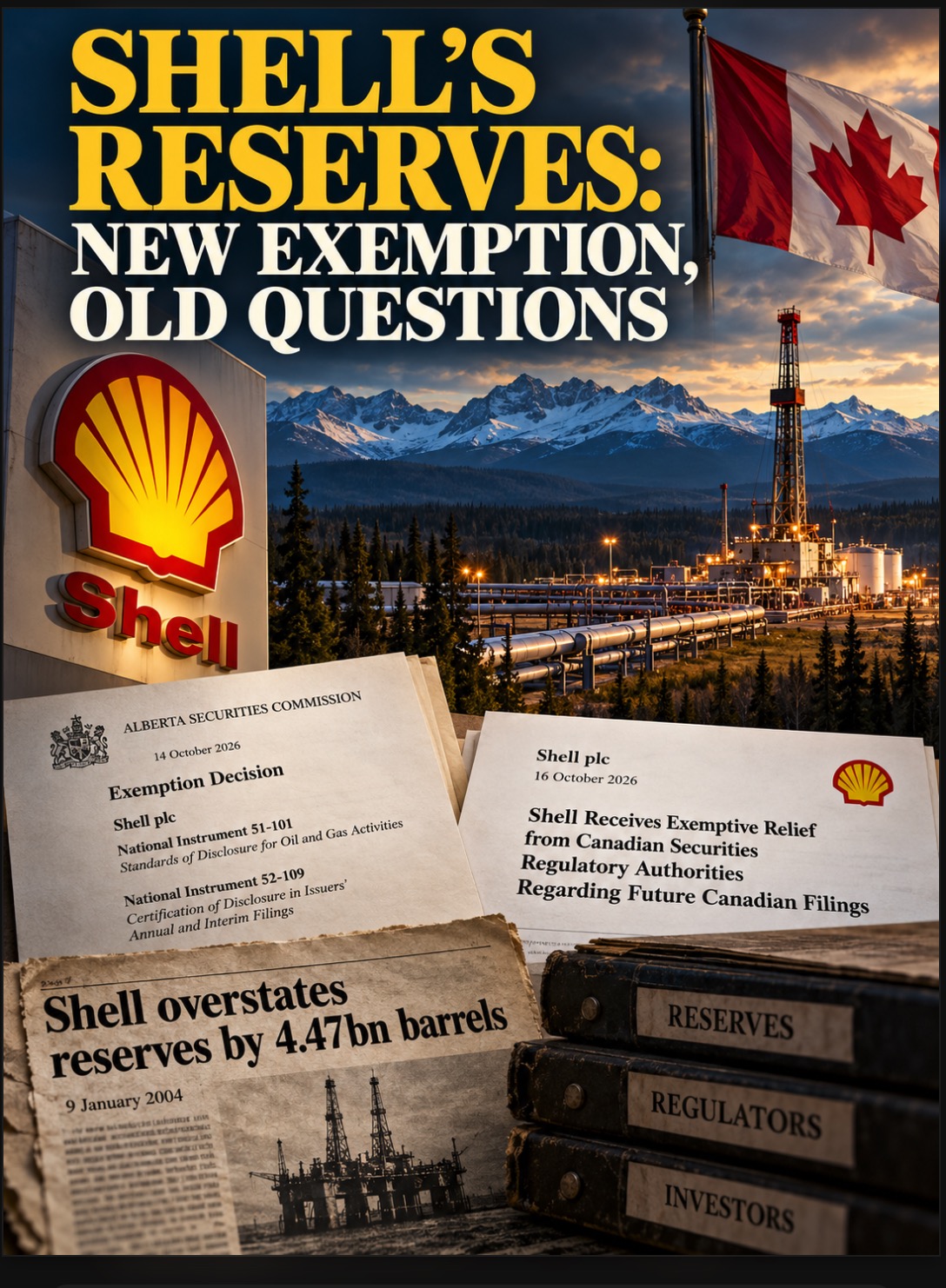
Shell has obtained permission from Canadian securities regulators to dispense with certain Canadian oil and gas reserves reporting requirements, following its multibillion-dollar acquisition of ARC Resources. Instead, the company will continue using its American securities reporting framework, subject to conditions that include filing the relevant disclosures in Canada. The decision may be a legitimate administrative accommodation for an international company already subject to extensive reporting obligations. But it also raises an important question about the information available to Canadian investors. For Shell, whose 2004 reserves scandal involved the overstatement of 4.47 billion barrels of oil equivalent, any change to reserves reporting deserves careful examination.
A regulatory announcement with a significant history
On 16 October 2026, Shell plc announced that it had received exemptive relief from Canadian securities regulatory authorities concerning future Canadian filings.
The announcement followed Shell’s acquisition of ARC Resources Ltd., completed on 2 September 2026.
That transaction made Shell a reporting issuer under Canadian securities legislation, creating additional obligations to provide ongoing financial and other disclosures.
One of those obligations concerned Canada’s National Instrument 51-101, known as Standards of Disclosure for Oil and Gas Activities.
Shell has now received permission not to comply with specified requirements under that instrument, provided it satisfies the conditions imposed by Canadian regulators.
Instead, Shell may provide oil and gas disclosures prepared under its existing American reporting framework.
The company must also make the relevant disclosures available through Canada’s SEDAR+ filing system.
Shell describes the decision as relief from overlapping regulatory requirements.
There is no suggestion in its announcement that the company has been excused from reporting its oil and gas reserves altogether.
Nor does the announcement establish that Canadian regulators have waived Shell’s broader securities-law obligations.
Nevertheless, the development is worth examining because reserves information is central to the valuation of an oil and gas company.
And in Shell’s case, the historical significance is considerable.
Original announcement: Shell receives exemptive relief from Canadian securities regulatory authorities regarding future Canadian filings — 16 October 2026
Why Shell suddenly became subject to Canadian reporting requirements
The immediate cause was Shell’s acquisition of ARC Resources, a major Canadian oil and gas producer.
ARC’s operations were concentrated in British Columbia and Alberta, including the Montney formation.
The Montney is one of Canada’s most important natural gas and liquids-producing regions.
Shell announced completion of the transaction on 2 September 2026.
According to its corporate announcement, the acquisition added approximately 370,000 barrels of oil equivalent per dayto Shell’s production portfolio.
The transaction was structured as a combination of cash and Shell shares.
Former ARC shareholders became entitled to receive CAD $8.20 in cash and 0.40247 Shell ordinary shares for each ARC share.
Shell valued the equity consideration at approximately US$13.9 billion at completion.
Including assumed net debt and leases, the enterprise value was approximately US$16.5 billion.
The acquisition was intended to strengthen Shell’s Canadian upstream business, particularly its exposure to natural gas and liquids production.
Shell’s chief executive, Wael Sawan, described the transaction as an opportunity to expand the company’s production portfolio and generate additional cash flow.
From a commercial perspective, the acquisition was substantial.
From a regulatory perspective, it also changed Shell’s position.
Because of the transaction, Shell became subject to Canadian reporting obligations that did not necessarily duplicate the requirements applicable to its existing international securities filings.
That created the basis for its application for exemptive relief.
Corporate source: Shell completes acquisition of ARC Resources — 2 September 2026
What exactly have Canadian regulators exempted Shell from?
The exemption concerns National Instrument 51-101.
This instrument establishes requirements for oil and gas disclosure by reporting issuers subject to Canadian securities law.
It addresses the reporting of reserves data and related information.
Under the normal Canadian framework, companies subject to the instrument may be required to provide annual reserves statements and associated evaluations and governance disclosures.
These include prescribed reporting forms.
Shell’s announcement specifically identifies Form 51-101F1, the Statement of Reserves Data and Other Oil and Gas Information.
It also refers to related forms and disclosure requirements.
Under the decision, Shell will no longer be required to prepare those particular Canadian filings as part of its annual reporting, provided the relevant conditions remain satisfied.
Instead, the company may use disclosures prepared in accordance with applicable American securities requirements.
Shell identified the US Securities and Exchange Commission, the Securities Act of 1933, the Securities Exchange Act of 1934, the Sarbanes-Oxley Act of 2002 and New York Stock Exchange rules among the applicable reporting framework.
That is a significant distinction.
The exemption permits substitution of an established international disclosure framework.
It does not grant a general licence to withhold reserves information.
The company’s announcement also states that the relevant American oil and gas disclosures must be filed with Canadian securities regulators through SEDAR+ as soon as practicable after they are filed with the SEC.
In short, Shell will not have to produce the same Canadian-specific reserves reporting package, but it remains required to provide the relevant American disclosures in Canada.
The question for shareholders is what differences, if any, that substitution makes to the information available.
An important additional detail: The regulator’s register refers to two instruments
The Alberta Securities Commission’s official exemption-order register records a decision concerning Shell plc dated 14 October 2026.
The entry identifies the decision as a dual decision involving two Canadian instruments:
- National Instrument 51-101 — Standards of Disclosure for Oil and Gas Activities.
- National Instrument 52-109 — Certification of Disclosure in Issuers’ Annual and Interim Filings.
This second reference deserves attention.
NI 52-109 concerns management certifications associated with financial reporting and disclosure controls.
Shell’s 16 October announcement focuses upon the oil and gas reserves reporting relief.
It does not provide the same detailed explanation of the NI 52-109 reference appearing in the regulator’s register.
Consequently, it would be premature to conclude that Shell has received any particular additional certification exemption without examining the operative decision and its conditions.
The register establishes that the second instrument is associated with the decision.
It does not, by itself, establish the precise scope of the relief under that instrument.
This is a matter that merits further documentary examination.
It also illustrates why the original regulator’s order is important.
Corporate announcements explain decisions from the company’s perspective.
The formal regulatory instrument establishes exactly what the authorities have authorised.
Canadian and American reserves reporting are not identical
Canada and the United States have well-developed systems for reporting oil and gas reserves.
Both are designed to provide useful information to investors.
However, their requirements are not identical.
Canada’s NI 51-101 framework is associated with the Canadian Oil and Gas Evaluation Handbook.
It provides a prescribed structure for reporting reserves and related oil and gas information.
Canadian disclosure commonly includes proved and probable reserves categories, as well as associated economic evaluations, subject to the applicable requirements.
The Canadian framework also places particular emphasis upon qualified reserves evaluators or auditors and management responsibilities for the reported information.
The SEC has its own definitions and disclosure rules.
Its mandatory proved reserves reporting framework includes specific requirements concerning reasonable certainty, economic producibility, pricing assumptions and other technical matters.
The SEC also permits or requires additional information in particular circumstances.
As a result, two companies with similar underlying assets might present reserves information differently depending upon the regulatory framework used.
This does not automatically make one framework more reliable than the other.
Nor does it mean that an SEC-reporting company necessarily supplies less information overall.
The issue is comparability.
For Canadian investors accustomed to NI 51-101 disclosures, the substitution of SEC reporting may alter the format, categories or assumptions used in the information they receive.
Investors must therefore understand the standards applied rather than simply comparing headline reserves figures.
For a company as large and geographically diversified as Shell, using a consistent international reporting framework may also avoid unnecessary duplication and conflicting presentations.
There is a legitimate administrative rationale for that approach.
The appropriate question is whether investors continue to receive sufficient, comprehensible and reliable information.
The historical shadow: Shell’s 2004 reserves scandal
Any discussion of Shell and reserves reporting inevitably recalls the events of 2004.
On 9 January 2004, the Royal Dutch/Shell Group announced that approximately 3.9 billion barrels of oil equivalent previously classified as proved reserves would have to be removed from that category.
Further reviews increased the amount.
By the completion of the regulatory process, the overstatement amounted to 4.47 billion barrels of oil equivalent.
That represented approximately 23 per cent of the proved reserves reported in Shell’s 2002 Form 20-F.
The disclosure caused an international corporate crisis.
Investors learned that Shell had previously overstated a fundamental indicator of its future production potential.
Senior management changes followed.
The company undertook extensive reviews of its reserves reporting procedures.
Regulators in the United States and the United Kingdom investigated.
The affair became one of the most serious corporate governance controversies in Shell’s modern history.
What the SEC actually found
On 24 August 2004, the US Securities and Exchange Commission announced settlement of enforcement proceedings involving Royal Dutch Petroleum Company and The Shell Transport and Trading Company.
The SEC’s findings were extensive.
According to the Commission, Shell had overstated proved hydrocarbon reserves in its 2002 Form 20-F by approximately 4.47 billion barrels of oil equivalent.
The SEC also found that Shell had overstated the standardised measure of future cash flows associated with the reserves by approximately $6.6 billion.
The regulator examined the company’s reserves reporting over several years.
It found deficiencies in internal controls and reporting procedures.
The SEC also addressed Shell’s reserves replacement ratio, a performance indicator closely watched by energy-sector investors.
The regulator concluded that the misstatements had created an inaccurate picture of Shell’s reserves replacement performance.
The financial consequences included a $120 million US civil penalty.
The companies settled without admitting or denying the SEC’s substantive findings.
Shell also undertook additional compliance measures.
The regulatory record is particularly important because it is not merely retrospective criticism from opponents of the company.
It is an authenticated enforcement record issued by the American securities regulator.
Primary historical source: US Securities and Exchange Commission — Royal Dutch Petroleum Company and Shell Transport Pay $120 Million to Settle Reserves Fraud Case, 24 August 2004
A second regulator also intervened
The UK Financial Services Authority also took enforcement action over Shell’s reserves reporting.
The British regulator imposed a substantial financial penalty and criticised the company’s disclosure practices.
The combined regulatory proceedings exposed weaknesses in the governance of a multinational oil company operating through an unusually complicated corporate structure.
The events contributed to fundamental changes in Shell’s organisation and management.
In 2005, the former dual-parent Royal Dutch/Shell structure was replaced by Royal Dutch Shell plc.
The 2004 reserves scandal was not the sole cause of that restructuring.
But it was a central part of the corporate governance crisis that preceded it.
For shareholders, the scandal illustrated a fundamental principle.
Reserves disclosure is not simply a technical exercise performed by petroleum engineers. It is a central component of corporate financial accountability.
Why reserves matter so much
An oil company’s reported reserves influence how investors assess its future.
They help inform expectations concerning production, revenues, cash flow and the economic life of assets.
Reserves reporting also affects assessments of whether a company is replacing the oil and gas it produces.
A company may report substantial current profits while facing long-term difficulties if it cannot replace depleted reserves economically.
That makes the distinction between discovered resources, contingent resources and proved reserves especially important.
Not every quantity of hydrocarbons believed to exist underground qualifies as proved reserves.
Classification depends upon technical, economic and regulatory criteria.
Prices, development plans, production rights and other assumptions can affect reported quantities.
When those estimates are materially misstated, investors may receive an inaccurate impression of the company’s future prospects.
That was one of the central lessons of Shell’s 2004 crisis.
COMMENTARY: An Administrative Exemption — But a Legitimate Shareholder Question
It would be wrong to portray the Canadian decision as evidence that Shell is concealing reserves information.
The available documents do not support that allegation.
There is also a straightforward argument in favour of the exemption.
Shell is an international company already subject to substantial securities reporting requirements.
Producing an additional Canadian reserves reporting package could impose costs without necessarily providing equivalent additional value.
Canadian regulators are entitled to consider whether an alternative disclosure framework provides adequate investor protection.
That appears to be the purpose of the arrangement Shell has announced.
However, shareholders also have legitimate reasons to examine what changes.
The relevant questions are practical.
Does the SEC framework provide all the categories of reserves information that Canadian investors would otherwise have received?
Are the valuation assumptions comparable?
Will reserve estimates relating to the newly acquired ARC assets be sufficiently transparent?
Are independent technical assessments required or disclosed to the same extent?
Will Canadian investors be able to locate and understand the relevant information without navigating several international reporting systems?
And what conditions must Shell continue satisfying to retain the exemption?
These questions do not imply wrongdoing.
They concern the effectiveness of disclosure.
The 2004 scandal is relevant history, not evidence of present misconduct
The temptation to connect Shell’s 2004 scandal directly with today’s exemption must be resisted.
The historical scandal involved material overstatements and regulatory findings concerning disclosure failures.
The present decision concerns permission to substitute one reporting framework for another.
They are not equivalent events.
No evidence examined for this article establishes that Shell’s current reserves are misstated.
No evidence establishes that the Canadian regulators have granted the exemption because of any improper influence.
No evidence establishes that Shell sought the exemption to conceal information from shareholders.
The historical connection is relevant because it demonstrates why accurate reserves reporting matters.
It does not justify treating the present regulatory decision as suspicious by default.
A credible independent archive must preserve that distinction.
The significance of the ARC acquisition
The scale of Shell’s acquisition of ARC Resources makes the issue commercially important.
The transaction added substantial production from Canadian assets.
It increased Shell’s exposure to North American gas and liquids.
It also brought former ARC shareholders into Shell’s shareholder base.
Those investors may have been accustomed to examining ARC’s disclosures under Canadian securities rules.
They will now need to assess Shell’s disclosures within a much larger international reporting framework.
The acquired Canadian assets will form part of Shell’s global portfolio.
Consequently, information previously available in a dedicated Canadian producer’s reporting may appear in a different structure or level of aggregation.
This does not necessarily mean investors will receive less reliable information.
But it makes the accessibility and comparability of information particularly important.
Shell’s decision to continue filing the relevant American disclosures through SEDAR+ is therefore an important protection.
The practical value of that protection will depend upon what information is actually provided and how readily investors can interpret it.
A question for Canadian regulators
The Alberta Securities Commission has publicly identified the exemption decision.
Shell has announced its principal effect.
The remaining task is to examine the complete decision and determine the exact conditions attached.
That examination should clarify the scope of relief under NI 51-101.
It should also establish the meaning of the NI 52-109 reference appearing in the regulator’s register.
The difference between a regulator’s formal decision and a company’s summary of that decision should not be overlooked.
For shareholders, the operative document matters.
It is the document that defines what Shell may do, what obligations continue and what circumstances could affect the exemption.
There is no indication that the authorities acted improperly.
The relevant question is whether the regulatory arrangement provides sufficiently clear and comparable disclosure for investors in Canada and elsewhere.
That is a legitimate subject for independent examination.
Conclusion: A Twenty-Two-Year Reminder of Why Reserves Transparency Matters
Shell’s Canadian exemption appears to arise from an identifiable administrative problem.
The company acquired a major Canadian oil and gas producer.
That acquisition created additional Canadian reporting obligations.
Shell applied for relief from certain requirements that overlap with its existing American reporting framework.
Canadian regulators granted the requested relief, subject to conditions.
The company must continue to provide relevant disclosures through SEDAR+.
On the available evidence, this is a reporting accommodation, not an exemption from securities accountability.
Nevertheless, it deserves attention.
Oil and gas reserves are central to the financial evaluation of energy companies.
Different reporting systems can produce different presentations of technically complex information.
And Shell has a documented history demonstrating the potentially serious consequences of inaccurate reserves disclosures.
In 2004, the SEC found that Shell had overstated proved reserves by 4.47 billion barrels of oil equivalent.
The resulting scandal damaged investor confidence and led to major regulatory penalties.
Twenty-two years later, that history remains relevant to the importance of rigorous and transparent reserves reporting.
It does not establish that anything improper has occurred in Canada.
But it does justify a continuing interest in how Shell reports the reserves underlying its substantial international operations.
The Canadian authorities have granted Shell regulatory flexibility. The essential shareholder question is whether the resulting disclosures will continue to provide investors with clear, reliable and comparable information.
That is the standard against which the exemption should ultimately be assessed.
Principal Documentary Sources
1. Shell plc — 16 October 2026
The original company announcement identifying the relief from NI 51-101 requirements and the continuing requirement to file relevant US disclosures on SEDAR+.
2. Alberta Securities Commission — 14 October 2026
Official Exemption Orders Register
Primary regulator’s register identifying Shell’s decision and the references to NI 51-101 and NI 52-109. The complete operative decision should be consulted for the detailed conditions.
3. Shell plc — 2 September 2026
Shell Completes Acquisition of ARC Resources
Authenticated corporate announcement confirming the transaction, production volumes and acquisition consideration.
4. ARC Resources — 2 September 2026
ARC Resources Announces Closing of Acquisition by Shell plc
Independent corporate confirmation of the acquisition structure and completion.
5. US Securities and Exchange Commission — 24 August 2004
SEC Enforcement Announcement Concerning Shell’s Overstatement of Proved Reserves
Authenticated regulatory record establishing the 4.47 billion barrels of oil equivalent overstatement, deficiencies identified by the SEC and the $120 million penalty.
6. US Securities and Exchange Commission — Litigation Release No. 18844
Royal Dutch Petroleum Company and Shell Transport — SEC Litigation Release
Formal litigation record describing the settlement, applicable findings and additional compliance measures.
7. Shell — Historical Corporate Disclosure
Shell’s 2004 Reserves Review and Corporate Governance Measures — SEC-Filed Announcement
Contemporaneous company material documenting reserves reviews, management changes and remedial measures.
Editorial and Legal Disclaimer
This article is based upon Shell’s 16 October 2026 announcement, the Alberta Securities Commission’s public register, corporate acquisition records and authenticated historical SEC enforcement documents.
The Canadian exemption is an established regulatory decision. Its detailed conditions should be understood by reference to the complete operative document.
The regulator’s register identifies NI 52-109 alongside NI 51-101. The precise significance of the additional reference has not been independently established from the full decision.
The historical 2004 reserves scandal is presented as documented corporate history, not as evidence of present misconduct.
No allegation is made that Shell’s current reserves disclosures are false, misleading or incomplete, or that Canadian regulators acted improperly.
Editorial analysis is identified separately from established facts.
The website’s general disclaimer also applies.








