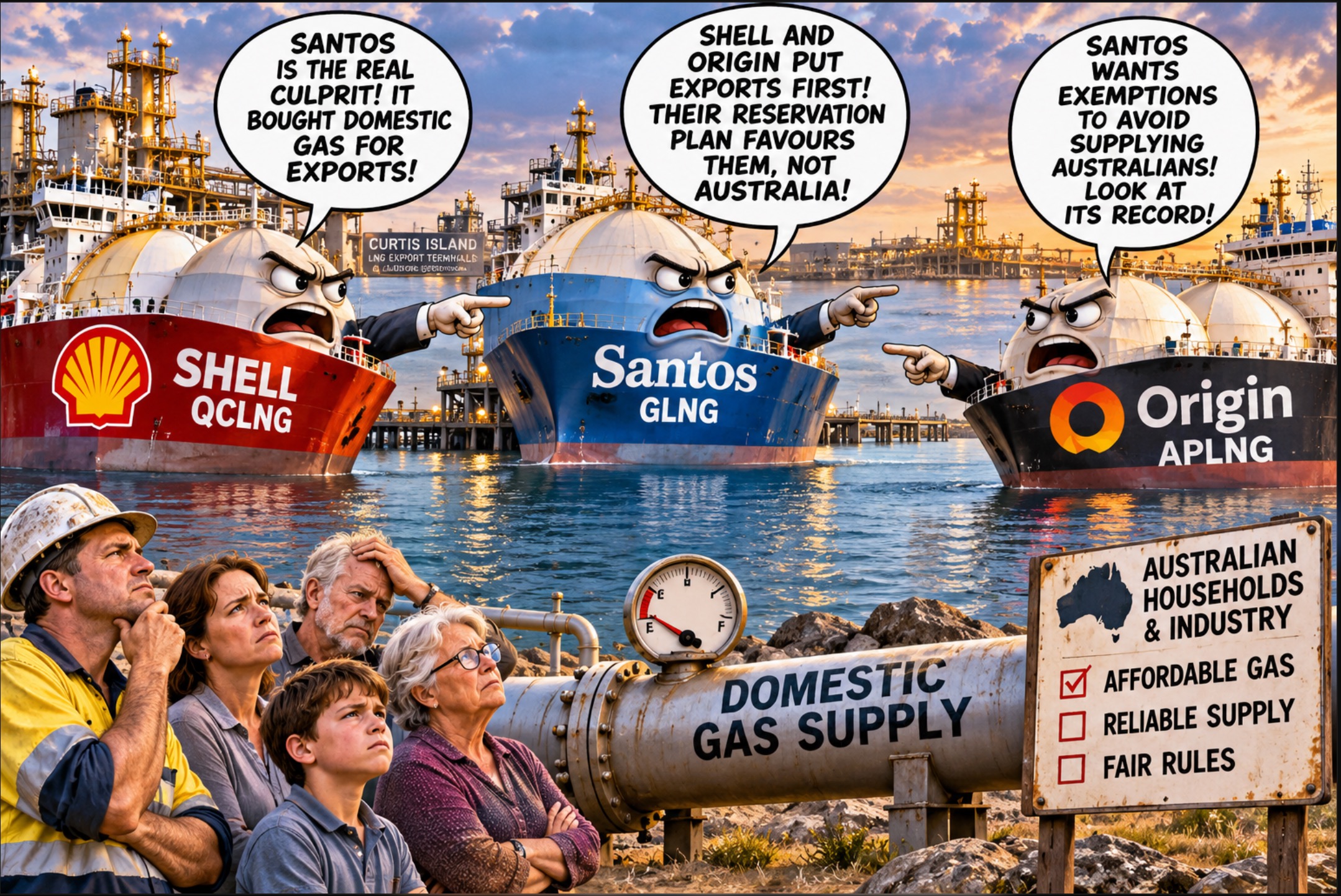
 Australia’s gas giants turn on one another over domestic supply, export profits and who should pay for the government’s proposed gas reservation scheme. Behind the corporate accusations lies a more uncomfortable question: why should a major gas-exporting nation struggle to guarantee affordable gas for its own citizens?
5 November 2026
By the Donovan–Shell Archive
There is something wonderfully revealing about the spectacle unfolding in Australia’s liquefied natural gas industry.
Three enormous gas-exporting businesses are arguing over who should be obliged to supply Australian customers.
Not whether Australia possesses sufficient gas resources.
Not whether overseas customers will continue receiving enormous shipments of LNG.
But which company should shoulder the financial consequences of ensuring Australians can buy some of their own country’s gas.
The latest confrontation involves Santos, Shell and Origin Energy.
According to a report published by The Australian on 4 November 2026, Santos has accused its competitors of promoting a regulatory arrangement that would favour their existing operations while imposing disproportionate obligations on Santos’s Gladstone LNG project.
The accusation is serious.
It is also extraordinarily ironic.
Because independent reporting by ABC Australia has previously identified Santos’s own LNG operation as a major contributor to the very domestic gas-market problems the proposed regulations are intended to address.
The result is a corporate argument in which everyone claims to be defending Australia’s interests.
And everyone, naturally, would prefer somebody else to pay.
The latest accusation: Santos turns on Shell and Origin
The dispute centres on three LNG export developments on Curtis Island, near Gladstone in Queensland.
Shell operates Queensland Curtis LNG (QCLNG).
Australia Pacific LNG (APLNG) is associated with Origin Energy and ConocoPhillips.
Gladstone LNG (GLNG) is operated by Santos.
All three projects export Australian gas to international customers.
Their commercial positions, however, are significantly different.
According to The Australian, Santos objects to proposals supported by QCLNG and APLNG that would recognise exporters’ existing contributions to domestic gas supplies when calculating new reservation obligations.
Santos argues that this approach could allow its competitors to satisfy regulatory requirements using gas they already supply to Australian customers.
GLNG, by contrast, could be required to find additional domestic gas while continuing to honour overseas LNG contracts.
Santos considers that unfair.
Its competitors might reasonably respond that the greater unfairness would be to disregard their previous contributions while allowing an exporter that historically purchased domestic gas for export to escape additional obligations.
Welcome to the Australian LNG industry’s interpretation of burden-sharing.
Santos’s allegations about Shell’s exports
The November report contains allegations that deserve careful examination.
Santos claims that uncontracted spot LNG exports by QCLNG and APLNG increased from approximately 75 petajoules in 2021 to 122 petajoules in 2024.
That would represent an increase of approximately 63%.
Santos also alleges that domestic gas supplies from those projects declined over the period.
Separately, it accuses its competitors of seeking domestic gas margins of between 300% and 500%, linked to international LNG pricing.
These are substantial claims.
However, the figures are presented here as allegations attributed to Santos. They should not be treated as independently verified findings.
The distinction between contracted exports, spot sales, gross domestic deliveries and net domestic supply is essential.
A company might increase spot exports while remaining a net supplier to the domestic market.
Similarly, a claim about unusually high margins requires scrutiny of the underlying price, production costs, transport costs and contractual terms.
Without those details, it would be premature to conclude that Shell or Origin engaged in improper pricing.
Nevertheless, the allegations deserve examination.
Australian consumers have a legitimate interest in knowing whether gas producers are prioritising export opportunities when domestic buyers face high prices.
And Shell should not escape scrutiny simply because Santos has its own uncomfortable history.
The Santos glasshouse
The strongest reason to investigate Santos’s latest accusations is the extensive independent reporting already available.
On 8 September 2026, ABC Australia published an investigation examining the role of Queensland’s LNG exporters in Australia’s domestic gas problems.
Its findings were particularly damaging to the position advanced by Santos.
The report explained that GLNG had been developed with substantial LNG export capacity but insufficient dedicated gas reserves to meet all its export commitments.
Consequently, GLNG historically purchased gas from Australia’s domestic market to fulfil overseas contracts.
Energy analyst Saul Kavonic estimated that the volumes involved over the preceding decade were equivalent to approximately 20% of eastern Australia’s domestic gas demand.
That is an extraordinary comparison.
It does not mean Santos literally removed one-fifth of all domestic gas in every year, but it illustrates the cumulative scale of GLNG’s reliance on third-party supplies.
The ABC contrasted GLNG’s position with QCLNG and APLNG, which had predominantly been net suppliers to Australia’s domestic market.
In other words, Shell and Origin’s projects had historically contributed gas to domestic customers on a net basis.
Santos’s GLNG project had historically depended on acquiring gas from that market.
This is a material distinction.
It would be neither accurate nor fair to overlook it.
Shell deserves credit where the evidence supports it
This archive has documented Shell’s environmental controversies, fossil-fuel expansion, litigation and corporate conduct for decades.
But criticism should never become a substitute for evidence.
On this particular issue, Shell’s historical record appears more favourable than Santos’s.
The ABC investigation reported that QCLNG and APLNG had overwhelmingly been net domestic gas suppliers.
That does not establish that every Shell pricing decision was reasonable.
It does not answer Santos’s allegations about recent spot exports.
And it does not demonstrate that Shell’s preferred reservation model would necessarily produce the best outcome for Australian consumers.
But it does mean Shell has a legitimate basis for arguing that previous domestic contributions should be considered when designing future obligations.
A company that has already supplied substantial quantities of gas domestically may reasonably question a system that treats it identically to an exporter that historically drew gas out of the domestic market.
The difficulty is designing rules that recognise genuine contributions without allowing companies to claim credit for supplies that would have reached domestic customers anyway.
That is where the regulatory argument becomes particularly important.
How Australia reached this extraordinary position
The origins of the dispute lie in the rapid expansion of LNG exports from eastern Australia.
During the previous decade, enormous investments transformed Queensland’s coal-seam gas industry.
Three LNG export developments were constructed on Curtis Island.
They connected eastern Australian gas resources to international energy markets, particularly in Asia.
The projects promised investment, employment, export earnings and economic growth.
But the development of a major LNG export industry also exposed domestic customers to competition from overseas buyers.
Gas that might previously have been sold into the Australian market could now be exported.
In principle, increased production could satisfy both markets.
In practice, the availability, location, price and contractual commitments associated with gas supplies created significant complications.
GLNG’s dependence on third-party domestic supplies became a particularly contentious feature of this system.
ABC reporting has also examined historical transactions through which gas originally associated with domestic supply arrangements ultimately supported exports.
For Australian manufacturers requiring reliable gas at internationally competitive prices, these developments were hardly academic.
Higher gas prices can affect production costs, investment decisions and employment.
Households are affected directly through energy bills and indirectly through the cost of goods and services.
The basic policy question is therefore straightforward.
How can Australia remain a major LNG exporter while ensuring sufficient gas is available to domestic users on reasonable terms?
The answer has proved considerably less straightforward.
Canberra’s proposed solution: reserve gas for Australians
The Albanese government announced a national domestic gas reservation policy in December 2025.
After consultation and revisions during 2026, the government introduced legislation intended to require LNG exporters to contribute gas to the domestic market.
The current framework provides for domestic supply obligations of up to 20% of annual LNG export volumes.
The scheme is scheduled to commence in 2027, with supply obligations beginning on 1 January 2028.
Importantly, the legislation includes provisions allowing obligations to be adjusted to account for existing export contracts and infrastructure constraints.
The government argues that the scheme will improve domestic supply security and place downward pressure on gas prices.
Those outcomes remain policy objectives, not established results.
The details matter enormously.
A reservation requirement that produces genuinely additional domestic supply could improve market conditions.
A scheme that permits exporters merely to reclassify existing supplies, purchase domestic producers or exploit contractual exemptions might achieve considerably less.
The question is not simply whether 20% sounds like a reassuring number.
It is whether the legislation will change the actual quantity of gas available to Australian customers.
The battle over exemptions
Santos has advocated protections for existing export contracts and changes to the proposed regulatory obligations.
According to the November reporting, its preferred approach includes recognition of contracts predating the government’s December 2025 announcement, greater flexibility over commercial terms, and circumstances in which reservation requirements could be reduced or suspended.
Some of these arguments raise legitimate concerns.
Long-term LNG contracts involve substantial financial commitments.
Abrupt regulatory changes can create commercial uncertainty and potentially affect investment.
Australia also has an interest in maintaining reliable relationships with international trading partners.
But there is another side.
If existing contracts, contractual extensions and other exemptions are defined too broadly, the companies most responsible for domestic supply pressures could face relatively limited obligations.
ABC investigations published in October examined precisely this possibility.
Analysts warned that aspects of the proposed scheme might permit exporters to reduce their exposure through contractual arrangements, acquisitions or accounting mechanisms without necessarily increasing physical gas deliveries.
These are concerns about potential loopholes, not findings that Santos has unlawfully exploited them.
Nevertheless, they deserve serious attention before the legislation is finalised.
A reservation scheme that rewards clever paperwork more generously than additional domestic supply would be a remarkable achievement in regulatory futility.
The industry’s favourite argument: investment will suffer
The gas industry has repeatedly warned that intervention could discourage investment.
That argument should not be dismissed automatically.
Gas developments require substantial capital, long planning periods and confidence in regulatory stability.
Poorly designed obligations could make marginal projects less attractive.
But investment arguments also require context.
A country’s natural resources are not simply an unrestricted entitlement for exporters.
Governments have legitimate responsibilities to domestic consumers, industrial competitiveness and energy security.
The relevant policy challenge is to balance those interests.
Santos’s warnings about investment should therefore be considered alongside its own commercial incentives.
Shell and Origin’s proposals should receive the same treatment.
No company becomes a disinterested public-policy expert merely by submitting a consultation response.
And no proposal should be accepted simply because its supporters describe it as market-efficient.
The decisive question is whether the resulting framework delivers more gas to Australian users at prices that support households and industry.
What about Shell’s shareholders?
Shell’s major institutional investors include global asset managers such as BlackRock and Vanguard, whose funds have substantial interests in large international energy companies.
Such investors have an obvious interest in disciplined capital allocation, regulatory predictability and sustainable financial returns.
But the long-term interests of shareholders are not necessarily served by every opportunity to maximise export revenues.
Prolonged disputes with governments, public dissatisfaction over energy prices and increasingly restrictive regulation can create significant commercial risks.
A transparent and workable domestic gas framework may offer greater long-term stability than repeated confrontations over supply obligations.
For Shell, the challenge is to demonstrate that its Australian operations can deliver competitive returns while maintaining constructive relationships with the country supplying the resource.
That is not an unreasonable expectation.
It is the ordinary price of operating a major energy business.
The environmental contradiction nobody should overlook
There is another dimension to this argument.
All three companies are debating how natural gas should be allocated between domestic consumption and overseas exports.
Yet LNG remains a fossil fuel.
Its production, processing, liquefaction, transportation and combustion generate greenhouse-gas emissions.
Methane leakage can add materially to the climate impact.
The industry’s argument that gas can support energy security and replace higher-emitting fuels in certain circumstances does not eliminate those emissions.
Nor should a domestic gas reservation scheme be mistaken for an energy-transition strategy.
The immediate policy objective is to ensure sufficient affordable gas for existing users.
That may be important for industries that cannot readily electrify.
But Australia’s longer-term climate and energy objectives also require reducing dependence on fossil fuels where practical.
Shell’s continued commitment to LNG expansion therefore remains relevant to any broader assessment of its environmental record.
The current dispute illustrates how difficult it can be to reconcile export-led fossil-fuel growth, domestic energy affordability and climate commitments.
A dispute in which everyone has something to lose
The November confrontation is unusual because it exposes divisions within an industry that often presents a united front against government intervention.
Shell and Origin have reasons to seek recognition for their historical domestic gas contributions.
Santos has reasons to resist obligations that could increase its costs or complicate existing export arrangements.
The government wants to improve domestic supply without undermining export earnings and investment.
Consumers want affordable energy.
Manufacturers want reliable contracts and predictable prices.
And environmental advocates want a credible pathway away from continued fossil-fuel dependence.
These interests overlap in some respects and conflict sharply in others.
The most important task for policymakers is to ensure that the eventual rules reward genuinely additional domestic supply rather than the most effective corporate lobbying.
That will require transparency about export volumes, domestic deliveries, contractual exemptions and the basis on which individual obligations are adjusted.
Without such transparency, the public may struggle to establish whether the scheme has achieved its purpose.
Conclusion: the gas industry’s remarkable circular firing squad
Santos accuses Shell and Origin of putting exports first.
Shell and Origin can point to their historical contributions to Australia’s domestic market.
Independent analysts have questioned whether Santos’s own LNG development helped create the supply pressures now requiring government intervention.
Meanwhile, the industry warns that imposing new obligations could discourage investment.
Each argument contains issues worth examining.
None should be accepted uncritically.
The ultimate irony is that a country blessed with enormous gas resources has reached a position in which its major exporters are fighting over responsibility for supplying domestic customers.
It is an impressive achievement.
Not necessarily one to celebrate.
For Shell, this particular controversy does not justify automatic condemnation.
Its historical domestic supply record deserves recognition.
But that recognition should not become a blank cheque for its preferred regulatory arrangements or prevent scrutiny of its current export and pricing practices.
For Santos, the challenge is more uncomfortable.
Before accusing competitors of pursuing an export agenda, it must contend with independent evidence concerning GLNG’s longstanding reliance on domestic gas purchases to fulfil overseas commitments.
And for Australia’s government, the challenge is to produce a scheme that changes actual supply rather than merely redistributing obligations on paper.
Australia’s households and manufacturers do not need another competition in corporate finger-pointing. They need gas they can actually obtain at reasonable prices.
The LNG industry has become remarkably accomplished at exporting Australia’s natural resources.
Perhaps its next great technological breakthrough will be ensuring Australians can afford some of them.
A fictional conversation: Sir Henri Deterding and John Donovan
The following is an imaginary satirical exchange. Sir Henri Deterding died in 1939. No dialogue is presented as an authentic historical quotation.
SIR HENRI DETERDING: Donovan! I am informed that Shell is being accused of exporting too much gas.
JOHN DONOVAN: By Santos, Sir Henri.
DETERDING: Santos? Another oil and gas company?
DONOVAN: Indeed. One that has itself been criticised for buying Australian domestic gas to fulfil export commitments.
DETERDING: Ach! So the exporter accuses the other exporters of exporting?
DONOVAN: That is a reasonable summary.
DETERDING: Mein Gott. In my day we called this commerce. Today, apparently, it is a parliamentary inquiry.
DONOVAN: The Australian government wants exporters to reserve gas for domestic customers.
DETERDING: Sensible. A nation should not have to beg foreign customers to return its own resources.
DONOVAN: The companies are arguing over exemptions.
DETERDING: Naturally. Every industrialist supports regulation, provided it regulates somebody else.
DONOVAN: Shell may actually have the better historical domestic supply record in this particular dispute.
DETERDING: You are defending Shell, Donovan?
DONOVAN: Where the evidence warrants it.
DETERDING: Ach. Most irritating. I had hoped you were reliably unreasonable.
DONOVAN: I leave that to the corporate lobbyists.
DETERDING: Ja. Then perhaps there is hope for you yet.
Principal sources
The Australian, 4 November 2026: Santos accuses Shell and Origin Energy of pushing export agenda through gas reservation advocacy — subscription may be required.
ABC News, 8 September 2026: Gas crisis divides industry amid claims culprit getting away ‘scot-free’
ABC News, 12 October 2026: Critics say ‘Santos-sized loopholes’ will make gas reservation a joke
ABC News, 27 October 2026: Warnings gas culprit Santos could slip through reservation net
Australian Government, updated 30 October 2026: Gas Market Review and reforms
Australian Government, 10 September 2026: Securing more affordable gas for Australians
Editorial note and disclaimer
This article is independent journalism, analysis, opinion and satire based on publicly available reporting and government documentation as of 5 November 2026. It is not financial or investment advice.
Allegations attributed to Santos concerning Shell, Origin Energy, LNG export volumes and pricing margins are reported as allegations, not established findings. Independent reporting concerning GLNG’s historical domestic gas purchases is distinguished from claims of unlawful conduct. No such unlawful conduct is alleged here.
The fictional dialogue involving Sir Henri Deterding and John Donovan is entirely imaginary and intended solely as satire.
The article was prepared with AI-assisted research and drafting. The cited reporting and government material provide the factual basis; no claim is made that the full paywalled article was independently inspected.
Readers should consult the original sources and relevant company disclosures when assessing disputed commercial or regulatory claims.
The central factual distinction is supported by ABC’s independent investigation: GLNG historically relied on domestic gas purchases for export, whereas QCLNG and APLNG were predominantly net domestic suppliers. The government’s current framework specifies obligations beginning on 1 January 2028.
*This website and sisters royaldutchshellgroup.com, shellnazihistory.com, royaldutchshell.website, johndonovan.website, shellnews.net, and shellwikipedia.com, are owned by John Donovan - more information here. There is also a Wikipedia segment, the Shell DPA Files, "Shell and the Spies", the Shell Leaks files, the Independent Shell Archive, as well as books written and published by John Donovan - Kindle eBooks. Timeline of the Donovan Shell Feud. Toxic History of Royal Dutch Shell Group. Shell and the Donovans: The Full Media Record — 550+ Articles, 110 Books, 40 Years. *All conjured up by internet wizz, Nick Gill.







