AN INDEPENDENT DOCUMENTARY INVESTIGATION
By the Donovan–Shell Archive
5 November 2026
Researched and drafted with assistance from ChatGPT, using authenticated corporate statements, European Bank for Reconstruction and Development project disclosures, European Union regulatory documents and contemporaneous reporting.
Shell has signed an agreement giving it exclusive rights to purchase substantial quantities of sustainable aviation fuel from a proposed Moroccan refinery. The announcement supports the company’s ambition to become a major supplier of lower-carbon aviation fuels. But an examination of previously published development-bank records reveals a more complicated picture. The $239 million facility is not yet operating. Its proposed financing remains under review, environmental assessments are continuing, and its planned start-up is almost two years away. The agreement also comes just fourteen months after Shell abandoned construction of its own much larger biofuels plant in Rotterdam. Together, the documents reveal an important evolution in Shell’s lower-carbon strategy: securing future supplies through commercial agreements while other companies develop and finance the production facilities.
Introduction: The agreement behind the announcement
On 2 November 2026, Shell announced a long-term agreement to purchase sustainable aviation fuel from a proposed production facility in Morocco.
The agreement involves Shell Trading Rotterdam B.V., a subsidiary of Shell plc, and Green Sky Manara LLC, part of the Green Sky Capital group.
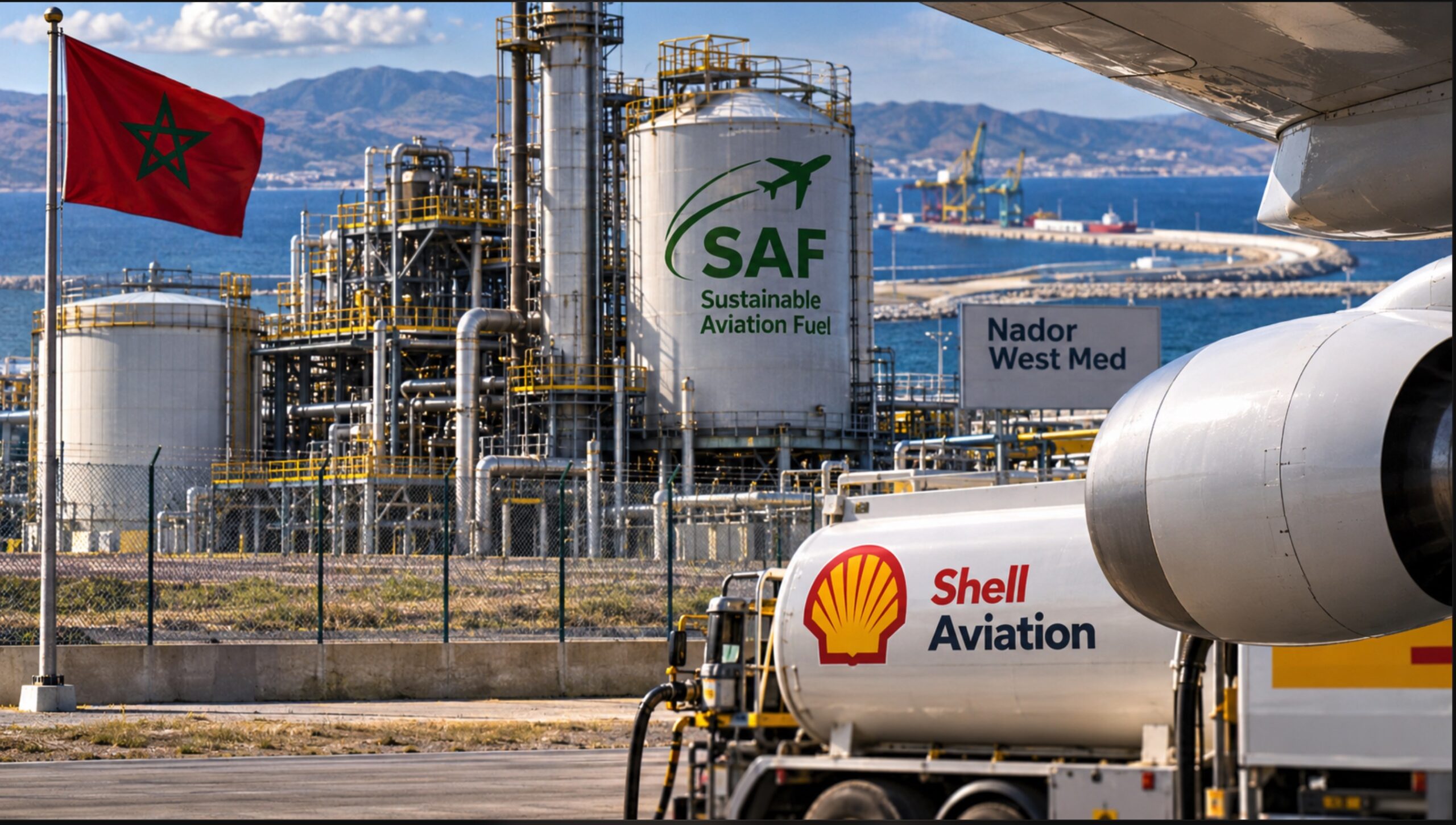
The proposed facility will be located at Port Nador, within the Nador West Med industrial and logistics development on Morocco’s Mediterranean coast.
Shell will hold exclusive purchasing rights covering approximately 150,000 tonnes annually of sustainable aviation fuel, commonly known as SAF, or an equivalent volume of hydrotreated vegetable oil used as renewable diesel.
The agreement also covers associated products, including bionaphtha and biopropane.
The plant is expected to begin operations in October 2028.
Shell Aviation confirmed these arrangements in its official corporate communications.
The company described the agreement as another step towards building international supply chains for lower-carbon aviation fuels.
For Shell, it represents access to potential future production without announcing construction of a new refinery of its own.
For Morocco, the project offers the prospect of developing a new export industry associated with aviation’s energy transition.
But the announcement requires careful interpretation.
Shell has secured contractual purchasing rights to future production. It has not announced that the facility is completed, that production has begun or that all financing arrangements have been finalised.
That distinction becomes particularly important when examining the project’s underlying financial documents.
Primary source: Shell Aviation — Official Corporate Announcement, November 2026.
Contemporaneous report: Morocco World News — Shell Secures Long-Term Supply Deal for Green Fuel Project at Nador West Med, 2 November 2026. LinkedIn
1. The development bank’s records tell a larger story
The European Bank for Reconstruction and Development has published a project summary containing substantial additional information.
The project is identified as:
SAF Project Manara Morocco
EBRD Project No. 57785
The record was first disclosed on 14 October 2026 and last updated on 29 October 2026.
It identifies the proposed project’s total cost as:
US$239 million.
The bank describes a facility capable of producing up to 200,000 tonnes of sustainable aviation fuel annually.
That figure is higher than the approximately 150,000 tonnes referred to in Shell’s purchasing agreement.
The difference does not necessarily indicate an inconsistency.
A plant may have a stated maximum production capacity while its principal customer contracts for a different annual quantity.
Furthermore, the facilities are designed to produce several types of renewable fuel, so the eventual product mix could affect the quantities available.
What matters is that the figures describe different aspects of the proposed development.
The 200,000-tonne figure is the bank’s stated design capacity.
The approximately 150,000-tonne figure concerns Shell’s announced purchasing rights.
Neither establishes actual production.
The bank also provides information about the proposed project’s financing, ownership, technology, employment arrangements and environmental assessment.
These details make the record particularly valuable.
They allow the announcement to be examined as an industrial development rather than merely as an expression of corporate environmental ambition.
Primary source: European Bank for Reconstruction and Development — SAF Project Manara Morocco, Project No. 57785. EBRD
2. Up to $135 million in proposed development-bank lending
The EBRD describes a proposed senior secured loan of up to $135 million.
The contemplated financing comprises two elements.
The first is an $85 million tranche described in the proposed loan structure as committed.
The second is a further $50 million uncommitted tranche.
Together, these represent a potential financing package of $135 million.
There is an important distinction between the terminology used to describe the proposed loan structure and the project’s present financing status.
The EBRD’s project record continues to classify the transaction as exploratory and pending concept review.
It would therefore be incorrect to describe the entire $135 million as a completed, approved and disbursed loan.
The bank’s financial summary separately identifies $85 million.
That figure corresponds to the proposed initial tranche.
The additional $50 million remains uncommitted within the financing structure.
The project record identifies 2 December 2026 as the anticipated approval date.
As of 5 November 2026, that date remains in the future.
The proposed financing has therefore not reached the final approval milestone indicated in the bank’s published timetable.
This is a crucial qualification.
A reader encountering Shell’s announcement might reasonably assume the project had already secured everything necessary to begin construction.
The development-bank documentation establishes that important financial and environmental processes remain underway.
The public record does not establish that the financing will be refused.
But neither does it establish that approval is guaranteed.
The bank’s final decision, financing conditions and subsequent construction timetable remain significant matters.
Source: EBRD — Project Status, Proposed Loan Structure and Approval Timetable. EBRD
3. European and international climate-finance support
The proposed financing arrangements contain another important feature.
They involve potential support from international climate-finance mechanisms.
The EBRD states that up to $20 million of the proposed loan amount is expected to be funded through the Green Climate Fund.
This would operate under the High Impact Programme for the Corporate Sector.
The programme is intended to support industrial decarbonisation and encourage investment in projects that might otherwise struggle to obtain commercially acceptable financing.
The EBRD also anticipates that the project will benefit from a first-loss risk-cover arrangement provided through the European Union’s EFSD+ guarantee framework.
Such arrangements can help financial institutions participate in investments that carry risks associated with new industries, markets or technologies.
They may reduce the exposure of lenders to certain potential losses.
But the structure requires careful description.
A proposed guarantee is not necessarily a direct cash grant to the project developer.
Likewise, concessional financing does not mean the entire investment is being paid for through public funds.
The EBRD’s documentation describes a proposed combination of commercial project finance, concessional climate funding and risk-sharing arrangements.
The precise financial terms and ultimate exposure of participating institutions are not fully disclosed in the material examined.
It would therefore be inappropriate to assign an invented monetary value to the proposed EU guarantee.
It would also be incorrect to suggest that Shell itself has received $135 million in financing.
The EBRD’s proposed borrower is associated with Green Sky Capital, not Shell plc.
Nevertheless, the arrangement raises an important question about the financing of the energy transition.
If the project succeeds, Shell could gain access to substantial quantities of lower-carbon fuels produced by a separately financed industrial facility.
The economic risks of constructing that facility would principally arise within the project and its financing arrangements, rather than through an announced Shell-owned refinery investment.
That distinction matters when assessing the relationship between commercial returns, public climate finance and the risks of developing new industrial capacity.
Source: EBRD — Project Finance, Additionality and Proposed Climate-Finance Support. EBRD
4. Who is developing the plant?
The development-bank records identify Green Sky Capital Manara Ltd in connection with the proposed financing.
The EBRD describes Green Sky Capital as a developer of sustainable aviation fuel projects across emerging markets.
It identifies the group’s financial backers as:
Green Sky Capital Management, Al Mana Holding and Vision Invest.
Shell’s agreement identifies Green Sky Manara LLC as its contractual counterparty.
The corporate names appearing in the two records should not automatically be treated as interchangeable legal entities.
The complete ownership and contractual structure has not been independently reconstructed from original corporate registry documents.
What the publicly available documents establish is that the project is being developed within the Green Sky Capital group.
They do not identify Shell as the owner of the proposed Moroccan production facility.
Nor has Shell announced that it is financing construction through an equity investment equivalent to the total project cost.
Instead, Shell’s disclosed role concerns future purchasing rights.
This is commercially significant.
It illustrates a supply-chain model under which energy traders can obtain future product volumes through agreements with independently developed production facilities.
The developer bears responsibility for arranging construction and financing, subject to the detailed contractual arrangements.
The purchaser gains access to supply if the project reaches commercial operation and performs as agreed.
The arrangement can benefit both parties.
But the full risk allocation depends upon contract terms that have not been publicly disclosed.
There is no basis for assuming that Shell has guaranteed completion of the plant or every obligation owed by the project developer.
5. Why the project needs a long-term customer
One of the most revealing statements in the EBRD disclosure concerns the importance of the purchasing agreement.
The bank explains that the project is supported by a long-term offtake arrangement with a private-sector counterparty.
Such agreements can be important when financing large industrial facilities.
A developer seeking project finance must demonstrate that the proposed output is likely to generate sufficient revenue to support the business.
Lenders need to consider projected sales, operating costs, construction risks and the borrower’s ability to service debt.
A long-term purchaser can improve confidence in future demand.
That does not necessarily mean the purchaser guarantees a particular price or volume under every circumstance.
Those details depend on the agreement.
But the commercial principle is clear.
A credible customer can make a proposed industrial investment easier to finance.
In this case, Shell is a major international energy trader with extensive aviation-fuel distribution capabilities.
Its agreement may therefore strengthen the commercial case for the Moroccan project.
That interpretation is consistent with the EBRD’s description of the importance of the project’s offtake arrangements.
However, the full contract has not been published.
It is not possible to establish independently whether it contains minimum-purchase obligations, price-indexation mechanisms, termination rights or financial guarantees.
Those details should not be invented.
The authenticated finding is that Shell has announced purchasing rights and the development bank regards a long-term offtake arrangement as an important feature of the proposed financing structure.
6. A striking comparison with Shell’s abandoned Rotterdam plant
The Moroccan announcement acquires additional significance when placed beside Shell’s own recent biofuels history.
On 3 September 2025, Shell announced that it would not restart construction of its planned biofuels facility in Rotterdam.
The project had been intended to produce approximately 820,000 tonnes of biofuels annually.
Its proposed output included sustainable aviation fuel and renewable diesel.
Shell had taken the final investment decision in 2021.
Construction began in 2022.
But work was subsequently suspended.
Following a commercial and technical review, Shell concluded that the project was insufficiently competitive.
It abandoned the development.
The decision represented a substantial reversal of an earlier investment commitment.
Shell explained that market conditions and projected completion costs had undermined the project’s commercial attractiveness.
The company nevertheless maintained that lower-carbon fuels remained important to its strategy.
It also emphasised that Shell had become a major trader and supplier of sustainable aviation fuel.
One disclosure was especially revealing.
Shell stated that in 2024 it had sold approximately ten times as much lower-carbon fuel as it produced.
That ratio illustrates a substantial difference between the company’s trading activities and its direct manufacturing operations.
Shell could remain a major supplier of lower-carbon fuels without producing all those fuels in facilities it owned.
The Moroccan agreement provides a new example of that distinction.
Shell abandoned a large production investment in Rotterdam but continues to secure future fuel supplies through agreements with other producers.
This does not prove that the Moroccan project will be more commercially successful.
Nor does it establish that Shell abandoned manufacturing merely to transfer environmental or financial risks to other parties.
It establishes a shift in the type of commercial exposure associated with these particular projects.
The Rotterdam development would have been a major Shell production facility.
The Moroccan project is being developed by another corporate group, with Shell positioned as a prospective purchaser.
The distinction is fundamental to understanding Shell’s present strategy.
Primary source: Shell — Decision Not to Restart Rotterdam Biofuels Plant, 3 September 2025.
Archive reference: Donovan–Shell Archive — Rotterdam Biofuels Construction Pause, 2 July 2024. Shell
7. The technology: Converting waste oils into aviation fuel
The Moroccan facility is intended to use a technology known as hydroprocessed esters and fatty acids, or HEFA.
This is one of the more commercially established methods of producing sustainable aviation fuel.
The process converts suitable oils and fats into hydrocarbon fuels through industrial treatment.
The EBRD identifies Axens’ licensed Vegan technology as the proposed production process.
The planned facility includes feedstock pretreatment, processing equipment, a hydrogen-production unit and storage infrastructure.
The intended raw materials include waste oils, greases and fats.
These can include used cooking oil and other suitable residual materials.
The project also provides for the production of renewable diesel, bionaphtha and biopropane.
That flexibility may be commercially advantageous because different products can serve different markets.
But it also means the advertised maximum SAF production figure should not be treated as a guarantee that the plant will always produce that quantity of aviation fuel.
The actual product mix will depend on operating decisions, technical capabilities, feedstock availability and market conditions.
There is another important distinction.
HEFA is not the same as synthetic aviation fuel manufactured from renewable hydrogen and captured carbon dioxide.
The proposed Moroccan facility is based on processing oils and fats.
The existence of a hydrogen-production unit in its design does not, by itself, establish that the hydrogen will be generated exclusively from renewable electricity.
The carbon intensity of the finished fuel will depend on the complete production pathway.
That includes the origin of the feedstocks, their transportation, processing inputs and the eventual use of the fuel.
These questions are directly relevant to sustainability certification.
8. Where will the raw materials come from?
The EBRD documentation identifies an important supply-chain challenge.
The plant is expected to obtain waste oils and residual fats through a collection network across Morocco.
The project also anticipates importing feedstocks when domestic supplies are insufficient.
This is commercially understandable.
A large refinery requires substantial quantities of raw materials.
If local supplies cannot meet demand consistently, imports may be necessary.
But the arrangement raises questions that deserve scrutiny.
Where will imported feedstocks originate?
How will suppliers demonstrate that materials classified as waste genuinely meet the relevant requirements?
What certification and traceability procedures will apply?
How will the project verify sustainability claims throughout the supply chain?
These are legitimate questions, not allegations of misconduct.
The documents examined do not establish that Green Sky Capital or Shell has purchased improperly classified waste materials.
Nor is there evidence that either company has falsified sustainability certificates.
Nevertheless, the feedstock question is central to the environmental credibility of the proposed plant.
Used cooking oil and other eligible waste materials can offer emissions advantages compared with fossil-derived fuels.
But lifecycle performance depends upon the precise production circumstances.
It is also important to distinguish waste-derived fuels from fuels produced using newly cultivated vegetable oils.
The sustainability treatment of different feedstocks can vary substantially.
The European Union has established detailed rules governing eligible aviation fuels and sustainability requirements.
The European Commission also operates the Union Database for Biofuels, intended to improve traceability of renewable-fuel transactions and associated sustainability information.
Those requirements matter because the Moroccan plant is expected to supply products into international markets where compliance documentation is commercially essential.
Sources:
EBRD — Environmental and Social Assessment of SAF Project Manara.
European Commission — Union Database for Biofuels. EBRD
9. Environmental assessment is still underway
The EBRD classifies the proposed development as an environmental Category B project.
That classification reflects the bank’s assessment framework.
It does not mean the facility has no environmental impacts.
Nor should it be confused with final approval of every environmental management measure.
The EBRD states that environmental and social due diligence remains underway.
A Moroccan environmental impact assessment is required.
The project developer has appointed consultants to undertake the necessary assessment work.
The bank identifies several matters under examination.
These include air emissions, noise, transport activity, cumulative impacts and stakeholder engagement.
The proposed industrial facility will also require appropriate wastewater management, fire protection, emergency response systems and process-safety measures.
The EBRD states that the project’s environmental and social documentation will be updated as the assessment progresses.
This is important because the facility involves substantial industrial processing.
Although its intended products are associated with emissions reduction, the refinery itself will consume energy and process chemical materials.
Its construction and operation will create environmental and safety obligations.
The bank’s assessment process is intended to examine those consequences.
The project record also states that no resettlement or impacts on sensitive biodiversity receptors are expected.
Those are the bank’s current assessment expectations.
They should not be represented as independently verified findings that all environmental impacts have been eliminated.
The relevant studies and regulatory processes are still progressing.
Source: EBRD — Environmental and Social Due Diligence, Project No. 57785. EBRD
10. Why the European market matters
The proposed facility is being developed during a significant change in the regulation of aviation fuels.
The European Union’s ReFuelEU Aviation regulation requires suppliers at covered EU airports to progressively increase the proportion of sustainable aviation fuel in their supplies.
The minimum share began at 2% in 2025.
It increases to 6% in 2030.
The requirements rise further in subsequent decades.
A separate obligation concerning synthetic aviation fuels begins in 2030.
These measures are intended to create demand for lower-carbon aviation fuels.
They also create commercial opportunities for producers capable of supplying certified products.
The Moroccan project may therefore benefit from proximity to European markets and access to Mediterranean transport infrastructure.
Shell’s trading and aviation-fuel distribution businesses provide potential routes through which such products could reach international customers.
However, the announced agreement does not identify the final destinations of all future cargoes.
It would therefore be inappropriate to claim that the entire Moroccan output is already committed to a particular European airport or national market.
Nor does a planned HEFA facility automatically satisfy the separate European requirement for synthetic aviation fuels.
The distinction between eligible bio-based SAF and synthetic aviation fuels is important.
The European regulation creates demand for both categories under different provisions.
Shell’s Moroccan agreement concerns the HEFA pathway.
It should not be characterised as a synthetic e-fuel project.
Official source: European Commission — ReFuelEU Aviation Regulation and Fuel Requirements. Mobility and Transport
11. A second Green Sky project in Egypt
The Moroccan agreement is not an isolated arrangement.
Shell Aviation has confirmed that it follows an earlier agreement involving Green Sky Capital’s proposed facility in Egypt.
That development is expected to produce up to approximately 145,000 tonnes of sustainable aviation fuel annually.
Its planned start-up is towards the end of 2027.
The projects therefore form part of a developing network of proposed production facilities supplying Shell’s international trading business.
Shell has also identified purchasing arrangements associated with facilities in Pakistan, Malaysia, Thailand and the United States.
The strategy is geographically diversified.
It potentially enables Shell to build relationships with suppliers across several markets.
But announcements concerning future facilities require careful interpretation.
A planned production capacity is not the same as actual production.
An agreed purchasing arrangement is not the same as a delivered cargo.
And a projected start-up date is not a guarantee that construction, commissioning and commercial operations will proceed exactly as scheduled.
The Moroccan and Egyptian facilities may eventually become important sources of supply.
Their combined potential should not be described as an established quantity of fuel already reaching customers.
The commercial significance lies in Shell’s attempt to secure future availability.
Whether that future supply materialises will depend upon project execution.
Source: Shell Aviation — Morocco and Egypt SAF Supply Arrangements. LinkedIn
EDITORIAL ANALYSIS
Shell is increasingly distinguishing the fuel business from the refinery business
The most interesting feature of this development is not simply the quantity of sustainable aviation fuel involved.
It is the commercial structure.
Shell has spent decades developing, owning and operating energy-production infrastructure.
It remains a major operator of oil, gas and LNG facilities.
But in lower-carbon fuels, its recent disclosures demonstrate the importance of another business model.
Shell can act as a trader, distributor and long-term purchaser without necessarily owning every production facility supplying its customers.
The Rotterdam cancellation and Moroccan agreement illustrate that distinction.
At Rotterdam, Shell faced the capital expenditure and commercial challenges associated with constructing a major refinery.
In Morocco, another developer is pursuing construction of a facility whose future output Shell has agreed to purchase.
That does not make the Moroccan arrangement risk-free for Shell.
Long-term purchasing agreements can involve financial commitments, market exposure and delivery risks.
The complete terms are not public.
Nevertheless, Shell’s disclosed role is different from that of the project developer.
The distinction may be commercially attractive.
Shell can use its international customer relationships and trading infrastructure to secure access to fuel produced by other companies.
The developers, meanwhile, can use long-term purchasing arrangements to support their efforts to obtain financing.
This is a recognisable commercial structure.
It is not inherently improper.
But it raises legitimate questions about where the financial and environmental responsibilities associated with the energy transition ultimately reside.
Public finance and private commercial benefits
The proposed EBRD financing adds another dimension.
The project is intended to support aviation decarbonisation.
It may create jobs, develop industrial skills and establish new renewable-fuel production capacity in Morocco.
Those are legitimate development objectives.
The EBRD’s involvement is consistent with its mandate to support commercially viable projects that also deliver wider economic and environmental benefits.
But the public-interest dimension deserves scrutiny.
The project anticipates potential concessional climate finance and European risk-sharing support.
At the same time, Shell has secured exclusive purchasing rights to a substantial part of the proposed production.
Those arrangements may be mutually beneficial.
They do not, by themselves, establish that Shell is improperly receiving a public subsidy.
There is no evidence in the material examined of unlawful preferential treatment.
However, the structure illustrates how climate-finance institutions and private energy companies can become commercially connected through investment in new supply chains.
The development bank may help finance the industrial facility.
The developer produces the fuel.
Shell purchases and markets the product.
Airlines and other customers ultimately pay for its use.
The environmental benefit, if realised, depends upon the production pathway and displacement of conventional fossil-derived fuels.
Understanding those relationships is important when assessing claims about the energy transition.
The carbon claims must remain conditional
Sustainable aviation fuel can reduce greenhouse-gas emissions over its lifecycle compared with conventional jet fuel.
But it does not eliminate combustion emissions.
Nor does every production pathway achieve the same reduction.
The proposed Moroccan project’s environmental performance will depend on actual feedstocks, energy inputs, processing methods and transport arrangements.
The relevant certification requirements are intended to address those factors.
Until the plant is operating and its fuel is being independently certified, its projected environmental benefits remain prospective.
There is a further distinction between regulatory eligibility and actual climate performance.
A fuel may qualify under a particular regulatory scheme while still having a non-zero lifecycle carbon footprint.
Claims about emissions savings must therefore be evaluated against the applicable methodology and actual production evidence.
The EBRD’s classification of the proposed investment as green finance is significant.
But it should not be confused with an independently verified calculation of emissions savings from fuel that has not yet been produced.
A revealing contrast in Shell’s capital allocation
The Moroccan announcement also belongs within Shell’s wider portfolio strategy.
Shell has been reducing or disposing of certain lower-carbon investments while continuing substantial commitments to oil and gas.
Recent examples include its withdrawal from the Rotterdam biofuels project and the disposal of other renewable-energy interests.
At the same time, Shell has continued expanding its LNG portfolio.
Its major investments in Canada illustrate the continuing importance of natural gas to its future business.
Those developments should not be treated as identical.
A refinery investment, an LNG expansion and a long-term SAF purchasing agreement have different commercial purposes and financial characteristics.
Nevertheless, taken together, they illustrate how Shell allocates capital among competing opportunities.
The company may decide that owning a particular production facility does not offer satisfactory returns.
It may nevertheless consider the products from that type of facility commercially attractive to trade.
That is an important distinction.
Shell can remain a major supplier of lower-carbon fuels while becoming more selective about where it commits capital to produce them.
The Moroccan agreement provides fresh evidence of that approach.
What should shareholders and regulators watch next?
The decisive issue is whether the proposed Moroccan facility advances from commercial announcements and preliminary financing arrangements to actual industrial production.
The next documentary checkpoints are identifiable.
The EBRD currently lists 2 December 2026 as the anticipated approval date for its proposed financing.
Environmental and social assessments remain in progress.
The project developer must secure the necessary financing and approvals.
Construction, commissioning and supply-chain arrangements must then proceed.
The plant is scheduled to begin operations in October 2028.
Each milestone will provide further evidence.
The approved financing terms, if disclosed, may clarify the distribution of commercial risk.
Completed environmental assessments may provide better information about the project’s likely impacts.
Feedstock sourcing and certification arrangements may demonstrate how sustainability requirements will be implemented.
And actual production and delivery records will eventually reveal whether the announced purchasing volumes become commercial reality.
Until then, the correct description is a proposed industrial development supported by an announced long-term purchasing agreement.
That is significant.
But it is not the same as an operating refinery supplying 150,000 tonnes of certified aviation fuel every year.
CONCLUSION: A NEW SUPPLY STRATEGY, NOT YET A NEW SUPPLY
Shell’s Moroccan agreement is commercially significant because it connects a major international energy trader with a proposed new renewable-fuels industry in North Africa.
The underlying project has a stated cost of $239 million.
The development bank is considering substantial financing support.
European climate-finance mechanisms may also play a role.
Shell has announced exclusive purchasing rights covering substantial potential annual production.
And the project could contribute to the growing supply of sustainable aviation fuel if it is successfully developed.
But the documents also establish important limitations.
The facility is still proposed.
The bank’s financing process remains incomplete.
Environmental assessments are continuing.
And the expected start-up date is almost two years away.
The agreement therefore represents a commercial commitment to potential future production rather than an announcement of completed industrial capacity.
Its importance becomes clearer when compared with Rotterdam.
Shell abandoned construction of a much larger biofuels facility in the Netherlands after concluding that the investment was commercially unattractive.
It is now securing future fuel supplies from projects developed by other companies.
That does not mean Shell has abandoned the lower-carbon fuels business.
It means the company is distinguishing between producing those fuels and buying them for resale.
For Shell shareholders, the commercial attraction is understandable.
For development banks, the potential benefits concern industrial development and emissions reduction.
For environmental observers, the principal questions concern feedstock sustainability, lifecycle emissions and the credibility of future production claims.
All three perspectives deserve consideration.
The evidence supports a clear conclusion.
Shell has secured a potentially valuable future supply relationship in Morocco. Whether the underlying project delivers the promised fuel, financial returns and environmental benefits remains to be demonstrated.
That distinction is more informative than either uncritical enthusiasm or unsupported accusations.
DOCUMENTARY FINDINGS
Established by authenticated documents
Shell Aviation announced a long-term offtake agreement with Green Sky Manara LLC in November 2026.
The agreement covers approximately 150,000 tonnes annually of sustainable aviation fuel or an equivalent volume of renewable diesel, together with associated renewable products.
The proposed facility is scheduled to begin operations in October 2028.
The EBRD identifies the underlying development as SAF Project Manara Morocco, Project No. 57785.
Its published project cost is $239 million.
The stated design capacity is up to 200,000 tonnes annually.
The EBRD describes a proposed financing arrangement of up to $135 million, including an $85 million tranche and a further $50 million uncommitted tranche.
The bank’s project record remains classified as exploratory and pending concept review.
Its listed approval date is 2 December 2026.
Environmental and social assessments remain underway.
The project contemplates the use of waste oils and residual fats, including imported feedstocks where necessary.
Shell cancelled its planned Rotterdam biofuels facility in September 2025.
The company’s own announcement confirmed that trading and supplying lower-carbon fuels remained part of its business strategy.
Corporate expectations and projections
The proposed Moroccan facility is expected to begin production in October 2028.
The project is intended to contribute to lower-carbon aviation-fuel supplies.
The EBRD anticipates economic, employment and climate-related benefits.
The proposed financing structure is expected to benefit from international climate-finance support.
These are projections and proposed arrangements rather than completed outcomes.
Not established by the documents examined
The full Shell–Green Sky Manara purchasing agreement has not been independently examined.
Its detailed pricing, delivery obligations and financial guarantees remain undisclosed.
The documents do not establish that Shell owns or directly finances construction of the Moroccan refinery.
The EBRD’s proposed loan has not been established as finally approved and fully disbursed.
The facility has not begun commercial production.
Actual annual SAF output has not been established.
Final lifecycle-emissions performance has not been independently demonstrated through operating data.
The complete future feedstock supply chain has not been verified.
No finding of unlawful conduct, improper public-finance arrangements or false sustainability certification has been identified.
PRINCIPAL DOCUMENTARY SOURCES
1. Shell Aviation — Official Corporate Announcement, November 2026
Shell’s statement confirming the long-term agreement with Green Sky Manara, the proposed volumes and the October 2028 start-up target.
Read Shell Aviation’s Official Announcement
2. European Bank for Reconstruction and Development — SAF Project Manara Morocco
Project No. 57785. Original disclosure dated 14 October 2026, last updated 29 October 2026.
The central source for the proposed $239 million development, production capacity, financing structure, environmental assessment and anticipated approval date.
Read the Complete EBRD Project Record
3. Morocco World News — 2 November 2026
Contemporaneous reporting of Shell’s agreement and the proposed Moroccan development.
Shell Secures Long-Term Supply Deal for Green Fuel Project at Nador West Med
4. Shell plc — 3 September 2025
Original corporate announcement confirming Shell’s decision not to resume construction of its Rotterdam biofuels facility.
Shell Will Not Restart Construction of Rotterdam Biofuels Plant
5. European Commission — ReFuelEU Aviation
Official explanation of the European Union’s sustainable aviation fuel requirements, including the progressively increasing minimum shares and separate synthetic-fuel obligations.
European Commission — ReFuelEU Aviation
6. European Commission — Union Database for Biofuels
Official explanation of the database intended to support renewable-fuel traceability and sustainability compliance.
European Commission — Union Database for Biofuels
7. Aviation Week — 2 November 2026
Contemporaneous industry reporting placing Shell’s Moroccan agreement alongside its earlier Egyptian SAF supply arrangements.
Shell Signs Morocco SAF Offtake Deal, Builds on Egypt Agreement
8. Donovan–Shell Archive — 2 July 2024
Historical coverage of Shell’s earlier decision to suspend construction of its proposed Rotterdam biofuels facility.
Shell Pauses Rotterdam Biofuels Plant Construction — Donovan–Shell Archive
DOCUMENTARY DISCLAIMER
This investigation is based on Shell Aviation’s official corporate communications, the European Bank for Reconstruction and Development’s publicly disclosed project documentation, European Commission regulatory publications, authenticated Shell corporate announcements and contemporaneous reporting.
The investigation distinguishes the announcement of a long-term purchasing agreement from completion of the associated production facility.
The proposed Moroccan plant is not represented as an operating refinery.
Its projected production capacity and start-up date are identified as forward-looking expectations.
The EBRD’s proposed financing is distinguished from approved and disbursed funds.
The term committed tranche is used in the context of the proposed loan structure and does not imply that the entire financing package has received final institutional approval.
The anticipated involvement of the Green Climate Fund and European Union guarantee mechanisms is reported from the development bank’s documents.
No unsupported claim is made concerning the final financial exposure of those institutions.
The proposed borrower and project developer are distinguished from Shell Trading Rotterdam B.V., the announced fuel purchaser.
The full commercial agreement between Shell and Green Sky Manara has not been independently obtained.
No assumption is made concerning undisclosed pricing, guarantees or termination provisions.
Environmental and climate benefits are identified as prospective and dependent upon actual feedstocks, production processes and regulatory compliance.
No allegation is made that Shell, Green Sky Capital, Green Sky Manara or the EBRD has engaged in unlawful conduct.
No allegation is made that the project is based upon fraudulent sustainability certification.
Shell’s decision to abandon its Rotterdam biofuels facility is distinguished from its subsequent commercial agreement to purchase fuels from a separately developed facility.
The comparison is offered as an analysis of the different commercial structures involved, not as evidence of misconduct.
No project-specific court proceedings have been relied upon or represented as findings in this investigation.
Editorial analysis is identified separately from established documentary facts and attributed corporate statements.
Relevant corrections, additional primary records and responses from Shell, Green Sky Capital, the European Bank for Reconstruction and Development and other interested parties are welcome.
The website’s general disclaimer also applies.
*This website and sisters royaldutchshellgroup.com, shellnazihistory.com, royaldutchshell.website, johndonovan.website, shellnews.net, and shellwikipedia.com, are owned by John Donovan - more information here. There is also a Wikipedia segment, the Shell DPA Files, "Shell and the Spies", the Shell Leaks files, the Independent Shell Archive, as well as books written and published by John Donovan - Kindle eBooks. Timeline of the Donovan Shell Feud. Toxic History of Royal Dutch Shell Group. Shell and the Donovans: The Full Media Record — 550+ Articles, 110 Books, 40 Years. *All conjured up by internet wizz, Nick Gill.