AN INDEPENDENT DOCUMENTARY INVESTIGATION
By the Donovan–Shell Archive | 9 November 2026
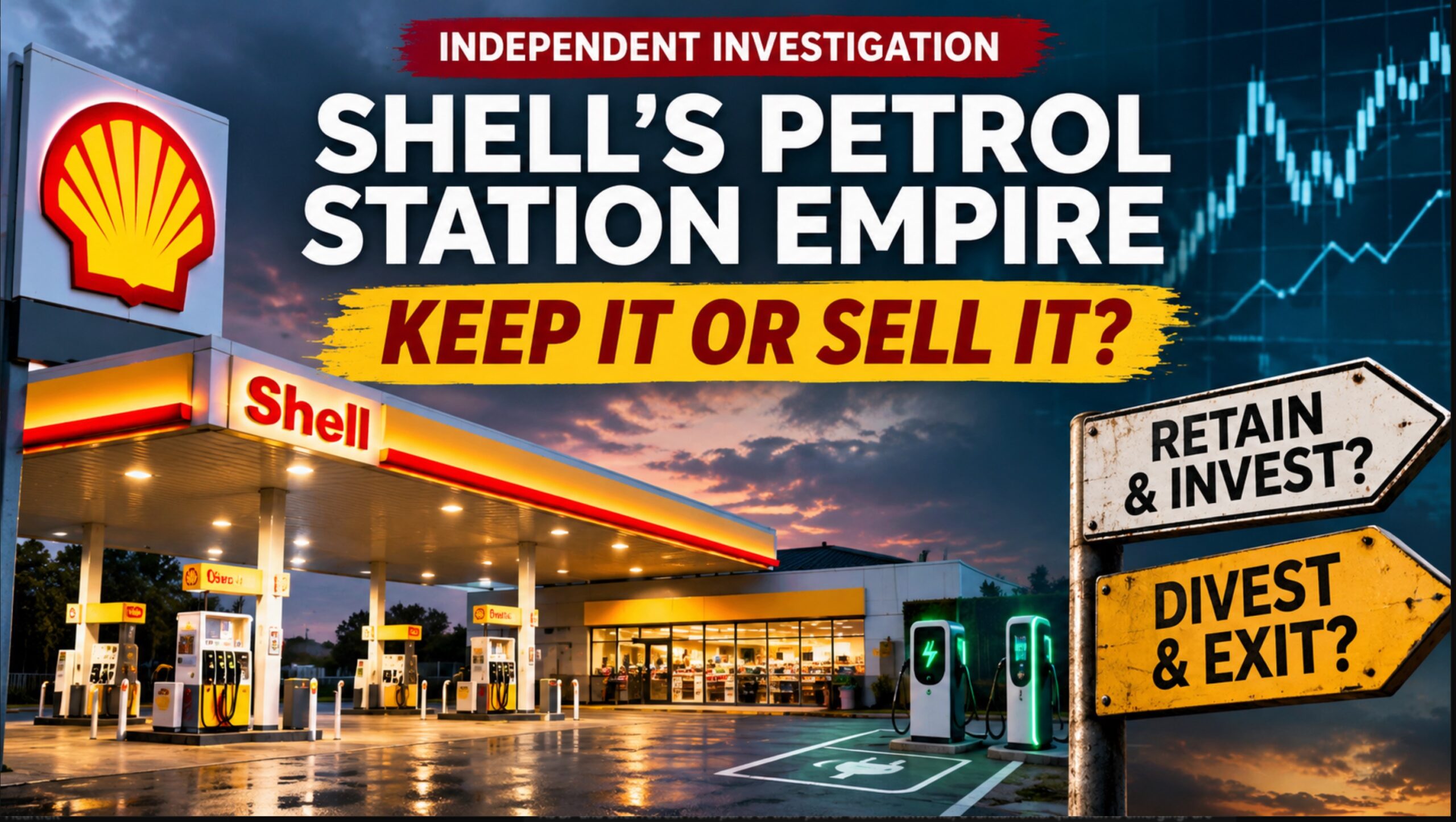
As BP and Shell retreat from parts of their petrol-station networks, a fundamental question is emerging: are the oil majors sitting on valuable retail businesses that might be worth more outside their corporate empires? Shell’s own financial disclosures reveal a shrinking network, substantial profits and an electric-vehicle charging business still waiting to make money.
The petrol station question Shell cannot avoid
For generations, the Shell emblem has been one of the world’s most familiar corporate symbols.
From motorway service stations to neighbourhood forecourts, the yellow-and-red scallop has represented the public face of a business whose largest investments and profits are often generated far from the ordinary motorist.
But a new question is confronting the international oil industry.
Does Shell still need to own petrol stations — or would its shareholders be better served by a different ownership structure?
The Financial Times has revisited this question, examining the changing economics of the forecourt businesses operated by BP and Shell.
Behind the debate lies a potentially significant issue of corporate valuation.
Petrol stations are no longer simply places to buy petrol or diesel. Successful sites increasingly combine convenience retailing, food, coffee, car washing, fleet services and electric-vehicle charging.
Those businesses may appeal to different investors from those attracted to oil production, LNG trading and offshore exploration.
Shell’s published figures make the question worth examining.
Shell’s global network has shrunk by more than 4,000 locations
According to Shell’s 2025 Form 20-F, filed with the US Securities and Exchange Commission, the number of Shell-branded mobility locations has fallen substantially.
| Year | Shell-branded mobility locations |
|---|---|
| 2023 | 47,004 |
| 2024 | 44,109 |
| 2025 | 42,724 |
Between the end of 2023 and the end of 2025, the network contracted by 4,280 locations — approximately 9.1%.
The reduction during 2025 alone was 1,385 locations.
These figures demand careful interpretation. Not every Shell-branded forecourt is owned or directly operated by Shell.
The company uses a variety of arrangements, ranging from outright ownership and joint ventures to licensing agreements under which independent operators use its brand.
Consequently, a decline in branded locations does not necessarily correspond to an equivalent reduction in Shell-owned properties.
Nevertheless, the overall direction is unmistakable.
Shell is concentrating its retail presence in markets where it expects stronger financial returns.
The quiet retreat from international markets
Shell’s annual filing describes several steps in that process.
The company disposed of its Pakistan business in 2024.
In 2025, Shell agreed to transfer its Indonesian mobility business, comprising approximately 200 sites, to a joint venture between Citadel Pacific and Sefas Group.
It also agreed to sell its Mexican mobility businesses.
Those arrangements were described in the annual filing as agreements, rather than necessarily completed transactions.
Shell additionally disclosed that it intended to concentrate 80% of Mobility cash capital expenditure in ten principal markets responsible for most of the relevant cash flow.
This is not a company abandoning its retail operations.
It is a company becoming considerably more selective about where it wishes to operate.
And that raises an interesting question.
If disposing of lower-return petrol stations improves the business, how much further could the restructuring go before shareholders begin to question the value of retaining the whole operation?
The surprising profitability of Shell’s Marketing business
Before treating the retail network as a candidate for wholesale disposal, shareholders should examine the financial results.
Shell’s Marketing division includes Mobility, Lubricants, and Sectors and Decarbonisation. It is therefore substantially broader than its petrol-station operations alone.
According to the company’s 2025 SEC filing, Marketing delivered:
| Financial measure | 2025 | 2024 |
|---|---|---|
| Adjusted Earnings | $3.994bn | $3.885bn |
| Adjusted EBITDA | $7.993bn | $7.476bn |
| Operating cash flow | $6.339bn | $7.363bn |
| Cash capital expenditure | $1.862bn | $2.445bn |
The figures reveal a business producing considerable earnings while reducing capital expenditure.
Marketing Adjusted Earnings increased by approximately $109 million, and Adjusted EBITDA rose by more than $500 million.
Shell reported that both Mobility and Lubricants achieved their strongest results to date in 2025.
That matters.
The argument for selling the petrol-station network cannot simply be that Shell is operating an unattractive business.
Its retail activities form part of a profitable and strategically important division.
The more sophisticated question is whether the market fully recognises their value within a vast integrated oil and gas company.
It is also essential not to assign the entire Marketing division’s $7.993 billion of Adjusted EBITDA to petrol stations. Shell does not provide sufficient separately disclosed financial information to justify that calculation.
The hidden value of millions of daily customers
Shell reported that approximately 29 million customers visited Shell-branded mobility sites every day in 2025.
It also operated around 13,000 convenience stores worldwide.
More than 2,900 Shell-operated stores had been upgraded with its Shell Café coffee and food offering since the concept’s introduction in 2021.
Those figures illustrate why an attractive petrol-station site can be much more than a fuel distribution point.
A motorist who stops for petrol may also purchase coffee, food, groceries or other services.
These purchases can generate commercial value distinct from the margin on a litre of fuel.
For an independent retailer, supermarket operator or specialist convenience-store business, a well-located forecourt could therefore represent an attractive investment.
The underlying property, where owned, may also have value separate from the operating business.
That does not mean the entire Shell network could be sold at a premium. Many branded locations are not Shell-owned, and profitability varies considerably across countries and sites.
But it does suggest that investors should understand the individual components before accepting a single valuation for the whole business.
The electric-vehicle charging contradiction
Perhaps the most interesting disclosure concerns electric vehicles.
Shell reported that its global network of owned or Shell-branded public EV charge points increased from almost 73,000 in 2024 to almost 88,000 in 2025.
That represents growth of approximately 21%.
Yet the same SEC filing acknowledges:
Shell’s global electric-vehicle charging business was not profitable in 2025.
Shell nevertheless expects to continue investing, anticipating that profitability may eventually be achieved.
The company identifies several factors affecting that outcome, including customer demand, competition, network accessibility, technology costs and government policies.
This presents a genuine strategic dilemma.
The charging network is expanding, but commercial success is not yet established.
Nor is a conventional forecourt necessarily the ideal location for every charging customer.
Some motorists charge at home or work. Others need rapid charging facilities during longer journeys.
A petrol station designed around a brief refuelling stop may require a different commercial model when customers remain on site substantially longer.
That creates opportunities for convenience retailing, but also investment requirements and operating risks.
A specialist charging or retail operator might be better placed to manage some of those activities.
Alternatively, Shell’s established brand, property relationships and customer network might give it advantages that would be expensive to recreate.
Both possibilities deserve examination.
Why a break-up could attract shareholders
There is a familiar argument in financial markets that diversified conglomerates can be valued at less than the sum of their individual businesses.
Investors may apply different valuation multiples to different activities.
An oil and gas producer faces commodity-price volatility, reserve replacement requirements, geopolitical risk and substantial long-term capital commitments.
A successful convenience retailer may instead attract investors interested in customer spending, recurring cash generation and comparatively predictable operating performance.
If Shell’s retail business were valued independently, its financial characteristics might attract a different shareholder base.
That could create opportunities through a sale, partial flotation, partnership or other restructuring.
But there is a major obstacle to calculating the potential benefit.
Shell does not separately disclose all the financial information necessary to place a defensible standalone valuation on its global petrol-station operations.
Its Marketing results also include major lubricants and commercial businesses.
Any claim that a retail separation would unlock a specific number of billions of dollars would therefore require assumptions not established by the published segment accounts.
That is an important limitation, not a minor technicality.
Why Shell might be reluctant to sell
There are also compelling reasons for retaining the business.
Shell’s forecourt network provides a direct relationship with motorists, fleet operators and commercial customers.
It offers outlets for refined products and premium fuels, supports trading and supply operations, and gives the company an established platform for introducing new transport services.
Retail operations can also provide earnings with different characteristics from the more volatile upstream oil and gas business.
A complete disposal could reduce that diversification.
Selling assets would generate proceeds, but Shell would also surrender future earnings and potentially valuable commercial relationships.
Even a transaction that appears attractive on a headline valuation might become less appealing once lost profits, taxes, restructuring expenses, brand arrangements and supply agreements are considered.
There is no automatic shareholder benefit from turning one company into two.
The commercial terms matter.
So does what Shell would do with the proceeds.
The BP comparison
Shell is not alone in facing these questions.
The Financial Times has examined similar pressures surrounding BP, where activist investors have scrutinised the group’s structure and the potential value of its convenience and mobility operations.
However, it would be misleading to assume that the two businesses should receive identical treatment.
Their geographic footprints, ownership arrangements, debt positions, operating performance and strategic priorities differ.
A transaction that makes sense for BP might not produce the same result for Shell.
Equally, the existence of potential buyers does not establish that shareholders would benefit from selling.
The relevant test is whether the financial value realised would exceed the benefits of retaining the assets.
What shareholders should be asking Shell
In our assessment, the most useful questions are not simply whether Shell should sell its petrol stations.
They are more precise.
How much of Shell’s Marketing profitability is attributable to Mobility alone, and how much specifically to retail forecourts?
What proportion of the 42,724 branded locations is owned by Shell, operated through joint ventures or licensed to third parties?
How much capital is tied up in company-owned retail property and infrastructure?
What return on capital is being generated by the ten priority markets compared with the remainder?
What conditions would make Shell’s EV-charging business commercially profitable?
Has the board evaluated the potential shareholder value of a partial flotation, franchise restructuring or disposal of selected retail networks?
And perhaps the most important question:
What evidence demonstrates that Shell’s present ownership structure generates more value than credible alternatives?
These questions are not demands for an immediate break-up.
They are reasonable tests of capital allocation and corporate transparency.
The Shell brand is not the same as Shell ownership
One distinction deserves emphasis.
Millions of customers encounter the Shell name every day, but they do not necessarily encounter a business owned by Shell plc.
The value of the company’s brand can survive changes in the ownership and operation of individual sites.
A petrol station may retain the Shell identity while its underlying business is owned by an independent operator or another organisation.
That creates the possibility of restructuring the operating business without surrendering every commercial benefit associated with the brand.
It also makes any simplistic valuation based on multiplying the number of Shell-branded stations by an assumed property value fundamentally unreliable.
The retail network is not a uniform portfolio of 42,724 Shell-owned properties.
Our conclusion: the case for scrutiny is stronger than the case for an immediate sale
The evidence supports three conclusions.
First, Shell has already been reshaping its international petrol-station network, with a clear emphasis on higher-return markets.
Second, its broader Marketing business remains profitable and strategically significant. Disposing of retail operations would involve relinquishing assets and earnings that continue to contribute to the group.
Third, the company’s present disclosures leave shareholders without a sufficiently detailed public financial breakdown to determine whether a separate retail business would command a higher valuation.
The Financial Times has raised a legitimate question.
Shell’s own figures explain why it matters.
But an investigation should not assume that selling the entire business is the correct answer merely because the network is shrinking.
A selective restructuring could produce better results. So could retaining the most profitable operations while extending licensing and partnership arrangements elsewhere.
There is even a plausible case for preserving the present structure, provided Shell can demonstrate that its integrated operations create sufficient additional value.
Ultimately, the question for shareholders is straightforward:
Is Shell retaining its petrol-station empire because it is the most valuable arrangement for investors — or because it is the arrangement the company has inherited?
The answer deserves more than a corporate slogan.
It deserves a transparent financial explanation.
Principal sources
- Financial Times — Should BP and Shell still own petrol stations? (9 November 2026) — The current industry debate; subscription access may be required.
- Shell plc — Form 20-F for 2025, US Securities and Exchange Commission — Primary source for retail network figures, Marketing financial results, EV charging, commercial strategy and divestments.
- Shell — Annual Report and Accounts 2025 — Group strategy, performance and financial disclosures.
- Shell — Annual Reports Archive — Historical filings and figures for comparison.
Editorial and methodology note: This article is an independent, AI-assisted documentary analysis prepared for the Donovan–Shell Archive. Financial figures are taken from Shell’s published filings. The proposed benefits and disadvantages of restructuring are analytical possibilities, not established forecasts. No claim is made that Shell has announced a complete retail break-up. Shell is welcome to provide factual corrections, supplementary financial information or a response for publication.
*This website and sisters royaldutchshellgroup.com, shellnazihistory.com, royaldutchshell.website, johndonovan.website, shellnews.net, and shellwikipedia.com, are owned by John Donovan - more information here. There is also a Wikipedia segment, the Shell DPA Files, "Shell and the Spies", the Shell Leaks files, the Independent Shell Archive, as well as books written and published by John Donovan - Kindle eBooks. Timeline of the Donovan Shell Feud. Toxic History of Royal Dutch Shell Group. Shell and the Donovans: The Full Media Record — 550+ Articles, 110 Books, 40 Years. *All conjured up by internet wizz, Nick Gill.