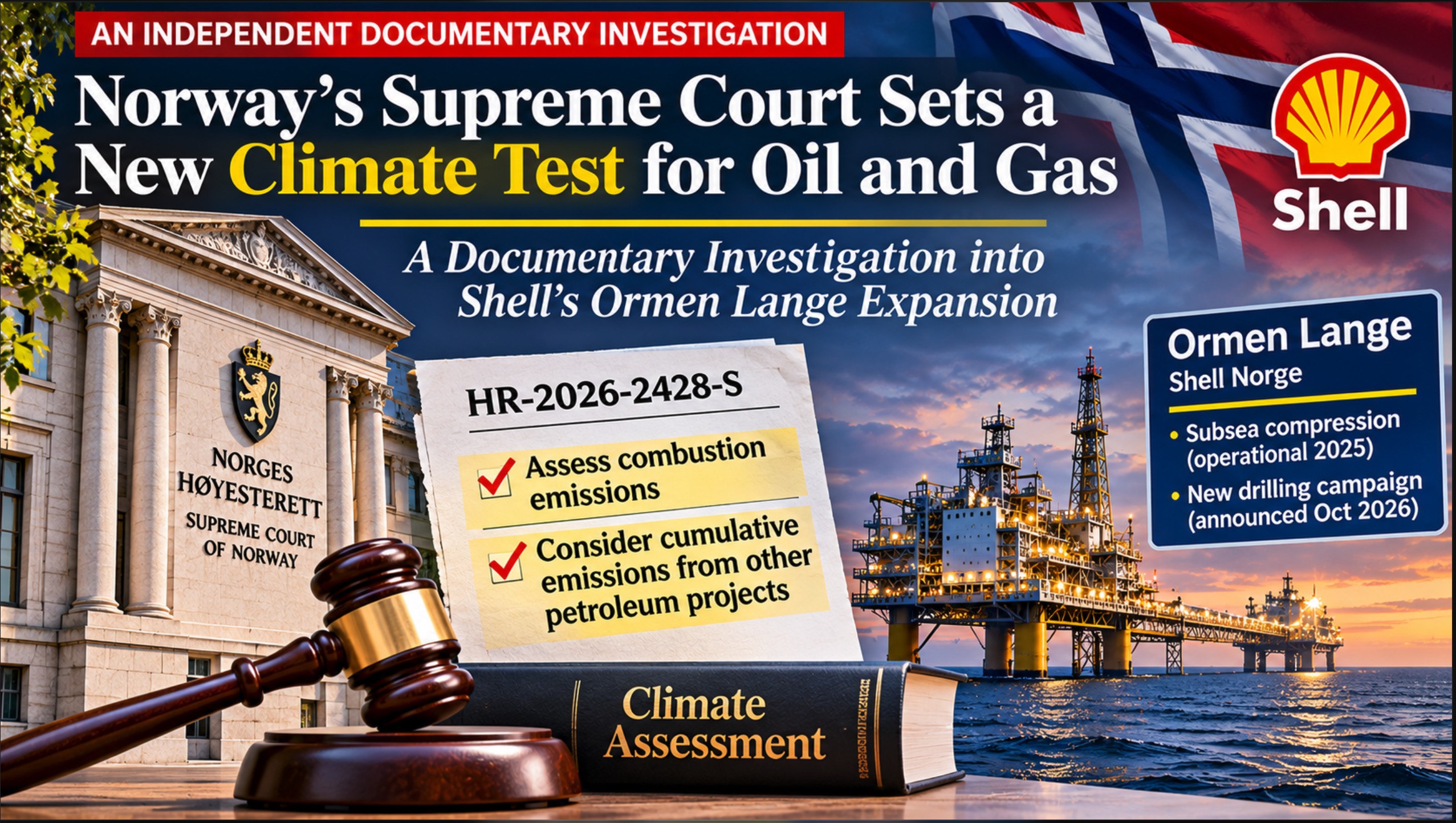
AN INDEPENDENT DOCUMENTARY INVESTIGATION
By the Donovan–Shell Archive
13 November 2026
Researched and drafted with assistance from ChatGPT, using the Norwegian Supreme Court’s published judgment summary, Norwegian Offshore Directorate records, Shell’s corporate disclosures, UK government decisions and contemporary legal analysis.
Norway’s highest court has ruled that offshore petroleum development approvals must take account of the climate effects of burning the oil and gas produced, not merely emissions from extraction. The decision concerns projects operated by Equinor and Aker BP, not Shell. But Shell’s continuing expansion of production from the enormous Ormen Lange gas field raises an important question for future development: how will Norway apply this newly clarified legal standard to projects designed to extract additional fossil fuels from existing reservoirs?
A major judgment on the future of Norwegian petroleum development
On 13 November 2026, Norway’s Supreme Court delivered a significant judgment concerning three previously approved offshore petroleum developments.
In HR-2026-2428-S, the court ruled that government decisions concerning the Breidablikk and Tyrving fields and the Yggdrasil development area were invalid because of deficiencies in their environmental assessment procedures.
The case arose from proceedings brought by Greenpeace Nordic and the Norwegian environmental organisation Nature and Youth against the Norwegian state.
The central issue was whether authorities had adequately considered the greenhouse gases produced when oil and gas extracted from the fields would ultimately be burned by customers.
For decades, the distinction between emissions generated during petroleum production and emissions arising from the subsequent use of petroleum products has been central to disputes over the oil industry’s climate responsibilities.
The Norwegian court has now clarified that the relevant environmental assessment obligations extend beyond emissions at production facilities.
Its decision goes further in one especially important respect.
By a majority of six judges to five, the Supreme Court held that the environmental assessment must consider the cumulative combustion emissions associated with other existing and approved petroleum developments on the Norwegian continental shelf.
The judgment therefore concerns not only how the emissions of one project are assessed, but also how those emissions are considered alongside the wider consequences of previously authorised petroleum production.
That distinction is central to understanding its possible implications for companies operating in Norway.
Primary source: Supreme Court of Norway, HR-2026-2428-S, 13 November 2026.
What the judges actually decided
The judgment contains several conclusions that should not be conflated.
First, all eleven Supreme Court judges agreed that the environmental impact assessments required under the applicable European legal framework must address the emissions generated when extracted petroleum is ultimately burned.
The requirement arises under the European Union’s Environmental Impact Assessment Directive, as incorporated into Norwegian law through the European Economic Area framework.
The court’s conclusion was consistent with an earlier advisory opinion from the EFTA Court.
Second, the Supreme Court considered how extensively the resulting climate effects must be assessed.
The majority concluded that examining each project’s combustion emissions in isolation was insufficient.
The assessment must address emissions from other existing and approved petroleum projects on the Norwegian continental shelf and their combined contribution to global warming.
Five judges disagreed with this additional requirement.
They considered that the assessment of a project’s own combustion emissions and their contribution to warming would satisfy the applicable obligations.
Third, the Supreme Court did not accept every argument advanced by the environmental organisations.
The court concluded unanimously that the law did not require an assessment of the concrete consequences of each anticipated increment in global temperature.
Nor did it require the particular emissions to be measured against remaining global carbon budgets in the manner sought by the claimants.
These qualifications are important.
The judgment does not create an automatic prohibition on new petroleum developments.
It establishes requirements concerning the evidence and assessments that must precede the relevant approval decisions.
The distinction is between a project being legally prohibited and a government being legally required to assess its environmental consequences properly.
The two are not equivalent.
The disputed approvals were invalid — but production was not automatically stopped
There is another particularly important limitation.
The oil companies holding the relevant petroleum rights were not parties to the proceedings before the Supreme Court.
The court expressly addressed the consequences of that procedural position.
It explained that declaring government approvals invalid in proceedings between environmental organisations and the state did not automatically mean that the approvals ceased to operate against the companies holding the petroleum rights.
The Norwegian Ministry of Energy must reconsider the relevant decisions using a legally adequate procedure.
According to an analysis published on 13 November by Norwegian law firm Schjødt, the court recognised that this reconsideration could ultimately result in either confirmation or alteration of the approvals.
The judgment therefore must not be reported as a court order immediately shutting down the three developments.
Nor should it be described as invalidating every existing Norwegian offshore petroleum approval.
Its direct operative consequences concern the particular decisions challenged in the proceedings.
Its wider significance lies in the legal standards it establishes for petroleum development assessments.
Supporting analysis: Schjødt — Norwegian climate ruling: Supreme Court declares PDO approvals for three petroleum fields invalid, 13 November 2026.
Why this judgment matters to Shell
Shell was not a defendant in the Norwegian proceedings.
The challenged developments are associated with other petroleum operators, principally Equinor and Aker BP.
It would therefore be misleading to suggest that the Supreme Court has found Shell responsible for any unlawful approval or environmental assessment in this case.
However, Shell remains an important operator on the Norwegian continental shelf.
Its principal operated asset there is Ormen Lange, one of Norway’s largest natural gas fields.
Ormen Lange began production in 2007 and supplies gas to European markets through the Nyhamna processing facility and the Norwegian gas export system.
Shell’s Norwegian subsidiary operates the field with a 17.8% interest.
Its partners include Petoro, Equinor, ORLEN Upstream Norway and Vår Energi.
Ormen Lange is particularly relevant because Shell has continued investing in technologies and drilling operations designed to extract additional gas from the existing reservoir.
Those projects provide a useful, specific example against which the new legal framework can be examined.
The question is not whether the Norwegian Supreme Court has invalidated Ormen Lange’s approvals.
It has not.
The question is how the clarified environmental assessment requirements may affect future development applications, amended development plans or other decisions concerning additional production from established offshore fields.
That is an important distinction for Shell and its industry partners.
Ormen Lange: extracting more gas from an established field
Shell’s investment strategy at Ormen Lange is based substantially on increasing the proportion of the reservoir’s gas that can ultimately be recovered.
As a gas field matures, reservoir pressure declines.
Without additional engineering measures, production can become more difficult and eventually commercially uneconomic.
One method of extending production is to install compression equipment that helps maintain the movement of gas from the reservoir through the production system.
In June 2025, Shell announced that subsea compression had commenced at Ormen Lange.
Two new compressor stations had been installed on the seabed approximately 120 kilometres offshore, connected to the Nyhamna processing facility.
The development was designed to increase the proportion of the field’s gas recovered from approximately 75% to 85%.
Shell estimated that the additional recovery enabled by the project could amount to 30–50 billion cubic metres of gas.
That is a substantial quantity.
It is also a field-wide estimate, not a volume attributable entirely to Shell’s 17.8% ownership interest.
The Norwegian Offshore Directorate’s official field record confirms that an amended plan for development and operation concerning subsea compression was approved in 2022.
The compression system subsequently entered operation in 2025.
This project was approved and implemented before the Supreme Court delivered its November 2026 judgment.
Nothing in that judgment establishes that the Ormen Lange approval was unlawful.
Nor does it automatically reopen or invalidate the 2022 decision.
Nevertheless, Ormen Lange illustrates the scale of additional hydrocarbon recovery that can be enabled through investments in already producing fields.
The emissions associated with constructing and operating the additional equipment represent one aspect of the project’s environmental consequences.
The emissions eventually arising from the combustion of the additional gas represent another.
The distinction is precisely the type of issue that the Supreme Court’s judgment addresses in the context of development-plan approvals.
Primary sources:
Shell Norway — First gas recovered from subsea compression at Ormen Lange, 27 June 2025.
Norwegian Offshore Directorate — Official Ormen Lange field record.
Shell announced another Ormen Lange investment only five weeks ago
An additional corporate announcement makes the timing of the Norwegian Supreme Court judgment especially noteworthy.
On 9 October 2026, Shell Norway announced a new drilling and well-intervention campaign at Ormen Lange.
According to Shell, the planned work is expected to increase recovery by approximately 3.5 billion standard cubic metres of gas over the remaining life of the field.
The campaign includes two sidetracks from existing wells to reach additional gas volumes.
There is also an option to modify a third well.
Shell expects the first production associated with this campaign during 2029.
In its announcement, the company explained that although Ormen Lange had been producing for nearly twenty years, opportunities remained to recover additional resources.
The investment was presented as a means of extracting gas that existing wells could not efficiently reach, while providing further energy supplies to Europe.
This was a specific, newly announced drilling investment.
It was not simply a general statement about Shell’s future petroleum ambitions.
There is, however, an essential regulatory qualification.
The publicly examined announcement does not establish whether the new well campaign requires a fresh plan for development and operation, an amendment to an existing approval, or another category of regulatory authorisation.
That question matters because the Supreme Court judgment concerns the environmental assessment requirements applicable to approvals of plans for development and operation.
It would be wrong to assume that every well intervention or sidetrack automatically triggers the same assessment process.
It would also be premature to claim that Shell’s October investment announcement is inconsistent with the November judgment.
What the two documents establish is that additional petroleum recovery remains commercially important to Shell in Norway, while the courts have clarified the obligations governing environmental assessment of petroleum developments.
Those facts justify further examination of the applicable permitting arrangements.
They do not establish non-compliance.
There is a further numerical point worth emphasising.
The additional 3.5 billion cubic metres identified in October should not automatically be added to the earlier 30–50-billion-cubic-metre recovery estimate.
The public information examined does not establish whether the newer recovery estimate is entirely additional to, or partly overlaps with, volumes associated with the wider field-development strategy.
Presenting them as an independently verified combined total would be misleading.
Primary source: Shell Norway — Ormen Lange: New investment to recover more gas, 9 October 2026.
The difference between low-emission production and low climate impact
The Ormen Lange development also illustrates a broader question concerning the way offshore petroleum projects are described.
Shell has emphasised the efficiency of its subsea technology and the role of Norwegian natural gas in supporting European energy security.
The subsea compression system is powered from shore, avoiding the need for an additional offshore production platform.
Such engineering arrangements can reduce operational emissions relative to some alternative development methods.
That is a legitimate consideration when evaluating a project’s environmental performance.
But the Norwegian Supreme Court’s judgment reinforces the legal distinction between emissions arising from extracting petroleum and those arising from ultimately burning it.
A gas project can have comparatively low emissions during production while still supplying hydrocarbons that generate substantial carbon dioxide when consumed.
Lower production emissions do not eliminate combustion emissions.
Conversely, the fact that combustion emissions must be assessed does not establish that every gas development must be rejected.
A government may consider energy supply, infrastructure, environmental effects and other lawful factors when deciding whether to approve a project.
What it cannot do, under the legal principles now clarified by Norway’s Supreme Court, is omit the required assessment of combustion-related climate effects.
For Shell, that distinction matters because its Norwegian projects are designed to maintain and extend gas supplies through existing infrastructure.
The company’s operational efficiency claims may remain relevant.
They are not a substitute for assessment of the climate consequences that the applicable legal framework requires.
A particularly revealing comparison with Britain’s Jackdaw decision
The new Norwegian judgment also has an important parallel in the United Kingdom.
On 21 October 2026, the British government announced that consent could be granted for production from the Jackdaw gas field in the North Sea.
The decision followed a lengthy legal and regulatory process.
Jackdaw’s earlier environmental approval had been affected by the UK Supreme Court’s 2024 judgment in the Finch case.
That decision required environmental impact assessments for relevant petroleum projects to address emissions resulting from the eventual combustion of extracted hydrocarbons.
A subsequent Scottish court ruling found that Jackdaw’s original consent could not stand because the relevant downstream emissions had not been assessed.
The UK authorities then reconsidered Jackdaw under a revised environmental assessment process.
Shell welcomed the October 2026 decision.
Adura, the joint venture between Shell and Equinor, is now the operator responsible for progressing Jackdaw.
The crucial point is that assessing downstream emissions did not automatically result in refusal.
The British authorities considered the supplementary environmental information and ultimately permitted the project to proceed.
This is a useful comparison with Norway, although the two countries’ regulatory systems, statutes and judicial procedures are not identical.
The Norwegian Supreme Court’s decision goes beyond a simple requirement to quantify the combustion emissions of an individual project.
Its majority also requires assessment of cumulative combustion emissions from other existing and approved petroleum projects on the Norwegian continental shelf.
The practical significance of that cumulative requirement may become clearer as Norwegian authorities revise their development-assessment procedures.
For Shell, the UK and Norwegian developments demonstrate why the content of environmental assessment — rather than merely the final approval or refusal — has become a central feature of offshore petroleum litigation.
Primary UK source: Department for Energy Security and Net Zero — Jackdaw gas field gets green light, 21 October 2026.
Previous Donovan–Shell Archive investigation: Jackdaw Approved Again: Shell Welcomes North Sea Decision, but Government Sees No Material Reduction in Bills, 21 October 2026.
The cumulative-emissions question may prove the most consequential
The narrow majority on cumulative emissions is arguably the most far-reaching part of the Norwegian judgment.
Its significance lies in the distinction between examining one petroleum development and examining that development within the wider context of already approved production.
Norway has authorised numerous offshore oil and gas projects over several decades.
An environmental assessment considering only one proposed field could describe that project’s combustion emissions without addressing how they relate to emissions associated with the country’s wider petroleum industry.
The Supreme Court majority concluded that the applicable legal framework requires consideration of that broader cumulative effect.
This does not make every producer responsible for the total emissions of every other operator.
It is a requirement concerning environmental assessment, not an automatic allocation of civil liability between petroleum companies.
Nor does it establish that Shell must account for the entire Norwegian petroleum industry’s emissions as emissions legally attributable to Shell plc.
The court’s reasoning concerns what must be included in the environmental information and governmental assessment relevant to the specified approval process.
The potential practical consequence is that future applications may require more extensive information about the relationship between proposed extraction and emissions associated with already authorised projects.
That could affect the preparation of environmental documents, consultation processes and the time required for regulatory consideration.
But the judgment does not itself quantify additional costs or establish that any particular Shell project will be delayed.
Those consequences remain matters for future regulatory decisions and project-specific evidence.
What remains uncertain for Ormen Lange?
The public records establish Shell’s existing development activities and the new Norwegian legal standard.
They do not establish exactly how the judgment will apply to every remaining stage of Ormen Lange’s development.
Several questions deserve clarification.
The first concerns the environmental assessment prepared for the 2022 amended development plan authorising subsea compression.
What treatment did that assessment give to the anticipated combustion emissions associated with additional gas recovery?
The second concerns the new drilling and well-intervention campaign announced in October 2026.
What regulatory applications or approvals are required for those activities, and do any of them fall within the development-plan procedures considered by the Supreme Court?
The third concerns the consequences of the judgment for future Norwegian projects involving Shell.
Will subsequent development plans or amendments require revised cumulative-emissions assessments under the clarified standard?
The fourth concerns implementation.
How will Norway’s Ministry of Energy incorporate the judgment into its official guidance, and what transitional arrangements, if any, will apply to projects already at an advanced stage of development?
These are legitimate documentary questions.
They do not imply that Shell has failed to obtain a required approval.
They arise because a newly delivered judgment has clarified the applicable legal principles at a time when Shell continues investing in additional Norwegian gas recovery.
Shell and Norway’s wider energy-security argument
Any responsible investigation must also acknowledge the arguments supporting continued Norwegian gas production.
Norway has become an exceptionally important supplier of natural gas to Europe.
Existing offshore infrastructure allows gas from fields including Ormen Lange to reach European markets through established processing facilities and pipelines.
Shell and its partners argue that investment in improved recovery can make effective use of that infrastructure while providing reliable supplies.
There are economic and engineering reasons why operators seek to extend production from existing fields.
Developing additional recovery from a mature reservoir may require less new infrastructure than developing an entirely separate discovery.
Existing processing plants, pipelines and operational systems can continue to be used.
That can be commercially attractive and may limit some types of additional environmental disturbance.
Environmental organisations advance a different consideration.
They argue that the full climate consequences of additional fossil-fuel extraction must be examined before governments authorise development.
The Norwegian Supreme Court has now clarified the scope of that assessment obligation.
It has not declared that energy security is irrelevant.
Nor has it ruled that national authorities must refuse every petroleum project whose eventual combustion would increase global greenhouse-gas emissions.
The legal requirement is more specific.
The relevant environmental effects must be adequately assessed, and the government must make its decision within the applicable legal framework.
This distinction is essential to fair reporting.
What the Donovan–Shell Archive’s earlier Jackdaw investigation helps establish
The Donovan–Shell Archive has already examined the consequences of the UK’s Finch judgment for Jackdaw.
That investigation considered the distinction between a project’s physical readiness and its legal authority to commence production.
The subsequent October approval demonstrated that a revised environmental assessment could lead to renewed consent.
The Norwegian judgment now presents a different but related development.
It confirms that downstream combustion emissions form part of the necessary environmental assessment for relevant Norwegian petroleum development approvals.
It also establishes a contested but binding majority interpretation requiring the cumulative effects of other existing and approved Norwegian petroleum projects to be considered.
The two jurisdictions therefore provide an opportunity to examine how governments translate judicial requirements concerning climate assessment into actual development decisions.
Shell’s involvement in both countries makes that comparison relevant.
But the historical and jurisdictional distinctions must be preserved.
Jackdaw was directly affected by litigation concerning its own environmental consent.
Ormen Lange was not one of the projects challenged in the Norwegian Supreme Court case.
The legal implications for Ormen Lange remain prospective and dependent on the regulatory decisions required for particular activities.
A comparison of the cases is therefore an analytical exercise, not evidence that Shell is facing an identical challenge in Norway.
DOCUMENTARY FINDINGS
Established by the Norwegian Supreme Court judgment of 13 November 2026
Norway’s Supreme Court ruled that the challenged development approvals for Breidablikk, Tyrving and the Yggdrasil area were invalid because of environmental assessment deficiencies.
All eleven judges agreed that the applicable environmental assessment requirements include emissions from the eventual combustion of extracted petroleum.
By six votes to five, the court concluded that cumulative emissions from other existing and approved petroleum developments on the Norwegian continental shelf must also be assessed.
The court did not require the detailed assessment of every concrete consequence of the resulting global temperature increase or an assessment against remaining global carbon budgets in the form sought by the claimants.
The petroleum companies holding the disputed rights were not parties to the case, and the judgment does not automatically extinguish their approvals.
Established by Shell’s published disclosures and official Norwegian records
Shell operates Ormen Lange with a 17.8% ownership interest.
An amended plan for subsea compression was approved in 2022.
Shell commenced subsea compression in June 2025, with an estimated 30–50 billion cubic metres of additional field-wide gas recovery.
On 9 October 2026, Shell announced another well-intervention and drilling campaign, with an estimated 3.5 billion standard cubic metres of additional recovery and first production expected in 2029.
The publicly examined documents do not establish whether the October campaign requires a new or amended development-plan approval.
Matters not established
The judgment does not find Shell to have breached Norwegian environmental law.
It does not invalidate Ormen Lange’s existing permits.
It does not order Shell to halt Norwegian gas production.
It does not establish that the new Ormen Lange drilling campaign will be delayed.
It does not determine whether additional environmental assessment will be required for any specific future Shell application.
Editorial analysis
The judgment is significant for Shell because it clarifies the legal framework governing relevant future petroleum development approvals in a country where Shell continues to operate, invest and seek additional gas recovery.
The most important question is how the authorities will apply the clarified requirements to new developments, amended plans and projects intended to extend production from existing reservoirs.
That question requires further documentation.
It cannot responsibly be answered by assuming that every past approval is now legally defective.
CONCLUSION: THE CLIMATE CONSEQUENCES OF PETROLEUM PRODUCTION CAN NO LONGER BE LEFT OUT OF THE ASSESSMENT
Norway’s Supreme Court has delivered a significant judgment.
The decision does not outlaw offshore oil and gas development.
It does not establish that Shell’s Norwegian operations are unlawful.
It does not automatically stop production at the three developments directly involved in the proceedings.
What it does establish is that environmental assessments for relevant petroleum development approvals must address the emissions associated with the eventual combustion of extracted hydrocarbons.
The narrow majority decision on cumulative emissions adds another important requirement.
The consequences of an individual development must be considered within the context of other existing and approved Norwegian petroleum projects.
For Shell, the significance lies in its continuing investment in additional offshore gas recovery.
Ormen Lange is an established field.
Its subsea compression system is already operating.
Shell has announced further drilling and well interventions designed to produce additional gas from 2029.
The company has legitimate commercial and energy-security reasons for pursuing that investment.
But the regulatory environment is evolving.
The question for Shell and Norwegian authorities is how future development decisions will reflect the new judicial clarification of environmental assessment law.
The judgment does not prejudge those decisions.
It does make the adequacy of the climate assessment an unavoidable part of the process wherever the clarified legal requirements apply.
For an industry built around long-term investments and complex regulatory approvals, that is a consequential development.
And for the Donovan–Shell Archive, it is precisely the type of legal change that deserves to be recorded alongside the company’s continuing investment decisions.
The evidence should determine the conclusions.
Not assumptions about what the court intended, what Shell might do, or how future projects will ultimately be decided.
PRINCIPAL DOCUMENTARY SOURCES
1. Supreme Court of Norway — 13 November 2026
HR-2026-2428-S: Official judgment summary and access to the court’s decision
The authoritative source for the judgment’s legal conclusions, voting divisions, treatment of combustion emissions, cumulative assessments and procedural consequences.
2. Schjødt — 13 November 2026
Norwegian climate ruling: Supreme Court declares PDO approvals for three petroleum fields invalid
Contemporary legal analysis explaining the court’s reasoning, the dissent and the implications for future Norwegian petroleum-development approvals.
3. Shell Norway — 9 October 2026
Ormen Lange: New investment to recover more gas
Shell’s primary disclosure concerning the new well-intervention and drilling campaign, anticipated additional recovery and expected production timetable.
4. Shell Norway — 27 June 2025
First gas recovered from subsea compression at Ormen Lange
Shell’s operational announcement identifying the subsea compression project, ownership interests and anticipated additional gas recovery.
5. Norwegian Offshore Directorate
Official Ormen Lange field record
Government-maintained information concerning development approvals, field status, production infrastructure and operational history, including the amended 2022 development plan.
6. UK Government — 21 October 2026
Jackdaw gas field gets green light
Official announcement explaining the renewed UK consent process following judicial requirements concerning downstream emissions.
7. Donovan–Shell Archive — 21 October 2026
Previous independent investigation providing historical context for the evolving treatment of downstream emissions in petroleum approvals.
DOCUMENTARY DISCLAIMER
This article is based principally on the Norwegian Supreme Court’s published summary of its judgment in HR-2026-2428-S, delivered on 13 November 2026, together with government-maintained Norwegian petroleum records, Shell corporate disclosures, official UK government publications and identified contemporary legal analysis.
The judgment directly concerns government decisions involving Breidablikk, Tyrving and the Yggdrasil development area. Shell is not identified as a party to those Supreme Court proceedings, and the judgment is not presented as a finding of wrongdoing by Shell plc or its subsidiaries.
References to possible consequences for Shell’s Ormen Lange investments represent independent analysis of future regulatory questions. They are not findings that an existing approval is unlawful, that additional authorisation is necessarily required, or that the judgment automatically applies retrospectively to Shell’s earlier projects.
Production and recovery estimates are attributed to their respective corporate or regulatory sources. They are forecasts or project estimates, not guarantees of future production. Figures relating to different projects are not added together where overlap cannot be excluded.
The separate statutory, procedural and judicial arrangements of Norway and the United Kingdom are distinguished. Similarities between their treatment of downstream emissions do not establish identical legal consequences.
Shell plc, A/S Norske Shell, the Norwegian Ministry of Energy and other relevant parties are invited to provide factual corrections, regulatory clarification or additional documents concerning the environmental assessment and approval arrangements for Ormen Lange’s ongoing and planned investments.
Substantiated corrections and additional evidence will be considered and reflected fairly.
This article is an independent documentary investigation, not a finding of corporate or regulatory liability or legal advice.