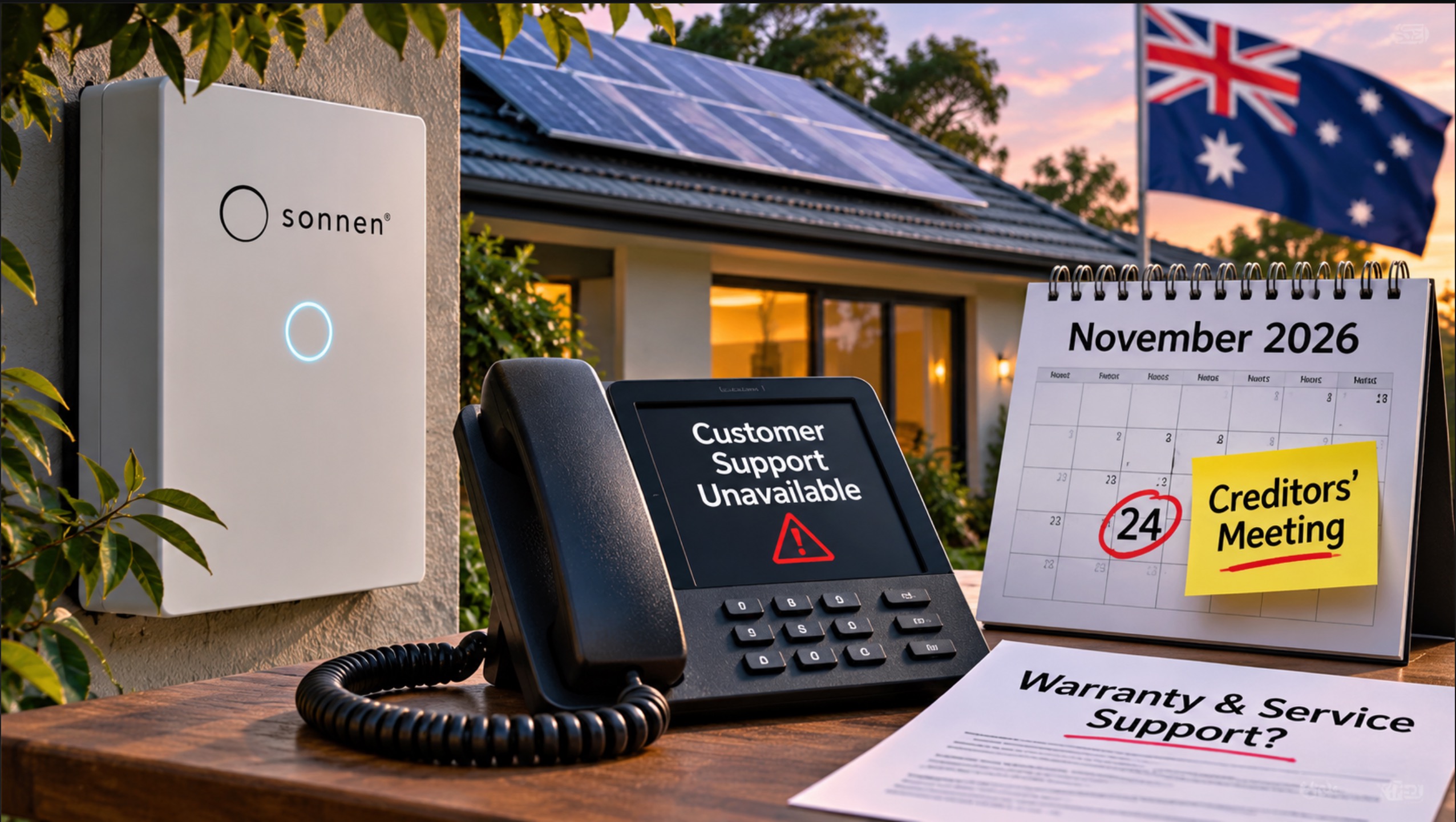
A new Australian investigation has documented difficulties obtaining technical support for Sonnen home batteries following the company’s collapse into voluntary administration. With creditors due to meet on 24 November, questions are mounting over warranties, servicing and the legacy of Shell’s abandoned clean-energy investment.
19 November 2026
By the Donovan–Shell Archive
For years, Sonnen represented the sort of clean-energy future that Shell plc wanted investors and the public to associate with its corporate transformation.
Household batteries. Solar electricity. Virtual power plants. An energy system in which consumers could generate, store and manage their own power.
Shell acquired the German battery pioneer outright in 2019, presenting the investment as part of its expanding electricity business.
In August 2026, Shell sold Sonnen to Munich-based investment vehicle Tiven.
Two months later, Sonnen GmbH filed for insolvency in Germany.
Now the consequences are becoming increasingly visible in Australia.
On 19 November, Australian energy publication Renew Economy reported that Sonnen Australia Pty Limited had entered voluntary administration, leaving customers uncertain about future warranty and technical support arrangements.
The report, by journalist Sophie Vorrath, included evidence from a customer who owns two Sonnen Evo batteries.
According to the investigation, the customer’s installer had informed him that Enervision, previously involved in providing Sonnen customer support, had ended its partnership with Sonnen.
The installer was seeking alternative technical assistance.
That is a significant development.
Until now, much of the discussion about Sonnen’s Australian administration has concerned what might happen to customers.
This report provides evidence that at least one customer and installer are already having to navigate disrupted support arrangements.
It does not establish that Sonnen batteries have stopped working, that every warranty has been cancelled or that support has ceased across Australia.
But it raises questions that cannot simply be dismissed as speculation.
An Australian business in administration
Sonnen Australia Pty Limited entered voluntary administration on 20 October 2026.
Hugh Armenis and Jason Lloyd Porter of SV Partners were appointed as joint administrators.
The appointment was formally publicised on 22 October.
A subsequent notice, dated 16 November, convened a second meeting of creditors.
According to published insolvency-notice information, that meeting is scheduled for 24 November 2026, with creditor documentation due by 23 November.
The meeting could determine whether the company enters liquidation, proceeds under a deed of company arrangement or returns to its directors.
No such outcome has yet been established.
The administrators’ findings and recommendations will therefore be particularly important.
The warranty question
For Australian households that invested substantial sums in Sonnen battery systems, the immediate concern is straightforward.
Who will provide repairs, replacement parts, software assistance and warranty support if something goes wrong?
Sonnen’s Australian warranty documentation names Sonnen Australia Pty Limited as the warrantor.
The company’s entry into administration does not automatically extinguish every contractual or statutory consumer right.
The Australian Competition and Consumer Commission explains that consumer guarantees under Australian Consumer Law operate separately from voluntary manufacturer warranties.
Depending on the circumstances, consumers may retain rights against the business that supplied the product.
However, the insolvency of a manufacturer or warrantor can make enforcing certain claims more difficult.
The distinction between possessing a legal right and obtaining a practical remedy is important.
A household battery is not a disposable appliance.
Customers reasonably expect years of operation, monitoring, maintenance and technical assistance.
The uncertainty becomes particularly serious when software and specialist servicing are integral to the product’s long-term performance.
What the latest investigation establishes
Renew Economy reports having examined a redacted letter supplied by the customer.
The correspondence indicated that the installer was exploring alternative technical-support arrangements following the reported end of Enervision’s Sonnen partnership.
The publication was seeking comment from Enervision.
The customer had also approached the Clean Energy Council concerning servicing and warranty responsibilities.
These are specific, reportable developments.
But they do not yet establish the scale of any disruption across Sonnen’s Australian installed customer base.
Nor has a comprehensive, independently verified account emerged explaining which organisations will assume ongoing support responsibilities.
Those questions require answers from the administrators and relevant service providers.
Shell’s Australian ambitions
The present difficulties are particularly striking when compared with Sonnen’s earlier ambitions.
In 2018, Sonnen established an Australian manufacturing operation in Adelaide, using premises associated with the former Holden automotive industry.
The company promoted plans for substantial local battery production and the development of virtual power plant technology.
Following Shell’s acquisition in 2019, Sonnen appeared to have the backing of one of the world’s largest energy companies.
Australia, with its extensive rooftop solar installations, was considered an attractive market for household energy storage.
Yet Sonnen subsequently encountered intense competition, particularly from lower-cost imported batteries.
Shell eventually decided to dispose of the business.
The Australian administration and German insolvency followed shortly afterwards.
It would be wrong to conclude, without further evidence, that Shell caused either insolvency through misconduct.
Equally, the timing makes the commercial history of the disposal a legitimate subject for examination.
What financial commitments accompanied the sale?
Were any transitional support obligations retained?
What arrangements were made for existing customers?
And what assurances, if any, were provided concerning continuity of warranties and technical services?
These remain questions, not accusations.
The American contrast
As previously reported by the Donovan–Shell Archive, Sonnen’s American operation continues to pursue commercial opportunities.
In late October, Sonnen Inc. participated in the launch of a residential battery virtual power plant pilot in Michigan.
Further American virtual-power-plant technology initiatives were announced in November.
The contrast is remarkable.
In Germany, insolvency proceedings.
In Australia, administration and customer-support uncertainty.
In America, continuing commercial development.
These developments concern different legal entities and should not be confused.
Nor does the continuation of American operations establish that valuable assets were improperly transferred from the German or Australian businesses.
Any such conclusion would require documentary evidence.
The next important date: 24 November
The second Australian creditors’ meeting offers the clearest immediate opportunity for answers.
The administrators’ report may clarify the company’s financial position, the prospects for restructuring and the treatment of creditors.
It may also provide further information relevant to customers, installers and service providers.
For now, the most important unanswered question is not whether Sonnen’s technology remains useful.
It plainly does.
The question is whether customers who purchased that technology will continue receiving the support they were led to expect.
Shell has already sold the business.
But the history of its ownership, the circumstances of the disposal and the subsequent consequences remain legitimate matters of public interest.
A clean-energy investment should be judged not only by the ambitions announced when it is acquired, but also by what happens to the people who depend on its products when ownership changes.
That is the next chapter of the Sonnen story.
And the creditors’ meeting on 24 November may provide some of the answers.
Principal sources
Renew Economy, 19 November 2026: Home battery trailblazer quietly enters administration, leaving Australian customers out in the cold
Australian insolvency notices, 16 November 2026: Notice of second meeting of creditors — Sonnen Australia Pty Limited
Australian administration chronology: Sonnen Australia Pty Limited — published notices and meeting dates
Australian Competition and Consumer Commission: Consumer rights when a business becomes insolvent
Australian Competition and Consumer Commission: Warranties and consumer guarantees
Donovan–Shell Archive, 24 October 2026: Shell’s Green Dream Goes Bust: Battery Pioneer Sonnen Files for Insolvency Just Two Months After Oil Giant Sells It
Donovan–Shell Archive, 4 November 2026: Sonnen’s German Business Faces Insolvency — But Its American Arm Launches a New Battery-Grid Project
DISCLAIMER
This article is independent news reporting, analysis and commentary, prepared with AI-assisted research and drafting. It is based on publicly available information as of 19 November 2026 and is not financial, investment or legal advice.
Reported difficulties obtaining technical support are distinguished from any claim of widespread service failure. Sonnen Australia’s voluntary administration does not establish that the company has entered liquidation or that all customer warranties have been cancelled.
No allegation of unlawful conduct by Shell plc, Tiven, Aurelius, Sonnen, Enervision or any individual is made. The circumstances and consequences of the restructuring remain subject to further documentary investigation.
The customer-support account is supported by Renew Economy‘s reporting, while the insolvency timetable is supported by published notice records. The ACCC confirms that statutory consumer guarantees and voluntary warranties are distinct, although insolvency can complicate remedies.
reneweconomy.com.au+4








