AN INDEPENDENT DOCUMENTARY INVESTIGATION
By the Donovan–Shell Archive
19 November 2026
Researched and drafted with assistance from ChatGPT.
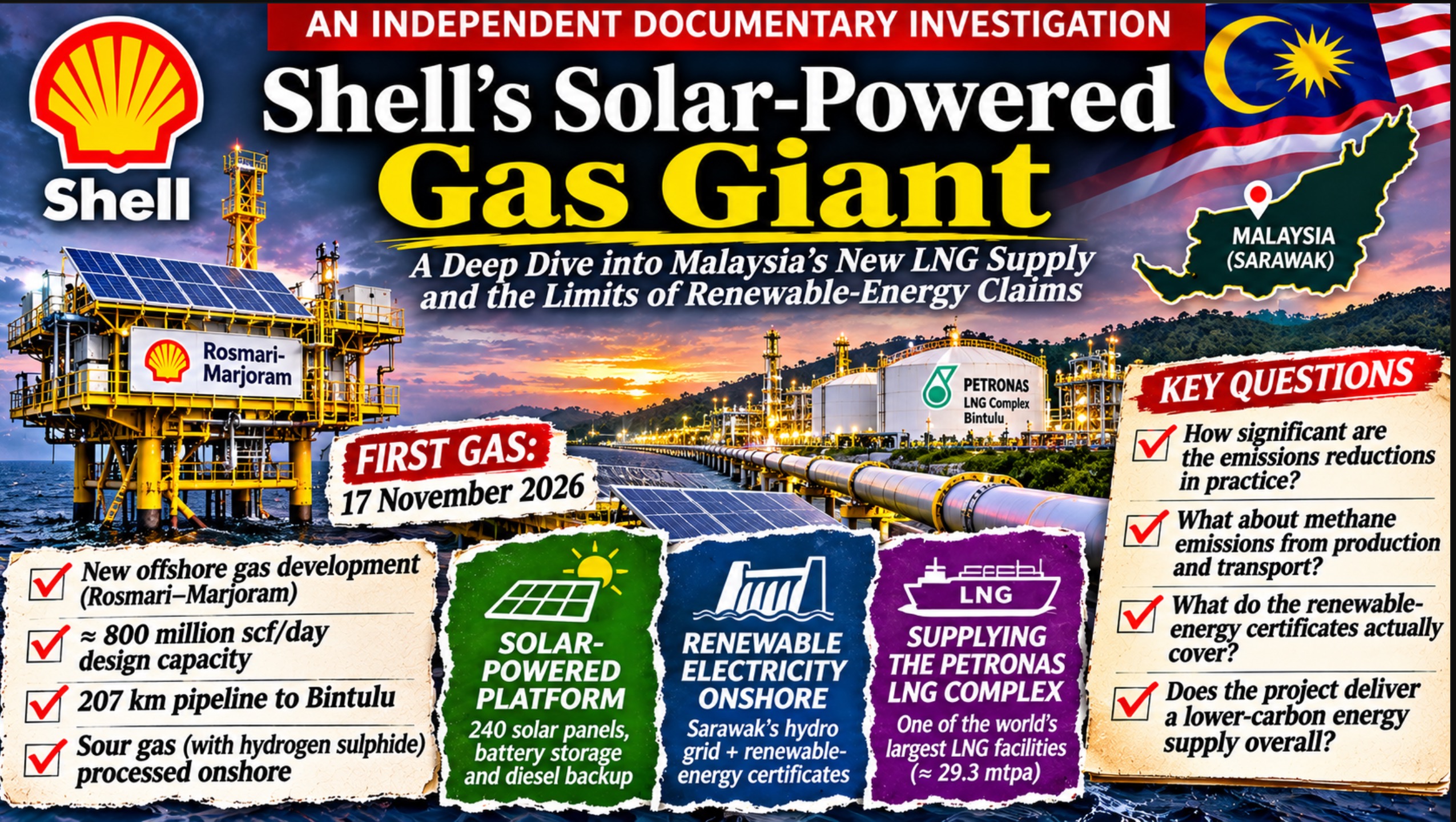
Shell has begun production from a major deepwater gas development offshore Malaysia, introducing new supplies to one of Asia’s largest liquefied natural gas processing complexes. The project combines an unmanned solar-powered platform, a 207-kilometre pipeline carrying sour gas and an onshore processing facility supplied with hydroelectricity and renewable-energy certificates. But what do these engineering features establish about the development’s environmental performance? An examination of Shell’s original investment decision, its latest corporate announcements, independent energy research and changes in project ownership reveals the commercial significance of Rosmari-Marjoram — and important questions that remain unanswered.
Introduction: A major new gas development enters production
On 17 November 2026, Shell announced that its Malaysian subsidiary, Sarawak Shell Berhad, had begun producing natural gas from the Rosmari and Marjoram fields offshore Sarawak.
The development lies approximately 220 kilometres from the Malaysian coast, in waters around 800 metres deep.
The project includes offshore wells, subsea equipment, an unmanned wellhead platform, a 207-kilometre pipeline and a new onshore gas-processing facility at Bintulu.
The development was designed to produce approximately 800 million standard cubic feet of gas per day.
The gas will be processed at Bintulu before being supplied to the nearby PETRONAS LNG Complex, where gas can be liquefied for shipment to customers across Asia.
Shell operates the development through Sarawak Shell Berhad, which reports a 71% interest.
In announcing first gas, Shell’s Upstream President, Peter Costello, described the project as contributing to the company’s production growth into the 2030s.
Primary source: Shell — First Gas from Rosmari-Marjoram, 17 November 2026.
The announcement establishes that production has commenced.
It does not establish that the development is already operating continuously at its full design capacity.
That distinction is important when assessing the scale of the new supply.
The announcement also contains an unusual feature.
Shell devotes considerable attention to the renewable electricity powering the development.
Its offshore platform uses solar panels.
The onshore processing plant draws upon Sarawak’s predominantly hydroelectric grid, supplemented by renewable-energy certificates.
These arrangements demonstrate an attempt to reduce emissions associated with powering the facilities.
But the facilities themselves are producing and processing natural gas.
The electricity required to operate an installation is only one component of the greenhouse-gas consequences of the energy ultimately supplied.
The difference between those two propositions is the central subject of this investigation.
1. The original 2022 investment decision
The development has a documentary history extending back more than a decade.
Rosmari and Marjoram were discovered in 2014.
On 5 September 2022, Sarawak Shell Berhad and PETRONAS Carigali announced a final investment decision to develop the fields.
Shell’s original announcement identified an 80% operating interest held by Sarawak Shell Berhad, with PETRONAS Carigali holding the remaining 20%.
The project was described as strategically important to sustaining gas deliveries to the PETRONAS LNG Complex.
Production was anticipated to begin in 2026.
The original announcement also highlighted the use of renewable power.
Shell said its offshore platform would use solar electricity, while the onshore plant would draw power from Sarawak’s hydroelectricity-based grid.
The anticipated production capacity was already stated as 800 million standard cubic feet per day.
The development therefore did not emerge unexpectedly in November 2026.
It represents the completion of a major investment decision taken four years earlier, built around gas discoveries made in 2014.
Original corporate document: Shell — 2022 Corporate Press Releases, page 77, “Shell invests in Rosmari-Marjoram in Sarawak, Malaysia”.
shell.com
A further milestone followed in September 2023, when Shell formally began development of the onshore processing plant at Bintulu.
The groundbreaking ceremony involved senior representatives of the Sarawak government, Shell and PETRONAS.
That announcement again identified the renewable-electricity arrangements and confirmed the project’s anticipated gas production capacity.
Shell Malaysia — Development of the Rosmari-Marjoram Onshore Plant, 21 September 2023.
The chronology demonstrates a consistent commercial objective.
Shell and its partners intended to develop substantial new offshore gas supplies while using renewable electricity to reduce at least part of the operational emissions associated with extracting and processing that gas.
Whether the resulting energy supply has a comparatively low lifecycle greenhouse-gas intensity is a separate question requiring additional evidence.
2. The unusual engineering challenge: Transporting sour gas over 207 kilometres
One of the most technically significant aspects of Rosmari-Marjoram is the nature of the gas.
Shell identifies the fields as containing sour gas.
This means the produced gas contains hydrogen sulphide.
Hydrogen sulphide is a highly toxic substance that requires carefully designed handling and processing systems.
Its presence makes production, transportation and processing more demanding than operations involving comparatively simple gas streams.
The development incorporates a long offshore pipeline carrying wet sour gas to shore.
Shell described the pipeline in 2022 and 2023 as one of the longest of its kind.
The new processing plant at Bintulu is intended to remove hydrogen sulphide before the treated gas enters the PETRONAS LNG supply system.
Shell states that this removal is undertaken safely.
The project therefore involves considerably more than connecting offshore wells to an existing gas network.
It requires specialised infrastructure capable of transporting and treating a potentially hazardous gas stream.
The engineering achievement is commercially significant.
It also raises legitimate questions about operational safeguards and environmental performance.
Those questions include how hydrogen sulphide is treated, what systems prevent accidental releases, how pipeline integrity is monitored, and what emergency-response arrangements apply.
The public first-gas announcement does not provide a complete technical description of these systems.
That omission should not be interpreted as evidence that the arrangements are inadequate.
Large industrial installations commonly maintain extensive engineering and safety documentation beyond the information included in media releases.
Nevertheless, the nature of the development makes those arrangements relevant to an independent assessment of the project.
A further distinction is necessary.
Hydrogen sulphide is not the same substance as carbon dioxide or methane.
Removing hydrogen sulphide from gas is important for safety and product quality.
It does not, by itself, establish the greenhouse-gas intensity of producing, liquefying, transporting or ultimately burning that gas.
Those are separate environmental considerations.
3. The solar-powered platform: What Shell actually says
The project incorporates an unusual renewable-electricity design for an offshore gas development.
Shell identifies 240 solar panels powering its unmanned offshore platform.
Battery storage is designed to provide up to three days of electricity.
Diesel generators remain available as backup.
Shell explains that the platform requires more electricity during maintenance visits, when personnel operate additional equipment.
Under those circumstances, the diesel generators can help meet the increased demand.
This is an important qualification.
The offshore platform is not described as operating exclusively on solar power under all circumstances.
It is designed to rely substantially on solar electricity during normal unmanned operation, with storage and diesel generation providing additional capacity when necessary.
The arrangement offers potential advantages.
A remotely operated offshore platform can require less routine staffing.
Using solar electricity can reduce the need to burn fuel for ordinary electricity generation.
Battery storage can improve continuity when sunlight is unavailable.
And reducing the operation of diesel generators may reduce emissions associated with supplying the platform’s electricity.
These are credible engineering benefits.
But their actual magnitude depends on operating conditions.
A detailed assessment would require information about annual electricity consumption, solar generation, battery performance, diesel use and any additional energy requirements.
Shell’s announcement confirms the design.
It does not provide a complete independently verified annual emissions calculation for the platform.
Primary source: Shell — Rosmari-Marjoram: Bringing New Gas to Asia, 17 November 2026.
The distinction matters because an installation powered partly by renewable electricity is not necessarily producing a renewable energy product.
Rosmari-Marjoram extracts natural gas.
The solar panels help operate part of the equipment used to extract it.
Those are different functions.
4. The onshore plant and the meaning of renewable-energy certificates
Shell makes a further claim concerning its onshore gas-processing facility.
The company states that the plant draws electricity from Sarawak’s predominantly hydroelectric grid, supplemented by renewable-energy certificates, to achieve the equivalent of 100% renewable electricity.
The wording is important.
Sarawak has substantial hydroelectric generating capacity.
Electricity supplied through the regional grid can therefore have a relatively low carbon intensity compared with electricity generated predominantly from fossil fuels.
But purchasing electricity from a grid is not necessarily the same as receiving electricity exclusively from a particular renewable generator at every moment.
Renewable-energy certificates provide a recognised accounting mechanism through which an organisation may claim specified renewable-electricity attributes.
The Greenhouse Gas Protocol distinguishes between location-based electricity accounting, which reflects the emissions characteristics of electricity supplied through the grid, and market-based accounting, which considers contractual instruments such as certificates.
Its guidance also specifies requirements concerning the ownership, tracking, retirement and appropriate application of those certificates.
Independent accounting standard: Greenhouse Gas Protocol — Reporting Requirements for Electricity Purchases.
GHG Protocol
That distinction does not make renewable-energy certificates inherently invalid.
They can form part of recognised corporate greenhouse-gas accounting.
But it means that statements concerning renewable-electricity use must be interpreted carefully.
The physical electricity supplied through a grid and the renewable attributes claimed through certificates are related but distinct matters.
For Rosmari-Marjoram, a comprehensive assessment would ideally identify the electricity actually consumed, the proportion attributed to hydroelectric generation, the certificates purchased and retired, and the resulting location-based and market-based emissions.
The first-gas announcement does not provide that detailed breakdown.
More fundamentally, even if the gas-processing plant’s purchased electricity could be accounted for entirely using renewable attributes, that would not eliminate emissions associated with the gas itself.
The gas still has to be processed.
It may subsequently be liquefied, shipped and regasified.
And when used as fuel, it releases carbon dioxide.
This is not an allegation of improper accounting by Shell.
It is a distinction between a recognised method of reducing or accounting for operational electricity emissions and the wider climate consequences of a fossil-fuel supply chain.
5. The destination: One of the world’s largest LNG complexes
The gas processed at Bintulu will supply the PETRONAS LNG Complex.
That connection is crucial to the project’s commercial importance.
PETRONAS describes its Bintulu complex as one of the world’s largest LNG facilities at a single location.
Its published specifications identify nine production trains and a total annual liquefaction capacity of approximately 29.3 million tonnes.
The complex supplies international LNG markets.
Primary source: PETRONAS — Liquefied Natural Gas Operations.
PETRONAS Global
Rosmari-Marjoram contributes a new source of feed gas to that established infrastructure.
It does not represent the construction of an entirely new 29.3-million-tonne LNG export facility.
Nor should its design gas production capacity be converted directly into a claimed volume of LNG exports without accounting for gas composition, processing, operational performance and other factors.
Shell’s production announcement confirms the new gas supply route.
It does not establish the volume of LNG subsequently exported from Bintulu that can be attributed specifically to Rosmari-Marjoram.
This distinction matters because gas production and LNG liquefaction are different stages in the energy supply chain.
One produces the raw commodity.
The other processes and prepares gas for international transportation.
Both involve commercial and environmental consequences.
The new fields may help sustain output from infrastructure that has operated for many years as older fields decline.
That is one of the central commercial reasons for developing additional resources offshore Sarawak.
6. The international context: Why new Asian gas supply matters in 2026
The timing of the production announcement is significant.
International gas markets have experienced substantial disruption during 2026.
The Middle East conflict has affected LNG supply and shipping through the Strait of Hormuz.
In its Global Gas Security Review 2026, the International Energy Agency described major reductions in LNG loadings from Qatar and the United Arab Emirates.
It estimated that global LNG supply could decline by approximately 3% in 2026 under the assumptions used in its forecast.
The IEA also documented increased pressure on Asian and European gas markets.
Independent source: International Energy Agency — Global Gas Security Review 2026, Executive Summary.
IEA
These developments help explain why bringing additional Asian gas production online has commercial significance.
New supply outside the most disrupted shipping routes can diversify sources available to regional buyers.
That does not mean Rosmari-Marjoram alone can compensate for losses from the Middle East.
The scale of the global LNG market is much larger than any single offshore development.
Nor is there evidence in the sources examined that the project was accelerated specifically because of the 2026 conflict.
Its investment decision dates from September 2022.
The first-gas announcement therefore confirms the implementation of an earlier project during a period when its intended output has acquired additional commercial relevance.
Shell’s position is that natural gas and LNG remain important to energy security and the transition towards lower-emission energy systems.
In its June 2026 LNG Outlook, Shell forecast global LNG demand increasing by approximately 65% between 2025 and 2050.
That is Shell’s forecast, not an established future outcome.
Shell — LNG Outlook 2026, published 30 June 2026.
The actual development of global gas demand will depend upon economic conditions, public policy, competing technologies, geopolitical events and energy prices.
7. The climate question: A lower-emission facility is not necessarily a low-emission energy supply
The distinction between operational emissions and lifecycle emissions is particularly important for LNG.
A development may use renewable electricity at its production facilities while still supplying a fuel that releases greenhouse gases during combustion.
Natural gas consists predominantly of methane.
Methane is itself a potent greenhouse gas.
Emissions can arise through leaks, venting, incomplete combustion and other activities throughout production and distribution.
Additional emissions can arise during processing, liquefaction, shipping and regasification.
Finally, burning the gas releases carbon dioxide.
The International Energy Agency examined these issues in detail in its report Assessing Emissions from LNG Supply and Abatement Options, published on 10 September 2026.
The agency estimated that, globally, average emissions associated with extracting and delivering natural gas represent a significant component of its overall lifecycle emissions.
Its analysis also emphasised the large differences between individual gas supply chains.
Independent scientific source: International Energy Agency — Assessing Emissions from LNG Supply and Abatement Options, 10 September 2026.
IEA
For Rosmari-Marjoram, this creates several distinct questions.
How much methane is released during production and transportation?
What quantities of greenhouse gases arise from processing the sour gas?
How much energy is consumed during liquefaction at Bintulu?
What emissions arise during transport to customers?
And how will the gas ultimately be used?
The project-specific answers cannot be obtained merely by observing that the offshore platform uses solar panels.
That is not a criticism of the solar installation.
The installation may be beneficial.
It is an acknowledgement that different environmental claims require different evidence.
The IEA’s global estimates also should not be applied mechanically to Rosmari-Marjoram.
They are industry-wide findings, not verified measurements of this development.
A defensible project-specific conclusion would require the relevant operating data and an appropriate assessment methodology.
8. Does LNG offer a climate benefit compared with coal?
Shell argues that LNG can provide a lower-carbon alternative to coal in electricity generation and industry.
This is a legitimate comparison under appropriate circumstances.
Natural gas combustion generally produces less carbon dioxide per unit of energy than coal combustion.
But a complete comparison must include other factors, including methane emissions, processing, transportation and the efficiency of the facilities using the fuels.
It must also specify what fuel or technology the LNG is replacing.
Gas replacing a relatively inefficient coal-fired power station presents one emissions comparison.
Gas displacing renewable electricity, or adding to energy consumption that would otherwise not have occurred, presents another.
The lifetime of new gas infrastructure also matters.
A facility designed to operate for many years may remain commercially valuable even as governments pursue increasingly stringent emissions objectives.
Those objectives may affect future demand, utilisation and the economics of the project.
The IEA’s September 2026 work reinforces the importance of examining the full supply chain rather than concentrating exclusively on emissions at the extraction site.
Accordingly, the use of renewable electricity at Rosmari-Marjoram cannot, by itself, establish the climate advantage of the LNG ultimately sold.
Such a claim would require an appropriately defined comparison supported by evidence.
9. The methane issue: What can and cannot be concluded
Shell has made corporate commitments concerning methane emissions.
Its published climate information identifies an objective of maintaining methane emissions intensity below 0.2% for operated oil and gas assets, alongside an ambition to approach near-zero methane emissions intensity by 2030.
Shell reports that its methane intensity for operated assets with marketed gas was 0.04% in 2025.
Shell — Climate Performance and Targets.
Those figures provide important context.
They indicate that Shell publicly recognises methane emissions as a material environmental issue and reports progress against company-wide targets.
But they should not be confused with a verified methane-intensity measurement for Rosmari-Marjoram after production began.
A project that commenced production on 17 November 2026 cannot have a full-year record of actual operating emissions for 2026 at the moment of start-up.
The appropriate questions therefore concern the monitoring arrangements that will operate as production develops.
Will Shell publish project-specific methane measurements?
Will it report detected leaks, corrective actions and relevant emissions?
How will emissions associated with the offshore pipeline and onshore processing plant be assessed?
And will sufficient information be available to distinguish estimated emissions from direct measurements?
The International Energy Agency’s Global Methane Tracker 2026 identifies methane leakage as an important issue throughout the oil and gas industry.
It also emphasises the potential for reducing losses through improved monitoring, equipment and operating practices.
IEA — Global Methane Tracker 2026.
IEA
These findings justify scrutiny of methane performance across gas developments generally.
They do not establish that Rosmari-Marjoram has experienced excessive methane leakage or breached any environmental standard.
No such finding has been established by the sources examined.
10. A change in the ownership picture since 2022
The documentary record contains another interesting development.
Shell’s September 2022 announcement identified Sarawak Shell Berhad as holding an 80% operating interest, with PETRONAS Carigali holding 20%.
Its November 2026 announcement identifies Shell’s interest as 71% and names additional project participants.
Those participants include INPEX Malaysia E&P 2E and SEARAH (Malaysia).
The difference requires careful interpretation because participating interests may relate to different petroleum arrangements, fields and corporate structures.
It would be premature to calculate the financial consequences merely by subtracting the two ownership percentages.
There is, however, a relevant transaction documented independently.
On 2 July 2026, TotalEnergies announced an agreement to sell its 85% interest in Malaysia’s offshore Block 2E to Japan’s INPEX for $350 million.
TotalEnergies explained that the interest represented a net 8.5% stake in the Marjoram gas field.
Primary source: TotalEnergies — Sale of Its Minority Non-Operated Interest in the Marjoram Gas Field, 2 July 2026.
TotalEnergies.com
The transaction demonstrates that interests associated with the development have been traded separately from Shell’s operation of the overall project.
But the published consideration cannot be used as a straightforward valuation of Shell’s entire 71% interest.
TotalEnergies was selling a specified non-operated position associated with one field.
Shell’s interests, obligations and commercial arrangements are different.
Nor does the TotalEnergies transaction, by itself, fully reconcile every difference between the 2022 and 2026 ownership disclosures.
The eventual ownership structure is an appropriate subject for further corporate-document examination.
What is established is that Shell remains the operator and majority participant in the development.
11. Shell’s wider Malaysian strategy: Older assets and newer gas projects
The Rosmari-Marjoram start-up also provides context for Shell’s wider Malaysian portfolio.
In September 2026, the Donovan–Shell Archive examined reports that Shell was considering disposing of its Bintulu gas-to-liquids business.
That investigation distinguished the potential sale of an established downstream processing asset from Shell’s continuing investment in offshore gas production.
Previous archive coverage — Shell Eyes $1 Billion Malaysia Asset Sale, 8 September 2026.
Rosmari-Marjoram now supplies a concrete example of where Shell has been willing to commit resources.
Its strategy is not simply to reduce Malaysian operations.
The company is making distinctions between different types of assets.
An established processing facility, a new deepwater gas development and a renewable-electricity business may have very different positions within Shell’s investment priorities.
This is consistent with the company’s wider strategy under Chief Executive Wael Sawan.
Shell has placed particular emphasis on integrated gas, LNG, energy trading, capital discipline and selective investment.
Its March 2025 Capital Markets Day announcement identified a target of growing LNG sales by 4–5% annually through 2030.
Shell — Capital Markets Day Strategy, 25 March 2025.
Rosmari-Marjoram fits within that stated commercial direction.
It contributes additional gas production to an established LNG supply system and is expected to operate into the 2030s.
However, the announcement does not establish the project’s ultimate profitability or the financial return Shell will achieve.
Those matters require further disclosures and operating performance over time.
12. The documentary questions that remain open
The first-gas announcement is a significant operational milestone.
But it does not resolve every question relevant to the project’s financial, environmental and corporate performance.
An informed assessment would benefit from fuller disclosure of actual production volumes after commissioning, the allocation of gas deliveries, and the operating performance of the processing infrastructure.
Project-specific emissions information would also be valuable.
In particular, measurements of methane releases, energy consumption and operational greenhouse-gas intensity would allow the environmental benefits of the renewable-power arrangements to be assessed more precisely.
A transparent explanation of the renewable-energy certificates used at Bintulu would help distinguish physical electricity consumption from contractual renewable-electricity claims.
Further information about sour-gas processing would assist an understanding of the treatment of hydrogen sulphide and the environmental safeguards associated with the facility.
Finally, a comprehensive account of the project’s current participating interests would clarify the corporate changes reflected in announcements between 2022 and 2026.
These are legitimate questions of disclosure and accountability.
They are not allegations that Shell has acted unlawfully or improperly.
The information currently available supports important conclusions about the project’s design and commercial purpose.
It does not support definitive conclusions about its future operating emissions, profitability or wider climate impact.
Documentary findings
What is established
Shell began producing gas from Rosmari-Marjoram on 17 November 2026.
The development lies approximately 220 kilometres offshore Sarawak.
It includes an unmanned offshore platform, a 207-kilometre pipeline and a new onshore gas-processing facility at Bintulu.
The project has been designed for production of approximately 800 million standard cubic feet of gas per day.
The gas contains hydrogen sulphide, which is removed during onshore processing.
The offshore platform uses solar electricity, battery storage and backup diesel generation.
The onshore plant uses electricity from Sarawak’s predominantly hydroelectric grid, supplemented by renewable-energy certificates.
The processed gas supplies the PETRONAS LNG Complex.
Shell reports that Sarawak Shell Berhad holds a 71% operating interest.
What consists of company claims, targets or forecasts
The 800-million-cubic-foot production figure is the project’s stated design capacity, not an independently verified continuous operating rate.
Shell’s statements concerning renewable electricity describe its power arrangements and associated accounting treatment.
Its forecasts of LNG demand and anticipated production growth remain forward-looking.
The reported benefits of replacing coal with gas depend on the relevant fuel-use and lifecycle-emissions comparisons.
What has not been established
The sources examined do not establish the project’s full-year operating emissions.
They do not independently verify project-specific methane intensity after start-up.
They do not establish that the gas supplied through the project has zero or negligible lifecycle greenhouse-gas emissions.
They do not establish improper use of renewable-energy certificates.
They do not establish unsafe sour-gas handling, regulatory breaches or environmental violations.
They do not provide sufficient information to determine Shell’s eventual financial return.
And they do not fully reconcile the different participating-interest disclosures published during the project’s development.
Conclusion: The importance of examining both the energy supplied and the energy consumed
Rosmari-Marjoram represents a substantial engineering and commercial achievement.
Shell and its partners have brought a deepwater sour-gas development into production, built an extensive pipeline to shore and established a new processing route supplying Malaysia’s existing LNG infrastructure.
The project may contribute valuable additional gas supply to Asian energy markets at a time of considerable international uncertainty.
Its renewable-electricity arrangements are also significant.
Using solar panels offshore and drawing upon Sarawak’s hydroelectric resources can reduce reliance on fossil-fuel electricity generation at the facilities themselves.
These features deserve acknowledgement.
But the environmental interpretation must be precise.
Renewable electricity used to operate natural-gas infrastructure does not make natural gas a renewable fuel.
Nor does a market-based renewable-electricity claim automatically establish that the full supply chain has negligible greenhouse-gas emissions.
Those conclusions require additional evidence.
The distinction is particularly important when considering Shell’s wider strategy.
The company continues to invest in major gas developments while presenting lower operational emissions as an important component of its approach to the energy transition.
There is no necessary contradiction in attempting to reduce the emissions associated with producing a fuel that remains commercially important.
Indeed, improving the environmental performance of existing and new energy infrastructure is a legitimate objective.
The relevant question is what those improvements achieve and how they are represented.
Rosmari-Marjoram demonstrates that Shell can combine renewable electricity with substantial new fossil-fuel production. It does not establish that the resulting LNG supply is environmentally neutral.
Those are different propositions.
The first is supported by the company’s engineering and investment disclosures.
The second would require an assessment of emissions throughout the supply chain, including the eventual use of the gas.
The documentary record therefore supports two conclusions.
Shell has successfully advanced a strategically important Malaysian gas development into production.
And the renewable-power arrangements highlighted in its announcement describe only part of the project’s environmental characteristics.
A complete assessment must examine both the energy consumed in producing the gas and the energy supplied to customers.
That is the distinction on which an evidence-based evaluation of Rosmari-Marjoram should rest.
Principal documentary sources
1. Shell plc — First Gas from Rosmari-Marjoram, 17 November 2026. Primary corporate announcement confirming production, ownership, infrastructure and power arrangements.
2. Shell — Original Rosmari-Marjoram Investment Decision, 5 September 2022, page 77 of archived press releases. Historical corporate evidence of the initial investment, design capacity and stated participating interests.
3. Shell Malaysia — Development of the Onshore Gas Plant, 21 September 2023. Project construction and electricity-supply information.
4. Shell — Rosmari-Marjoram: Bringing New Gas to Asia, 17 November 2026. Further company information on engineering, production and renewable power.
5. PETRONAS — Liquefied Natural Gas Operations. Original operator information concerning the Bintulu LNG Complex.
6. International Energy Agency — Global Gas Security Review 2026. Independent assessment of LNG supply disruption and international gas markets.
7. International Energy Agency — Assessing Emissions from LNG Supply and Abatement Options, 10 September 2026. Independent analysis of emissions along the LNG supply chain.
8. International Energy Agency — Global Methane Tracker 2026. Scientific and industry-wide evidence concerning methane emissions and their mitigation.
9. Greenhouse Gas Protocol — Scope 2 Electricity Reporting Guidance. Accounting guidance concerning renewable-energy certificates and electricity disclosures.
10. TotalEnergies — Marjoram Interest Sale Announcement, 2 July 2026. Primary evidence concerning the separately disclosed transaction involving an interest in the Marjoram field.
11. Shell — LNG Outlook 2026, 30 June 2026. Shell’s published LNG market forecasts.
12. Donovan–Shell Archive — Shell Eyes $1 Billion Malaysia Asset Sale, 8 September 2026. Historical context concerning Shell’s Malaysian asset portfolio.
Documentary disclaimer
This article is an independent documentary investigation based on publicly available corporate announcements, historical investment disclosures, international energy research and recognised greenhouse-gas accounting guidance.
The commencement of production from Rosmari-Marjoram on 17 November 2026 is established by Shell’s official announcement.
Statements concerning design capacity, operating arrangements, renewable-electricity use and project ownership are attributed to the companies issuing the relevant disclosures.
The investigation has not obtained a complete independently audited project-specific lifecycle greenhouse-gas assessment, post-start-up methane measurement report or detailed sour-gas safety assessment.
Industry-wide findings published by the International Energy Agency are identified as general evidence and are not represented as direct measurements of Rosmari-Marjoram.
The discussion of renewable-energy certificates distinguishes accepted market-based accounting methods from physical electricity generation and does not allege improper accounting by Shell.
No allegation is made that Shell plc, Sarawak Shell Berhad, PETRONAS, INPEX, SEARAH or any other project participant has breached environmental law, safety regulations or disclosure obligations.
The differences between ownership figures published in 2022 and 2026 are noted without assuming that those disclosures describe identical interests or that any particular transfer occurred.
Statements concerning future LNG demand, production performance, commercial returns and environmental benefits are forward-looking where indicated.
The editorial analysis concerns the interpretation of documentary evidence and should not be treated as a judicial finding, technical certification or investment recommendation.
The Donovan–Shell Archive welcomes factual corrections, relevant primary documents and responses from Shell plc, PETRONAS, other project participants, technical experts and regulatory authorities.
Substantiated corrections and material additional evidence will be considered fairly.








