By the Donovan–Shell Archive
26 November 2026
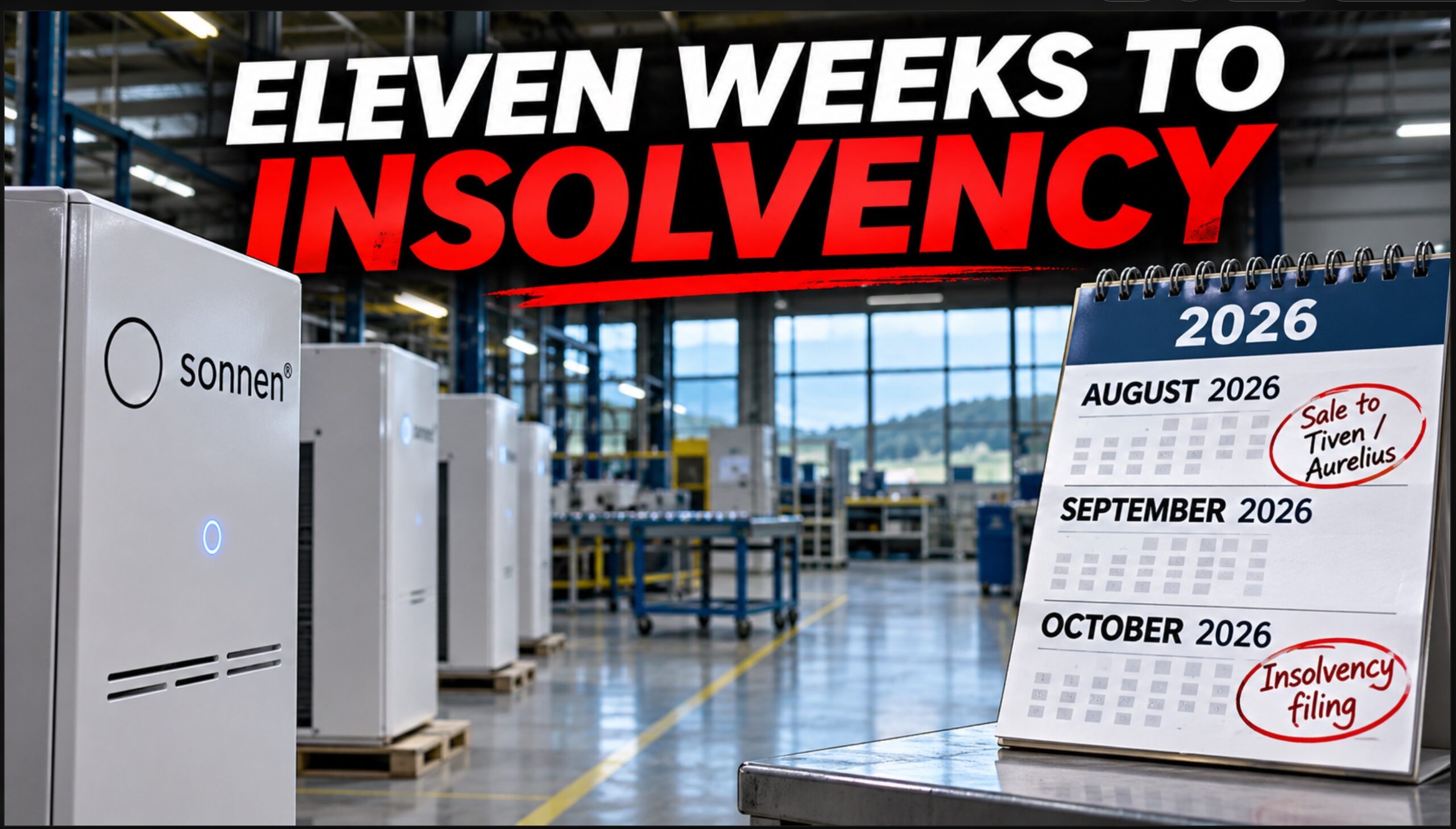
Fresh investigative reporting from Germany has raised fundamental questions about the circumstances surrounding the collapse of Sonnen GmbH, the pioneering battery-storage company sold by Shell in August 2026.
According to the German publication The Pioneer, Sonnen may have been in a stronger financial position before its disposal than the subsequent insolvency might suggest.
There are also reports that employees were presented with a long-term restructuring strategy under the new ownership, only to discover eleven weeks later that their company had filed for insolvency.
The latest revelations shift attention from Shell’s decision to abandon another renewable-energy investment to potentially more consequential questions about the terms of the disposal, the selection of the purchaser and the financial arrangements accompanying the transaction.
A six-to-eight-year recovery programme
In an investigation entitled Der unnötige Untergang von Sonnen — The Unnecessary Downfall of Sonnen — German journalist Claudia Scholz describes a videoconference reportedly held with Sonnen employees on 5 August 2026.
According to her account, René Herzog, associated with the investment group Aurelius, presented employees with a turnaround strategy under which Sonnen would be restructured over six to eight years before being sold at a profit.
On 22 October 2026, Sonnen GmbH filed for insolvency.
The contrast between the reported August presentation and the October insolvency could hardly be greater.
What happened during those intervening eleven weeks?
Did previously unidentified financial problems emerge?
Did anticipated funding fail to materialise?
Or did the new owner fundamentally reconsider its strategy?
These are questions, not findings of misconduct. Establishing the answers would require access to the acquisition agreement, financial forecasts, funding commitments and management records.
Was Sonnen already recovering under Shell?
Perhaps the most significant aspect of the new German investigation concerns Sonnen’s financial position before the sale.
The Pioneer reports indications of economic improvement at both the operating company and its holding company, together with the apparent availability of substantial cash reserves.
There is some additional evidence that management had previously identified an improvement in trading conditions.
On 31 August 2026, the specialist renewable-energy publication pv magazine reported earlier comments from Sonnen Chief Revenue Officer Andreas Plenk indicating that the company had returned to growth in 2025 despite difficult market conditions, and that its order books for 2026 were encouraging.
Revenue growth, of course, does not necessarily translate into profitability. Nor does the existence of cash reserves establish that a business can meet its future obligations.
Nevertheless, these accounts provide a legitimate basis for examining whether the insolvency was inevitable when Shell disposed of the company.
Evidence pointing in the opposite direction
An independent investigation must also consider evidence that may contradict its central hypothesis.
In that context, the Donovan–Shell Archive has identified a publicly accessible professional profile of Maximilian Tritschler, who describes himself as having served as interim chief financial officer at Sonnen GmbH during September and October 2026.
His profile, published through the German interim-management organisation DDIM, presents a materially less optimistic assessment.
It describes an unprofitable battery-manufacturing operation, considerable pressure on cash resources and limited liquidity, alongside more successful activities in the United States and installation businesses.
The profile also describes work undertaken on cash-flow forecasting, outstanding customer payments, supplier liabilities and financial planning.
Source: DDIM professional profile — Maximilian Tritschler
This is a self-reported professional account rather than an independently audited financial statement. Nevertheless, its author claims direct involvement in the company’s financial management during the critical period between the acquisition and the insolvency.
The apparent differences between this account and the findings reported by The Pioneer warrant examination.
They may reflect different dates, corporate entities, financial definitions or changes in Sonnen’s circumstances following the acquisition.
The central question is therefore not simply whether Sonnen possessed cash before the disposal, but what happened to its liquidity, financing arrangements and obligations during the weeks that followed.
What exactly did Shell sell — and to whom?
Precision concerning the identity of the purchaser is important.
Sonnen was acquired by Tiven, the family investment vehicle of Gert Purkert, a co-founder of the international investment group Aurelius.
Shell confirmed the transaction in August and identified Aurelius WaterRise as an adviser to Tiven.
The distinction between the purchasing entity and the advisory organisation matters when assessing their respective legal and commercial responsibilities.
The financial terms of the transaction were not publicly disclosed in the reporting reviewed for this investigation.
Shell described the disposal as part of its continuing efforts to optimise its business portfolio.
That explanation addresses Shell’s strategic reasons for selling Sonnen.
It does not explain the financial safeguards, if any, negotiated to support the continued operation of the business following the change of ownership.
The British documentary trail
Official British corporate filings provide independent documentary evidence of changes associated with the acquisition.
The Companies House filing history for Sonnen UK Limited, company number 15053621, records the following:
- 4 August 2026: Shell plc ceased to be registered as a person with significant control.
- 4 August 2026: Gert Purkert became registered as a person with significant control.
- 4 August 2026: Pieter Andreas Plenk was appointed a director.
- 12 October 2026: Oliver Koch ceased to be a director.
Several of these changes were formally notified to Companies House during October.
Source: Companies House — Sonnen UK Limited filing history
These records establish the reported changes in control and management of the British subsidiary.
They do not establish the financial terms of the wider acquisition, whether any assets were subsequently transferred between group companies, or whether the British business was adequately funded.
The American business tells a different story
On the very day that Sonnen GmbH filed for insolvency in Germany, Sonnen USA issued an announcement presenting a markedly different picture of its commercial prospects.
The American business reported that its sales had doubled and production output had tripled compared with the previous year.
It also anticipated further expansion of its American operations, including its virtual power plant activities.
These are company-reported performance indicators and have not been independently audited for this investigation.
Source: Sonnen USA announcement, 22 October 2026
The apparent commercial strength of the American operation raises questions about the relationship between the financially distressed German business and other parts of the former Shell-owned group.
Among the matters deserving examination are the ownership and valuation of Sonnen’s intellectual property, software platforms, patents, trademarks, manufacturing assets and commercial agreements.
Were any such assets transferred or licensed to other corporate entities following the acquisition?
If so, on what terms, and how were their values determined?
The continuation of a successful overseas business alongside the insolvency of another group company is not inherently improper. No evidence reviewed for this article establishes an unlawful transfer of assets.
However, disclosure of the relevant arrangements would assist creditors and other interested parties in understanding the restructuring.
Employees and customers bear the uncertainty
Behind the corporate restructuring are employees whose livelihoods depend on Sonnen and households that have invested substantial sums in its battery-storage systems.
Handelsblatt reported on 22 October that approximately 400 employees at Sonnen’s Wildpoldsried headquarters had been informed of the insolvency filing.
The newspaper also reported plans to maintain support for more than 150,000 existing customers, notwithstanding the restructuring of the wider business.
Source: Handelsblatt — Sonnen GmbH files for insolvency
For customers, continuity involves considerably more than whether their batteries continue functioning today.
It includes:
- Manufacturer warranties.
- Replacement batteries and components.
- Technical support and maintenance.
- Software and firmware updates.
- Remote monitoring and cloud-based services.
- Participation in virtual power plant programmes.
- Existing electricity supply and associated service contracts.
The commercial life expectancy of a household battery system may extend well beyond the survival of the company that originally manufactured it.
Who will assume responsibility for these obligations if the original contracting company is unable to honour them?
An intention to maintain customer support is welcome, but it is not equivalent to a legally enforceable and adequately financed guarantee of long-term service.
The German insolvency proceedings
On 23 October, the German energy publication Energie & Management reported confirmation from Sonnen that the company had applied for insolvency under self-administration.
Under this procedure, management may remain responsible for operating the business, subject to applicable judicial supervision.
Sonnen indicated that the application concerned Sonnen GmbH rather than every corporate entity within the group.
Source: Energie & Management — Sonnenuntergang in Wildpoldsried
A subsequent report by German energy information website Deutsche Energie Partner stated that its search of the official German insolvency announcements portal on 25 November had not located a corresponding published notice.
Source: Deutsche Energie Partner — Sonnen insolvency and customer information
The Donovan–Shell Archive has not independently confirmed that registry search.
The reported absence of a public notice does not invalidate Sonnen’s confirmation that an application was made. It does, however, leave important procedural details requiring verification, including the court reference, the appointment of any supervising insolvency official and the current status of the application.
Ten questions for Shell, Tiven and Aurelius
In the interests of transparency and corporate accountability, the Donovan–Shell Archive invites the companies concerned to address the following questions.
1. The purchaser
What due diligence did Shell undertake concerning Tiven’s ability and intention to finance Sonnen’s continued operations?
2. The sale price
What consideration did Shell receive or agree to receive for Sonnen, including any contingent payments or retained financial interests?
3. Financial support
Did Shell provide cash, guarantees, loans, working capital or other financial assistance as part of the disposal?
4. The restructuring strategy
Was the reported six-to-eight-year turnaround programme presented to employees on 5 August supported by an approved and adequately funded business plan?
5. The decision to file for insolvency
What financial or commercial developments between 4 August and 22 October caused the proposed turnaround to be replaced by an insolvency application?
6. Cash movements
Were material distributions, intercompany payments, management charges, advisory fees or other transfers of funds made following the acquisition?
7. Intellectual property and other assets
Have any patents, trademarks, software platforms, manufacturing assets or valuable commercial agreements been transferred or licensed to other entities since the acquisition?
8. The United States business
What is the present ownership structure of Sonnen USA, and how are its financial and intellectual property arrangements connected to the German company?
9. Customer protection
What binding and adequately financed arrangements exist to protect existing customers’ warranties, technical support and long-term service requirements?
10. Employee protection
What commitments were made concerning employment continuity, and what assistance is being provided to employees affected by the restructuring?
These questions are not allegations that improper transactions or unlawful conduct occurred. They identify matters on which greater disclosure would improve public understanding.
Shell’s wider corporate responsibility
Shell is entitled to dispose of businesses that no longer fit its commercial strategy.
Nor does a subsequent insolvency automatically make a former owner legally responsible for the failure of a company it has sold.
But Shell is not an incidental participant in Sonnen’s history.
It acquired the business in 2019, promoted it as part of its evolving energy strategy and controlled it for approximately seven years.
The remarkably short interval between its departure and Sonnen’s insolvency makes the circumstances of the disposal a legitimate subject of public scrutiny.
For Shell shareholders, the issue includes the stewardship of corporate resources invested over those seven years.
For Sonnen employees, it concerns the assurances they reportedly received about their future.
For customers, it concerns the continuing value and support of equipment in which they invested their own money.
For creditors, it concerns the financial position and remaining assets of the companies responsible for meeting their claims.
Conclusion: Eleven weeks that require explanation
The latest German reporting does not conclusively establish that Sonnen’s insolvency was avoidable.
Indeed, the publicly accessible account attributed to its interim chief financial officer identifies serious financial difficulties.
But the reported long-term restructuring presentation, the indications of an earlier commercial recovery and the apparent success of the American business collectively justify a closer examination of the transaction.
The acquisition agreement, contemporaneous financial records and subsequent insolvency documentation may ultimately provide satisfactory explanations.
Until those records become available, the central question remains unanswered:
How did a company reportedly presented to its employees as a six-to-eight-year turnaround opportunity become an insolvency case just eleven weeks later?
Shell, Tiven and Aurelius are well placed to contribute to answering that question.
Previous coverage
Invitation to provide evidence and respond
The Donovan–Shell Archive welcomes documentary information from current and former Sonnen employees, customers, creditors, suppliers and other parties with relevant knowledge.
Shell plc, Tiven, Aurelius and Sonnen are invited to provide responses, factual corrections or documentary clarification. Any substantive responses received will be fairly reflected in subsequent coverage.
Editorial and methodology note: This independent article was prepared with AI-assisted research and drafting, drawing on publicly accessible corporate records, company announcements, professional information and German journalistic reporting. The complete subscription-only investigation published by The Pioneer was not accessible. Reported claims have been distinguished from documented facts, and no finding of unlawful conduct is asserted.