By John Donovan — 29 October 2026
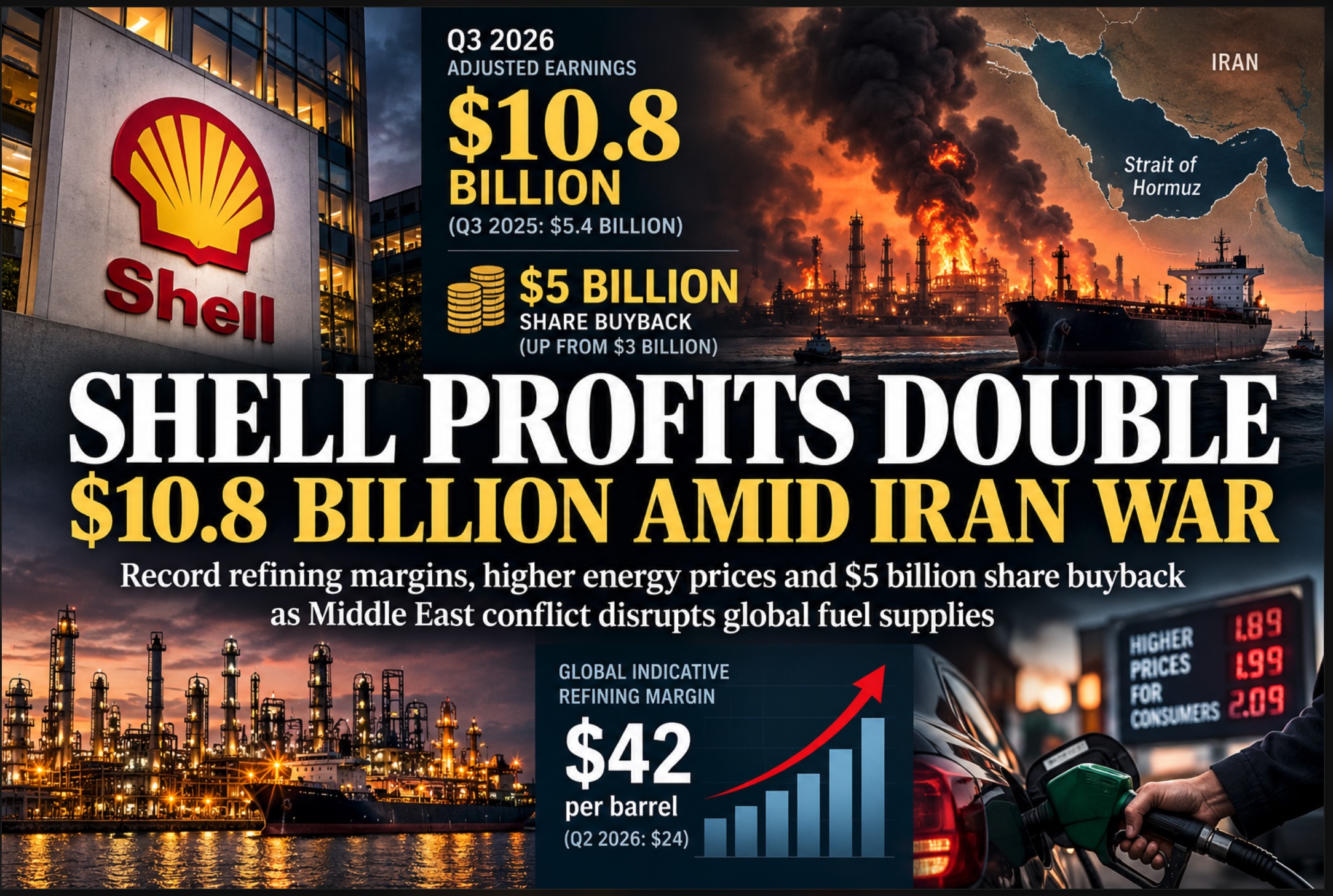
Shell has reported one of the largest quarterly profits in its history as the war involving Iran disrupts global energy supplies and pushes refining margins to record levels. The oil and gas giant announced adjusted earnings of $10.8 billion for the third quarter of 2026, almost double the equivalent figure a year earlier, while increasing its next share buyback programme to $5 billion. The results illustrate a troubling paradox: the same international conflict that has damaged energy infrastructure, disrupted fuel supplies and increased costs for consumers has also created exceptionally profitable trading and refining conditions for some of the world’s largest energy companies.
Shell announces another extraordinary quarter
On Thursday, 29 October 2026, Shell plc announced adjusted earnings of $10.814 billion for the three months ending 30 September.
The result compares with $5.432 billion in the corresponding quarter of 2025.
It also represents an increase from the $9.836 billion recorded during the second quarter of 2026.
Analysts had expected approximately $10.33 billion.
Shell exceeded that forecast.
The company’s results were accompanied by another substantial announcement.
Shell will undertake a new $5 billion share buyback programme over the next three months, compared with $3 billion announced for the preceding quarter.
The increase is particularly striking because it comes during a period of severe disruption to the global energy system.
Oil and gas prices have risen sharply as the conflict involving the United States, Israel and Iran has affected production, transportation and refining facilities across the Middle East.
The closure and disruption of important energy transportation routes, particularly the Strait of Hormuz, have contributed to shortages and volatility.
For consumers and energy-importing economies, those developments have created significant financial pressures.
For Shell, the higher prices and tighter refining markets have supported exceptionally strong earnings.
Source: The Guardian — Shell Profits Double to $10.8bn, 29 October 2026
Primary source: Shell plc — Third Quarter 2026 Results Announcement
The figures behind Shell’s extraordinary performance
Shell’s official results reveal the scale of the company’s performance.
| Financial measure | Third quarter 2026 |
|---|---|
| Adjusted earnings | $10.814 billion |
| Income attributable to shareholders | $12.1 billion |
| Adjusted EBITDA | $22.736 billion |
| Cash flow from operating activities | $21.043 billion |
| Free cash flow | $16.3 billion |
| New share buyback programme | $5 billion |
| Global indicative refining margin | $42 per barrel |
The distinction between adjusted earnings and statutory profit matters.
Shell’s preferred adjusted earnings measure excludes certain items to provide a comparison of underlying performance between reporting periods.
The company separately reported approximately $12.1 billion in income attributable to shareholders.
The $10.8 billion figure featured in newspaper headlines is therefore Shell’s adjusted earnings figure, not the statutory bottom-line measure.
Both figures demonstrate substantial profitability.
The results also reveal that Shell generated approximately $21 billion in operating cash flow during the quarter, despite disruptions affecting its Middle Eastern operations.
The remarkable refining margin: $42 per barrel
Perhaps the most striking development is the extraordinary increase in Shell’s refining margin.
In its trading update on 7 October, Shell indicated that the global indicative refining margin for the third quarter would reach $42 per barrel.
Today’s full results confirmed that figure.
For comparison, the margin had been $24 per barrel during the second quarter.
That is an increase of 75% in a single quarter.
The indicative margin is a benchmark used by Shell to assess the refining environment. It is not a statement that the company earned exactly $42 in net profit on every barrel processed.
Nevertheless, it demonstrates the dramatic improvement in the commercial environment for refining.
The Guardian reports that the previous record was approximately $28 per barrel, reached during the early stages of Russia’s invasion of Ukraine.
The latest margin substantially exceeds that earlier peak.
The increase reflects shortages of refined fuels, including diesel, as disruptions and damage to refineries in the Middle East and Russia have reduced available supply.
When refinery capacity is disrupted while demand remains substantial, the prices of refined products can rise more rapidly than the cost of crude oil.
That can produce exceptionally high margins for refineries that remain operational.
Shell’s Chemicals and Products division recorded approximately $3.855 billion in adjusted earnings during the quarter, of which about $3.8 billion came from Products.
This was the company’s largest reported segment contribution to adjusted earnings during the period.
The figures help explain why Shell’s earnings have increased so sharply.
Source: Shell — Third Quarter 2026 Trading Update, 7 October
War creates both profits and losses for Shell
There is an important qualification to the suggestion that the Iran war has been uniformly beneficial to Shell.
The conflict has also damaged facilities in which the company has substantial interests.
Shell’s operations in Qatar have been particularly affected.
The company’s Pearl gas-to-liquids facility suffered disruption following attacks on regional energy infrastructure.
Shell’s wider gas production was also affected by damage and outages across the region.
The Wall Street Journal reports that production at Pearl had not resumed at the time of today’s results.
Yet Shell’s overall financial performance remained exceptionally strong.
Higher oil and gas prices, improved refining margins and the contribution from other operations more than offset the effects of some of those disruptions.
The company’s Integrated Gas division reported adjusted earnings of approximately $3.037 billion.
Upstream operations generated approximately $3.189 billion.
Marketing contributed approximately $1.164 billion.
The results therefore demonstrate that Shell’s different businesses can respond very differently to a geopolitical crisis.
An individual facility may suffer serious damage.
Production volumes may decline.
But other businesses can benefit from the resulting shortage of supply.
The company’s global portfolio allows it to operate across these different market conditions.
That capacity is commercially valuable to shareholders.
It also raises wider questions about how the costs and benefits of international energy disruption are distributed.
Oil prices rise as consumers face increased costs
The conflict has pushed international energy prices significantly higher.
According to the Guardian, the global benchmark oil price averaged approximately $94.90 per barrel during the third quarter.
That compares with $69.10 during the equivalent period in 2025.
European benchmark gas prices averaged almost €64 per megawatt-hour, compared with more than €48 during the preceding quarter.
These figures illustrate how dramatically the energy market has changed.
For an international oil and gas producer, higher selling prices can increase revenue and profitability.
For consumers and many industrial businesses, the same changes increase costs.
The effects are not identical for every company or household.
Energy producers can also experience higher operating costs, damage, production interruptions and changing tax obligations.
Nevertheless, the fundamental relationship is clear.
Disruption that restricts supply can increase the profitability of energy companies whose remaining production and refining capacity benefits from higher market prices.
That is precisely the environment reflected in Shell’s latest results.
Wael Sawan welcomes strong performance
Shell chief executive Wael Sawan attributed the results to the company’s operational performance during a period of severe disruption.
In its official announcement, Shell highlighted the resilience of its global operations and the work undertaken by its employees.
Sawan also pointed to the company’s continued investment in its Integrated Gas business.
The developments announced during the quarter included completion of the acquisition of ARC Resources and a final investment decision on the second phase of LNG Canada.
Shell said its financial strength allowed the company to announce the increased share buyback programme.
Those investments are consistent with the company’s strategy of maintaining substantial exposure to oil and gas, particularly liquefied natural gas.
The results demonstrate the financial appeal of that strategy under current market conditions.
However, it would be incorrect to assume that exceptionally high prices and refining margins will necessarily continue indefinitely.
Commodity markets remain volatile.
Higher prices may encourage additional production or reduce demand.
Military and diplomatic developments could also alter the supply outlook.
Shell’s own financial disclosures recognise the uncertainty surrounding future commodity prices and geopolitical events.
Shareholders receive another $5 billion buyback
The increase in Shell’s share repurchase programme deserves particular attention.
The company has announced that it intends to spend $5 billion repurchasing its own shares during the next three months.
That represents an increase of approximately 67% compared with the previous $3 billion programme.
Share buybacks reduce the number of shares outstanding when the repurchased shares are cancelled.
They can increase earnings per remaining share and return capital to shareholders.
They do not, however, guarantee an increase in the company’s share price.
Nor are they equivalent to an ordinary cash dividend received equally by every shareholder.
The commercial justification depends upon the price paid, the company’s alternative investment opportunities and its wider financial circumstances.
For investors, Shell’s ability to fund such substantial distributions is evidence of strong cash generation.
For critics, the scale of the payouts raises questions about corporate priorities during a period when high energy costs are affecting households and businesses.
Both perspectives deserve consideration.
The important fact is that Shell has chosen to increase shareholder distributions while benefiting from exceptionally favourable refining and commodity-price conditions.
Other European oil companies are also reporting windfalls
Shell is not alone.
The Financial Times reports that several major European oil companies are increasing shareholder distributions following the surge in energy prices and refining profitability.
TotalEnergies reported approximately $9.1 billion in adjusted earnings, more than double its comparable result a year earlier.
The French company also announced an increase in its dividend and additional share buybacks.
Spain’s Repsol reported a substantial increase in adjusted net income and announced higher shareholder distributions.
Other major European energy companies have also benefited from stronger commodity markets.
This broader industry pattern matters.
Shell’s results cannot be explained solely by changes in its internal operating efficiency.
The external market environment has contributed substantially.
The war has created shortages, price volatility and trading opportunities affecting the industry as a whole.
Shell’s global scale and commercial capabilities have enabled it to benefit significantly from those conditions.
Climate campaigners respond
Environmental campaigners have criticised the sharp increase in fossil-fuel profits.
The Guardian reports that Greenpeace senior campaigner Philip Evans condemned the contrast between Shell’s profitability and the financial and environmental pressures facing communities.
His criticism linked the company’s earnings to wider concerns about fossil-fuel dependence, climate-related disasters and rising costs.
These are positions advanced by Greenpeace.
They should be distinguished from Shell’s audited or reported financial results.
Shell maintains that its principal responsibility is to operate safely, supply energy to customers and generate sustainable returns for investors.
The company also continues to invest in certain lower-carbon businesses, although oil and gas remain central to its strategy.
The disagreement reflects a wider debate about the role of fossil-fuel companies in a world attempting to reduce greenhouse-gas emissions while remaining dependent upon oil and natural gas.
Today’s figures give that debate renewed prominence.
Editorial commentary: When international conflict becomes an exceptionally profitable quarter
There is an uncomfortable reality at the centre of Shell’s latest results.
A major international conflict has damaged energy infrastructure and disrupted supplies.
Those disruptions have contributed to higher prices.
Higher prices have increased costs for consumers and many businesses.
Yet they have also created exceptionally profitable conditions for Shell.
This is not evidence that Shell caused the conflict.
It is not evidence that Shell wanted the conflict to occur.
Nor does it establish that the company has engaged in unlawful profiteering.
Such allegations would require evidence that has not been presented here.
But it does demonstrate how the structure of the international energy industry can produce financial outcomes that appear deeply contradictory.
A damaged refinery in one country can increase the value of refining capacity elsewhere.
A disrupted transportation route can increase the value of alternative supplies.
A shortage that causes difficulties for consumers can increase the earnings of companies able to sell into the constrained market.
Those are commercial consequences of supply and demand.
They are also consequences worth examining critically.
Shell’s shareholders are entitled to consider the company’s financial performance.
The company has delivered substantial earnings, cash flow and shareholder distributions.
But the wider public is equally entitled to examine the circumstances in which those profits were generated.
The distinction between operational achievement and favourable external market conditions is particularly important.
Shell’s management has emphasised operational performance.
The official results also acknowledge the contribution from elevated commodity prices and record refining margins.
Both factors played a role.
The company’s ability to capture additional value under difficult conditions is commercially significant.
But the exceptional prices were not created solely by managerial excellence.
They were also influenced by war, damaged infrastructure and constrained supplies.
Shell’s financial success and the wider economic damage associated with the energy crisis are not mutually exclusive. They are occurring simultaneously.
For shareholders, the results demonstrate the continuing profitability of a business model heavily exposed to oil, gas and refining.
For policymakers, they raise questions about energy security, diversification, taxation and the distribution of windfall gains.
For consumers, they are another reminder that the benefits of higher energy prices are not shared equally.
These issues cannot be resolved by examining one company’s quarterly earnings.
But the figures provide a compelling reason to ask the questions.
The broader historical context is also revealing.
In 2022, Russia’s invasion of Ukraine caused extraordinary disruption to European energy markets.
Energy producers benefited from elevated prices while consumers faced exceptional costs.
In 2026, another major conflict has again created conditions in which oil and gas companies are recording unusually high earnings.
The circumstances of the two conflicts differ substantially.
Nevertheless, the financial pattern deserves attention.
Geopolitical disruption can destroy economic value in some parts of the energy system while creating exceptional profitability in others.
Shell’s latest results demonstrate that relationship with unusual clarity.
Documentary findings
Established facts: Shell reported $10.814 billion in third-quarter adjusted earnings, compared with $5.432 billion one year earlier. The company announced a $5 billion share repurchase programme. Its global indicative refining margin increased to $42 per barrel from $24 in the preceding quarter. Shell generated approximately $21 billion in cash flow from operating activities and reported $12.1 billion in income attributable to shareholders.
Documented explanations: Shell attributed its strong results to operational performance, elevated commodity prices and record refining margins. Contemporary reporting identified disruptions associated with the Iran war as an important contributor to higher energy and refined-fuel prices. The conflict also damaged or disrupted some Shell operations.
Editorial interpretation: The divergence between exceptionally strong corporate profits and the costs imposed upon consumers by energy disruption raises legitimate questions about corporate responsibility, shareholder distributions and public energy policy.
Matters not established: These figures do not establish that Shell caused or encouraged the conflict, engaged in illegal price manipulation, or earned its entire reported profit directly from the war. Nor do they establish that record refining margins will continue.
Principal sources
- Shell plc — Third Quarter 2026 Results, 29 October 2026 — Primary corporate announcement containing the earnings, cash-flow, segment-performance and shareholder-distribution figures.
- The Guardian — Shell Profits Double to $10.8bn as Iran War Pushes Up Profit Margin on Oil — Jillian Ambrose’s reporting on the results, energy prices and environmental reaction.
- Reuters — Shell Expects Record Refining Margins, 7 October 2026 — Contemporary analysis of the refinery-margin increase and market disruptions.
- Shell — Third Quarter 2026 Trading Update — Shell’s earlier official indications concerning production, margins and trading conditions.
- Reuters — Oil Majors Face Spending Test from Iran War Windfall Cash, 20 October 2026 — Industry-wide examination of the profitability surge and questions about capital allocation.
- Financial Times — European Oil Majors Lift Buybacks as Iran War Drives Bumper Profits, 29 October 2026 — Comparative reporting on Shell, TotalEnergies, Repsol and other European producers.
Documentary disclaimer: This article distinguishes official Shell financial disclosures and independently reported market developments from editorial interpretation. Adjusted earnings are a non-GAAP performance measure and differ from statutory income attributable to shareholders. The $42-per-barrel indicative refining margin is not Shell’s net profit on each barrel processed. No allegation is made that Shell caused the Iran conflict, deliberately manipulated energy prices or acted unlawfully. Forward-looking assessments of commodity prices, shareholder distributions and investment performance remain subject to uncertainty. Factual corrections and responses from Shell and other interested parties are welcome.
The website’s general disclaimer also applies.








