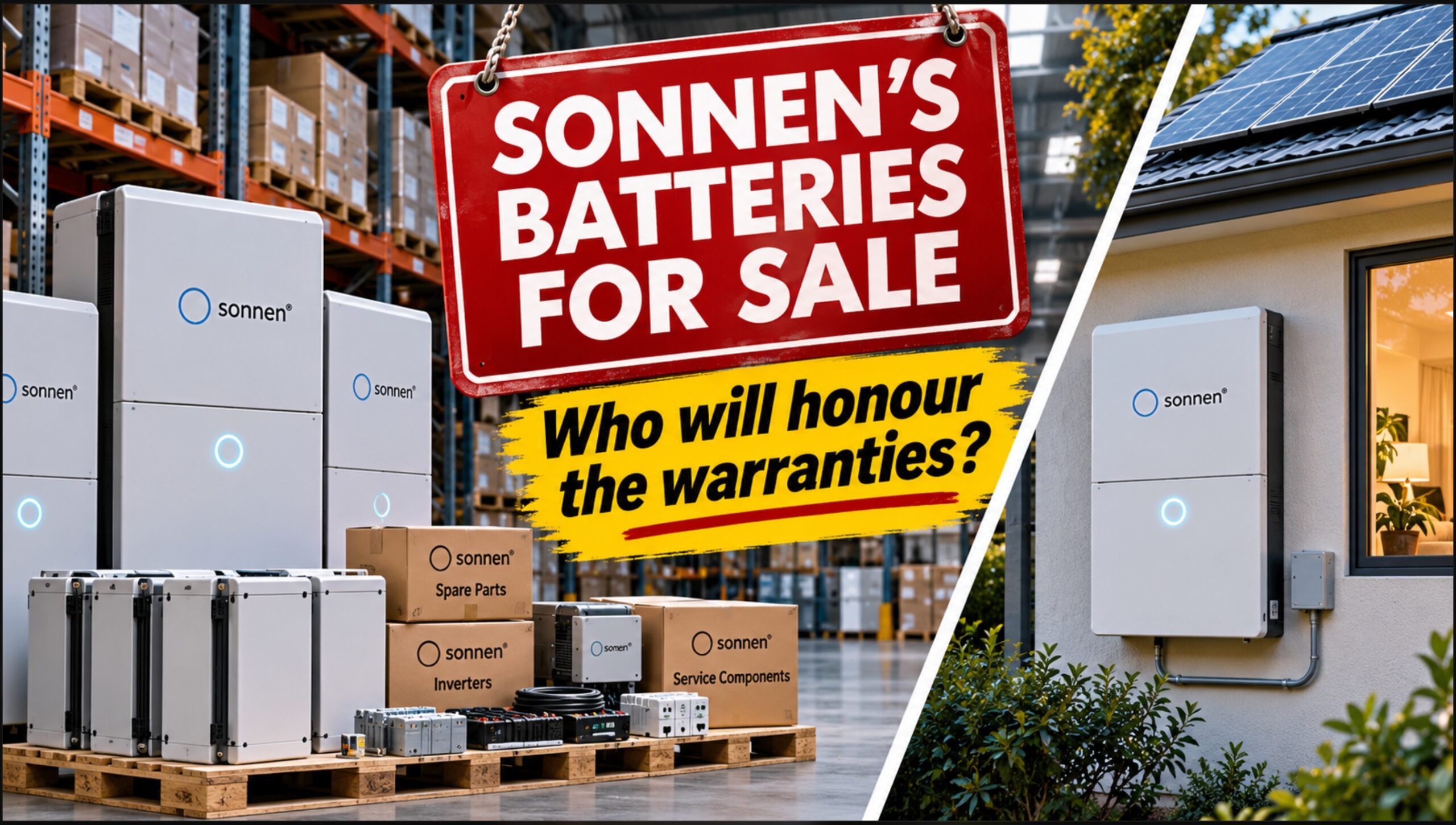
 AI-generated editorial illustration. The warehouse, battery inventory and residential installation are illustrative and do not depict the actual premises or assets involved in the Australian liquidation.
AN INDEPENDENT DOCUMENTARY INVESTIGATION
By the Donovan–Shell Archive
29 November 2026
The collapse of Sonnen, the battery-storage pioneer sold by Shell in August 2026, has entered a significant new phase in Australia.
The appointed liquidators of Sonnen Australia Pty Limited have issued an urgent invitation for prospective purchasers to acquire the company’s battery inventory, energy-system equipment and service components.
The announcement, published on 27 November 2026 by Australian insolvency specialists SV Partners, provides direct documentary evidence that the liquidation has progressed to the attempted disposal of physical assets.
Among the items being offered are components potentially important to the continued operation, maintenance and repair of existing Sonnen battery installations.
For Australian households that invested in Sonnen’s technology, the development raises increasingly pressing questions about the future availability of replacement parts, manufacturer warranties and technical support.
For Shell, it represents another chapter in the continuing collapse of parts of a business it owned for approximately seven years before selling it in August.
An urgent invitation to prospective purchasers
SV Partners has confirmed that Hugh Armenis and Jason Lloyd Porter were appointed liquidators of Sonnen Australia Pty Limited on 24 November 2026.
Their announcement identifies inventory associated with three Sonnen battery-system product lines:
- sonnenBatterie 8.
- sonnenBatterie 9.
- sonnenBatterie Evo.
The stock being offered includes battery modules of several capacities, power-conversion equipment, metering devices and other electrical and servicing components.
Expressions of interest must be submitted by 5 pm on Friday, 11 December 2026.
The liquidators have provided a dedicated email address for prospective purchasers: [email protected].
The announcement describes the Australian company as having operated a battery distribution and support business in Adelaide within the wider German Sonnen group.
Primary documentary source:
The published invitation does not disclose the total quantity or estimated value of the inventory, nor does it identify a prospective purchaser.
It establishes that a sale is being pursued, not that a transaction has already been completed.
From Shell’s disposal to liquidation
The sequence of events is striking.
2019: Shell acquired Sonnen, presenting the business as part of its developing strategy in distributed energy, residential battery storage and electricity services.
August 2026: Shell disposed of Sonnen to Tiven, the family investment vehicle of Aurelius co-founder Gert Purkert, with Aurelius WaterRise acting in an advisory capacity.
20 October 2026: Sonnen Australia entered voluntary administration.
22 October 2026: Sonnen GmbH filed for insolvency in Germany.
24 November 2026: The Australian company entered liquidation, with Hugh Armenis and Jason Lloyd Porter appointed as liquidators.
25 November 2026: Notice of the Australian winding-up resolution was published.
27 November 2026: The liquidators announced the proposed sale of battery inventory and servicing components.
11 December 2026: Deadline for prospective purchasers to express interest.
The transition from Shell ownership to liquidation and the proposed disposal of Australian inventory has taken less than four months.
Source: Australian insolvency notice, 25 November 2026
The Australian liquidation concerns a separate legal entity from Sonnen GmbH in Germany. It should not be interpreted as establishing that every Sonnen subsidiary has ceased trading or is subject to liquidation.
When the spare parts become liquidation assets
The proposed inventory disposal highlights an often-overlooked dimension of the renewable-energy industry.
Residential battery systems are not simply products purchased once and then forgotten.
Their long-term usefulness can depend on the continuing availability of compatible components, specialist technicians, diagnostic systems, software updates and manufacturer support.
A household investing in a battery-storage installation reasonably expects that the equipment will remain serviceable for many years.
The manufacturer’s survival, or the existence of alternative arrangements for supporting its products, can therefore become an important consideration in the economic value of that investment.
Sonnen Australia’s inventory is particularly relevant in this context because the liquidators are offering equipment associated with several generations of its battery technology.
The proposed sale could potentially result in replacement stock becoming available through an independent supplier or specialist servicing business.
Alternatively, the inventory could be acquired for resale without any associated commitment to support existing customers.
The announcement does not establish which outcome is envisaged.
Nor does it specify whether any inventory has been set aside for outstanding warranty or repair claims.
What happens to Sonnen’s warranties?
The distinction between purchasing physical assets and assuming contractual liabilities is fundamental.
A company acquiring battery modules and other equipment from a liquidator does not necessarily assume responsibility for warranties previously issued by the insolvent business.
A purchaser may acquire inventory without accepting the financial obligations associated with products already sold.
That distinction could have considerable practical significance for existing Sonnen customers.
The liquidators’ announcement does not confirm:
- The transfer of existing manufacturer warranty obligations.
- The establishment of a successor technical-support organisation.
- The availability of replacement components for outstanding warranty claims.
- Continued access to manufacturer diagnostic systems.
- Long-term maintenance of monitoring platforms or software services.
- The transfer of intellectual property or associated licensing rights.
These omissions do not establish that arrangements for customer protection are absent or that such arrangements cannot subsequently be negotiated.
They do establish that the inventory sale announcement itself provides no assurance on these matters.
Australian installers confront the consequences
The effects of Sonnen’s difficulties are extending beyond the company and its direct customers.
Australian installers and retailers that previously supplied Sonnen battery systems are confronting questions about their continuing responsibilities.
On 25 November 2026, Australian renewable-energy installer SAE Group published a dedicated information and support page for Sonnen battery owners.
It provides access to product documentation and a means of requesting assistance.
However, the company also identifies uncertainty regarding manufacturer warranties, replacement parts, technical support and ongoing software-related services.
Source: SAE Group — Sonnen battery owner support and updates
Separately, an installer bulletin published by McKercher Corporation and updated on 26 November discusses the implications of the liquidation for businesses that previously installed Sonnen products.
It highlights the potential responsibilities of retailers and installers when customers can no longer rely upon the original manufacturer’s Australian operation.
Source: McKercher Corporation — Sonnen Australia in liquidation: what installers face
These publications illustrate how the consequences of a manufacturer’s insolvency may extend throughout its commercial distribution and installation network.
Australian consumer law may offer additional protection
The liquidation of a manufacturer does not necessarily extinguish all the rights available to consumers.
Under Australian Consumer Law, statutory consumer guarantees may apply independently of a manufacturer’s express warranty.
Depending on the circumstances, customers may retain rights against the retailer or other business that supplied their equipment.
The Australian Competition and Consumer Commission provides guidance on these protections.
Source: ACCC — Consumer rights and guarantees
Nevertheless, the existence of legal rights does not automatically resolve practical difficulties associated with the availability of proprietary components or specialist technical support.
A retailer may have obligations towards a customer while facing considerable difficulty obtaining the equipment necessary to fulfil them.
This is one reason why the outcome of the proposed Sonnen inventory sale deserves attention.
Affected customers should retain their purchase documentation, warranty agreements and correspondence, and obtain advice concerning their individual circumstances where necessary.
The unanswered questions surrounding Shell’s sale
The Donovan–Shell Archive has previously examined the circumstances surrounding Shell’s disposal of Sonnen and the rapid emergence of insolvency proceedings.
Our investigation published on 26 November considered German reporting that Sonnen employees had been presented with a restructuring strategy extending over six to eight years.
Within approximately eleven weeks, the German company had filed for insolvency.
That investigation also examined conflicting accounts concerning Sonnen’s financial position and identified questions about its liquidity, funding arrangements and the relationship between different parts of the international business.
The latest Australian development adds a further dimension: what provision was made for the long-term protection of customers when Shell disposed of the group?
Did the acquisition agreement include provisions intended to maintain adequate reserves of replacement components?
Were arrangements made to finance continuing warranty obligations?
Did Shell assess the purchaser’s capacity to sustain the infrastructure required to support existing battery installations?
Were commitments concerning customer protection included in the transaction documentation?
The relevant contractual provisions have not been established from the publicly available evidence reviewed for this article.
These questions are not assertions that Shell, Tiven or Aurelius acted unlawfully.
Nor is the liquidation sale itself evidence of improper asset stripping. The realisation of assets is a normal function of liquidation proceedings.
The questions concern the extent to which the consequences now confronting customers and other stakeholders were anticipated and addressed when the business changed ownership.
What about Sonnen’s software and intellectual property?
The inventory sale also draws attention to the distinction between physical equipment and the technology necessary to operate and maintain it.
Modern residential battery systems may depend on proprietary software, remote monitoring, communications infrastructure and specialist diagnostic tools.
A purchaser of replacement battery modules may not automatically acquire access to those systems.
Similarly, the acquisition of physical inventory does not necessarily convey ownership of patents, trademarks, software or other intellectual property.
The liquidators’ announcement identifies physical stock. It does not disclose a corresponding sale of intellectual property or the transfer of software-platform responsibilities.
The Donovan–Shell Archive has not established that any such transfer has taken place in connection with the Australian liquidation.
The relationship between these assets and the surviving operations elsewhere in the Sonnen group, including the United States, remains an important subject for further documentary research.
Seven questions arising from the Australian liquidation
The following questions are now particularly relevant to the interests of Sonnen customers, installers and creditors.
1. Warranty obligations
Is any existing Sonnen entity, prospective purchaser or third-party organisation prepared to assume responsibility for outstanding Australian manufacturer warranties?
2. Replacement components
Will any inventory be reserved or otherwise made available to satisfy existing repair and warranty requirements?
3. Future technical support
Are arrangements being considered for an independent or successor Sonnen servicing business in Australia?
4. Software continuity
Who will maintain the monitoring platforms, diagnostic tools and other software services associated with Australian installations?
5. Employee expertise
Could former Sonnen employees be retained or engaged by a purchaser to preserve specialist technical knowledge and customer-support capabilities?
6. Asset ownership and intellectual property
Does the Australian company own, or have transferable rights to use, intellectual property required to service the systems associated with the inventory being offered?
7. Shell’s disposal agreement
What financial or contractual arrangements, if any, were included in Shell’s August disposal to safeguard continuing customer support and warranty obligations?
Answers to these questions would assist customers and installers in assessing the longer-term consequences of the liquidation.
The wider implications for the renewable-energy industry
The Sonnen case has relevance beyond the history of a single battery manufacturer or Shell’s changing approach to renewable-energy investment.
Governments encourage households to invest in technologies intended to reduce electricity costs, improve energy security and support decarbonisation.
The credibility of those policies depends partly upon consumers having confidence in the durability and serviceability of the products they purchase.
If a battery manufacturer fails, customers may discover that the value of their investment depends not only on the physical condition of the equipment but also on the survival of the commercial infrastructure supporting it.
This raises legitimate questions about whether the renewable-energy industry should develop stronger mechanisms for protecting customers against manufacturer failure.
Such mechanisms might include independently backed warranties, arrangements for continued access to replacement parts, transferable servicing rights and contingency plans for software-dependent products.
These are broader policy considerations rather than findings of wrongdoing in the Sonnen case.
Nevertheless, Sonnen’s difficulties provide a timely illustration of why such issues deserve attention.
Conclusion: The equipment remains, but who will support it?
On 27 November 2026, the Australian liquidators formally invited prospective purchasers to acquire Sonnen’s remaining battery and service-component inventory covered by their announcement.
That development is now a matter of documentary record.
What remains uncertain is whether a successful purchaser will acquire anything beyond physical equipment, and whether the transaction will contribute to a sustainable solution for existing Sonnen customers.
The proposed sale could present an opportunity to preserve an important source of replacement parts and specialist support.
It could also proceed without resolving the outstanding questions concerning manufacturer warranties and long-term servicing.
The bidding deadline of 11 December 2026 represents the next identifiable milestone in the Australian proceedings.
For the households that invested in Sonnen’s technology, the most important question is not simply who buys the remaining batteries and spare parts.
It is who, if anyone, will stand behind the batteries they have already bought.
Primary documents and further reading
27 November 2026 — SV Partners: Sonnen Australia inventory sale announcement
25 November 2026 — Sonnen Australia winding-up notice
SAE Group — Sonnen battery owner support
McKercher Corporation — Implications of Sonnen Australia’s liquidation for installers
Australian Competition and Consumer Commission — Consumer rights and guarantees
Previous Donovan–Shell Archive investigations
Invitation to provide evidence and respond
The Donovan–Shell Archive welcomes information from affected Sonnen customers, former employees, installers, suppliers and creditors.
Shell plc, Tiven, Aurelius, Sonnen and the appointed Australian liquidators are invited to provide factual clarification or relevant documentary information. Any substantive responses received will be fairly reflected in subsequent coverage.
Editorial and methodology note: This independent documentary investigation was prepared with AI-assisted research and drafting. Its principal new evidence is the inventory sale announcement published directly by the appointed Australian liquidators on 27 November 2026. The announcement confirms a proposed sale, not a completed transaction. Questions concerning warranty continuity, financing, intellectual property and contractual responsibilities remain unresolved. No finding of unlawful conduct is asserted. This article does not constitute individual legal advice.