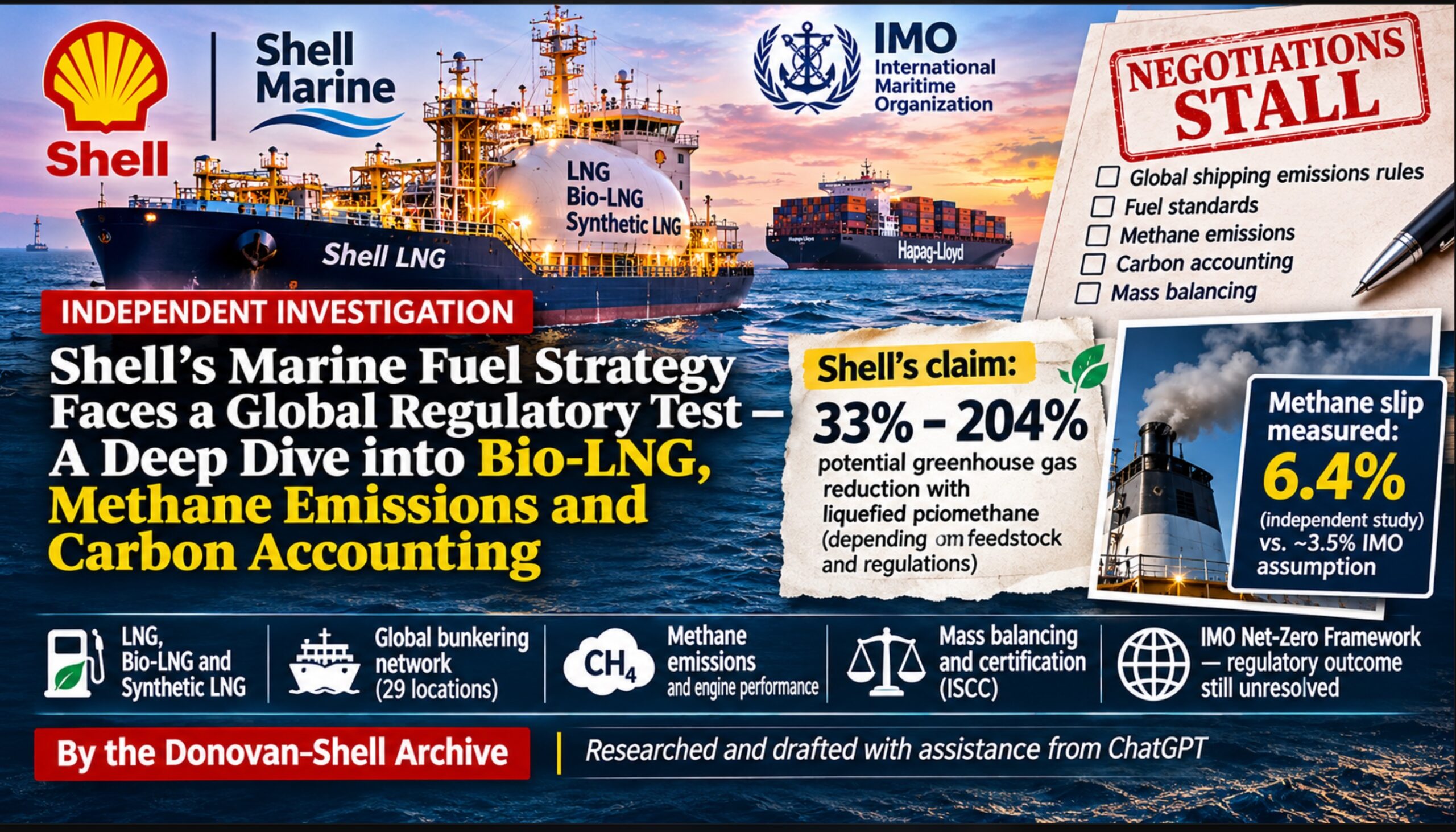
AN INDEPENDENT DOCUMENTARY INVESTIGATION
By the Donovan–Shell Archive
28 November 2026
Researched and drafted with assistance from ChatGPT.
International negotiations over the future regulation of greenhouse gas emissions from shipping ended on Friday without an agreed compromise text. The development has significant implications for Shell, which operates an extensive international marine LNG supply network and is promoting renewable methane-based fuels as a route towards maritime decarbonisation.
An examination of Shell’s own corporate publications, independent scientific measurements and international regulatory documents reveals a fundamental question: how much of the claimed environmental benefit arises from actual emissions reductions, and how much depends upon the accounting methodology used to calculate them?
1. International negotiations end without an agreed text
On 27 November 2026, the International Maritime Organization’s 23rd Intersessional Working Group on the Reduction of Greenhouse Gas Emissions from Ships concluded its meeting in London.
According to an assessment published yesterday by University College London’s Shipping and Oceans Research Group, the meeting ended without agreement on a text reconciling the outstanding differences between participating governments.
The researchers nevertheless reported continuing support among many countries that spoke during the discussions for central elements of the original proposed framework.
These include progressively stricter fuel-emissions standards, a central financial mechanism and incentives for fuels with exceptionally low greenhouse gas emissions.
The negotiations now move to the IMO’s Marine Environment Protection Committee, which is scheduled to meet from 30 November to 3 December 2026.
A resumed extraordinary session on 4 December remains subject to confirmation.
The international framework has not been abandoned. Nor has its final adoption been secured.
Sources:
University College London — Assessment of the IMO Negotiations, 27 November 2026
Ship & Bunker — Working Group Ends Without Agreed Text, 27 November 2026
International Maritime Organization — Official Meeting Schedule
2. Shell warned of the consequences earlier this month
The latest development follows an intervention by Shell itself.
On 13 November 2026, S&P Global Energy reported that Shell had expressed concern about continuing delays in establishing international rules for lower-emission marine fuels.
In a statement supplied to the publication on 12 November, Shell argued that regulatory uncertainty risked delaying investments in fuel-production infrastructure intended to operate for decades.
The company called for regulatory:
“clarity, not perfection”
Shell also advocated recognition of mass-balancing arrangements for renewable methane-based fuels, arguing that physically segregating large quantities of renewable fuel would present substantial logistical difficulties.
The statement establishes Shell’s interest in both the timing and technical design of the proposed regulations.
3. The scale of Shell’s existing commercial commitment
Shell’s own marine business website provides a useful indication of the scale of its investment in LNG refuelling infrastructure.
Its published figures identify:
| Shell marine LNG network | Corporate figures |
|---|---|
| Countries served | 13 |
| Refuelling locations | 29 |
| Bunkering vessels | 16 |
| Additional newbuild vessels | 4 |
| Bunkering operations | More than 4,000 |
Shell describes this as the world’s largest LNG bunkering network.
Bunkering is the process of supplying fuel to ships.
The network provides Shell with a commercial platform capable of supplying conventional LNG, renewable biomethane and potentially synthetic methane-based fuels.
For Shell, international rules determining which fuels qualify for favourable environmental treatment could therefore influence the utilisation and commercial prospects of infrastructure in which the company and its partners have already invested.
Primary source: Shell Marine — LNG, Bio-LNG and Synthetic LNG
4. The environmental claim that deserves closer examination
On 11 September 2025, Shell announced a multi-year agreement with the international shipping company Hapag-Lloyd for the supply of liquefied biomethane.
The agreement builds upon an earlier LNG supply and decarbonisation partnership established in 2023.
Buried within Shell’s September 2025 announcement is a particularly striking numerical claim.
Shell stated that liquefied biomethane could potentially achieve greenhouse gas reductions of between:
33% and 204%
when compared with very low sulphur fuel oil, depending upon feedstock and applicable regulations.
A reduction exceeding 100% requires explanation.
It does not mean that the physical combustion of methane aboard a ship produces no greenhouse gases.
Nor does it mean that every ship using Shell’s renewable fuel automatically removes carbon dioxide from the atmosphere.
Shell’s accompanying explanatory note identifies the importance of avoided emissions associated with certain feedstocks, particularly manure, under recognised European lifecycle accounting methodologies.
Under particular circumstances, credits for preventing emissions that would otherwise have occurred can produce a calculated negative net lifecycle emissions intensity.
The 204% figure is therefore a potential result of a specified accounting methodology, rather than a universal characteristic of liquefied biomethane.
Primary source: Shell — Hapag-Lloyd and Shell Sign Multi-Year Liquefied Biomethane Deal, 11 September 2025
5. How a greenhouse gas reduction can exceed 100%
A simplified hypothetical example helps explain the underlying calculation.
Suppose conventional marine fuel produces 100 units of greenhouse gas emissions over its lifecycle.
An alternative fuel might produce 40 units through its manufacture, transportation and consumption.
However, the production of that alternative fuel might also prevent 60 units of emissions that would otherwise have occurred through the decomposition of organic waste.
The resulting net lifecycle calculation would be:
| Illustrative accounting component | Emissions units |
|---|---|
| Conventional fuel benchmark | 100 |
| Alternative fuel lifecycle emissions | 40 |
| Avoided waste-related emissions | −60 |
| Calculated net alternative fuel emissions | −20 |
| Reduction relative to conventional fuel | 120% |
These figures are illustrative only. They are not measurements of Shell’s operations or a reconstruction of its 204% claim.
The environmental value of such a calculation depends heavily upon whether the avoided emissions would genuinely have occurred without the alternative fuel project.
It also depends upon the accuracy of the underlying emissions measurements and whether the environmental benefit has been claimed elsewhere.
A negative calculated lifecycle intensity can represent a legitimate environmental benefit. But it is not the same as negative physical emissions from a ship’s exhaust.
That distinction becomes particularly important when regulators attach financial rewards or compliance advantages to calculated emissions reductions.
6. The difference between fossil LNG, bio-LNG and synthetic LNG
Shell promotes three related categories of methane-based marine fuel.
Conventional LNG is predominantly derived from fossil natural gas.
Bio-LNG is produced by processing organic materials, such as agricultural residues, food waste and manure, into biomethane and subsequently liquefying it.
Synthetic LNG can be manufactured using hydrogen and captured carbon dioxide, with its overall environmental performance dependent upon the origin of the hydrogen, carbon and energy used in production.
The attraction of these fuels for Shell is that compatible infrastructure and ship engines can accommodate them without necessarily requiring wholesale replacement.
That potentially allows existing investments in LNG distribution and marine propulsion to remain commercially useful as emissions standards become more demanding.
However, the different origins of the fuels do not eliminate their shared physical characteristics.
All three contain methane, and all require consideration of methane leakage and incomplete combustion.
Primary source: Shell Marine — The Methane-Based Marine Fuel Pathway
7. What mass balancing actually means
The Hapag-Lloyd agreement provides a documented example of Shell’s use of mass balancing.
The companies explain that biomethane can be introduced into existing gas distribution infrastructure, with corresponding quantities subsequently allocated to marine fuel customers through certified arrangements.
The individual renewable methane molecules originally introduced into the gas network need not be physically traced into a particular ship’s fuel tank.
Instead, the sustainability characteristics are allocated through an accounting and certification system linked to quantities entering and leaving the supply chain.
This is not inherently improper.
Mass balancing is an established method for managing renewable materials within interconnected infrastructure where maintaining complete physical separation would be costly or impractical.
Its credibility depends, however, upon reliable measurement, reconciliation of quantities, independent verification and protection against multiple claims for the same environmental benefit.
The International Sustainability and Carbon Certification system, known as ISCC, publishes detailed chain-of-custody and traceability requirements covering such arrangements.
Shell and Hapag-Lloyd state that the biomethane supplied under their agreement is ISCC EU certified.
Sources:
Hapag-Lloyd — Official Announcement of the Shell Biomethane Agreement
ISCC — Traceability and Chain-of-Custody Requirements
8. Certification is important — but does not answer every question
Certification can provide evidence that renewable fuel quantities and sustainability characteristics have been recorded and allocated according to a recognised methodology.
It does not necessarily establish the precise physical emissions produced by every ship consuming the allocated fuel.
Nor does recognition under one regulatory framework automatically establish equivalent recognition under another.
This is particularly relevant to Shell’s international operations.
An accounting arrangement accepted under European renewable energy legislation may require different treatment under a future international maritime convention.
The regulations governing those distinctions could determine whether particular fuel deliveries qualify for compliance credits, financial rewards or other advantages.
The existence of certified mass balancing should therefore be distinguished from the separate question of how regulators recognise the resulting environmental claims.
There is no evidence presented in this investigation that Shell or Hapag-Lloyd has improperly allocated sustainability credits.
The issue is the importance of establishing internationally consistent safeguards before such arrangements are expanded.
9. Independent scientists identify a physical emissions problem
In January 2024, the International Council on Clean Transportation published the results of a major scientific project examining methane emissions from LNG-powered shipping.
The research was undertaken in collaboration with Explicit ApS and the Netherlands Organisation for Applied Scientific Research, known as TNO.
The project involved measurements using drones, helicopters and onboard equipment.
Its particular focus was methane slip — the escape of unburned methane from ship engines.
Measurements from 18 ships using low-pressure, dual-fuel, four-stroke engines produced an average methane-slip figure of 6.4%.
This was considerably higher than the regulatory assumptions against which the researchers compared their results.
Marine engine methane slip
Measured results compared with regulatory assumptions cited in the January 2024 study
Independent measurements
6.4%
IMO assumption in study
3.5%
EU assumption in study
3.1%
Source: ICCT/TNO FUMES research, January 2024. Results concern the specified engine category and sample, not all LNG-powered vessels or Shell’s fleet.
Methane is a powerful greenhouse gas. Consequently, incomplete combustion can significantly affect the overall climate performance of a methane-based marine fuel.
This remains relevant whether the methane originated from fossil natural gas or renewable organic material.
Primary scientific sources:
ICCT — Fugitive and Unburned Methane Emissions from Ships
TNO — Real-World Methane Emissions from LNG-Fuelled Ships Higher Than Regulatory Assumptions
10. The industry disputes the interpretation of the research
The marine LNG industry has challenged aspects of the scientific study.
SEA-LNG, an industry coalition of which Shell identifies itself as a member, published a detailed response questioning the representativeness of the measurements.
Its objections included the limited sample of vessels, the concentration of measurements on particular engine technologies and the operating conditions under which emissions were recorded.
The industry organisation also emphasised improvements in newer engine designs and the comparatively lower methane-slip characteristics of certain high-pressure propulsion systems.
These qualifications deserve recognition.
The 6.4% result should not be presented as an established average for all LNG-powered ships.
Nevertheless, the research provides evidence that emissions performance can differ significantly between engine designs and operating conditions.
The dispute reinforces the importance of reliable, representative physical measurements alongside lifecycle accounting.
Source: SEA-LNG — Response to the ICCT FUMES Study
11. Shell acknowledges the importance of methane emissions
Shell’s own marine website recognises that methane emissions are an important factor in the overall greenhouse gas performance of LNG.
The company identifies efforts to reduce both upstream methane emissions and methane released through incomplete combustion aboard ships.
It also refers to collaboration with other industry participants on methane-abatement technologies.
This is an important qualification to Shell’s promotion of methane-based marine fuels.
It demonstrates that the company does not present the physical emissions problem as nonexistent.
The outstanding question is how effectively these technologies and operational improvements reduce actual emissions across the vessels using Shell’s fuel.
Independent verification would provide a stronger basis for judging the claimed environmental benefits than reliance upon generic fuel classifications alone.
Primary source: Shell Marine — Methane Emissions and Abatement Technologies
12. What the international regulator is trying to achieve
The IMO’s proposed Net-Zero Framework was approved in draft form in April 2025.
It combines two principal mechanisms.
The first is a progressively tightening standard governing the greenhouse gas intensity of marine energy consumption.
The second is an economic mechanism intended to encourage emissions reductions through financial obligations and incentives.
The framework is intended to apply to large oceangoing ships exceeding 5,000 gross tonnage, a category responsible for more than 85% of global shipping emissions according to the IMO.
The proposed regulations also reflect the importance of examining greenhouse gas emissions throughout a fuel’s lifecycle.
This incorporates production, processing, transportation and consumption rather than considering carbon dioxide emissions from ship exhaust alone.
Formal adoption was originally envisaged for October 2025 but was postponed.
Yesterday’s conclusion of the working-group negotiations demonstrates that significant outstanding issues remain.
Primary sources:
IMO — Proposed Net-Zero Framework: Frequently Asked Questions
IMO — Lifecycle Greenhouse Gas Intensity Guidelines
13. Europe has already introduced its own requirements
While the international negotiations continue, the European Union has implemented FuelEU Maritime.
The regulations have applied generally since 1 January 2025 and establish progressively stricter greenhouse gas intensity requirements for covered shipping activities.
The European framework considers carbon dioxide, methane and nitrous oxide emissions across the fuel lifecycle.
It also provides flexibility mechanisms through which shipping companies can manage compliance.
The existence of European rules alongside an unresolved international framework is commercially important for Shell.
Companies supplying marine fuels across international markets may encounter different requirements governing the recognition of renewable feedstocks, emissions factors and sustainability documentation.
Shell’s argument for regulatory consistency therefore has a practical commercial foundation.
However, consistency is not necessarily sufficient on its own.
The environmental integrity of the agreed accounting rules remains equally important.
Primary source: European Commission — FuelEU Maritime Regulation
14. The international carbon-accounting questions remain unresolved
On 19 November 2026, S&P Global Energy reported concerns from the e-NG Coalition, an organisation promoting synthetic methane.
The organisation identified continuing uncertainty over how conventional LNG, renewable biomethane and synthetic methane would be assessed under the IMO’s proposed framework.
Issues included emissions factors, avoided emissions and the treatment of mass-balanced renewable fuels.
Those issues are technically complex but have potentially substantial commercial consequences.
A fuel classified as having exceptionally low lifecycle emissions could qualify for more favourable regulatory treatment.
A change in the permitted accounting methodology could alter that classification without any corresponding alteration to the physical fuel supplied.
For a company such as Shell, which is developing a business based upon the compatibility of conventional and renewable methane fuels, the regulatory outcome matters considerably.
This does not establish that Shell has exerted improper influence over the negotiations.
It establishes that Shell has an identifiable commercial interest in how the outstanding technical questions are resolved.
15. The $2.116 billion biogas impairment provides additional context
On 29 October 2026, the Donovan–Shell Archive examined Shell’s third-quarter financial disclosures.
Among the most significant findings was a US$2.116 billion impairment of a European biogas asset within Shell’s Marketing business.
Shell attributed the impairment principally to revised expectations concerning market development and the associated commercial value of the investment.
That earlier investigation established the considerable financial uncertainty surrounding at least one element of Shell’s biogas portfolio.
The new maritime regulatory controversy provides a related but distinct perspective.
Shell is promoting renewable biomethane as a product capable of serving industrial and transport markets through established infrastructure.
The future regulatory treatment of marine biomethane could influence demand for that product.
However, the documents examined do not establish that delays at the IMO caused Shell’s October impairment, or that the impaired asset is directly connected with its Hapag-Lloyd supply agreement.
Any assertion of such a causal relationship would be speculative.
The documented significance is that Shell has substantial interests in renewable methane markets at a time when important international regulatory arrangements remain unsettled.
Sources:
Shell — Third-Quarter 2026 Financial Statements
16. The documentary distinction: physical emissions versus accounting emissions
The evidence examined for this investigation reveals three distinct measurements that should not be confused.
| Measurement | What it establishes |
|---|---|
| Physical exhaust emissions | Greenhouse gases actually released by a ship’s engines |
| Lifecycle emissions | The calculated environmental impact of producing, transporting and using fuel |
| Certified sustainability attributes | Environmental characteristics allocated under recognised supply-chain accounting rules |
Each has a legitimate purpose.
Physical measurements help determine actual engine performance.
Lifecycle assessments provide a broader view of environmental consequences.
Certification enables sustainability characteristics to be tracked through commercial supply chains.
But none should be represented as a complete substitute for the others.
The challenge facing the IMO is to establish a framework that integrates these different forms of evidence without rewarding reductions that cannot be adequately substantiated.
17. Questions Shell could usefully answer
Shell’s published materials provide a basis for several legitimate questions of public and shareholder interest.
-
What proportion of Shell’s marine LNG sales currently qualifies as certified renewable biomethane?
-
What quantities of renewable methane are physically introduced into the supply networks supporting Shell’s marine fuel contracts?
-
What independently measured methane-slip figures are available for vessels consuming Shell-supplied fuels?
-
What safeguards prevent the same avoided-emissions benefit from being allocated to multiple customers?
-
Under precisely which feedstock and lifecycle assumptions does Shell’s advertised potential 204% greenhouse gas reduction arise?
-
How would different IMO accounting methodologies affect the environmental classification of Shell’s marine bio-LNG?
-
Does Shell intend to publish independently verified lifecycle emissions data for its principal marine fuel supply agreements?
These questions do not imply misconduct.
They arise directly from Shell’s published environmental representations and the outstanding international regulatory discussions.
18. The next regulatory decision
The IMO’s Marine Environment Protection Committee is scheduled to convene on Monday, 30 November 2026.
According to yesterday’s assessment by University College London, the absence of an agreed compromise text makes formal adoption during the forthcoming meetings less likely.
The researchers nevertheless identify a possible alternative involving agreement in principle followed by formal adoption during 2027.
That remains an assessment of possible outcomes, not an announced regulatory decision.
For Shell and the wider shipping industry, the importance of the forthcoming meetings extends beyond the timing of adoption.
The final treatment of lifecycle emissions, renewable fuel certification, methane leakage and avoided emissions could significantly affect the commercial attractiveness of different marine fuels.
Source: University College London — Assessment of Outstanding Negotiating Issues, 27 November 2026
Conclusion: Environmental claims must withstand independent scrutiny
Shell’s marine fuel strategy is based partly upon the proposition that existing methane infrastructure can support the transition from fossil natural gas towards renewable and synthetic fuels.
There are legitimate arguments in favour of that approach.
Using existing equipment could reduce the need for infrastructure replacement. Renewable biomethane can provide environmental benefits where its production prevents emissions from organic waste. Improved engine technologies can potentially reduce methane leakage.
But these benefits are neither automatic nor uniform.
Independent scientific research demonstrates that actual methane emissions can exceed regulatory assumptions for particular engine technologies.
Shell’s own published claim of potential greenhouse gas reductions exceeding 100% illustrates the considerable importance of avoided-emissions methodologies.
And its use of mass-balanced renewable fuels makes the integrity of certification and supply-chain accounting particularly significant.
The international negotiations that concluded yesterday without an agreed text have consequently left unresolved issues with direct implications for Shell’s commercial and environmental strategy.
The central test should be whether the final regulatory arrangements reward demonstrable environmental improvements, supported by credible scientific measurements and auditable accounting, rather than merely favourable numerical classifications.
For Shell, its customers and the wider shipping industry, that distinction could determine whether renewable methane becomes a credible instrument of maritime decarbonisation.
Principal documentary sources
International Maritime Organization
Official Meeting Schedule — November and December 2026
IMO Net-Zero Framework — Official Explanation
IMO Lifecycle Greenhouse Gas Assessment Framework
University College London — 27 November 2026
Assessment of the 23rd Intersessional Working Group Negotiations
Shell corporate publications
Shell Marine — LNG, Bio-LNG and Synthetic LNG
Shell and Hapag-Lloyd — Multi-Year Liquefied Biomethane Agreement, 11 September 2025
Shell and Hapag-Lloyd — Original Marine Fuel Collaboration, 27 February 2023
Independent scientific research
International Council on Clean Transportation — FUMES Methane Emissions Research
Netherlands Organisation for Applied Scientific Research — Methane Emissions Findings
Industry response
SEA-LNG — Criticism of the FUMES Research Methodology
European regulation and certification
European Commission — FuelEU Maritime
ISCC — Traceability and Chain of Custody
Contemporary specialist reporting
S&P Global Energy — Shell’s Position on Marine Fuel Regulations, 13 November 2026
S&P Global Energy — Outstanding Marine Fuel Carbon Accounting Issues, 19 November 2026
Ship & Bunker — IMO Negotiations Conclude Without Agreed Text, 27 November 2026
Donovan–Shell Archive — 29 October 2026
Documentary disclaimer
This independent documentary investigation is based upon publicly accessible international regulatory documents, corporate publications, scientific research, industry responses, specialist reporting and previously published Donovan–Shell Archive material available as of 28 November 2026.
The outcome of the 23–27 November IMO working-group negotiations is attributed to the contemporaneous assessment published by University College London’s Shipping and Oceans Research Group and associated specialist reporting. A complete official IMO report of that session was not located at the time of this investigation.
Shell’s potential greenhouse gas reduction range of 33% to 204% is taken from its September 2025 corporate announcement. It is expressly conditional upon feedstock and applicable accounting methodologies and is not represented as a measured result for an individual vessel, fuel delivery or customer.
The hypothetical emissions calculation included in this investigation is an editorial illustration and does not reproduce Shell’s actual calculations.
The independent methane-slip measurements concern a specified sample of vessels and engine technologies. They are not represented as measurements of Shell’s fleet or as a universal average for LNG-powered shipping. Relevant industry criticism of the research has been included.
Mass balancing is a recognised supply-chain accounting methodology. No allegation is made that Shell, Hapag-Lloyd or their certification providers have engaged in fraudulent accounting, double counting or improper environmental claims.
No causal connection has been established between the IMO negotiations and Shell’s previously disclosed European biogas impairment.
No final regulatory outcome or determination of legal liability is asserted.
The Donovan–Shell Archive welcomes authenticated documents, substantiated factual corrections and responses from Shell plc, Hapag-Lloyd, the International Maritime Organization, scientific researchers and relevant certification organisations.
Researched and drafted with assistance from ChatGPT. This article constitutes independent documentary journalism and editorial analysis, not legal or investment advice.